
13 min walk
Bat Chum
- Must see
- Historic monument
Language · 11 published
Place of worship · Siem Reap
| Monday | 07:30 – 17:30 |
|---|---|
| Tuesday | 07:30 – 17:30 |
| Wednesday | 07:30 – 17:30 |
| Thursday | 07:30 – 17:30 |
| Friday | 07:30 – 17:30 |
| Saturday | 07:30 – 17:30 |
| Sunday | 07:30 – 17:30 |
Checked 2026-08-31 · Source
Read from the OpenStreetMap access tags; anything not listed has no tag recorded.
Set the group type to family in the planner and the day window contracts to about three quarters of a solo day.
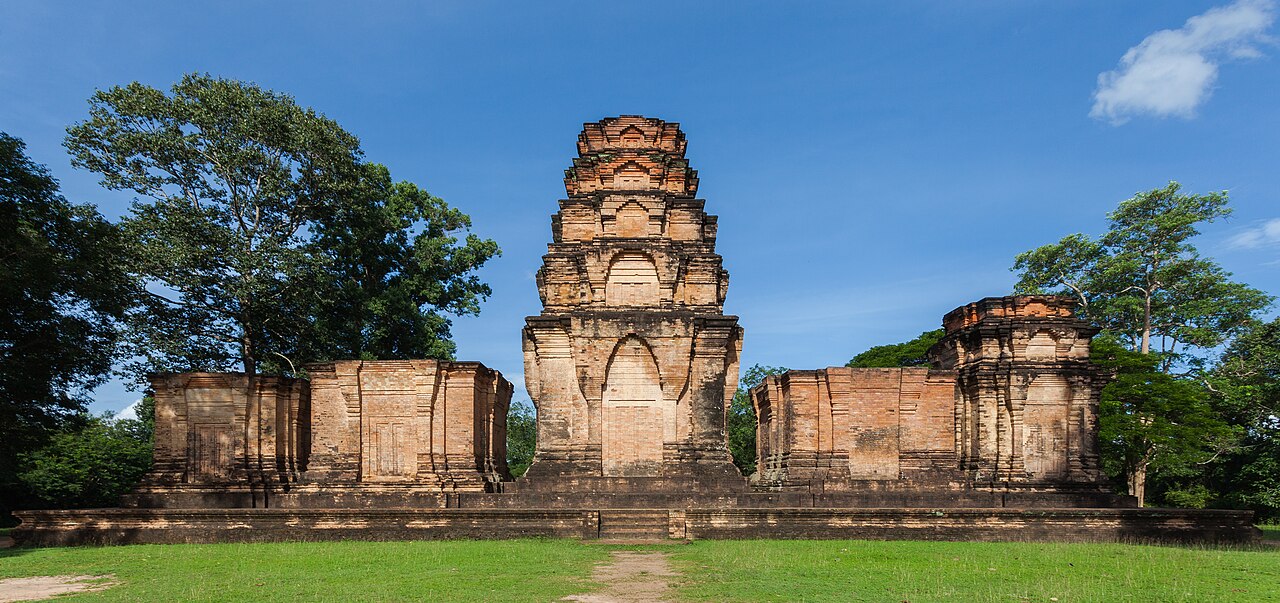
Prasat Kravan is a 10th-century Hindu temple complex located east of Angkor Wat in the Angkor Archaeological Park, Cambodia. Built during the reign of Harshavarman I, the temple consists of five brick towers aligned on a north-south axis. The structure is dedicated to Vishnu and is notable for its unusual brick construction, as most contemporary Khmer temples used sandstone. The site forms part of the UNESCO World Heritage inscription for Angkor, recognized for its outstanding cultural significance and architectural innovation in the Khmer Empire.
Checked 2026-08-26
The interior of Prasat Kravan contains remarkable bas-relief carvings executed directly into brick, a rare technique in Khmer architecture. The central tower features depictions of Vishnu in his three-step stride across the universe, a scene from Hindu cosmology. The northern tower displays images of Lakshmi, Vishnu's consort. These interior reliefs are considered among the finest examples of brick carving in the Angkor region. The temple's relatively modest scale compared to neighboring monuments allows visitors to examine these artistic details with greater intimacy and appreciation.
Checked 2026-08-26
A visit to Prasat Kravan typically requires between twenty and forty minutes for most visitors. The compact layout permits efficient exploration of all five towers without extensive walking. Those with particular interest in Khmer brickwork and Vishnu iconography may wish to allocate additional time for detailed examination of the interior reliefs. The temple is frequently combined with visits to nearby eastern Angkor sites including Banteay Kdei, Srah Srang, and Ta Prohm. Travelers should factor transportation time between locations when planning their broader Angkor itinerary.
Checked 2026-08-26
Visitors should consult official Angkor Archaeological Park authorities or licensed tour operators for current access schedules before planning their visit. The temple's eastward orientation means morning light illuminates the tower facades, potentially offering favorable conditions for viewing exterior details. Cambodia's dry season from November to April generally provides more predictable travel conditions, though the site remains accessible year-round. Afternoon visits may encounter reduced crowds compared to peak morning hours at more prominent Angkor monuments. Prasat Kravan also earns time in a siem reap itinerary because WIKIDATA_PRODUCTION reconciliation for the ranked entry; identity and coordinates were verified without a nearby fallback. Its value becomes clearer when the stop is compared with the surrounding streets and the other ranked places nearby. Check the operator's own site for the travel date before relying on a schedule or fare.
Checked 2026-08-26
Access to Prasat Kravan requires a valid Angkor Archaeological Park admission pass, purchased from the official ticket center. Pass options have historically included single-day, three-day, and seven-day durations, though current categories and rates must be verified with authorized vendors. The temple itself does not levy separate entrance fees beyond the park pass. Visitors should procure tickets only from official sources to avoid fraudulent sales. Currency and payment methods accepted should be confirmed directly with park administration. Check the operator's own site for the travel date before relying on a schedule or fare.
Checked 2026-08-26
Prasat Kravan is situated approximately one kilometer east of Angkor Wat along the Grand Circuit road through the archaeological park. Transportation options include hired tuk-tuk, bicycle, or motorbike taxi with licensed drivers. Many visitors reach the temple as part of organized tour itineraries covering multiple eastern sites. The route from Siem Reap town covers roughly eight kilometers. Road conditions vary seasonally, with potential dust during dry months and muddy surfaces following heavy rainfall. Self-guided travelers should carry adequate water and sun protection for transit between monuments.
Checked 2026-08-26
The brick towers show significant weathering and structural vulnerability, requiring visitors to exercise caution when entering and moving within confined spaces. Interior floors may be uneven or slippery. Low doorways necessitate careful passage to avoid head injury. The site lacks substantial shade, creating exposure risks during midday heat. Monsoon season brings increased humidity and potential flooding of surrounding areas. Visitors should respect roped-off sections indicating conservation work or unstable masonry. Appropriate footwear with grip is advisable. As with all Angkor sites, valuables should be secured against opportunistic theft in unattended vehicles.
Checked 2026-08-26
The intimate scale of Prasat Kravan permits close-range photography of architectural details unavailable at larger monuments. Interior reliefs require adjustment for low natural light conditions; flash photography may disturb other visitors and potentially affect sensitive pigments. The north-south alignment creates asymmetric lighting opportunities throughout the day. Morning illumination on eastern facades contrasts with shadowed western surfaces. The reddish brick tones respond distinctly to golden hour conditions. Tripod use may be restricted without advance permission from heritage authorities. Visitors should prioritize visual observation when technical limitations prevent satisfactory image capture.
Checked 2026-08-26
Yes, Prasat Kravan is located within the Angkor Archaeological Park and accessible with a valid park admission pass. No separate temple-specific ticket is required.
The temple is notable for its brick construction with bas-relief carvings executed directly into brick rather than sandstone, a rare technique in Khmer temple architecture.
Prasat Kravan is significantly smaller, consisting of five compact brick towers. Its modest scale allows for intimate examination of details that larger monuments do not permit.
The Vishnu and Lakshmi bas-reliefs survive in recognizable form despite centuries of exposure, though visitors should expect weathering consistent with the temple's age and materials.
Yes, the temple is accessible to independent travelers, though interpretive signage is limited. A guide enhances understanding of the brick-carving technique and Hindu iconography.
The temple was constructed as a Hindu monument dedicated to Vishnu, reflecting the state religious patronage of the early Khmer Empire period.
Loading the interactive map…
The interactive map could not be loaded.

Last updated:
Source: OpenStreetMap contributors, Wikidata ·