

86 min walk
Cambodian Landmine Museum
- Must see
- Museum
Language · 11 published
Historic monument · Siem Reap
ប្រាសាទបន្ទាយស្រី
| Monday | 07:30 – 17:30 |
|---|---|
| Tuesday | 07:30 – 17:30 |
| Wednesday | 07:30 – 17:30 |
| Thursday | 07:30 – 17:30 |
| Friday | 07:30 – 17:30 |
| Saturday | 07:30 – 17:30 |
| Sunday | 07:30 – 17:30 |
Checked 2026-08-31 · Source
Read from the OpenStreetMap access tags; anything not listed has no tag recorded.
Set the group type to family in the planner and the day window contracts to about three quarters of a solo day.
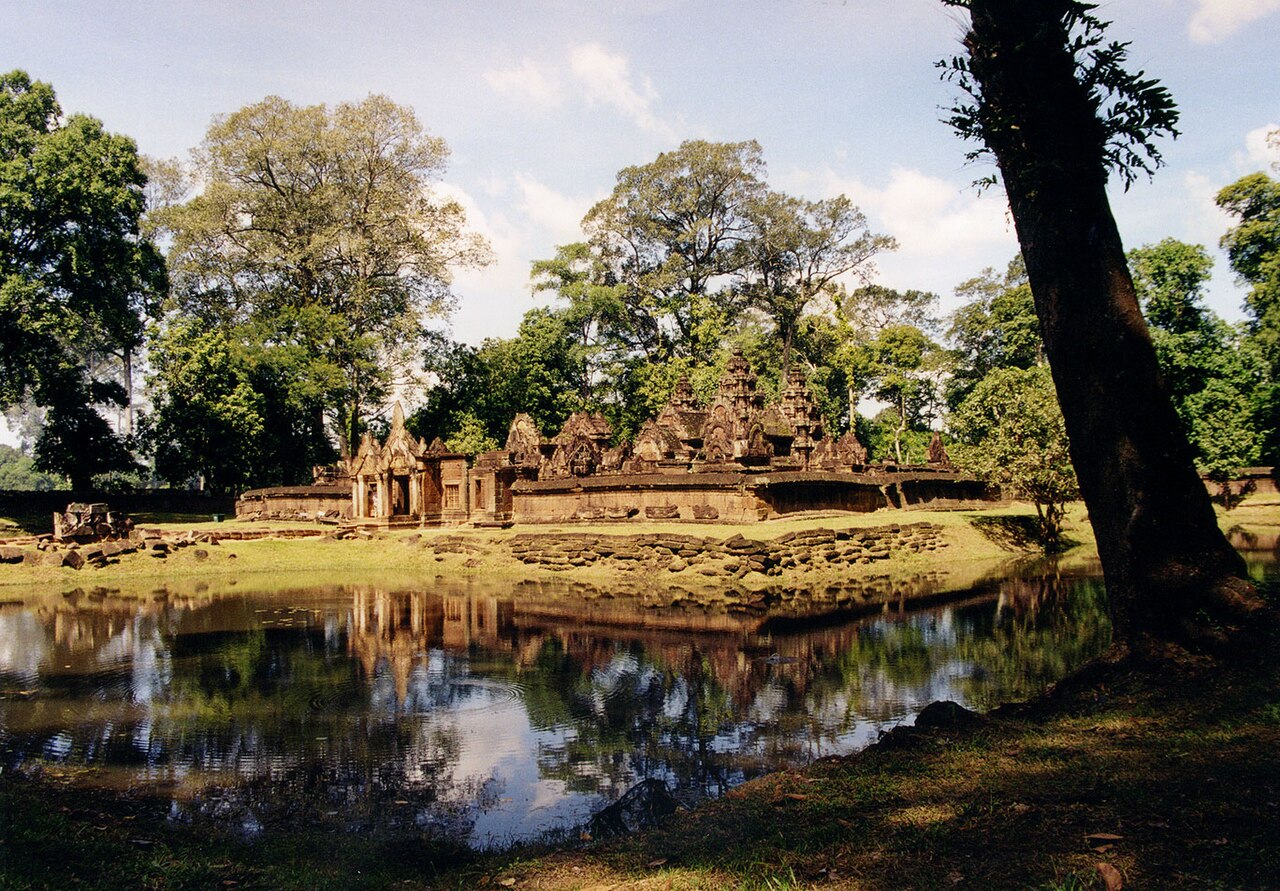
Banteay Srei is a 10th-century Cambodian temple dedicated to Shiva, about 25 kilometres northeast of the main Angkor complex. Its smaller scale is part of its appeal: the sanctuary is celebrated for exceptionally fine pink sandstone carvings rather than monumental size. Built by Brahmin counsellors rather than a king, it offers a more intimate encounter with Khmer art and religious architecture. The name is commonly translated as Citadel of Women. Banteay Srei is a 10th-century Cambodian temple dedicated to the Hindu god Shiva. Located roughly 25 kilometres northeast of the main Angkor complex, it stands apart from the grand state temples commissioned by kings. The site is celebrated for its exceptionally fine pink sandstone carvings, which remain remarkably well-preserved. Built not by royalty but by Brahmin counsellors, the temple's modest scale contrasts with its extraordinary artistic refinement. The name translates approximately as Citadel of Women, a reference to the delicacy of its decorative work. Yes, entry requires the Angkor Pass covering the broader archaeological park. No separate temple-specific ticket applies.
Checked 2026-08-26 · Source
Three central towers sit within concentric walls, a moat, and laterite boundaries. The sanctuary is richly decorated with narrative and ornamental reliefs connected to Hindu mythology, including scenes associated with the Ramayana and Mahabharata. Study the pediments, lintels, doorways, false doors, and colonettes, where the quality of the carving is especially apparent. The compact layout lets visitors concentrate on detail, craftsmanship, and the relationship between structure and sculpture. The temple complex comprises three central towers enclosed by concentric walls. Every surface carries intricate narrative and decorative reliefs depicting scenes from Hindu mythology, particularly the Ramayana and Mahabharata. The pediments and lintels achieve a level of detail rarely matched in Khmer architecture. Visitors encounter elaborately carved doorways, false doors, and colonettes throughout.
Checked 2026-08-26 · Source
Allow sixty to ninety minutes for the temple itself. The compact footprint keeps walking distances short, but the carved surfaces deserve slow looking and repeated stops. Travelers deeply interested in Khmer art may stay longer. Because Banteay Srei lies outside the central Angkor cluster, most visitors make it part of a half-day excursion that may also include other outlying sites such as Kbal Spean or Beng Mealea. Start early to manage heat and crowds.
Checked 2026-08-26 · Source
November through March generally offers the most predictable dry-season conditions for the journey from Siem Reap. Morning light brings cooler temperatures and warm color to the pink sandstone, while late afternoon can also flatter the relief work. Midday heat is intense because shade is limited around the sanctuary. Group arrivals can create crowded bottlenecks, so an early start helps preserve the intimate scale that makes Banteay Srei distinctive.
Checked 2026-08-26 · Source
Entry to Banteay Srei is covered by the Angkor Pass rather than a separate temple ticket. Arrange the pass before traveling into the outlying temple area, and keep the visit within the pass’s permitted validity. The ticket is part of a wider Angkor plan, so the temple works well as one stop in a day that includes additional archaeological sites. Carry the pass in a form that is easy to present at the park entrance.
Checked 2026-08-26 · Source
Banteay Srei lies roughly 25 kilometres from central Siem Reap, with a journey of about 45 minutes each way in normal conditions. Tuk-tuk hire is a common way to make the excursion, while cars and motorbikes offer alternatives. Experienced cyclists can ride the paved route, but the distance and heat require preparation. There is no direct public bus service described for the temple, so arrange transport as part of the day’s plan.
Checked 2026-08-26 · Source
Wet stone can be slippery, and the exposed setting becomes hot when the sun is high. Carry water and sun protection because services are limited compared with central Siem Reap. Persistent vendors operate near the entrance and parking area. Wear clothing covering shoulders and knees as a respectful choice at this religious site. Some sculptures have been moved into protected storage, with replicas occupying certain positions. Stay on designated paths to protect fragile archaeological surfaces.
Checked 2026-08-26 · Source
Pink sandstone changes character with the light, making morning and late afternoon especially rewarding for photography. Close details of reliefs, lintels, and pediments deserve telephoto or macro attention, while the compact corridors favor lightweight equipment. Harsh midday light can flatten carving depth, and shade is limited. Keep tripods unobtrusive, respect other visitors, and follow site restrictions. Drone use requires explicit authorization in the protected Angkor World Heritage setting.
Checked 2026-08-26 · Source
Yes. Entry uses the Angkor Pass, which covers the broader archaeological park rather than a separate Banteay Srei ticket.
Banteay Srei is much smaller, was built by Brahmin counsellors, and is particularly known for intricate pink sandstone carving rather than monumental scale.
Experienced cyclists can ride the roughly 25-kilometre route from Siem Reap, although tuk-tuks, cars, and motorbikes are common alternatives.
Some original sculptures have been moved into protected storage, and replicas occupy certain positions within the temple complex.
The name is commonly translated as Citadel of Women, a reference associated with the delicacy of the temple’s decorative carving.
Allow sixty to ninety minutes at the temple, or plan a half-day excursion when combining it with other outlying Angkor sites.
Loading the interactive map…
The interactive map could not be loaded.
Last updated:
Source: OpenStreetMap contributors, Wikidata ·