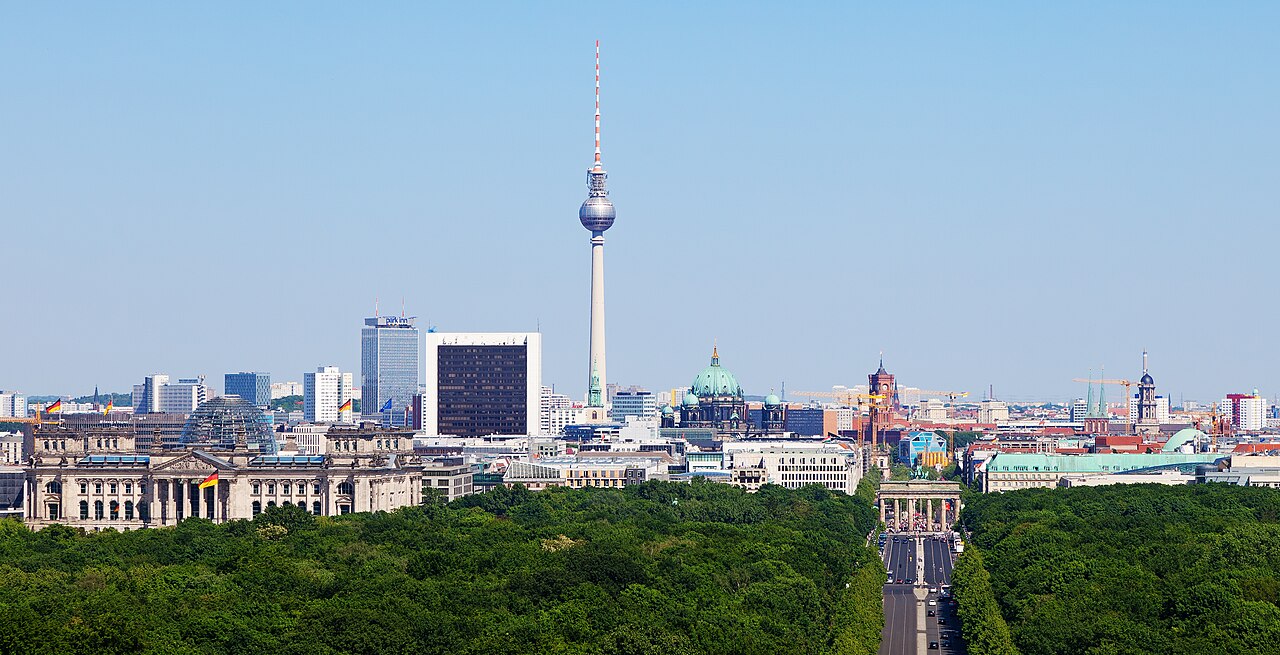
Brandenburger Tor
The Brandenburg Gate is the last of Berlin's city gates still standing, and it closes the western end of the Unter den Linden boulevard on Pariser Platz.
- Must see
- Art and culture venue
Language · 1 published
City guide · Germany
Berlin is polycentric and much larger than its central monument cluster suggests. Mitte contains Museum Island, the Brandenburg Gate and the government district; Charlottenburg forms a western centre around its palace and shopping streets; Kreuzberg, Friedrichshain and Neukolln extend south and east. Major Cold War sites, parks and museums are dispersed, so a useful itinerary follows districts and rail corridors.
Ranked by importance — sitelinks, pageviews and heritage status, not editor preference.
100 places match
Category
Typical visit duration
The Brandenburg Gate is the last of Berlin's city gates still standing, and it closes the western end of the Unter den Linden boulevard on Pariser Platz.
The Reichstag Building stands on Platz der Republik in the Tiergarten district, on the left bank of the Spree, and it is the seat of the Bundestag, the German parliament.
The Brandenburg Gate is an 18th-century neoclassical monument in Berlin, Germany. Commissioned by King Frederick William II of Prussia, it was completed in 1791 based on designs by Carl Gotthard Langhans.
The Berliner Fernsehturm is a working broadcast tower with a public viewing level inside its sphere, and it is the tallest thing in the city by a wide margin.
Museumsinsel is the northern end of an island in the Spree, in the middle of Berlin, given over almost entirely to museums.
Berlin Cathedral, known locally as Berliner Dom, stands as a prominent landmark on Museum Island in the heart of Berlin. This Protestant church serves as a major place of worship and houses the Hohenzollern crypt.
The Humboldt Forum occupies the rebuilt Berlin Palace on Schlossplatz, at the eastern end of Unter den Linden and across the Lustgarten from the Berlin Cathedral.
Charlottenburg Palace, known locally as Schloss Charlottenburg, stands as the largest and most significant palace complex in Berlin.
Gendarmenmarkt is a historic public square in the Mitte district of central Berlin. The ensemble comprises the Konzerthaus concert hall flanked by the German Cathedral and the French Cathedral, two nearly identical domed church structures.
The Berlin Wall Memorial occupies 1.4 kilometres of Bernauer Strasse, the street where the border between Wedding and Mitte ran directly along the front doors of the East Berlin houses.
The East Side Gallery is an open-air gallery on a preserved section of the former Berlin Wall in Friedrichshain-Kreuzberg. It stretches along Mühlenstraße and comprises approximately 1,316 metres of concrete wall surface.
Checkpoint Charlie was the best-known Berlin Wall crossing point between East and West Berlin during the Cold War. Located on Friedrichstraße, it became a symbol of the division and subsequent reunification of Germany.
The Topography of Terror is an outdoor and indoor history museum in Berlin, Germany. It stands on the former site of the Gestapo and SS headquarters, the central instruments of Nazi persecution.
Potsdamer Platz is a major public square and traffic intersection in central Berlin. Historically one of Europe's busiest squares, it was devastated during World War II and left desolate during the Cold War when the Berlin Wall bisected it.
The Memorial to the Murdered Jews of Europe is Germany's central Holocaust memorial, and it is two things at one address rather than one.
The Siegessäule, or Victory Column, stands in Berlin's Tiergarten park. Erected in the 1870s to commemorate Prussian military victories, the monument features a gilded bronze statue of Victoria at its summit.
Berlin Zoological Garden, known locally as Zoo Berlin, is a major zoological garden in Berlin, Germany. It is one of the city's most prominent attractions and features among Berlin's top ten visitor destinations according to official tourism sources.
The Pergamon Museum is a major art museum on Museum Island in Berlin. Its local name is Pergamonmuseum. The building houses reconstructed monumental buildings from ancient civilisations, including the Pergamon Altar, the Market Gate of Miletus, and the Ishtar Gate.
The Neues Museum is a museum building on Museum Island in Berlin, Germany. It was constructed between 1843 and 1855 according to plans by Friedrich August Stüler.
The Alte Nationalgalerie is a prominent art museum on Berlin's Museum Island, a UNESCO World Heritage site. Its neoclassical temple design, completed in 1876, houses nineteenth-century paintings and sculptures.
The Bode-Museum stands on the northern tip of Museum Island in Berlin, its domed structure visible across the Spree river. Opened in 1904 and originally named the Kaiser-Friedrich-Museum, it was renamed in 1956 after its first director, Wilhelm von Bode.
The Jewish Museum Berlin is a major cultural institution dedicated to two millennia of German-Jewish history and culture.
The Rotes Rathaus is the historic city hall of Berlin, serving as the seat of the Governing Mayor and the Senate of Berlin.
Mauerpark is a public park in Berlin's Prenzlauer Berg district, occupying a former section of the death strip associated with the Berlin Wall. The name translates directly to Wall Park, referencing this divided history.
Hackesche Höfe is a historic courtyard complex in Berlin's Mitte district, situated in the Spandauer Vorstadt area near Hackescher Markt. Constructed in the early twentieth century around 1906-1907, the ensemble comprises eight interconnected courtyards with Art Nouveau architectural detailing.
The Botanischer Garten is Berlin's botanical garden and associated museum, operated as a scientific institution. It serves as both a public attraction and a research facility for plant science.
Futurium is a museum and exhibition space in Berlin dedicated to exploring possible futures. It opened in 2019 near the Hauptbahnhof on the site of a former freight station.
The DDR Museum is an interactive museum in Berlin dedicated to everyday life in the former German Democratic Republic. Located on the Spree River near Museum Island, it presents the history and culture of East Germany through immersive exhibitions.
The Neue Synagoge, or New Synagogue Berlin, stands on Oranienburger Straße as one of the city's most significant Jewish heritage landmarks.
The Spandau Citadel, known locally as Zitadelle Spandau, is a fortress complex in Berlin's Spandau district. Constructed in the 16th century on the site of earlier medieval fortifications, it represents one of Europe's best-preserved Renaissance military structures.
Treptower Park is a large public park in the Treptow-Köpenick district of Berlin. The park extends along the River Spree and is one of the city's most significant green spaces.
Urban Nation is a museum dedicated to urban contemporary art in Berlin. It occupies a distinctive building that serves as a venue for street art and graffiti culture.
The James Simon Gallery serves as the main entrance building for Berlin's Museum Island, a UNESCO World Heritage site. Named after Jewish art patron James Simon, the structure was designed by British architect David Chipperfield.
The Pergamonmuseum stands on Museum Island in central Berlin, and at the moment it is a building nobody can walk into.
Konzerthaus Berlin is a prominent concert hall situated on Gendarmenmarkt, one of Berlin's most distinguished squares. The building occupies a site of significant architectural heritage, flanked by the German and French Cathedrals.
Waldbühne is an open-air amphitheatre in Berlin, Germany, located within the Westend district near the Olympic Stadium complex. Originally constructed for the 1936 Summer Olympics, it was designed by architect Werner March as part of the larger Reichssportfeld grounds.
Berlin Hauptbahnhof is the principal railway station of Berlin and the largest grade-separated railway station in Europe. Opened in 2006, it serves as a major transport hub connecting regional, national, and international rail services.
The Altes Museum is a neoclassical museum building on Museum Island in Berlin. Designed by Karl Friedrich Schinkel and opened in 1830, it was originally constructed to house the Prussian royal collection of classical antiquities.
The Schiller Theater, known locally as Schillertheater, is a prominent theatre building in Berlin. It stands as a significant cultural venue in the German capital, contributing to the city's renowned theatrical landscape.
Körnerpark is a public park in Berlin, Germany. The space features formal garden design with symmetrical layouts typical of early twentieth-century German park architecture. The park contains a central grassy area framed by pathways and bordered by tree plantings.
Berlin-Tempelhof Airport is a former commercial airport in central Berlin, Germany. It ceased operations in 2008 and has since been repurposed as a vast public park and event space.
The Kaiser-Wilhelm-Gedächtniskirche, locally known as the Neue Kaiser-Wilhelm-Gedächtniskirche, stands as a prominent landmark in Berlin. The original church was severely damaged during World War II, and its ruined tower remains preserved as a poignant memorial.
The Bell Tower of Berlin Olympic Stadium, known locally as Olympia-Glockenturm, stands as a landmark structure associated with the 1936 Summer Olympics complex in western Berlin.
Zoo Palast is a historic cinema located in Berlin, Germany. Situated in the Charlottenburg district near the Berlin Zoological Garden, it has long served as a prominent venue for film screenings and premieres.
The Soviet War Memorial in Berlin is a monumental commemorative site erected by the Soviet Union to honor Red Army soldiers who fell in the Battle of Berlin in 1945.
The Berlin State Opera, locally known as Staatsoper Unter den Linden, stands as one of Germany's most prominent opera houses.
Marx-Engels-Forum is an open-air public park and memorial ensemble located in Berlin's central Mitte district.
The Soviet War Memorial Schönholzer Heide is a monumental cemetery and memorial complex in Berlin's Pankow district. It commemorates Soviet soldiers who died during the Battle of Berlin in 1945.
Mater Dolorosa is a Catholic church located in Berlin, Germany. The name translates from Latin as 'Sorrowful Mother,' referring to the Virgin Mary in her grief.
Grunewald Tower, known locally as Grunewaldturm, stands as a historic observation structure within Berlin's expansive Grunewald forest area. The tower offers elevated vantage points over surrounding woodland and nearby waterways.
Aquarium Berlin is a zoological aquarium located in Berlin, Germany. It operates in conjunction with the adjacent Berlin Zoological Garden, forming one of the most comprehensive combined zoo and aquarium facilities in Europe.
Gärten der Welt, known in English as Gardens of the World, is a landscaped park in Berlin. The attraction presents multiple themed garden areas representing different international horticultural traditions.
The Bauakademie is a historic building in Berlin associated with architectural education and Prussian building administration. Originally constructed in the 19th century, it served as an influential institution for training architects and engineers.
Bierpinsel is a distinctive tower structure in Berlin, Germany. The building features an unusual architectural design that has made it a recognizable landmark in the city's urban landscape.
Source: OpenStreetMap contributors, Wikidata ·
Mitte is the main first-visit anchor, stretching from Alexanderplatz and Museum Island west toward Unter den Linden, Brandenburg Gate and Tiergarten. Kreuzberg lies south, Friedrichshain east, and Charlottenburg forms a separate western centre. The S-Bahn Ring is a useful boundary for the inner city, but important sites also sit beyond it. Avoid combining opposite outer districts in the same half-day.
Checked 2026-08-26
Use S-Bahn and U-Bahn trains for long movements, with trams and buses filling gaps between rail corridors. Berlin uses fare zones A, B and C; the airport and nearby Potsdam are in zone C. Tickets are valid across participating modes within the purchased zones, but paper or app tickets must meet the stated activation rules. Walk once you reach a district cluster.
Checked 2026-08-26
A fixed duration is not recorded. Plan by district: Mitte, a western cluster, an eastern or southern neighbourhood, and any specialised museum or outer site that matters to you.
Mitte contains many headline sights, but Berlin is polycentric. Charlottenburg, Kreuzberg, Friedrichshain and outer memorial or palace sites require separate rail journeys.
Use S-Bahn and U-Bahn for cross-city travel, then trams, buses or walking within districts. One zonal ticket can cover participating modes for the chosen validity area.
Berlin Brandenburg Airport is in zone C. A journey between the airport and the central city therefore needs a ticket whose zones include C as well as the destination area.
Treat Potsdam as a separate excursion. It lies outside Berlin's central districts and in fare zone C, so it needs dedicated travel time and the correct ticket coverage.
Set your days, your pace and the hours you actually want to be out. The planner works around closing days and travel time, and leaves room to eat.