.jpg)


13 min walk
Meunier Museum
- High · Heritage site
- Museum
Language · 1 published
Museum · Brussels
Musée Horta - Hortamuseum

| Monday | Closed |
|---|---|
| Tuesday | 14:00 – 17:30 |
| Wednesday | 14:00 – 17:30 |
| Thursday | 14:00 – 17:30 |
| Friday | 14:00 – 17:30 |
| Saturday | 11:00 – 17:30 |
| Sunday | 11:00 – 17:30 |
Checked 2026-08-26 · Source
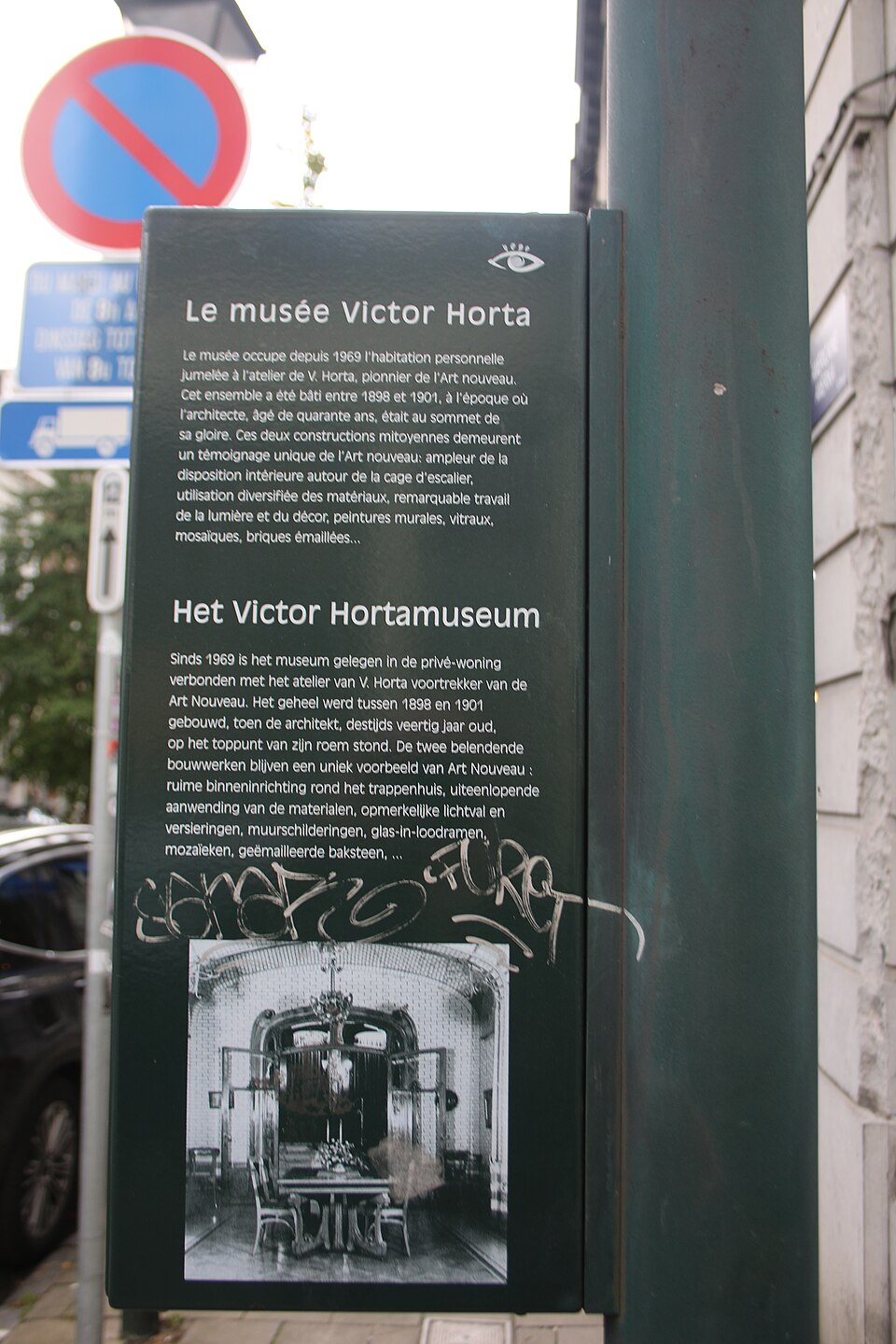
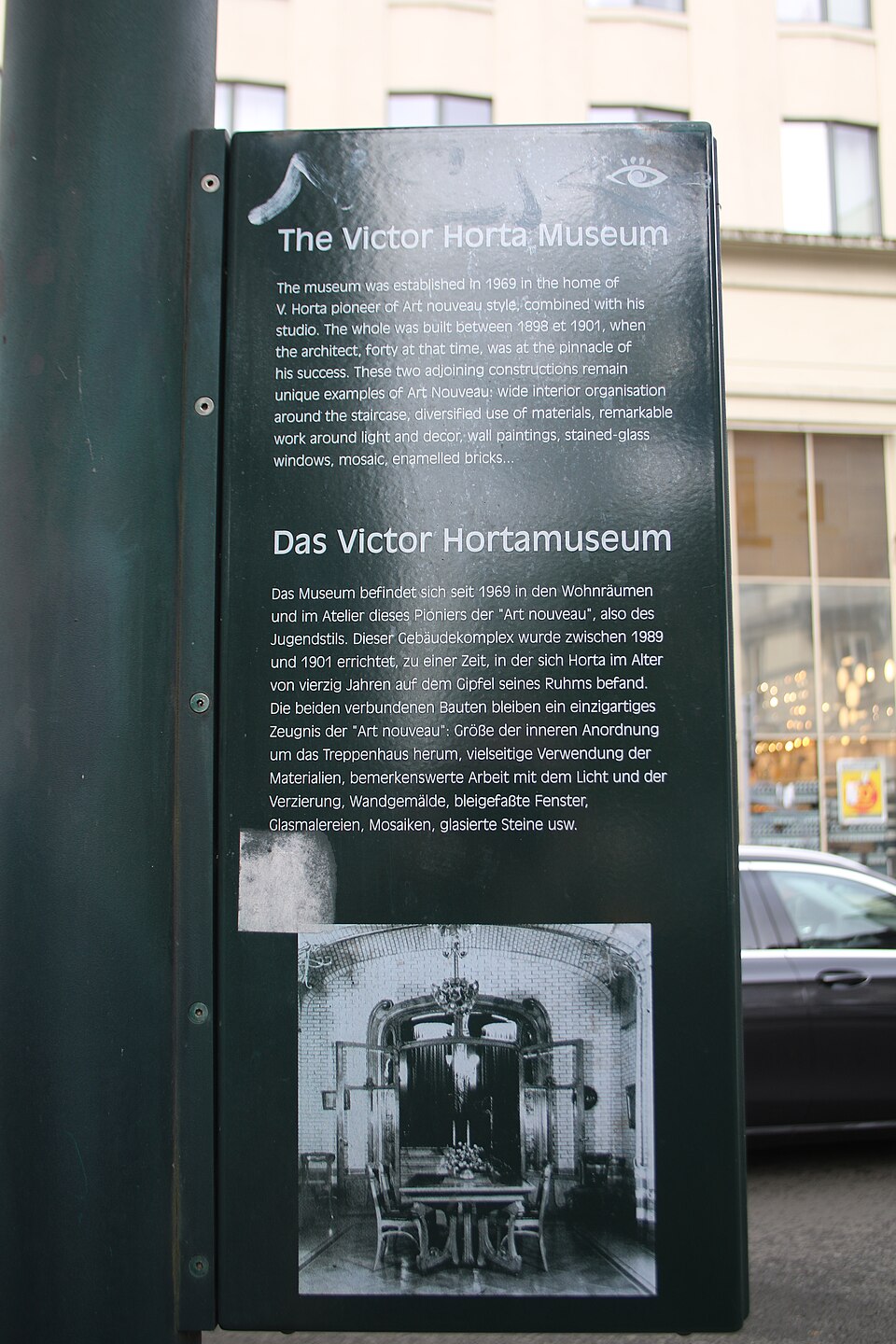
The Horta Museum is the house and architectural studio that Victor Horta built for himself in Saint-Gilles, and it is the only building on the Art Nouveau circuit in Brussels that a visitor can walk through room by room. Horta bought two adjoining plots on the rue Américaine in 1898 and finished the pair of buildings in 1901, at the peak of the movement he had started eight years earlier with the Tassel House. He lived and worked there for less than twenty years: by 1919, with Art Nouveau out of fashion, he sold both buildings and moved to the avenue Louise.
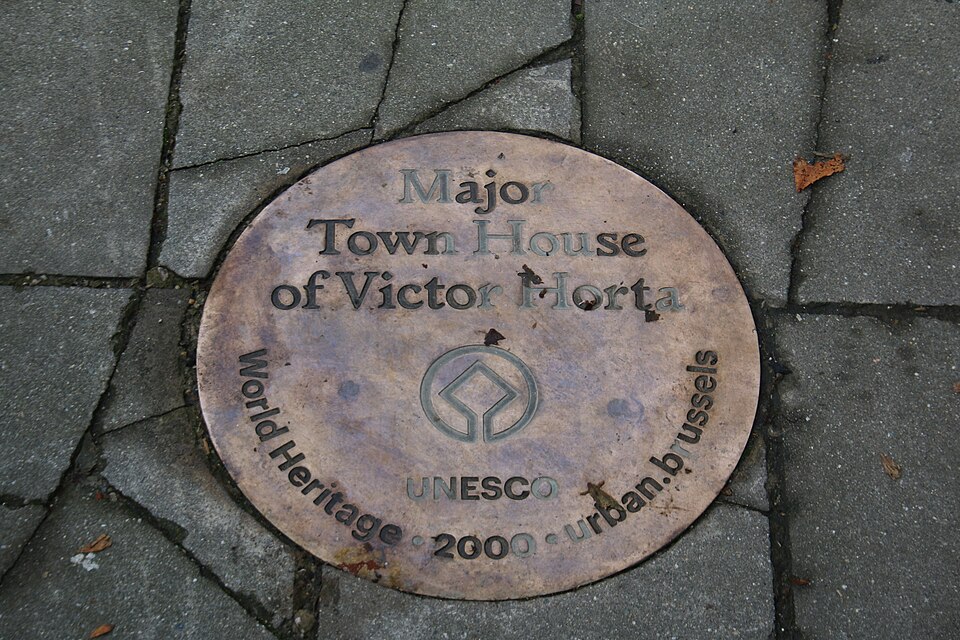
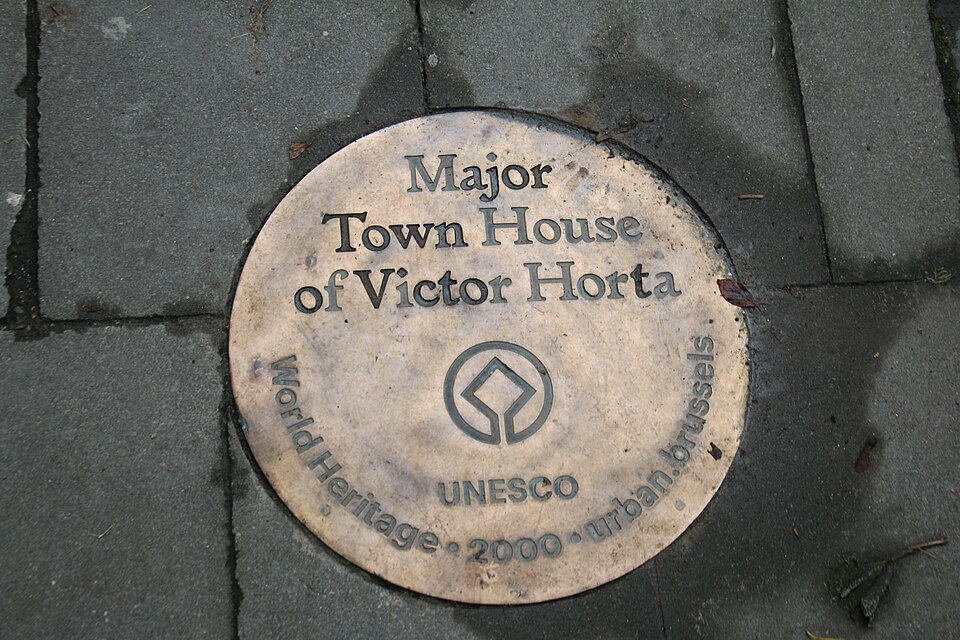
What followed was decline rather than preservation. The municipality of Saint-Gilles bought number 25 in 1961, at the urging of Jean Delhaye, a former pupil of Horta's, and the museum opened in 1969. The studio at number 23 had by then been converted into a separate dwelling and was only reunited with the house in 1971. A second restoration campaign ran from 1989 to 2014 under Françoise Aubry and Barbara Van der Wee. Since 2016 visitors have entered through number 27, a neighbouring house of 1900 by Jules Brunfaut that now holds the ticket desk, the shop and the temporary exhibition space. The house and studio are inscribed on the UNESCO World Heritage List.
Checked 2026-08-26 · Source
The visit is two buildings joined together, and they were designed for different lives. House number 25 opens into a hall and a parlour for receiving callers. Above it the reception rooms of the first floor are arranged around the stairwell that is the whole point of the building: a shaft of iron, mirrors and pale walls lit from above through a skylight, so that daylight falls down through the middle of the house instead of in from its ends. The floor above that is private - a boudoir, a family sitting room, and bedrooms for Horta, his wife, his daughter and guests. Staff slept in the attic. Precious woods, stained glass, exposed metal and a palette of autumn colours run through all of it, with the furniture, the ironwork and the fittings designed as one piece with the rooms.
Studio number 23 was a workplace. The ground floor was administrative, the first floor held the smoking room where clients were received and Horta's own office looking onto the garden, the light-filled second floor was where draughtsmen turned his ideas into drawings, and a sculpture studio occupied the basement. Those rooms are now given over to explaining the restoration and Horta's career. The garden opposite the entrance hall can be visited when the weather allows; the garden behind the house and studio is closed for conservation reasons.
Checked 2026-08-26 · Source
The museum's own answer is one hour and fifteen minutes on average for the house and studio, and that is a realistic figure rather than a conservative one. The tour is self-guided - a paper guide in French, Dutch and English is handed over at reception and the rooms are followed one by one - so a visitor who reads every panel and stops on every landing will spend closer to an hour and a half, while someone moving steadily can be out in an hour. A guided tour, which must be booked at least seven days ahead, also lasts about an hour and a quarter.
Two things pull the real figure upwards. The temporary exhibition space and the shop are in the modern annexe at number 27 and are not counted in that hour and a quarter, so add twenty to thirty minutes if an exhibition is on. Lockers are compulsory and the coats, bags, phones and cameras have to be deposited before entering and collected afterwards, which is another few minutes at each end. Anyone combining the visit with the Maison Hannon on the discounted combined ticket should budget for a ten-minute walk between the two on top of both visits.
Checked 2026-08-26 · Source
The opening pattern is unusual and it decides the shape of the day. On Tuesday, Wednesday, Thursday and Friday the museum opens only at 2pm and closes at 5.30pm - a window of three and a half hours. On Saturday and Sunday it opens at 11am and closes at 5.30pm. Monday it is closed. It also closes on 1 January, 1 May, Ascension Day, 21 July, 15 August, 1 November, 11 November and 25 December.
So a weekday visit cannot be a morning visit, and a weekday afternoon that also contains something else is tight. The weekend is the only time the house can be seen before lunch, and the first Sunday of each month is free of charge with the support of the Fédération Wallonie-Bruxelles, which means places on that day go early and only an online booking secures one.
The one judgement worth adding to the published hours concerns light. The stairwell and the first-floor rooms are lit through a skylight, so the house reads best when the sky is bright, and a Saturday or Sunday late morning gives the highest sun of any slot the museum offers. The museum does not publish visitor numbers by month or by hour, so the busiest periods cannot be stated here.
Checked 2026-08-26 · Source
A full adult ticket for the house and studio is 14 euros. Students under 30, jobseekers and residents of Saint-Gilles pay 6 euros; young visitors aged 6 to 17 and holders of the European Disability Card pay 3.50 euros; Article 27 holders pay 1.25 euros; children under 6 enter free. The RANN Pass is 10.50 euros. The Museum Pass Musées, the Art Nouveau Pass, membership of the Friends of the Horta Museum, a press card, an ICOM card and an OKV card all give free entry. Valid proof is required for every reduced rate, it is issued in the holder's name and valid for a single ticket, and without it the adult rate applies.
Entry is free to everyone on the first Sunday of each month, booking online, with limited places.
A combined ticket with the Maison Hannon, a ten-minute walk away, is sold at a discount: 22 euros for an adult instead of 28, 8 euros instead of 10 for a young person aged 18 to 26, and 5 euros instead of 7 for a child under 18. The Museum Pass Musées and the Art Nouveau Pass cannot be used towards a combined ticket; pass holders book the two houses separately. Only an online booking guarantees admission, though some tickets may be available on arrival after a wait.
Checked 2026-08-26 · Source
The address is 27 rue Américaine, 1060 Saint-Gilles - number 27, the modern annexe, not the house at 25, because reception and the ticket desk moved there in 2016. No car is needed and a car is the worst way to arrive: the museum has no car park of its own, and the streets around it are metered paid parking.
Public transport puts a visitor within three minutes on foot. Trams 81, 92 and 97 stop at Janson, three minutes away; bus 54 stops at Trinité, also three minutes. Both drop a visitor on or beside the chaussée de Charleroi, which is the spine of this part of Saint-Gilles and is itself lined with the kind of turn-of-the-century façades the museum explains.
For cyclists there is bike parking at 196 chaussée de Charleroi, two minutes from the door, and Villo! docking station 78 at 370-376 chaussée de Waterloo, five minutes away. Arriving on foot from the Louise or Châtelain area takes about fifteen minutes and is pleasant. Tickets carry a time slot and the museum asks visitors to arrive at the stated time rather than early, because there is little room to wait inside; missing the slot loses the priority admission it buys.
Checked 2026-08-26 · Source
This is a fragile private house rather than a gallery, and the rules that follow from that surprise people. The cloakroom is compulsory: cameras, mobile phones, bags of any size, coats, umbrellas, uncapped walking sticks, food and drink all go into a locker in the entrance hall before the house is entered. Phones are forbidden inside, and so are audio guides, which is why the guide handed out is on paper.
The climb is the other thing to know. The house and studio contain stairways of 375 steps in total and very narrow corridors. Only the modern annexe - the shop and the temporary exhibitions - is wheelchair accessible; the museum states plainly that the historic buildings are not, and that the visit is physically demanding and not recommended for anyone with reduced mobility or breathing difficulties. Assistance animals are admitted to the house on presentation of a European Disability Card. Children under 12 must be accompanied.
The two operator pages disagree on last admission: the opening-times page gives 45 minutes before closing, with the studio itself shut to new arrivals 30 minutes before, while the visitor guidelines give 30 minutes before closing. Plan on the earlier of the two - 4.45pm - and treat the closing routine as beginning at 5pm.
Checked 2026-08-26 · Source
Photography inside the house and studio is prohibited outright during opening hours, and the ban is enforced at the door rather than in the rooms: cameras and phones are not merely to be kept switched off, they may not be carried in at all and must be left in the lockers. The museum gives its reasons - to prevent accidental contact with the collection in narrow spaces, and to stop the queues that form when people stop to shoot. Selfie sticks are on the list of items refused anywhere on the premises.
There is one legitimate way in for a camera. The museum runs a dedicated photography session once a month, capped at five people, bookable in advance through its Filming and photography page, and open only to non-commercial photographs taken for scientific or artistic purposes; no flash and no tripod. Commercial shoots are handled separately as private bookings.
That leaves the exterior, which is worth the walk in its own right. The façade of numbers 23 and 25 - the stone, the ironwork and the bowed windows - can be photographed freely from the pavement of the rue Américaine, and the street is narrow enough that a wide lens or a step back onto the opposite kerb helps.
Checked 2026-08-26 · Source
The museum states that a tour of the house and studio takes one hour and fifteen minutes on average. The tour is self-guided, with a paper guide provided in French, Dutch and English, so an unhurried visitor who reads everything will be closer to an hour and a half. A guided tour lasts about the same, one hour and a quarter. Add twenty to thirty minutes if there is a temporary exhibition on in the annexe at number 27, and a few minutes at each end for the compulsory lockers.
The museum is closed on Mondays. From Tuesday to Friday it opens at 2pm and closes at 5.30pm; on Saturday and Sunday it opens at 11am and closes at 5.30pm. There is no midday break, but the weekday window is only three and a half hours long, so a weekday visit cannot be a morning one. The museum also closes on 1 January, 1 May, Ascension Day, 21 July, 15 August, 1 November, 11 November and 25 December.
A full adult ticket is 14 euros. Students under 30, jobseekers and residents of Saint-Gilles pay 6 euros, visitors aged 6 to 17 and European Disability Card holders 3.50 euros, Article 27 holders 1.25 euros, and children under 6 enter free. The Museum Pass Musées, the Art Nouveau Pass, press, ICOM and OKV cards give free entry. Entry is free for everyone on the first Sunday of each month, with limited places that must be booked online. Valid proof is required for every reduced rate.
No. Photography and video inside the house and studio are prohibited during opening hours, and cameras and phones may not be carried in at all - they must be left in the lockers in the entrance hall. The museum cites the risk of accidental contact with the collection and congestion in the narrow rooms. The one exception is a dedicated photography session held once a month for a maximum of five people, bookable in advance and limited to non-commercial photographs taken for scientific or artistic purposes.
Only in part. The modern annexe at number 27, which holds the shop and the temporary exhibitions, is accessible. The historic house and studio are not: the museum states that they contain stairways totalling 375 steps and very narrow corridors, and that the visit is physically demanding and not recommended for anyone with reduced mobility or with respiratory difficulties. No alternative arrangement is offered for visitors with reduced mobility who do not use a wheelchair. Assistance animals are admitted on presentation of a European Disability Card.
Booking online is what guarantees admission and a short wait. The museum says that only an online booking assures access to the house and studio, while some tickets may be available for purchase on arrival, with the possibility of a long wait. Tickets carry a time slot and visitors are asked to arrive at the time printed rather than early, because there is little space inside to wait; arriving outside the slot forfeits priority entry. Guided tours must be booked at least seven days in advance.
Loading the interactive map…
The interactive map could not be loaded.
Last updated:
Source: OpenStreetMap contributors, Wikidata ·