_St._Michael_%26_St._Gudula_Cathedral_Tower,_Brussels.jpg)
.jpg)
_-_Tagzania_-_1768047805916.jpg)
_-_Tagzania_-_1768047806120.jpg)
_-_Tagzania_-_1768047806303.jpg)
_-_Tagzania_-_1768047806483.jpg)
5 min walk
Marc Sleen Museum
- Must see
- Museum
Language · 1 published
Place of worship · Brussels
Cathédrale Saints-Michel-et-Gudule - Sint-Michiels-en-Goedelekathedraal
| Monday | 08:00 – 18:00 |
|---|---|
| Tuesday | 08:00 – 18:00 |
| Wednesday | 08:00 – 18:00 |
| Thursday | 08:00 – 18:00 |
| Friday | 08:00 – 18:00 |
| Saturday | 08:00 – 17:00 |
| Sunday | 13:00 – 18:00 |
Checked 2026-08-26 · Source
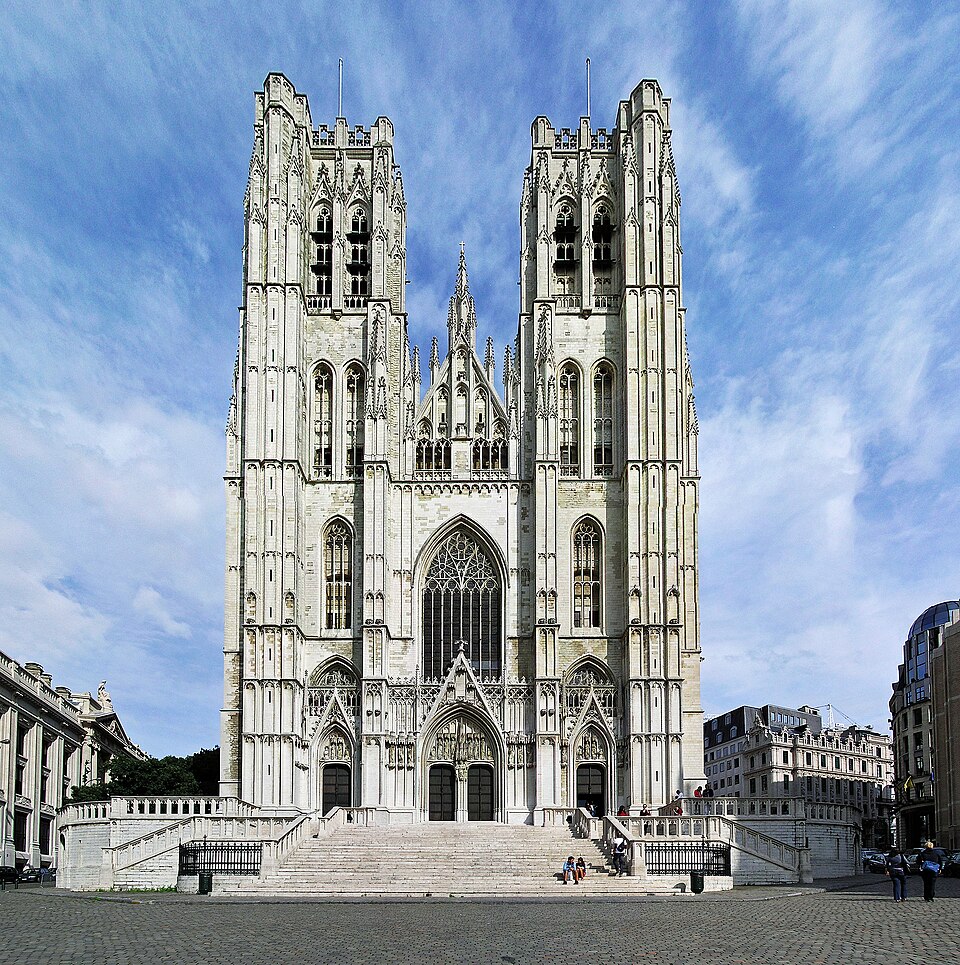
The Cathedral of St. Michael and St. Gudula stands on the Treurenberg slope in central Brussels, dedicated to the two patron saints of the city and built in Brabantine Gothic. A chapel to Saint Michael probably occupied the site as early as the ninth century, at the crossroads of two trade routes, one running between Flanders and Cologne and the other between Antwerp and Mons. An eleventh-century Romanesque church replaced it, and in 1047 Lambert II, Count of Leuven, founded a chapter there and had the relics of Saint Gudula brought in from Saint-Gery Island. Henry II, Duke of Brabant, ordered a Gothic collegiate church in 1226. The choir was built between 1226 and 1276, the nave and transept across the fourteenth to sixteenth centuries, and the main structure was finished just before Charles V's reign began in 1519, some three hundred years of work in all. The two western towers, raised between 1470 and 1485 and attributed to Jan van Ruysbroeck, carry no spires and were meant to be far taller. The building runs 110 metres long, 30 metres wide and 26.5 metres high inside, with the entrance towers at 69 metres. It was listed as a historic monument in 1936 and became a cathedral only in 1962, sharing that rank with St. Rumbold's in Mechelen.
Checked 2026-08-26 · Source
Three parts of the building are treated as separate visits by the cathedral itself. The Treasury occupies the Gothic Chapel of the Holy Sacrament and holds reliquaries, including the Dhramal reliquary cross, along with monstrances, chalices, ciboria and liturgical vestments, Michel Coxcie's Legend of Saint Gudula and a Virgin and Child by Conrad Meit. The Romanesque remains are the preserved front section of the older church, reached separately. The crypt sits beneath the choir, an eleventh-century Romanesque chamber laid out like a small church and probably built to hold Saint Gudula's relics, its walls carrying drawings, names and Latin inscriptions. Above the main west door is the Last Judgement window of 1528, which the cathedral describes in three bands of colour: green earth at the bottom, blue sky in the centre, gold for the divine sphere above, with Saint Michael weighing souls in the middle. The bells belong to two towers. Salvator, the great bourdon of 6,800 kilograms cast in 1638, hangs in the north tower and rings only on grave or festive occasions. The south tower holds a carillon whose seven ringing bells are named Fabiola, Maria, Michael, Gudula, Philippe, Astrid and Laurent, and which plays automatically every quarter hour.
Checked 2026-08-26 · Source

Allow an hour. The cathedral publishes no suggested length for a free visit, so the hour is this guide's judgement, but it is built from durations the cathedral does publish for its own tours. Its self-guided route with QR codes comes in two formats, thirty minutes and forty-five minutes. Its volunteer guides offer a tour of a minimum of one hour for the building alone, and a tour of one to two hours that adds the Treasury, the Romanesque remains and the crypt. The tower visit is a separate commitment of about two and a half hours. So an hour walks the nave, the ambulatory chapels and the Treasury at a pace that lets a visitor stand still in front of the Last Judgement window rather than pass under it. Thirty minutes is enough for the nave and the west window and nothing else. Two hours is the right budget only for a visitor who has arranged the crypt in advance, since the crypt is not walk-in and cannot be added to a visit on the day. Anyone attempting the towers should treat that as its own morning rather than as an extension.
Checked 2026-08-26 · Source

The cathedral is open to visitors Monday to Friday from 08.00 to 18.00, Saturday from 08.00 to 17.00 and Sunday from 13.00 to 18.00. There is no closing day and no published midday break, but Sunday's late start is real: the building holds its main services in the morning and does not receive visitors until one o'clock. Visits are not permitted during services at any time. The cathedral's own prayer page lists a weekday Eucharist at 12.30, while the block on its home page names two weekday celebrations, at 08.00 and 12.30; the two pages disagree and both are reproduced here rather than blended. At the weekend there is a Saturday service at 17.30 and Sunday services at 09.30 and 11.00, the last of them bilingual in French and Dutch. Through July and August the eleven o'clock Sunday Mass carries a visiting choir. Mid-morning on a weekday is the widest clear window. The tower visits run only from March to October, and the free guided tour in French and English is Saturdays at 14.00. Through 2026 the cathedral is marking its eight hundredth anniversary with extra activities.
Checked 2026-08-26 · Source
Entering the cathedral costs nothing. Four things inside it are charged for, all in cash on the spot. The Treasury is 3 euros per person, 30 euros for a group of ten to thirty, 15 euros for a school class, and free for children under twelve; it opens during the cathedral's own hours, but only when volunteers are there to receive visitors. The Romanesque remains are 2 euros per person and are open during cathedral hours. The crypt is 4 euros per person, paid at the Treasury counter, and is reachable only by appointment through the non-profit Church and Tourism Brussels on 02 219 75 30. The tower visit is 15 euros per person, runs March to October for groups of ten to twenty-four, and must be booked several weeks ahead through the same organisation. The self-guided route with QR codes is 5 euros for the thirty-minute version and 6 euros for the forty-five-minute one, paid at a kiosk inside the entrance, in French, Dutch, English or Spanish. Guided tours by the volunteer team are free. The shop sells guide booklets at 4 and 7 euros, and a children's activity booklet free.
Checked 2026-08-26 · Source
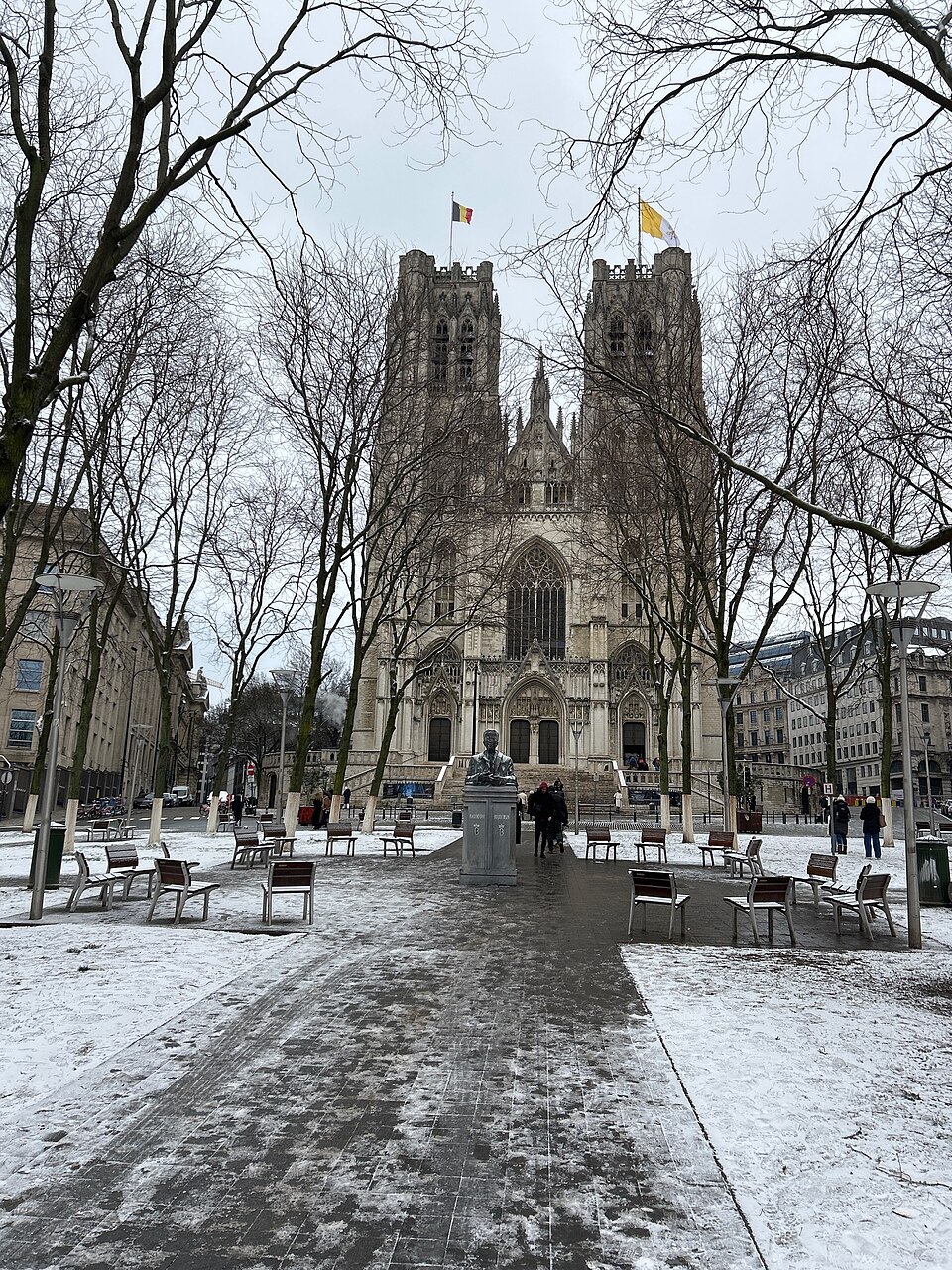
The cathedral stands on the Parvis Sainte-Gudule, the wide forecourt on the Treurenberg slope above the lower town, east of the Boulevard de l'Imperatrice. The forecourt itself is a twentieth-century creation: Wikipedia records that the open space in front of the building dates from the construction of the north-south rail connection, which runs below the boulevard immediately to the west. What the cathedral publishes about arriving is limited to one line and it concerns access rather than transport. Visitors with reduced mobility are directed to the shop door on Place Sainte-Gudule, on the right-hand side when facing the building, where ringing the bell brings someone to open it. Beyond that the cathedral's own site says nothing about public transport, nothing about parking and nothing about arriving by car, so this guide records no car recommendation for it rather than borrowing one from a listing site. What can be said honestly is that the address is inside the central pentagon of Brussels, on foot from the lower town, and that the building is approached across a paved square rather than a car park.
Checked 2026-08-26
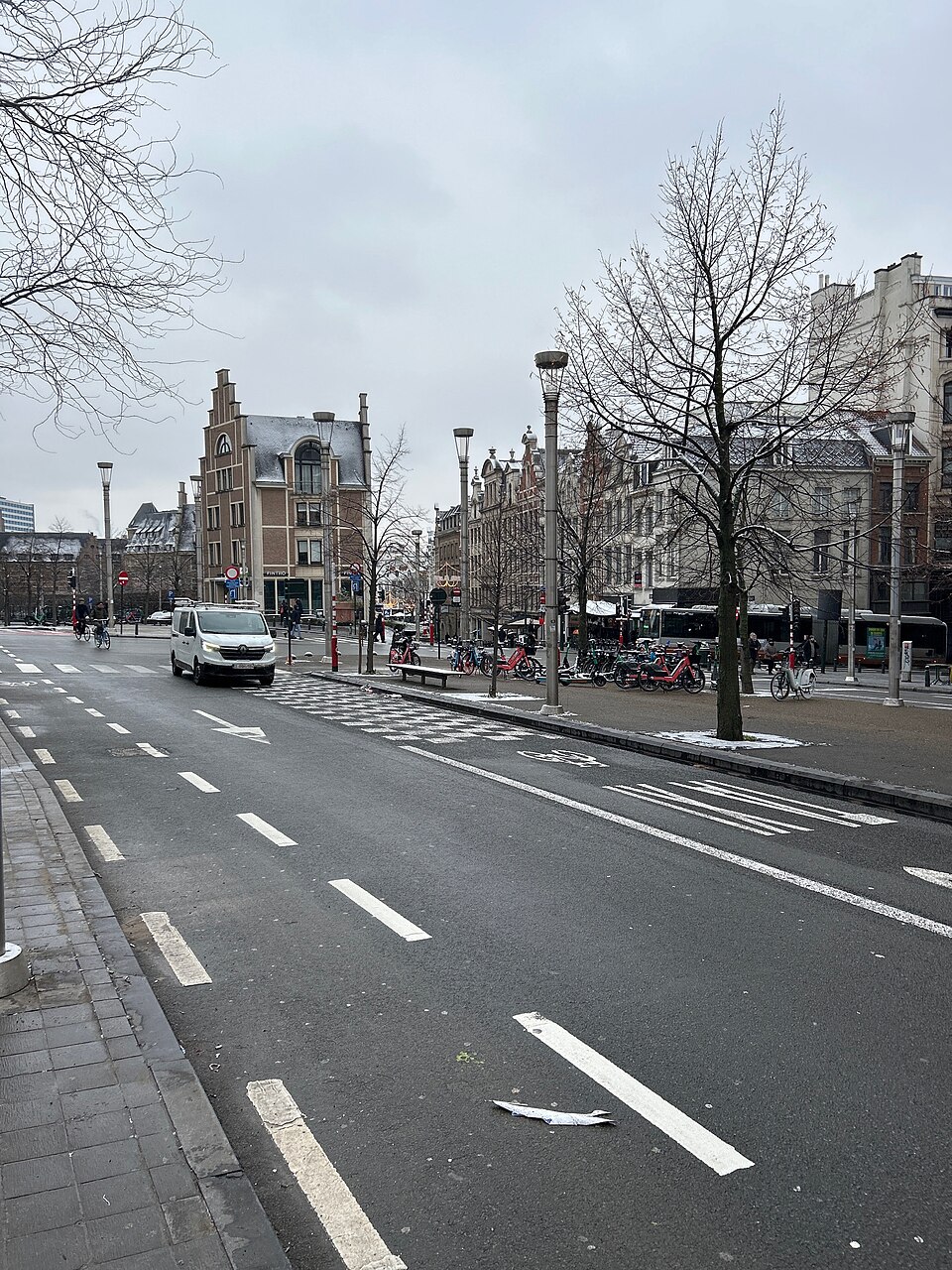
This is a working church before it is a monument, and its published rules of conduct are specific. Silence and a respectful attitude are expected, dress is to be correct and decent, food and drink must be consumed outside, and animals are not admitted apart from dogs accompanying visitors with impaired sight. Begging is permitted neither inside nor within the railings, and canvassing, soliciting and petition-signing are all forbidden. Staff are there to welcome visitors and to keep the peace of the place, and disruptive or aggressive behaviour leads to eviction. The practical traps are four. Visits are not allowed during services, which on a Sunday morning means the doors do not open to visitors until 13.00. The Treasury keeps the cathedral's hours only when volunteers are present, so it can be shut inside its posted window. The crypt cannot be added on the day and needs an appointment made in advance by telephone. And the Saturday guided tour is cancelled outright if a wedding or a funeral is scheduled, which is why the cathedral asks visitors to ring and confirm it. Carry cash: the paid areas take nothing else.
Checked 2026-08-26 · Source

The rules of conduct the cathedral publishes cover silence, dress, food and animals, and say nothing at all about cameras, so there is no published photography policy to quote and none is invented here. What follows is geometry. The Last Judgement window sits above the main west door, which means it is lit from behind and is a picture taken from inside the nave looking back west, best in the afternoon when the sun has come round to that face. The same afternoon light falls on the west front outside; in the morning the two towers are in their own shade. Those towers end flat, without spires, so a photograph that crops them at the top loses the one detail that identifies the building. The forecourt gives enough distance to hold the whole facade in frame, which is unusual for a Gothic front in a dense city centre. Inside, the light is low and uneven, with added lighting on the pulpit, the choir altar, the side chapels and the ambulatory works, so brace against a pillar rather than raising the shutter speed. A flash in a church where silence is requested is conspicuous.
Checked 2026-08-26
No. Entry to the cathedral is free. Four parts of it are charged separately and in cash on the spot: the Treasury at 3 euros per person, the Romanesque remains at 2 euros, the crypt at 4 euros and the tower visit at 15 euros. The self-guided route with QR codes costs 5 euros for thirty minutes or 6 euros for forty-five, paid at a kiosk by the entrance. Guided tours by the volunteer team are free.
The cathedral receives visitors Monday to Friday from 08.00 to 18.00, on Saturday from 08.00 to 17.00 and on Sunday from 13.00 to 18.00. There is no weekly closing day and no midday break in the published hours. Visits are not permitted during services, so the practical window is narrower than the posted one, and Sunday mornings are given over to worship entirely.
Allow an hour. The cathedral publishes no suggested length for a free visit, so the hour is this guide's editorial judgement, drawn from the durations it does publish: thirty or forty-five minutes for the self-guided QR route, a minimum of one hour for a guided tour of the building, and one to two hours for a guided tour that also takes in the Treasury, the Romanesque remains and the crypt.
No. The crypt is open by appointment only and is arranged through the non-profit Church and Tourism Brussels on 02 219 75 30, with the 4 euro fee paid at the Treasury counter. The tower visit runs only from March to October, lasts about two and a half hours, takes groups of ten to twenty-four, requires registration several weeks in advance and sets a minimum age of seven. The Treasury and the Romanesque remains, by contrast, are walk-in during cathedral hours.
No. The cathedral states plainly that visits are not allowed during services. Its prayer page lists a weekday Eucharist at 12.30, while its home page names two weekday celebrations, at 08.00 and 12.30; the two pages disagree and both are given here rather than averaged. At the weekend there is a service on Saturday at 17.30 and services on Sunday at 09.30 and 11.00, the second bilingual in French and Dutch, which is why Sunday visiting begins only at 13.00.
Yes. The cathedral states that it is accessible to people with reduced mobility, and directs them to the shop door on Place Sainte-Gudule, which is on the right-hand side when facing the building; ringing the bell brings a member of staff to open it. Guide dogs accompanying visitors with impaired sight are the one exception to the rule that animals are not admitted. The cathedral publishes nothing about parking or transport, so no arrival advice is recorded here.
Loading the interactive map…
The interactive map could not be loaded.
Last updated:
Source: OpenStreetMap contributors, Wikidata ·