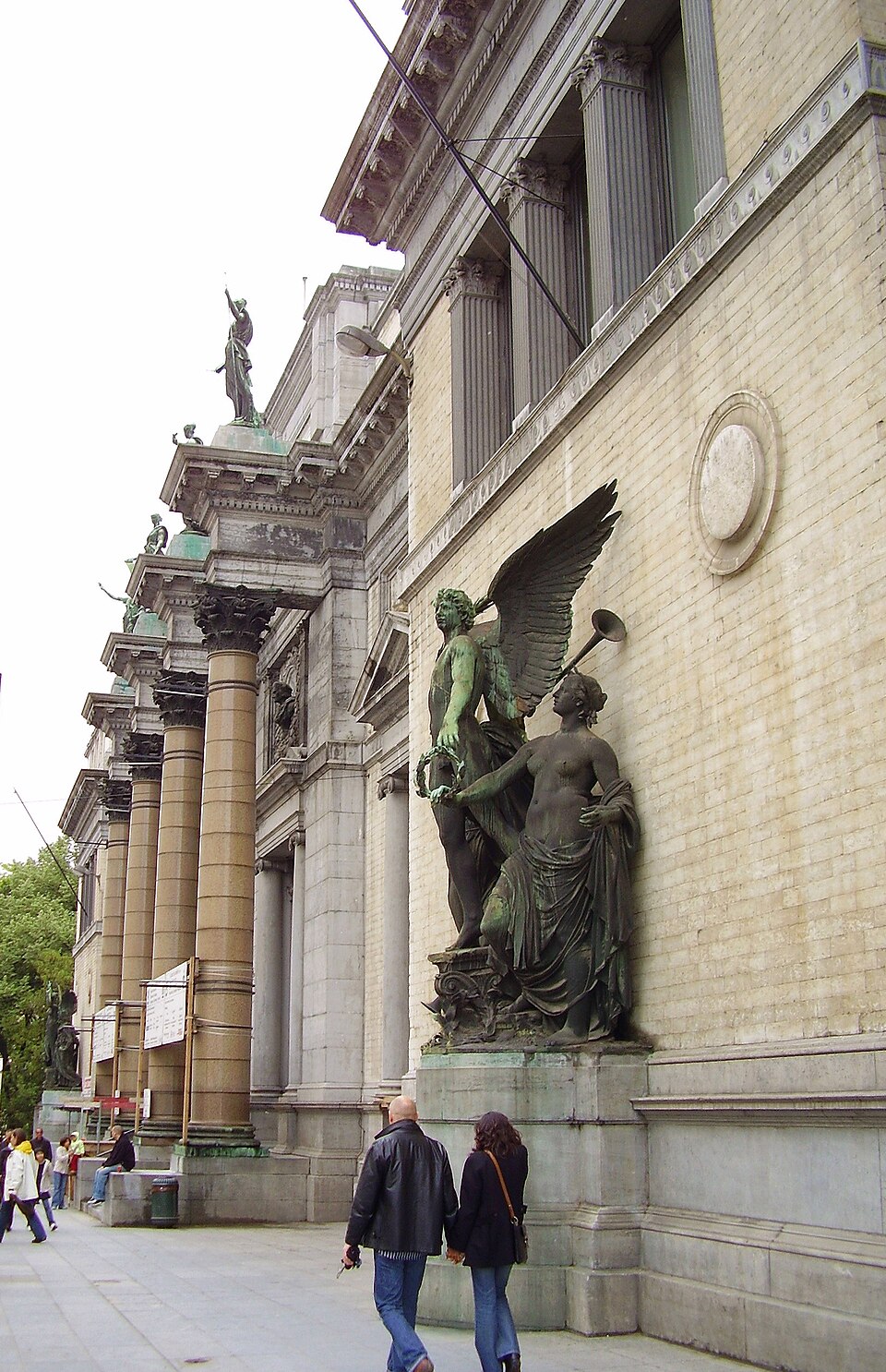
The Old Masters Museum is one of the four sites that make up the Royal Museums of Fine Arts of Belgium, a federal institution whose main entrance is at Rue de la Régence 3, on the slope below the Place Royale in central Brussels. Its permanent route covers painting and sculpture from the fifteenth to the eighteenth century, and since 2025 it has been absorbing display sections that reach further forward in time. The collection's origins are administrative rather than princely: works were seized from religious institutions during the French Revolution, and the museum itself was founded in 1801 under Napoleon. It grew in earnest after Belgian independence in 1830, and in 1914 the de Grez donation added more than four thousand works on paper from the sixteenth to the nineteenth century, including sheets by Hendrick Goltzius, Jacques de Gheyn the Younger and Rembrandt. Two neighbouring museums in the group, the Musée Fin-de-Siècle and the Musée Wiertz, are closed for works, and the museum states that pieces from the Fin-de-Siecle and Modern collections are being folded into the Old Masters route, a reintegration it expects to complete by the end of 2026. What a visitor sees today is therefore a route in motion rather than a fixed hang.
The core of the collection is Southern Netherlandish painting, and it is the reason most visitors come. The fifteenth century is represented by Rogier van der Weyden, Petrus Christus, Dirk Bouts, Hans Memling, Hieronymus Bosch and Gerard David. The sixteenth century belongs to Pieter Bruegel the Elder, whose room holds The Fall of the Rebel Angels and The Census at Bethlehem; the museum has digitised that room in three dimensions, so it is possible to walk it in 360 degrees online before or after a visit, with gigapixel images and specialist commentary. The Flemish school from the fifteenth to the eighteenth century continues through Peter Paul Rubens, Anthony van Dyck and Jacques Jordaens, and the French and Italian schools appear through Simon Vouet, Philippe de Champaigne, Le Lorrain, Jusepe de Ribera and Giovanni Battista Tiepolo. Because of the reintegration under way, later works have begun to appear in the permanent rooms: the museum names James Ensor, Fernand Khnopff and Léon Spilliaert from the years around 1900, and Salvador Dalí, Henri Matisse, Francis Bacon, Marcel Broodthaers and Ann Veronica Janssens from the twentieth century onward. Jacques-Louis David's The Death of Marat belongs to these collections. Which of these are hanging on any given day is not published in advance, so treat the later material as a possibility rather than a promise.
The museum answers this question itself, and its answer is unusually direct. Visitors spend an average of ninety minutes in the museum, and if the intention is to see all the collections it advises allowing half a day to a full day. Ninety minutes is the figure recorded here as the planning duration, and it is a realistic one for the Old Masters route alone at a walking pace that stops properly at the Bruegel and van der Weyden rooms and passes the rest. It is not enough to add the Magritte Museum, which shares the building complex and is a separate route with its own crowd rhythm; a combined visit is a half day, not a long morning. The two smaller sites in the group, the Wiertz and Meunier museums, take about forty-five minutes each by the museum's own reckoning, though the Wiertz has been closed for works since 11 October 2024. Once inside, there is no imposed time limit: the museum states that after arriving within the time slot on the ticket, a visitor is free to spend as long as they like in the galleries. The practical ceiling is the closing announcement rather than the ticket.
The week has two shapes. Tuesday to Friday the museum opens at 10:00 and closes at 17:00; Saturdays, Sundays and public holidays it opens later and closes later, 11:00 to 18:00. It is closed every Monday, which is the single most common wasted journey here. The hours page lists the annual closures as 1 January, 1 May, 1 November, 11 November and 25 December; the museum's own page and the visitor FAQ add 18 June to that list, so a visit on that date should be checked with the museum first rather than assumed. On 24 and 31 December the museum closes at 15:00. The first Wednesday of every month is free from 13:00, which makes that afternoon the busiest predictable slot in the month and the worst one for an unhurried look at the Bruegel room; the museum also notes that if a first Wednesday falls on a closing day the free afternoon is not rescheduled. A weekday morning shortly after opening is the calmest arrival, and it also leaves the most room before the ticket desks shut. The museum publishes no seasonal visitor figures, so there is no basis here for naming a best or worst month.
The admission page prices the Old Masters Museum at 13 euros for an adult. Visitors over 65, and adults in groups of at least fifteen, pay 10 euros. Young people aged 18 to 25, registered jobseekers and integration income beneficiaries pay 5 euros. Children from 0 to 17 outside a group visit are free, as are holders of a European Disability Card and one accompanying person, press with a valid card, teachers with a teacher card, ICOM members, BELSPO staff, City of Brussels guides, and holders of the Friends of the RMFAB, Maecenas Circle, Brussels Card, Ribbedebie and Attractions et Tourisme cards. A combined ticket with the Musée Magritte Museum is 20 euros, and an audio guide is 5 euros. Note a genuine conflict on the operator's own site: the Old Masters museum page carries a different table, with an adult at 10 euros, a senior at 8 and a student under 26 at 3. Both are operator pages and they disagree; the dedicated admission page is the more recent-looking of the two, but the safe assumption is 13 euros. Tickets are valid only for the day printed on them, the museum works in time slots with a thirty-minute margin, and it does not take part in the Museum PASS scheme.
No car is needed, and bringing one is the harder option. The entrance at Rue de la Régence 3 is a five-minute walk from Brussels Central station by the museum's own reckoning, uphill through the Mont des Arts. On the metro, lines 1 and 5 stop at Gare Centrale, the nearest station, and at Parc. Trams 92 and 93 stop at Royale, directly above the museum on the Place Royale. Buses 33, 38, 71 and 95 also stop at Royale, and 29, 63, 65 and 66 stop at Parc or Gare Centrale. For those who do drive, the museum names three public car parks nearby rather than running its own: Albertine, at Rue des Sols and Place de la Justice; Parking 2 Portes, at Rue de Namur and Boulevard de Waterloo; and Parking Poelaert on Place Poelaert. There is no bicycle parking at the museum, and folding bikes and scooters are not accepted in the lockers, which matters if the plan was to arrive on two wheels. If a ticket was bought online for the Magritte Museum, entry is at Place Royale 2; without an online ticket, everyone enters through the Old Masters building on Rue de la Régence and crosses internally.
Bags are the practical hazard. Large bags, rucksacks and umbrellas must go into the cloakroom, and the museum is explicit that bags are not carried around the route; the cloakrooms are automatic lockers near the ticket desks in the Forum and at the Magritte entrance, free, and emptied the same day. Suitcases are accepted only under 55 by 50 by 35 centimetres, and anything larger is refused entry to the building altogether, so arriving straight from a station with luggage does not work. There are extra security checks at the entrance and they can add time. Food and drink go in the locker too; picnics are not permitted anywhere inside and there is currently no space to eat. Personal walking sticks must be left in the cloakroom and an approved one is issued instead. Pushchairs are allowed throughout and lifts serve every floor. Pets are refused; a guide dog needs to be arranged in advance with the museum. On closing, the two operator pages disagree on the ticket desks: the hours page says they shut at 16:30 on weekdays and 17:30 at weekends, while the FAQ says ticket sales stop 45 minutes before closing. Galleries are cleared from 16:45 after an announcement.
Photographs and video for private use are permitted throughout the Royal Museums of Fine Arts of Belgium, with conditions the museum sets out plainly. Keep a reasonable distance from the works, watch what is behind and beside you when framing a painting or a statue, and respect other visitors, including anyone who does not want to appear in a picture. Selfie sticks, flash units and other bulky equipment are not allowed. Tripods fall under the same rule: the museum refers to mechanical feet among the items that must be left in the lockers, alongside bags and non-approved walking sticks, and guards will stop a visitor carrying them into the route. Anything beyond a smartphone or a camera counts as a shoot rather than a snapshot, and the museum does not authorise those for individuals at all, on the stated grounds that it cannot supervise them safely; press and partner shoots are arranged in advance through the press office. In practice this means handheld, available light, no rig. The rooms are lit for conservation rather than for cameras, so expect low light and reflective varnish on the older panels, and shoot at an angle to the glass. The museum notes that the square outside is public and photographs freely.
No. The museum is closed every Monday. Tuesday to Friday it is open 10:00 to 17:00, and on Saturdays, Sundays and public holidays 11:00 to 18:00. The operator also lists annual closures on 1 January, 1 May, 1 November, 11 November and 25 December, and closes at 15:00 on 24 and 31 December. The museum's own page and its visitor FAQ add 18 June to the closure list while the opening-hours page does not, so a visit on that date is worth confirming directly.
How much does a ticket cost?
The admission page prices an adult ticket at 13 euros, with 10 euros for over-65s and for adults in groups of fifteen or more, 5 euros for 18 to 25 year olds and for registered jobseekers, and free entry for children aged 0 to 17. A combined ticket with the Musée Magritte Museum is 20 euros and an audio guide adds 5 euros. The museum's own Old Masters page carries a conflicting older-looking table with an adult at 10 euros and a student under 26 at 3; both pages belong to the operator and they disagree.
How long should a visit take?
The museum states that visitors spend an average of ninety minutes, and that seeing all the collections asks for half a day to a full day. Ninety minutes suits the Old Masters route on its own, with real time at the Bruegel and early Netherlandish rooms. Adding the Magritte Museum on a combined ticket turns it into a half day. There is no time limit once inside: after arriving within the slot printed on the ticket, a visitor may stay as long as they like until the closing announcement.
Is there a free day?
Yes. The permanent collections are free from 13:00 on the first Wednesday of every month, an arrangement the museum calls Happy Wednesday. It does not cover temporary exhibitions, tickets for it cannot be booked online, and it means queueing at the ticket office rather than walking in. If the first Wednesday falls on a day the museum is closed, the free afternoon is not moved to another date. It is also, predictably, the busiest half-day in the month.
Can photographs be taken inside?
Yes, for private use. The museum asks visitors to keep a reasonable distance from the works, to be careful of paintings and sculpture nearby, and to respect other visitors who may not wish to be photographed. Selfie sticks, flash units and other cumbersome devices are not permitted, and tripods must be left in the lockers. Anything requiring equipment beyond a smartphone or a camera counts as a shoot and is not authorised for individuals; press and partner requests go through the press office.
Is a car needed to reach the museum?
No. The entrance on Rue de la Régence is about five minutes on foot from Brussels Central station, metro lines 1 and 5 stop at Gare Centrale, trams 92 and 93 and buses 33, 38, 71 and 95 stop at Royale on the square above, and buses 29, 63, 65 and 66 stop at Parc or Gare Centrale. The museum runs no car park of its own and points drivers to three public ones nearby: Albertine, Parking 2 Portes and Parking Poelaert. There is no bicycle parking, and folding bikes and scooters are not accepted in the cloakroom lockers.
Nothing non-essential is set before you choose, in regions where consent is required. If you decline, ads still appear but they are non-personalised, and analytics is switched off entirely.