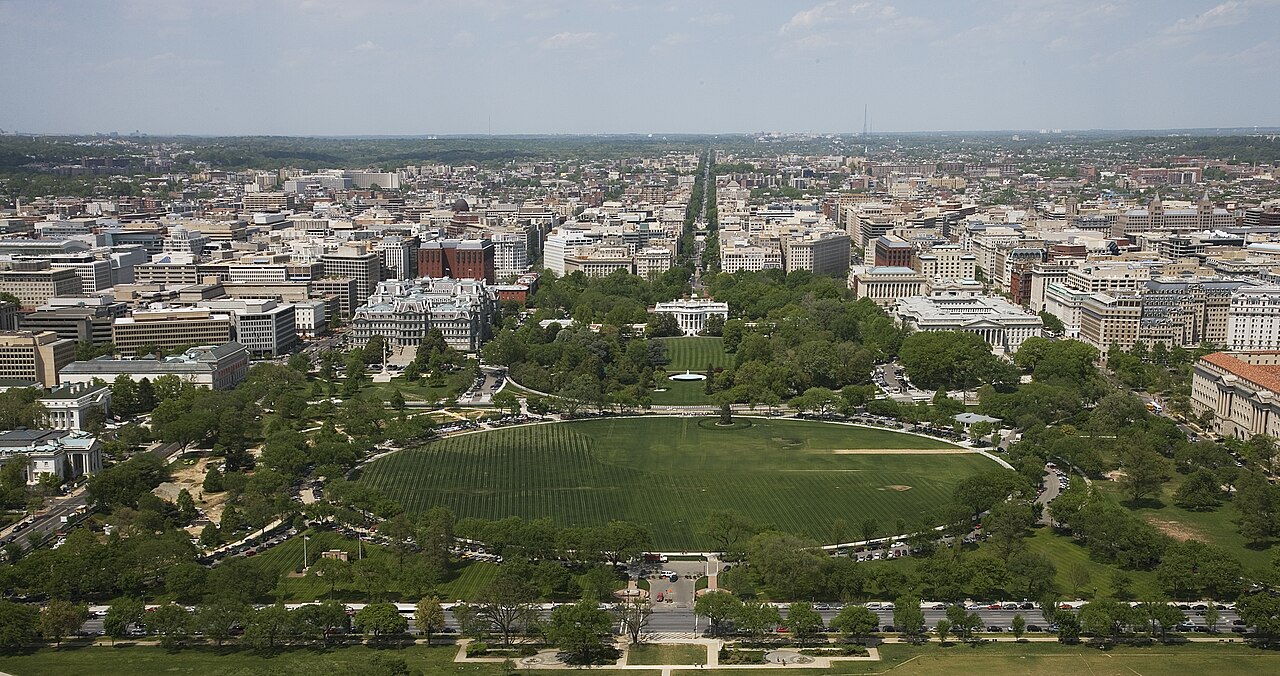
White House
The White House is the official residence and workplace of the President of the United States, located at 1600 Pennsylvania Avenue NW. Completed in 1800, it stands among the most globally recognised civic landmarks.
- Must see
- Activity
Language · 1 published
City guide · United States
Washington is organised around the National Mall, but the city is much more than its monumental core. The Mall links the Capitol, Smithsonian museums and western memorials; Downtown and Penn Quarter sit north, Capitol Hill and Navy Yard lie east and southeast, and Dupont Circle, Georgetown, Shaw and The Wharf form separate neighbourhood destinations. Plan the Mall on foot and use Metro for movement between neighbourhood clusters.
Ranked by importance — sitelinks, pageviews and heritage status, not editor preference.
100 places match
Category
Typical visit duration
Interests
The White House is the official residence and workplace of the President of the United States, located at 1600 Pennsylvania Avenue NW. Completed in 1800, it stands among the most globally recognised civic landmarks.
National Gallery of Art is the United States national art museum, spread across the classical West Building, modern East Building and outdoor Sculpture Garden.. Its value comes from both the specific site and its relationship to Washington's wider civic landscape.
National Museum of Natural History is the Smithsonian museum devoted to the natural world, human origins, planetary history and biological diversity.. Its value comes from both the specific site and its relationship to Washington's wider civic landscape.
National Air and Space Museum is the Smithsonian's central Washington museum of aviation, spaceflight and the technologies that connect them.. Its value comes from both the specific site and its relationship to Washington's wider civic landscape.
National Museum of African American History and Culture is the Smithsonian museum documenting African American history, culture and community through national collections and lived experience..
The Library of Congress is the national library of the United States and the oldest federal cultural institution in the country. Its principal public building, the Thomas Jefferson Building, stands on Capitol Hill adjacent to the United States Capitol.
United States Holocaust Memorial Museum is the United States memorial museum dedicated to documenting the Holocaust and confronting its continuing historical meaning.. Its value comes from both the specific site and its relationship to Washington's wider civic landscape.
The National Museum of American History is a Smithsonian Institution museum located on the National Mall in Washington, D.C. It serves as the Smithsonian's central collection for United States social, political, and material history.
The Smithsonian American Art Museum is a major national art museum in Washington, D.C. It occupies the historic Patent Office Building, a Greek Revival landmark constructed between 1836 and 1867.
The National Portrait Gallery is a Smithsonian Institution museum in Washington, D.C., dedicated to portraiture. It shares the historic Patent Office Building with the Smithsonian American Art Museum.
The Hirshhorn Museum and Sculpture Garden is the Smithsonian Institution's museum dedicated to modern and contemporary art. Located on the National Mall in Washington, D.C., it features a distinctive cylindrical building designed by Gordon Bunshaft.
The National Museum of the American Indian is a Smithsonian museum in Washington, D.C., dedicated to the cultures of Indigenous peoples of the Americas. Its Washington location occupies a distinctive building on the National Mall.
The National Zoological Park is a Smithsonian Institution zoo in Washington, D.C. Established in 1889, it is one of the oldest zoos in the United States.
The National Museum of Asian Art is the Smithsonian Institution's national museum dedicated to Asian art. It encompasses two distinct collections: the Freer Gallery of Art and the Arthur M.
The International Spy Museum is an independent museum in Washington, D.C. dedicated to espionage, intelligence operations, and tradecraft. It examines the history and practice of spying through a global lens, covering both historical and contemporary contexts.
The National Archives Museum is a federal institution on the National Mall in Washington, DC. It serves as the public exhibition space of the National Archives and Records Administration.
The Tidal Basin is a man-made reservoir in Washington, D.C., created in the early twentieth century as part of the Potomac River reclamation project.
The Wharf is a redeveloped waterfront district along the Washington Channel in Southwest Washington, D.C. It represents a major transformation of the city's southwestern waterfront from industrial and maritime uses into a mixed-use destination.
Dumbarton Oaks is a research institute, museum, and historic garden in Washington, D.C. It houses exceptional collections of Byzantine and pre-Columbian art. The institution supports scholarly research in these fields and garden studies.
The Phillips Collection is the United States' first museum of modern art, located in the Dupont Circle neighborhood of Washington, D.C.
Hillwood Estate, Museum & Gardens is the former estate of Marjorie Merriweather Post, a prominent American socialite and heiress. Located in Washington, D.C., it operates as a museum showcasing her extensive collections of decorative arts.
The Freer Gallery of Art is a Smithsonian museum in Washington, D.C., dedicated to Asian art and the works of American artist James McNeill Whistler.
The Renwick Gallery is a branch of the Smithsonian American Art Museum, located near the White House in Washington, D.C.
The National Building Museum is a major architecture and design museum housed in the former Pension Building in Washington, D.C. The building itself is a significant historic structure, originally constructed to serve pension needs.
The National Postal Museum is a Smithsonian Institution museum dedicated to the history of the United States Postal Service and philately. Located adjacent to Union Station in Washington, D.C., it occupies the historic City Post Office building constructed in 1914.
The National Museum of Women in the Arts is the world's first major museum dedicated solely to women artists. Located in Washington, D.C., it occupies a historic former Masonic temple building.
The Museum of the Bible is a large museum in Washington, D.C. dedicated to examining the Bible's history, narrative, and cultural influence. It opened in 2017 near the National Mall.
Planet Word is an interactive language arts museum located in Washington, D.C. It occupies the historic Franklin School building, a significant architectural landmark in the city.
The Anacostia Community Museum is a Smithsonian Institution museum located in Washington, D.C.'s Anacostia neighborhood. Established in 1967, it was originally founded as the Anacostia Neighborhood Museum with a mission to serve the local community.
The National Museum of African Art is the Smithsonian Institution's dedicated museum for the arts of Africa. Located on the National Mall in Washington, D.C., it holds the nation's premier collection of African art.
The Arts and Industries Building is a historic Smithsonian museum structure located on the National Mall in Washington, D.C. Constructed in 1881, it was designed to house the United States National Museum's growing collections.
The Smithsonian Institution Building, commonly called the Castle, stands on the National Mall in Washington, D.C. Completed in 1855, it was the first Smithsonian building and originally housed all Smithsonian operations.
The National Law Enforcement Museum is a national museum in Washington, D.C. interpreting American law enforcement history and service.
President Lincoln's Cottage is a historic house museum on the grounds of the Armed Forces Retirement Home in Washington, D.C. It served as Abraham Lincoln's seasonal residence during his presidency, offering retreat from the White House.
The African American Civil War Museum interprets the history of the United States Colored Troops and the broader African American experience during the American Civil War era.
Decatur House is a historic house museum located near the White House in Washington, D.C. It was built in 1818 for Commodore Stephen Decatur, a celebrated naval hero of the War of 1812.
The DAR Museum is a period-rooms and decorative-arts museum in Washington, D.C., maintained by the Daughters of the American Revolution. It occupies space within the organization's National Society headquarters.
Larz Anderson House is a Gilded Age mansion in Washington, D.C. It serves as the headquarters of the Society of the Cincinnati, the nation's oldest patriotic organization, founded in 1783 by officers of the Continental Army.
The Woodrow Wilson House is the former residence of the twenty-eighth President of the United States, Woodrow Wilson. Located in Washington, D.C., this historic property served as Wilson's final home following his departure from the White House.
The Heurich House Museum is a preserved Gilded Age mansion in Washington, D.C., built for and owned by Christian Heurich, a German immigrant who became one of the city's most successful brewers.
Tudor Place is a Federal-period estate located in Georgetown, Washington, D.C. The property was built by Martha Washington's granddaughter and remained in the same family for six generations, from 1805 to 1983.
Arena Stage is a leading resident theatre in Washington, D.C., focused on American plays and new work. Founded in 1950, it has established itself as a major cultural institution dedicated to American voices and stories.
Source: OpenStreetMap contributors, Wikidata ·
The National Mall is the main east-west axis, with the Capitol at its eastern end and the Lincoln Memorial toward the Potomac. Downtown and Penn Quarter are north of the Mall; Capitol Hill continues east; The Wharf and Navy Yard occupy separate waterfronts to the south. Dupont Circle and Adams Morgan are northwest, while Georgetown sits west without a Metrorail station. Distances across the Mall are longer than they appear on a diagram.
Checked 2026-08-26
Walk within the National Mall and use Metrorail for longer connections between central districts. Metrobus fills gaps, particularly where rail does not reach directly, and Capital Bikeshare provides another option for waterfronts and broad avenues. Most visitors do not need a car because parking and traffic complicate central trips. Use WMATA's current trip planner and service notices for station access, closures and transfers.
Checked 2026-08-26
A fixed stay length is not recorded. Plan the National Mall and its museums first, then add Capitol Hill, Georgetown or another neighbourhood according to your priorities.
Yes, but it is longer than it looks on a map. Divide the Capitol and museum end from the western memorials if you want time inside institutions.
Most visitors do not. Walking, Metrorail and Metrobus cover the principal visitor districts, while a car adds traffic and parking constraints in the centre.
No. Georgetown has no Metrorail station, so reach it by bus, walking, cycling or a connection from a nearby rail station.
Combine the Mall with Downtown or Penn Quarter, Capitol Hill with Navy Yard, and The Wharf with the southern waterfront. Use Metro between these clusters.
Set your days, your pace and the hours you actually want to be out. The planner works around closing days and travel time, and leaves room to eat.