City guide
Best Things to Do in Budapest
Editorial responsibility: Elena Voss · SSMTour Travel Editor
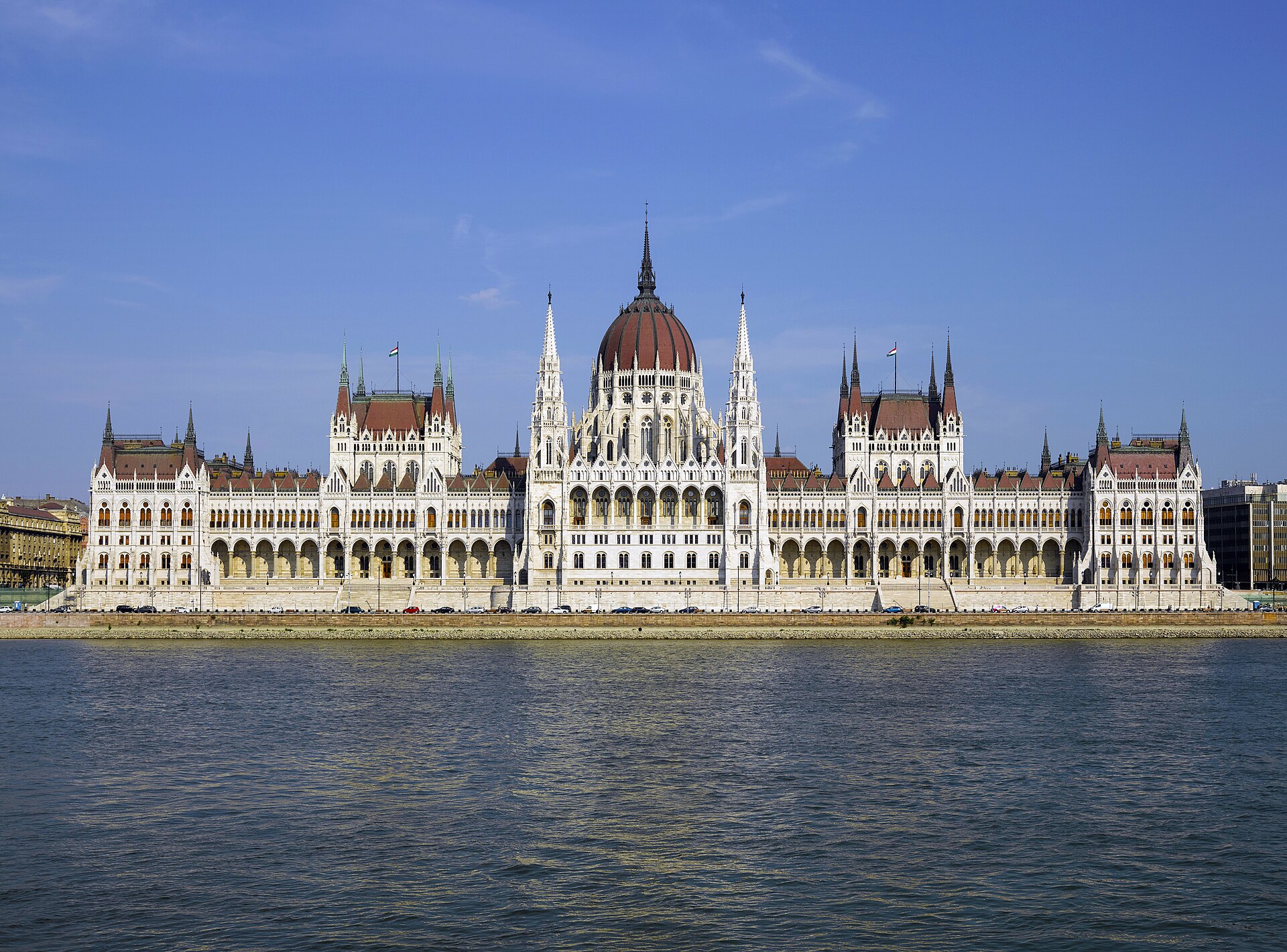

Choose Budapest sights by setting and interest, from Parliament and the Castle District to Danube views, sacred interiors, thermal baths and City Park.
This guide is part of our Budapest destination coverage. Budapest
1. Read the riverfront at the Hungarian Parliament
The Hungarian Parliament Building gives Budapest its clearest civic landmark and one of its most recognisable Danube silhouettes. Imre Steindl’s winning Neo-Gothic design emerged from a national competition, and the building was shaped as both a working legislature and a monumental statement. Seen from Buda, the long façade, central dome and riverside setting read as one composition; from Kossuth Lajos Square, stone tracery, pinnacles, sculpture and repeated window bays dominate.
Inside, the official parliamentary material centres ceremonial circulation and Hungarian state symbols. The grand staircase leads towards the Dome Hall, where the Holy Crown is displayed, while museum exhibitions address the building and the history of legislation. The contrast between Gothic Revival exterior vocabulary and the institution’s modern political function is fundamental to the experience. Kossuth Square expands that story into public space through memorials and the carefully framed river frontage. Parliament is therefore simultaneously an architectural monument, a museum setting, a repository of regalia and the active home of the National Assembly.
Checked 2026-09-08 · Official site · www.parlament.hu
Checked 2026-09-08 · Official site · www.parlament.hu
2. Treat Buda Castle as a cultural district
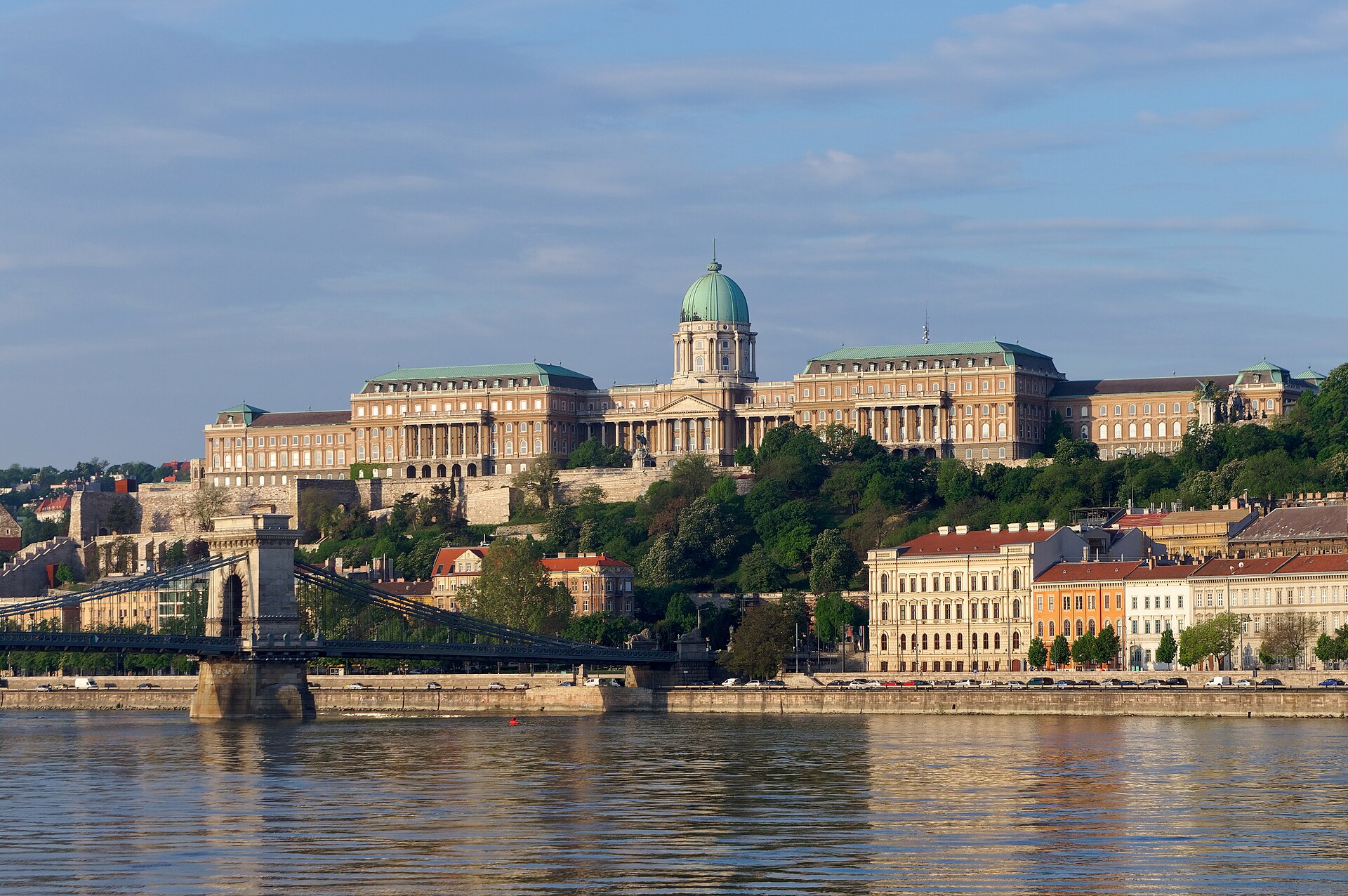

Buda Castle is a hilltop district rather than a single doorway. The Royal Palace now contains major cultural institutions, including the Hungarian National Gallery and Budapest History Museum, while the surrounding Castle District adds courtyards, lanes, terraces and views. Palace wings occupy the southern part of the height; the old quarter continues north towards Szentháromság Square, Matthias Church and Fisherman’s Bastion. Walls and slopes keep the relationship with the Danube visible.
The national tourism authority identifies the district as part of Budapest’s World Heritage setting and distinguishes the Royal Palace from the broader neighbourhood commonly called the castle. The National Gallery brings Hungarian art into a former seat of power, while the history museum interprets the city within the same palace complex. Elsewhere, archives, the presidential seat, religious architecture and rebuilt historic fabric give the quarter several institutional layers. “Buda Castle” consequently describes both a palace monument and an inhabited cultural landscape whose identity depends on streets, courts, collections and the elevated position above Pest.
Checked 2026-09-08 · Official site · visithungary.com
3. Use Fisherman’s Bastion to understand the panorama
_28.jpg)
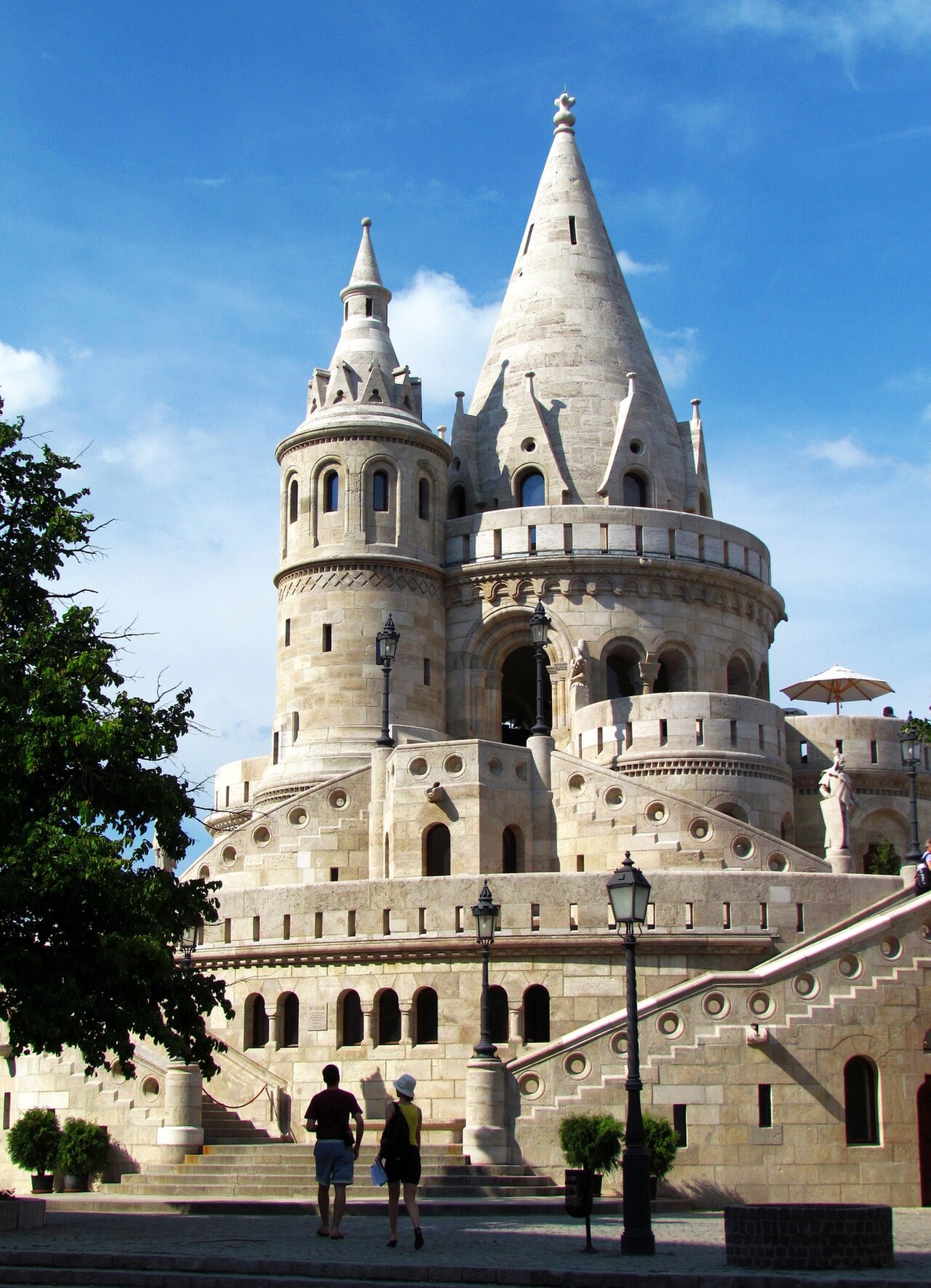
Fisherman’s Bastion is a viewpoint and architectural promenade built into the Castle District. Its long arc of stairs, corridors and towers faces the Danube, with the Parliament Building forming the dominant landmark across the water. The national tourism authority dates the modern structure to work begun in 1899 under Frigyes Schulek and opened to the public in 1905. The seven stone towers refer to the Magyar tribal leaders associated with the Hungarian settlement of the Carpathian Basin.
Schulek composed the northern and southern bastions, connecting corridors, monumental stairway and courtyard as one ensemble. Archaeological discoveries made during construction included Gothic and Renaissance tombstones and remains of a Dominican sanctuary. The equestrian statue of King Saint Stephen occupies the courtyard, with reliefs referring to episodes of his reign. Pale stone, conical roofs, repeated arches and changing terrace levels create the bastion’s distinctive neo-Romanesque character. Beside it, Matthias Church adds a taller and more colourful vertical element; beyond it, the river and Parliament turn the architecture into a frame for the larger cityscape.
Checked 2026-09-08 · Official site · visithungary.com
4. Choose art, devotion or a panorama at St. Stephen’s Basilica


St. Stephen’s Basilica combines a monumental church interior, the Holy Right relic associated with Hungary’s first king and an elevated panorama from the dome terrace. Construction began in 1851 to József Hild’s plans, survived the collapse of the dome and continued under Miklós Ybl, who corrected the structure and reshaped it in a Renaissance spirit. The church was consecrated in 1905 after a building history lasting more than half a century.
Mosaics, paintings, sculpture and stained glass fill the interior, and restoration completed in the early twenty-first century renewed both the building and its artworks. The relic is displayed at the altar of the Assumption in a double reliquary, connecting the basilica’s dedication with Saint Stephen and the foundation of the Hungarian state. Above, the dome terrace opens a circular view across Pest’s roofs and street grid. Sacred function, national relic, historic engineering and city panorama coexist within the same structure, giving the basilica a role that is religious, artistic and civic.
Checked 2026-09-08 · Official site · www.visitesztergom-budapest.hu
5. Cross the Danube on the Széchenyi Chain Bridge
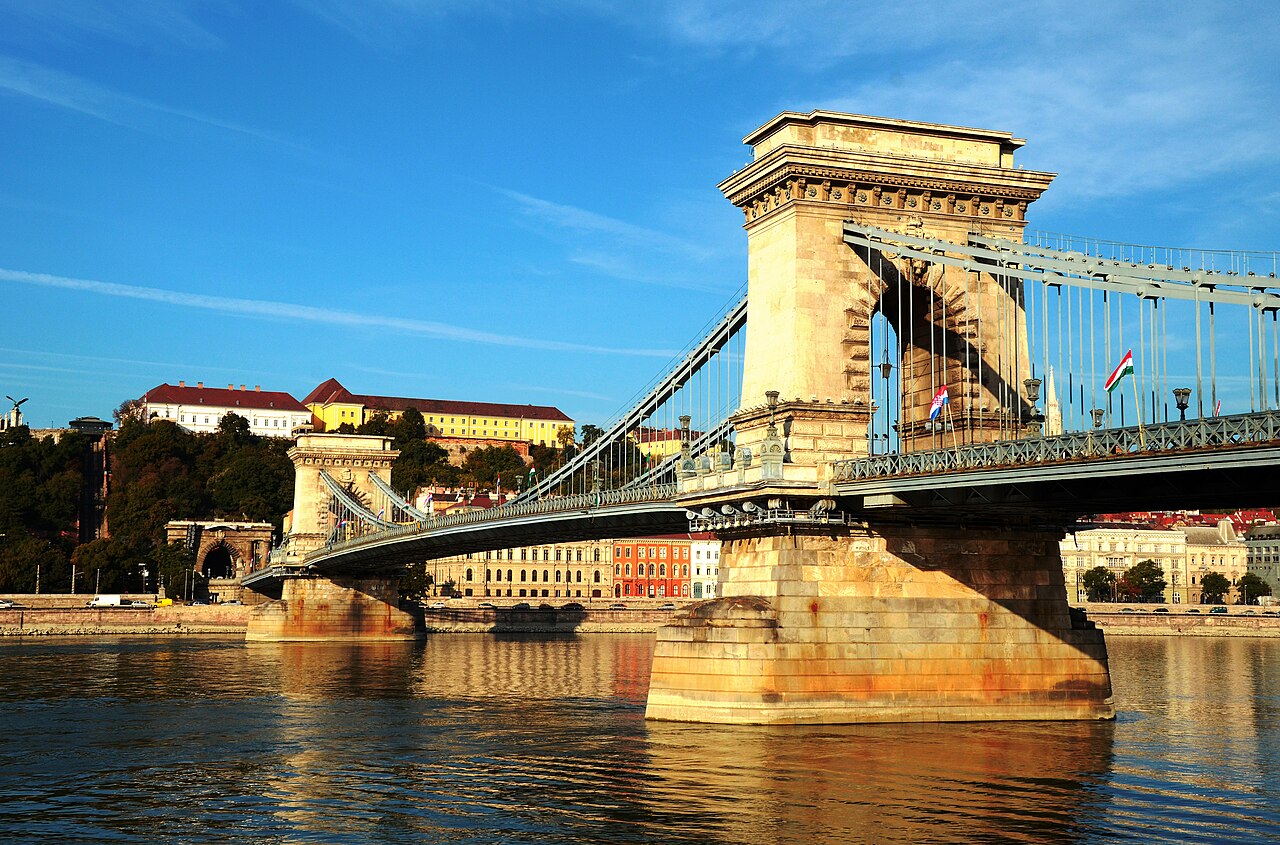

The Széchenyi Chain Bridge gives Budapest a powerful river-level landmark between central Pest and the foot of Castle Hill. Stone pylons frame the roadway and pavements, iron chains draw catenary curves above the deck, and lion sculptures guard the approaches. Northward, Parliament anchors the Pest frontage; westward, the bridge meets Clark Ádám Square below the Buda slope and tunnel. The span makes the two banks visible as parts of one engineered composition.
BKK describes the bridge as a defining element of the World Heritage Danube bank. Its reconstruction renewed the structure and historic details, replaced deteriorated elements and widened the pedestrian pavements from their previous dimensions. Reconstructed three-armed candelabra and restored bridgehead spaces reinforce the historic appearance without concealing the bridge’s continuing transport function. At close range the chains, riveted metalwork, masonry and sculpture dominate; from either embankment the complete span becomes a horizontal counterpoint to Budapest’s domes, towers and rising western topography.
Checked 2026-09-08 · Official site · bkk.hu
6. Make Széchenyi Thermal Bath a deliberate experience


Széchenyi Thermal Bath represents Budapest’s bathing culture on a monumental scale. The operator identifies it as one of Europe’s largest spa complexes and the first thermal bath in Pest. The complex grew from mining engineer Vilmos Zsigmondy’s successful deep drilling in City Park, where an artesian bath operated by 1881. The present building opened in 1913 to plans by Győző Czigler, and a large outdoor department was added in 1927.
Yellow Neo-Baroque elevations surround the famous exterior pools, while indoor thermal areas preserve the complex’s original medical and bathing purpose. Later alterations added services and modernised water circulation, but the arrangement still expresses the early-twentieth-century idea of bathing as both public health infrastructure and social recreation. Curved pool edges, arcaded façades, domes and steam above outdoor water create the most recognisable scene. Within City Park, the bath also belongs to a larger metropolitan landscape shaped by the Millennium-era development around Heroes’ Square and Andrássy Avenue.
Checked 2026-09-08 · Official site · www.szechenyibath.hu
7. Read Budapest’s layered history at Matthias Church


Matthias Church brings medieval fabric, royal ceremony and nineteenth-century restoration into one building. Its formal name is the Church of the Assumption of Buda Castle, while the popular name recalls King Matthias. The national tourism authority traces the church to the thirteenth century and identifies the fourteenth-century Maria Gate among the medieval elements that survived the building’s turbulent history. The patterned roof and slender tower now dominate Szentháromság Square.
After the Ottoman capture of Buda in 1541, the building was converted into a mosque; following the recapture of the city in 1686, it returned to Catholic use and acquired Baroque features. Frigyes Schulek’s later work shaped the current Gothic Revival appearance and visually linked the church with neighbouring Fisherman’s Bastion. Royal weddings, coronation ceremonies, surviving medieval stonework and changing religious use give the interior and exterior several chronological layers. The result is not a preserved building from one moment but an architectural record of Buda’s successive political and sacred identities.
Checked 2026-09-08 · Official site · visithungary.com
8. Decode the monument at Heroes’ Square


Heroes’ Square presents sculpture as a historical programme. The Millennium Monument replaced an earlier ornamental fountain and commemorated the thousandth anniversary associated with the Hungarian conquest of 896. A central column carries Archangel Gabriel, while equestrian figures of the seven Magyar chieftains stand at its base. Two semicircular colonnades display later rulers, generals and political figures selected to represent the formation of modern Hungary.
Reliefs beneath the standing figures depict episodes connected with their reigns or actions, and allegorical groups crown the colonnades. War and Peace appear in chariots above the curved wings, accompanied by figures representing Labour and Wealth, Knowledge and Glory. The open geometry allows the entire sculptural arrangement to be read against the sky. Andrássy Avenue terminates at the square, major museums face its sides and City Park extends behind the monument. This position turns the memorial into a ceremonial gateway between the nineteenth-century boulevard and Budapest’s metropolitan park landscape.
Checked 2026-09-08 · Official site · visithungary.com
Choose one close river view and one wide panorama
The Danube composition contains three complementary scales. At Parliament, the eye meets carved stone, repeated window bays, pinnacles and the dome at close range. At the Széchenyi Chain Bridge, the horizontal span, portals and suspension chains pull both banks into the same frame. From Fisherman’s Bastion, those elements recede into a broad panorama in which the river becomes the central band and Parliament the dominant object on Pest.
These views explain why the landmarks cannot be reduced to isolated façades. BKK identifies the bridge as a defining element of the World Heritage riverbank, while the national tourism authority emphasises the bastion’s direct Parliament outlook. The water reflects changing light and creates distance between the civic frontage and Castle Hill. St. Stephen’s Basilica adds another vertical marker behind the Pest bank, but its dome terrace describes the street grid more strongly than the classic cross-river composition. Close detail, structural crossing and elevated panorama reveal different evidence; each has its own visual purpose.
Checked 2026-09-08 · Official site · visithungary.com
Checked 2026-09-08 · Official site · bkk.hu
Keep the Castle District as one layered block
Castle Hill compresses several periods of Buda into adjoining architecture. Matthias Church preserves medieval fabric, carries memories of Ottoman conversion and Catholic reuse, and presents the nineteenth-century work that shaped its current silhouette. Fisherman’s Bastion belongs to that later transformation: Frigyes Schulek designed its terraces and towers beside the church, turning the edge of the hill into a historical monument and city overlook. The Royal Palace adds a different institutional layer through national art and urban-history collections.
The district’s materials make those layers visible. Patterned roof tiles and Gothic forms distinguish the church; pale arcades and conical towers identify the bastion; palace wings and courtyards occupy the southern part of the height. Cobbled lanes, walls and outlooks connect them without erasing their separate functions. The Hungarian Tourism Agency describes the quarter as a cultural hub containing museums, galleries, archives and the presidential seat. “Buda Castle” therefore names a historic urban ensemble as much as a palace, and the experience extends beyond any single entrance.
Checked 2026-09-08 · Official site · visithungary.com
Checked 2026-09-08 · Official site · visithungary.com
Pair City Park with history or bathing
The axis from Andrássy Avenue through Heroes’ Square into City Park joins national commemoration with metropolitan leisure. The Millennium Monument marks the anniversary associated with the Magyar conquest through Archangel Gabriel, the mounted chieftains, rulers, statesmen and narrative reliefs. Museums face the open square, while the park begins behind the colonnades. The result is a ceremonial threshold rather than an ordinary traffic junction.
Deeper in the park, Széchenyi Thermal Bath tells a separate story of geology, engineering and public recreation. Vilmos Zsigmondy’s deep drilling led to an artesian bath before the present complex opened in 1913; the outdoor department followed in 1927. Yellow Neo-Baroque architecture surrounds pools whose use continues Budapest’s thermal tradition. The monument looks backward through selected historical figures, whereas the bath embodies an urban practice still lived in the present. Their proximity makes City Park a concentrated expression of how Budapest constructed identity, spectacle and everyday pleasure around the turn of the twentieth century.
Checked 2026-09-08 · Official site · visithungary.com
Checked 2026-09-08 · Official site · www.szechenyibath.hu
Choose Budapest sights by the experience you want
The eight landmarks form a compact survey of nineteenth- and early-twentieth-century Budapest design. Parliament uses Gothic Revival vocabulary—pinnacles, tracery, a rhythmic river façade and a dominant dome—for a modern legislature. Frigyes Schulek’s work around Matthias Church and Fisherman’s Bastion combines a restored medieval church silhouette with the bastion’s neo-Romanesque arcades, conical towers and theatrical stairs. The basilica answers with monumental mass, mosaics and a high Renaissance-influenced dome.
Engineering contributes an equally recognisable language. The Chain Bridge draws a strong horizontal line between masonry portals, with iron chains declaring how the span is held. Széchenyi Thermal Bath surrounds water with an elaborate Neo-Baroque setting whose yellow elevations and curved pool edges have become part of the city’s visual identity. Heroes’ Square expands architecture into urban scenography: a tall central column, semicircular colonnades, mounted figures and relief panels occupy an open ceremonial field at the end of the avenue.
Scale changes the encounter. Palace courts are read by moving through connected exterior spaces; the bastion is read along an edge; the bridge is read across water; the square is read by circling sculptural groups; the bath is read as rooms and pools within one envelope. Ornament also carries different subjects, from saints and royal memory to legislators, chieftains and allegorical figures. Together these contrasts reveal a capital expressing politics, faith, commemoration, technology and leisure through deliberately public forms. The result is not one Budapest style but a sequence of architectural languages that become legible beside the Danube, on Castle Hill and along the avenue to City Park.
- Hungarian Parliament Building
- Buda Castle
- Fisherman's Bastion
- St. Stephen's Basilica
- Széchenyi Chain Bridge
- Szechenyi Thermal Bath
- Matthias Church
- Heroes' Square
Checked 2026-09-08 · Official site · visithungary.com
Checked 2026-09-08 · Official site · www.parlament.hu
Turn this list into a plan
Set your days, your pace and the hours you actually want to be out. The planner works around closing days and travel time, and leaves room to eat.