


.jpg)
_mit_Kettenbr%C3%BCcke.jpg)
_mit_Kettenbr%C3%BCcke.jpg)
3 min walk
Oroszlán
- Notable
- Art and culture venue
Language · 1 published
Historic monument · Budapest
Széchenyi lánchíd
| Monday | 00:00 – 23:59 |
|---|---|
| Tuesday | 00:00 – 23:59 |
| Wednesday | 00:00 – 23:59 |
| Thursday | 00:00 – 23:59 |
| Friday | 00:00 – 23:59 |
| Saturday | 00:00 – 23:59 |
| Sunday | 00:00 – 23:59 |
Parsed from OpenStreetMap opening hours on 2026-08-26.
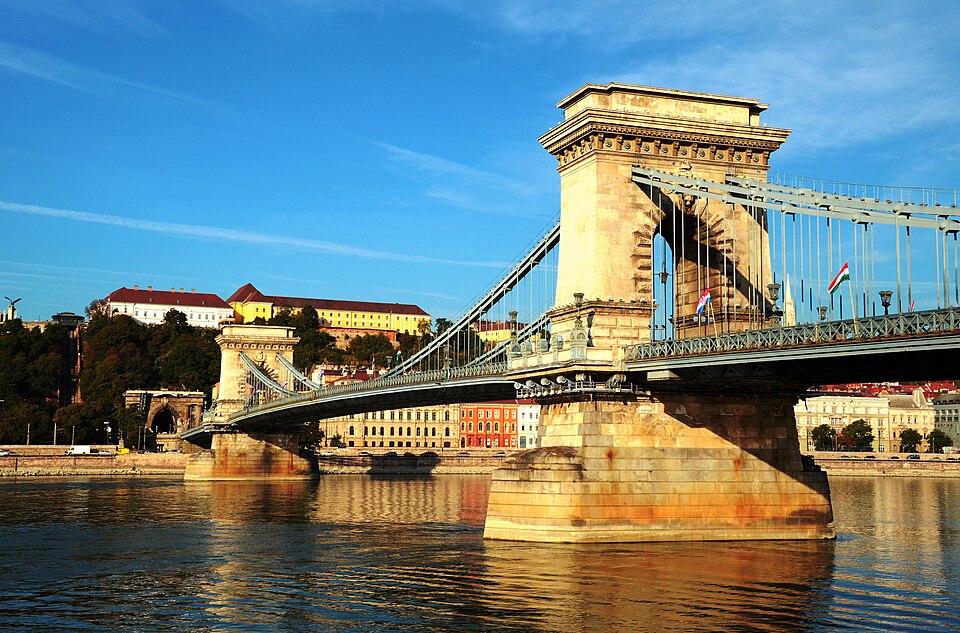
The Széchenyi Chain Bridge carries the central Danube crossing between Buda and Pest, and it was the first permanent bridge to link the two halves of the Hungarian capital. The English engineer William Tierney Clark designed it in 1839; the Scottish engineer Adam Clark, no relation, supervised the building of it; it opened in 1849, after the Hungarian Revolution of 1848. The sections were fabricated in Britain and shipped to Hungary for assembly, which makes it an enlarged relative of Tierney Clark's Marlow Bridge over the Thames. Its centre span of 202 metres was among the largest anywhere at the time. Much of the money came from the Greek merchant Georgios Sinas, whose name is cut into the base of the south-western foundation on the Buda bank. The bridge was given Széchenyi's name in 1898, though almost nobody in Budapest calls it anything but the Lánchíd, the chain bridge. Retreating German troops blew it up on 18 January 1945 during the siege of Budapest and only the towers were left standing; it was rebuilt and reopened in 1949. What a visitor walks across today is therefore a post-war reconstruction of an 1849 design, faithful enough that the joins are invisible from the deck.
Checked 2026-08-26 · Source
There is no interior to visit. Everything worth stopping for sits on the deck or at the two ends. Four stone lions by the sculptor János Marschalkó guard the abutments; they were installed in 1852, three years after the bridge opened, and the Trafalgar Square lions commissioned in 1858 are close cousins of them in design. The decoration on the chains, the towers and the railings is cast iron. Adam Clark's name is cut into the inscription on each side in the local name order, as Clark Ádám, which catches out English readers expecting it the other way round. A plaque on the Pest side commemorates the only two surviving Tierney Clark suspension bridges, this one and the bridge at Marlow in England. The ends matter as much as the span. The Pest end lands on Széchenyi Square, with the Gresham Palace and the Hungarian Academy of Sciences facing it. The Buda end lands on Adam Clark Square, beside the Zero Kilometre Stone from which Hungarian road distances are measured and the lower station of the Castle Hill Funicular up to Buda Castle. That pairing is the reason the bridge is normally walked rather than merely photographed from a quay.
Checked 2026-08-26 · Source

Thirty minutes is the figure this guide records, and it assumes the crossing is being made as a sight rather than as a commute. The deck is a few hundred metres of straight, level walking, and anyone crossing to get somewhere will be over it in seven or eight minutes without hurrying. Almost nobody crosses it that way the first time. The stops are predictable: a lion at each end, the view upstream towards Parliament, the view downstream, the Buda hill filling the frame ahead, and the halfway pause that everyone makes whether they intended to or not. Half an hour covers a one-way crossing with those stops and a few minutes on the square at each end. Allow forty-five to sixty minutes for a return crossing, or for a crossing combined with the Zero Kilometre Stone and a look at the funicular queue on the Buda side. The bridge works best as the link between two longer stops rather than as a visit in its own right, and the usual shape of a morning is Széchenyi Square or Parliament on the Pest bank, then the crossing, then the climb to the Castle.
Checked 2026-08-26
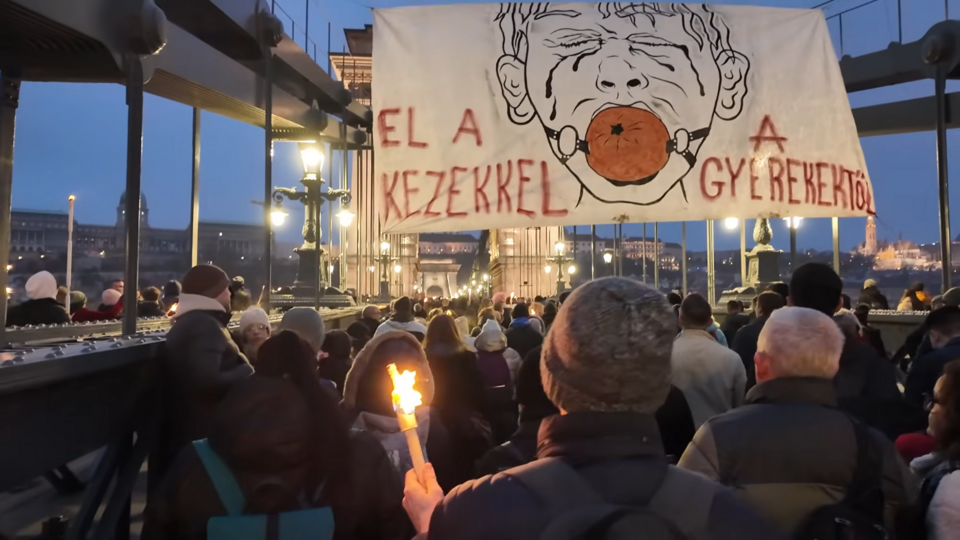
The bridge is a public street rather than a ticketed attraction, and the city's tourism office publishes no opening hours for it; there is no gate, no closing time and no closed day recorded anywhere on the operator's page. That leaves the choice of hour entirely to the light and the crowd. Early morning is the quiet crossing: the deck belongs to commuters and runners, the lions can be photographed without waiting, and the sun comes over Pest and lights the Buda hill ahead of anyone walking west. Late afternoon reverses that and puts the light on Parliament instead. The evening is the crossing most people remember, because the reconstruction fitted the street lighting and the decorative lighting with energy-saving LED lamps whose colour can be changed automatically; besides the constant warm white, the bridge can be lit in other colours, and on Hungarian national holidays in the colours of the flag. Late spring and early autumn are the comfortable months, since the deck is fully exposed and the Danube funnels wind along it. High summer at midday is hot, crowded and flat-lit, and is the one combination worth avoiding.
Checked 2026-08-26 · Source
There is nothing to buy. The Chain Bridge is a public crossing, not a ticketed monument: no admission is charged, no ticket office exists, and the city's tourism office records the toll as a historical detail, noting that until 1918 everyone including the nobility had to pay a bridge toll to cross. Since then the crossing has been free on foot, and it remains so. No paid tower climb, no chamber inside the pylons and no guided access to the structure is offered or advertised on the operator's page, so a visitor who has been told that the bridge can be climbed has been told wrong. The Budapest Card, which the tourism office promotes alongside the bridge, buys public transport and discounts elsewhere in the city and is not needed to set foot on the deck. What can cost money nearby is everything the bridge leads to: the Castle Hill Funicular from Adam Clark Square at the Buda end is a paid ride, and the museums up on Castle Hill charge their own admission. Budget for those rather than for the bridge itself, and carry nothing for the crossing.
Checked 2026-08-26 · Source
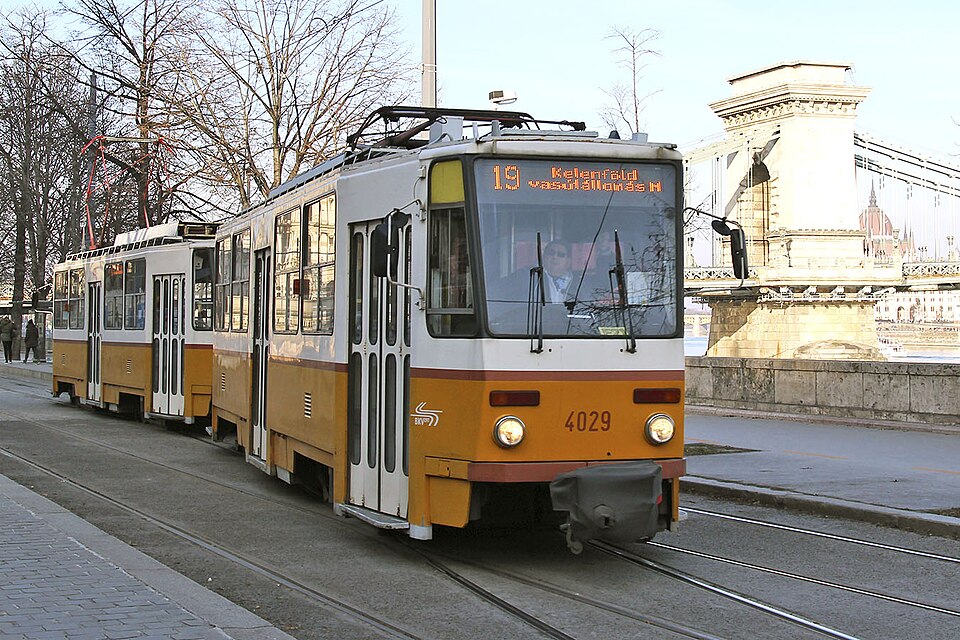
The address the tourism office gives is 1051 Budapest, Széchenyi Lánchíd, which is the Pest bridgehead on Széchenyi Square. The Buda end is Adam Clark Square, at the mouth of the tunnel under Castle Hill and at the foot of the funicular. A car is not merely unnecessary here, it is not allowed: after the reconstruction the residents of Budapest voted on the bridge's future and it has not been reopened to car traffic, so only BKK buses, taxis, motorbikes and cyclists cross it alongside pedestrians. Do not plan on driving over it or on stopping on it, and do not look for parking at either bridgehead. Arrive on foot from the Pest embankment, from the Castle side, or by public transport. Specific bus and tram line numbers are not recorded in this entry: BKK's own site refused automated access on the day these facts were checked, so rather than copy line numbers from a third party, check bkk.hu or the BudapestGO planner for the current services to Széchenyi István tér and Clark Ádám tér before setting out. OpenStreetMap records the footway across the bridge as wheelchair accessible.
Checked 2026-08-26 · Source
The bridge being closed to cars misleads people into treating the roadway as a promenade. It is not one. Buses, taxis and motorbikes still cross, cyclists cross at speed, and the pavement on each side is narrow enough that two groups stopping for photographs will block it completely. Stand at the railing, not in the middle of the walkway, and look before stepping out to change sides. The deck is fully exposed, so wind off the Danube is stronger on the bridge than on either bank, and rain arrives sideways; in winter the stone and the cast iron get slick, and the steps and kerbs at the abutments are the places where people go over. The crush concentrates at the four lions and at the funicular queue on Adam Clark Square, which is where bags should be in front rather than behind. At the Buda end the tunnel mouth and the roundabout carry real traffic despite the car-free deck, and the crossing there is the genuine hazard of the visit. Anyone continuing up to the Castle should also expect the funicular queue to be long in the middle of the day.
Checked 2026-08-26
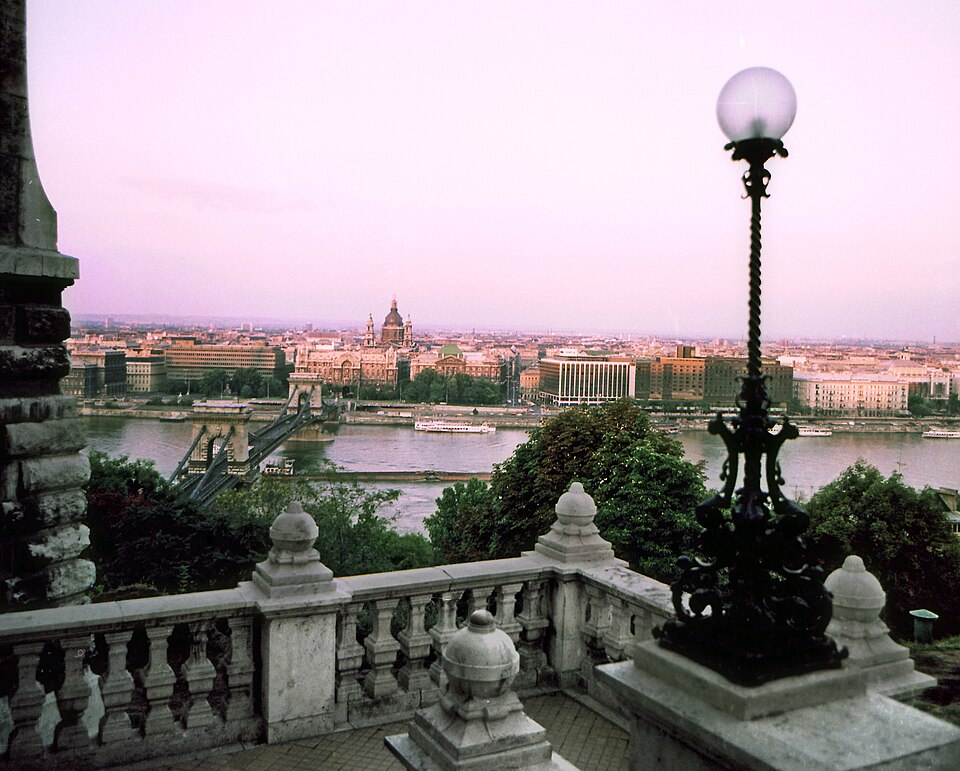
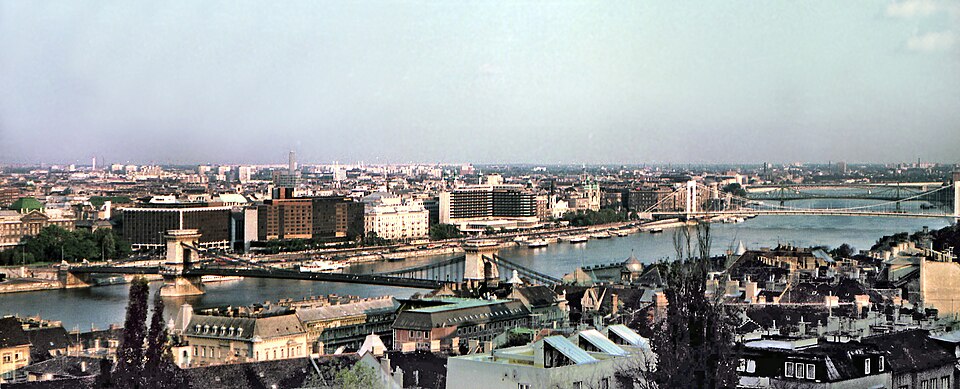
The bridge is a better subject than it is a viewpoint, so plan for two separate shots. From the deck, the picture is upstream towards Parliament, framed between the chains and the tower; it wants the low sun of late afternoon or the blue half-hour after sunset, and it wants a spot at the railing well clear of the tower so the ironwork leads the eye instead of blocking it. From off the bridge, the classic frame is from the Buda embankment or from the Fisherman's Bastion above, with the whole span and the lit chains reading against the Pest waterfront. The lighting is the reason to come back at night: the decorative lamps are LED and their colour can be switched, so a bridge that is warm white on one evening can be another colour on the next, and the colours of the Hungarian flag on a national holiday. The lions are a close subject rather than a wide one, shot low from the front so that the head reads against the sky. Bring something to steady the camera after dark; the deck vibrates when a bus crosses.
Checked 2026-08-26
Nothing. The Chain Bridge is a public crossing rather than a ticketed attraction, and no admission is charged to walk across it. The city's tourism office mentions a toll only as history, recording that until 1918 everyone, the nobility included, had to pay a bridge toll to cross. No ticket office, tower climb or paid access to the structure is offered today. The Budapest Card is not needed to set foot on the bridge.
No opening hours are published for it. The bridge is a public street with no gate and no ticket office, and the operator's own page records neither an opening time, a closing time nor a closed day. This entry therefore records no opening hours rather than guessing at them. In practice the crossing is a working part of the city's street network and is used at every hour, but that is an observation, not a published timetable.
Seven or eight minutes if the crossing is simply a way of getting to the other bank. Thirty minutes is the more realistic figure for a first visit, and it is the visit duration recorded here: it covers a one-way crossing with stops at the lions, at the upstream view towards Parliament and at the halfway point, plus a few minutes on the square at each end. Allow forty-five to sixty minutes for a return crossing.
No. After the reconstruction the residents of Budapest voted on the bridge's future and it has not been reopened to car traffic. The city's tourism office states that only BKK buses, taxis, motorbikes and cyclists may cross, in addition to pedestrians. Private cars are excluded, there is no stopping on the deck and there is no parking at either bridgehead, so the crossing should be planned on foot or by public transport.
Yes. The structural and monumental reconstruction of the bridge was completed in August 2023, and the bridge has been in use since. The work included restoring the stone lions, which were removed to a studio in Pest during the renovation, and refitting both the street lighting and the decorative lighting with energy-saving LED lamps whose colour can be changed automatically. Before this, the last major renovation had been carried out in 1986 to 1988.
They do have tongues. The story that the sculptor János Marschalkó forgot to carve them and threw himself into the Danube in shame is a legend, and the city's tourism office says so plainly: the tongues are there, they are simply not visible from the angle most people look at the lions from. Marschalkó carved the four lions when the bridge was first built and they were installed in 1852.
Loading the interactive map…
The interactive map could not be loaded.
Last updated:
Source: OpenStreetMap contributors, Wikidata ·