


6 min walk
Evangélikus Országos Múzeum
- High
- Museum
Language · 1 published
Place of worship · Budapest
Szent István-bazilika
| Monday | 09:00 – 17:45 |
|---|---|
| Tuesday | 09:00 – 17:45 |
| Wednesday | 09:00 – 17:45 |
| Thursday | 09:00 – 17:45 |
| Friday | 09:00 – 17:45 |
| Saturday | 09:00 – 17:45 |
| Sunday | 13:00 – 17:45 |
Checked 2026-08-26 · Source
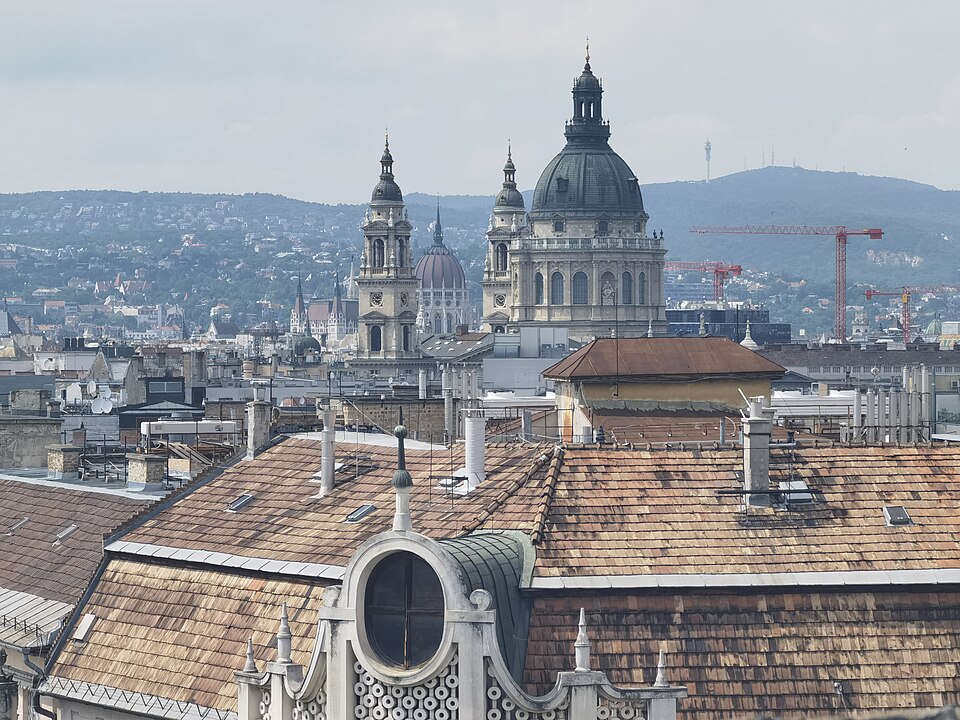
St Stephen's Basilica stands on Szent István tér in Lipótváros, the flat nineteenth-century grid of central Pest, and is the largest church in Budapest and the third largest in Hungary. It is a co-cathedral of the Archdiocese of Esztergom-Budapest, and it is a working parish church before it is an attraction. Building began in 1851 to József Hild's classicist design and ran for fifty-four years. The dome came down partway through: the parish's own history puts that collapse in 1868, a year after Hild's death, while the English Wikipedia article dates it to 1858. Both accounts agree on what followed. Miklós Ybl took over, corrected the design errors and reinterpreted the whole church in Renaissance terms. After Ybl died in 1891 the interior, furnishing and decoration were designed by the architect József Kauser and the parish priest Lénárd Lollok to a single iconographic programme, and only Hungarian sculptors and painters were invited to make the works of art. The church has carried the first Hungarian king's name since 1897 and was consecrated in 1905; the keystone was laid in 1906 with Franz Joseph I present. Pope Pius XI granted it the title basilica minor in 1931. It was completely renovated between 1983 and 2003. Wikipedia gives its height as 96 metres, the same as the Parliament building, with a length of 87.4 metres and a width of 55 metres.
Checked 2026-08-26 · Source
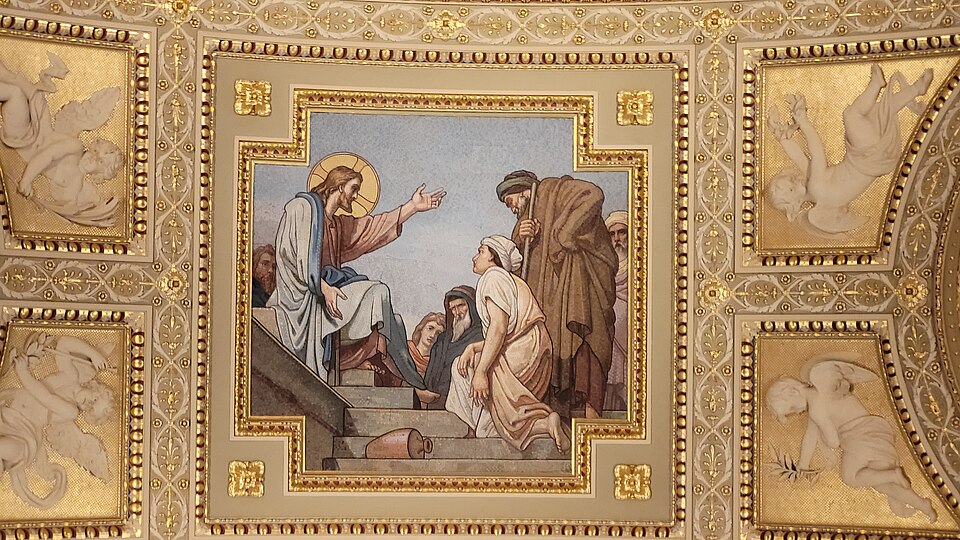
The plan is a Greek cross, and three things account for most of a visit. The first is the Holy Right, the mummified right hand of King Stephen, kept at the Altar of Our Lady of Hungary. It sits in a glass cylinder inside a chapel-shaped neo-Gothic reliquary designed by József Lippert and made in Vienna in 1862; the relic was entrusted to this parish in 1950, displayed in the Holy Right chapel from 1987, and moved into the church itself in 2018. The second is the decoration overhead. The frescoes originally planned were replaced by glass mosaics, the larger ones made by the Venetian firm Salviati and the smaller by Miksa Róth of Pest. Károly Lotz designed the main dome mosaic, God the Father at the centre with prophets and St John the Baptist around Christ, and the four evangelists fill the fields above the dome's supporting pillars. Alajos Stróbl's marble St Gellért and St Imre, Károly Senyei's St Elizabeth and János Fadrusz's St László stand in the niches below. The third is the 1905 József Angster organ, rebuilt repeatedly and now carrying 93 stops and 7,544 pipes, the longest 10.5 metres and the smallest 5 millimetres, with a trumpet choir projecting horizontally from its front. The Treasury, reopened in 2011 in a space three times its old size, holds the papal letter granting the basilica minor title, a Herend porcelain copy of the Holy Crown, the country's largest monstrance of 1938, a chalice given by John Paul II in 1991 and Cardinal Mindszenty's personal liturgical objects.
Checked 2026-08-26 · Source

The operator publishes no suggested visit length, so the figure recorded here is a planning estimate rather than a sourced fact: seventy-five minutes for the full all-in-one ticket. That breaks down roughly as twenty-five to thirty minutes in the church hall, fifteen to twenty in the Treasury and twenty to twenty-five on the panoramic terrace, with the lift queue included. The church hall itself is quick to read. It is one tall centralised space, and the four things worth stopping at, the Holy Right, the main altar canopy, the dome mosaics and the organ front, are all visible without walking far. Half an hour covers it unhurried; twenty minutes covers it if the terrace is the point of the trip. The terrace is what stretches the visit unpredictably. There are two lifts and one staircase, and at the busy end of the afternoon the wait for a lift can add ten or fifteen minutes at each end, which is the single biggest variable in the whole visit. Anyone buying only the church-hall ticket should allow thirty to forty minutes including the ticket queue. Anyone buying the all-in-one and expecting to photograph from the terrace should allow closer to ninety.
Checked 2026-08-26
The two halves of the site keep different hours, and confusing them is the commonest way to waste a morning. The church hall is open Monday to Saturday from 09:00 to 17:45, with tickets issued only until 17:15, and on Sunday from 13:00 to 17:45, with tickets from 12:30. The panoramic terrace and the Treasury are open every day from 09:00 to 19:00, with tickets issued until 18:30, and the ticket office beside the basilica keeps the same 09:00 to 18:30 hours daily. So on a Sunday morning the terrace and Treasury are open and the church hall is not, because Mass has the building. There is no weekly closing day. One caution about the operator's own site: the opening-hours page gives 17:45 as the church-hall closing time while the sidebar block repeated across the rest of the site gives 18:00. Treat 17:45 as the figure to plan against, and note that the ticket cut-off at 17:15 binds well before either. Weekends bring wedding ceremonies, and the ticket page warns plainly that these can restrict access to the church hall. The visitor regulations put it more bluntly still: liturgy always takes precedence over tourist access, and the times of admission can be changed unilaterally. A weekday morning is the safest slot; the last hour before 19:00 on the terrace is the best light.
Checked 2026-08-26 · Source
Everyone entering pays, and tickets are checked at the door. The price list valid from 1 December 2025 sets three tiers for a full-price adult: 2,600 HUF for the church hall alone, 5,000 HUF for the panoramic terrace and Treasury together, and 6,800 HUF for the all-in-one ticket covering all three. Children under 18 and students with a Hungarian or international student card pay 2,000, 4,000 and 5,500 HUF; over-65s pay the same. A family ticket for two adults and two children under 12 costs 7,300, 15,500 or 20,400 HUF. Groups of more than 15 pay 1,800 HUF a head for the church hall, and one group leader goes free. A Budapest Card or Hungary Card brings the adult church hall to 2,100 HUF. Children under 6 enter free, as do pilgrim groups, official religious persons and disabled visitors with a companion, all on production of a certificate, though those categories still pay for the terrace. Reduced tickets can only be bought at the ticket office, with the qualifying card shown; the online channel sells full-price ones. Tickets are valid for one day only and are not refundable, and the operator states that a mistaken online purchase, wrong date or wrong quantity, is not refunded either, though [email protected] will consider moving it. Guided tours are priced separately per group, from 30,000 HUF, and must be booked in writing at least 48 hours ahead.
Checked 2026-08-26 · Source
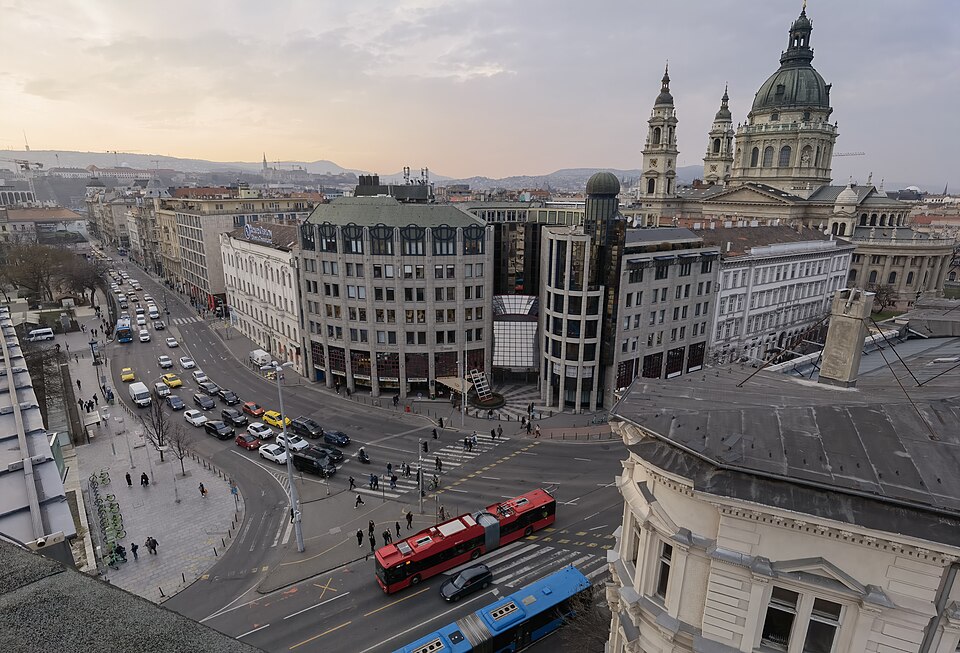
The address is Szent István tér 1, 1051 Budapest, in the fifth district, and no car is needed or wanted. The basilica sits inside the densest part of the metro network: OpenStreetMap places the M1 station at Bajcsy-Zsilinszky út about 150 metres east of the building, Deák Ferenc tér, where M1, M2 and M3 meet, about 275 metres south, and the M3 station at Arany János utca about 345 metres north. All three are a walk of a few minutes across flat ground, and the approach from Zrínyi utca, the pedestrian street running east from the square, gives the façade its best first view. The operator publishes no parking information and no driving directions at all, which is a fair reflection of the situation; the surrounding streets are metered, one-way and busy, and the square itself is pedestrian. The ticket office is a separate building beside the basilica rather than inside it, so the queue forms outside. OpenStreetMap records the building as wheelchair accessible, and the terrace has lifts installed in the old chimney trunks, so the climb is not the only way up. The parish's memorial office has its own entrance on the Bajcsy-Zsilinszky út side, which is not the visitor entrance and is easy to mistake for it.
Checked 2026-08-26 · Source
This is a sacred building with a published dress code, and it is enforced at the door. The regulations ask for knee-length or longer skirts or trousers and a top covering the shoulders, or a scarf if the top does not qualify; men need a shirt and knee-length or longer trousers. Inappropriate clothing can mean refusal of entry, and the ticket is not refunded. Bags may be inspected on the way in or out, animals other than identified assistance dogs are not admitted, and smoking is banned throughout the premises and within five metres of the gates. There is no first-aid service on site. The terrace carries its own warnings. It is visited at the visitor's own risk, the staircase is artificially lit, and the rules ask visitors to keep to the wall side, use the handrails and stay four or five steps apart; minors and anyone needing assistance must have a chaperon. Two operator pages disagree on how many steps there are, the terrace page saying 304 and the visitor regulations saying 364, so anyone weighing the climb should assume the higher figure. At 65 metres the terrace catches stormy wind and ice, and the paving can turn slippery. Finally, liturgy outranks sightseeing: admission can be restricted or stopped at any time for a service, and weekend weddings routinely close parts of the church hall.
Checked 2026-08-26 · Source
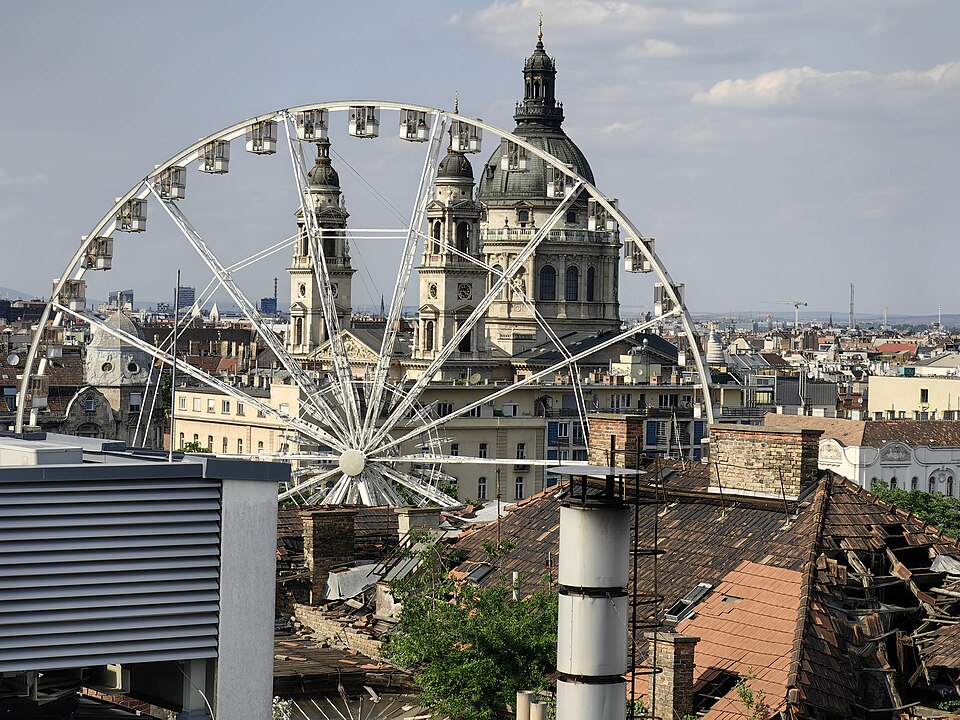
The visitor regulations set no general ban on photography, and cameras are taken for granted in the terrace rules, which are the only place they are mentioned. Those rules matter: on the terrace a phone, camera or pair of binoculars must be carried on a neck strap or wrist strap, everything carried must be secured before stepping out, and nothing may be thrown or dropped over the edge. Leaning over the railing or standing on it is forbidden, and the operator accepts no liability for anything that falls. Tripods are not addressed either way in the published rules, so ask at the ticket office rather than assume. The terrace itself is a stone walkway at 65 metres built right around the main dome, which the operator calls the highest viewing point in Pest, and it gives a full 360-degree turn: the Danube and the Buda hills on one side, the Pest roofscape and the Parliament dome on the other. It is open until 19:00 every day, which in summer puts the last hour into low golden light and in winter puts it well after dark, when the lit city becomes the subject instead. Inside, the church hall is dark and the mosaics are high, so expect to work at a high ISO. Outside, the west front faces the square and takes the afternoon sun, which is when Mór Than's 1893 tympanum mosaic reads properly.
Checked 2026-08-26 · Source
Everyone entering pays, and there are three separate tickets. On the price list valid from 1 December 2025 a full-price adult pays 2,600 HUF for the church hall, 5,000 HUF for the panoramic terrace and Treasury together, and 6,800 HUF for the all-in-one ticket. Under-18s, students with a valid card and over-65s pay 2,000, 4,000 or 5,500 HUF, children under 6 are free, and a Budapest Card or Hungary Card brings the adult church hall to 2,100 HUF. Reduced tickets are sold only at the ticket office, with the qualifying card shown.
There is no weekly closing day, but the church hall and the terrace do not keep the same hours. The church hall opens Monday to Saturday 09:00 to 17:45 and Sunday 13:00 to 17:45, with tickets issued until 17:15 and, on Sunday, from 12:30. The panoramic terrace and Treasury open every day 09:00 to 19:00, with tickets until 18:30. Note that the operator's own site is inconsistent: the opening-hours page says the church hall closes at 17:45 while the sidebar elsewhere says 18:00. Plan against 17:45, and against the 17:15 ticket cut-off before that.
The operator publishes no suggested duration, so this is a planning estimate: about 75 minutes for the full all-in-one ticket, roughly 25 to 30 minutes in the church hall, 15 to 20 in the Treasury and 20 to 25 on the terrace including the lift wait. The church hall alone, with the ticket queue, is a 30 to 40 minute stop. The one thing that stretches the visit unpredictably is the queue for the terrace lifts late in the afternoon, which can add ten or fifteen minutes at each end.
There is a lift. During the 2003 renovation lifts were installed in the old chimney trunks, so climbing is optional. The stairs remain, and the operator's two pages disagree on how many there are: the terrace page says 304 steps and the visitor regulations say 364. Anyone deciding whether to walk up should assume the larger number. The regulations also treat the climb as taken at the visitor's own risk, ask visitors to keep to the wall side and use the handrails, and require a chaperon for minors and for anyone needing assistance.
Yes, and it is published and enforced. The visitor regulations ask women for a knee-length or longer skirt or trousers and a top that covers the shoulders, or a scarf if the top does not, and men for a short or long-sleeved shirt with knee-length or longer trousers. Inappropriate clothing may mean refusal of entry, and the ticket is not refunded in that case. The regulations also note that the basilica is primarily a place of worship: liturgical functions always take precedence over tourist access, and weekend wedding ceremonies can restrict access to the church hall.
No. The basilica is at Szent István tér 1 in the fifth district, in the middle of the metro network. OpenStreetMap places the M1 station at Bajcsy-Zsilinszky út roughly 150 metres away, the M1, M2 and M3 interchange at Deák Ferenc tér roughly 275 metres away, and the M3 station at Arany János utca roughly 345 metres away, all flat walks of a few minutes. The square is pedestrian and the surrounding streets are metered and one-way, and the operator publishes no parking information or driving directions at all.
Loading the interactive map…
The interactive map could not be loaded.
Last updated:
Source: OpenStreetMap contributors, Wikidata ·