Wat Bowonniwet Vihara is the headquarters temple of the Thammayut order, and that single fact governs everything a visitor sees in the compound. The order was a reform movement founded on stricter observance of monastic discipline, and Prince Bhikkhu Mongkut — later Rama IV — was this monastery's first abbot from 1836, holding the post for twenty-seven years before he left it for the throne. Since then it has been the ordination temple of choice for Thai royalty, and it remains a functioning seminary rather than a monument. Its second claim is art-historical and disproportionate to its size: the murals of Khrua In Khong, painted here, are the point at which Western perspective enters Thai Buddhist painting, and art historians cite them far more often than the temple's modest thirteen-language Wikipedia presence would predict. It stands in Banglamphu, a few minutes on foot from Khao San Road, which makes the contrast the sharpest in this list — the loudest street in Bangkok on one side of a wall and the institutional centre of Thai monastic reform on the other.
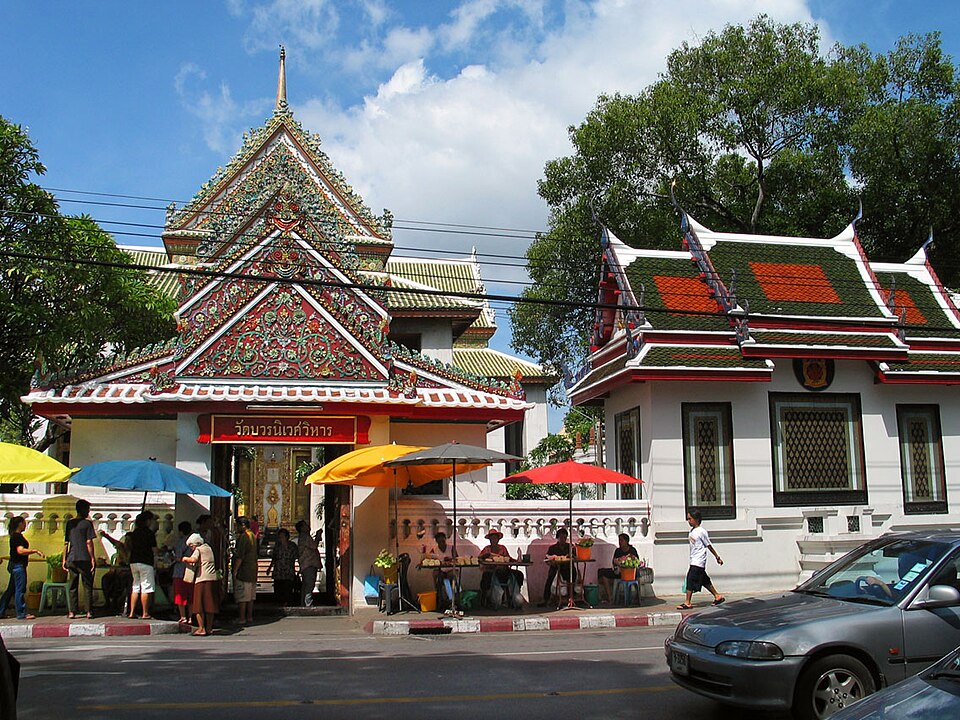
The compound reads as a working campus with a monument at its centre rather than as a walled temple set piece. The gilded chedi is the fixed point, with the principal buildings arranged around it and monastic quarters, teaching rooms and the Phor Por Ror building filling the ground behind. What a visitor comes for is inside the ubosot, where Khrua In Khong's murals cover the walls. They do not look like the temple painting elsewhere in Bangkok. Instead of the flat registers, gold-on-red grounds and floating scenes of the classical convention, they use recession, cast shadow, horizon lines and figures in Western dress, so a Thai Buddhist allegory is staged in what looks at first glance like a nineteenth-century European landscape. Standing in front of them is the whole visit; they need slow looking and a few minutes for the eyes to adjust, because the interior is dark and the paint is aged. The rest of the compound rewards a circuit on foot — monks in the ochre of the order crossing between buildings, and none of the retail apparatus that surrounds the temples on the tourist circuit.
Forty-five minutes is the figure to plan on, and it is weighted differently from the other temples on this list: about half of it belongs inside the ubosot with the murals, because they are the reason to come and they do not read quickly. Ten to fifteen minutes covers a slow circuit of the chedi and the surrounding buildings, and the remainder absorbs shoes on and off and the wait if a service is in progress. The monastery publishes no suggested duration, so this is editorial judgement. Anyone with a specific interest in nineteenth-century Thai painting should double it and expect to sit down.
November to February, for Bangkok's cool dry season; the monastery publishes nothing seasonal of its own, so the recommendation is the city's climate rather than the temple's calendar. Around 08:00 is the hour to aim for. Two things build through the morning in Banglamphu — the heat, and the coach groups working the old-town circuit — and the ubosot interior is at its most usable when neither has arrived. There is a second reason particular to this temple: early morning is when it is most visibly a working monastery rather than a sight, and the compound at that hour is largely monks and residents. None of this is an operator statement, since the monastery publishes no hours at all.
Nothing about an admission fee, and nothing about entry being free, is published anywhere on the monastery's own website. That is the honest position and it is not the same as saying entry is free: it means the operator has published no figure and none has been recorded. The whole page tree of https://watbowon.org/ was walked through its sitemap and no page carries a price. Treat this the way a working Thai monastery is normally treated — carry small notes, expect a donation box rather than a ticket window, and give what seems right. Note also that the Phor Por Ror building inside the compound publishes no separate rate, so if a fee is asked there it cannot be checked in advance.
The temple sits in Banglamphu inside the walkable old-town core, so no car is needed and none helps. It is a few minutes on foot from Khao San Road, which is the landmark most visitors are already near, and buses run along Phra Sumen Road and Bowon Niwet Road past the compound. Coming from the river, the Chao Phraya express-boat piers on the Banglamphu side put a visitor within a walk of ten to fifteen minutes. There is no rail station immediately adjacent, and a taxi into Banglamphu in the middle of the day will spend longer in traffic on Phra Athit and Chakrabongse than the walk would take. Pair it with a walking circuit of the old town rather than with a driving itinerary.
This is the headquarters of a monastic order, and the traps follow from that. First, nothing is published: the monastery's own site carries no opening hours on any page, and the website recorded in OpenStreetMap for it is dead — it now redirects to an unrelated commercial domain, so any hours a visitor finds through that route are worthless. Second, the compound's rhythm is monastic, not touristic. Ordinations, funerals of note and royal ceremonies take place here, and a building can be inaccessible with no notice; if chanting is under way in the ubosot, wait outside rather than walk in. Third, the Phor Por Ror building's own visiting times are not published either. Fourth, keep a distance in the ordinary interactions — a Thammayut monastery observes the discipline strictly, and women should place an offering down rather than hand it directly to a monk. Dress rules are the usual Thai ones, covered in full on the Wat Ratchabophit page. Finally, the walk from Khao San arrives in a very different register than it departs; make the adjustment before entering, not at the gate.
The murals are the subject and they are difficult: the ubosot interior is dark, the pigments are muted and aged, and flash is both intrusive and useless at the working distance. Push the sensitivity, brace against a column rather than carrying a tripod into a working hall, and accept a slower shutter. Because Khrua In Khong's compositions use recession and depth, they photograph better as whole panels than as details — a cropped fragment loses precisely the perspective that makes them important. Outside, the gilded chedi takes early sun cleanly and the compound's open ground gives a standpoint far enough back to fit it. Do not photograph monks without asking, do not photograph a ceremony in progress at all, and step out of the ubosot to change lenses. No photography policy is published by the monastery, so the resident community's instruction is the rule.
Checked 2026-08-25
Common questions
What are the opening hours of Wat Bowonniwet Vihara?
The monastery publishes none. Its own site, https://watbowon.org/, was walked through its sitemap and no page carries visiting hours; the about page is an unedited placeholder and the contact page is a bare form. The website recorded for the temple in OpenStreetMap is dead and redirects to an unrelated commercial domain, so hours found through that route should be ignored. Plan around normal daylight temple practice and expect parts of the compound to be in use.
Is there an entrance fee at Wat Bowonniwet Vihara?
No fee is published, and neither is a statement that entry is free — the monastery's website says nothing on the subject at all, so nothing has been recorded. Carry small notes for a donation box, and note that no separate rate is published for the Phor Por Ror building inside the compound either.
What should I wear to Wat Bowonniwet Vihara?
Shoulders and knees covered, and shoes off before entering the ordination hall — the standard Thai monastery rules, which this temple observes strictly because it is the headquarters of a reform order founded on stricter discipline. The rules are set out in full on the Wat Ratchabophit page. Add one thing specific to a Thammayut monastery: a woman should set an offering down for a monk to pick up rather than hand it over directly.
Why are the murals at Wat Bowonniwet Vihara important?
They are the work of Khrua In Khong, and they mark the point at which Western perspective enters Thai Buddhist painting. Instead of the flat registers and gold-on-red grounds of the classical convention, they use recession, shadow and horizon lines, with figures in Western dress carrying Buddhist allegory. Art historians cite them well out of proportion to the temple's modest presence in the encyclopaedias.
Can I visit the Phor Por Ror building inside the compound?
Its visiting hours are not published on the monastery's website, so this page records none. The only listings found for it were aggregators, which are not used for practical facts here. Ask at the compound on the day.
How far is Wat Bowonniwet Vihara from Khao San Road?
A few minutes on foot. The temple stands in Banglamphu inside the walkable old-town core, with buses along Phra Sumen Road and Bowon Niwet Road, and the Chao Phraya express-boat piers on that side of the river are a ten-to-fifteen-minute walk away. No car is needed and in midday traffic a taxi is slower than walking.
Nothing non-essential is set before you choose, in regions where consent is required. If you decline, ads still appear but they are non-personalised, and analytics is switched off entirely.


_%E0%B8%A7%E0%B8%B1%E0%B8%94%E0%B8%9A%E0%B8%A7%E0%B8%A3%E0%B8%99%E0%B8%B4%E0%B9%80%E0%B8%A7%E0%B8%A8%E0%B8%A3%E0%B8%B2%E0%B8%8A%E0%B8%A7%E0%B8%A3%E0%B8%A7%E0%B8%B4%E0%B8%AB%E0%B8%B2%E0%B8%A3_%E0%B9%80%E0%B8%82%E0%B8%95%E0%B8%9E%E0%B8%A3%E0%B8%B0%E0%B8%99%E0%B8%84%E0%B8%A3_%E0%B8%81%E0%B8%A3%E0%B8%B8%E0%B8%87%E0%B9%80%E0%B8%97%E0%B8%9E%E0%B8%A1%E0%B8%AB%E0%B8%B2%E0%B8%99%E0%B8%84%E0%B8%A3_(5).jpg)
_%E0%B8%A7%E0%B8%B1%E0%B8%94%E0%B8%9A%E0%B8%A7%E0%B8%A3%E0%B8%99%E0%B8%B4%E0%B9%80%E0%B8%A7%E0%B8%A8%E0%B8%A3%E0%B8%B2%E0%B8%8A%E0%B8%A7%E0%B8%A3%E0%B8%A7%E0%B8%B4%E0%B8%AB%E0%B8%B2%E0%B8%A3_%E0%B9%80%E0%B8%82%E0%B8%95%E0%B8%9E%E0%B8%A3%E0%B8%B0%E0%B8%99%E0%B8%84%E0%B8%A3_%E0%B8%81%E0%B8%A3%E0%B8%B8%E0%B8%87%E0%B9%80%E0%B8%97%E0%B8%9E%E0%B8%A1%E0%B8%AB%E0%B8%B2%E0%B8%99%E0%B8%84%E0%B8%A3_(6).jpg)
_%E0%B8%A7%E0%B8%B1%E0%B8%94%E0%B8%9A%E0%B8%A7%E0%B8%A3%E0%B8%99%E0%B8%B4%E0%B9%80%E0%B8%A7%E0%B8%A8%E0%B8%A3%E0%B8%B2%E0%B8%8A%E0%B8%A7%E0%B8%A3%E0%B8%A7%E0%B8%B4%E0%B8%AB%E0%B8%B2%E0%B8%A3_%E0%B9%80%E0%B8%82%E0%B8%95%E0%B8%9E%E0%B8%A3%E0%B8%B0%E0%B8%99%E0%B8%84%E0%B8%A3_%E0%B8%81%E0%B8%A3%E0%B8%B8%E0%B8%87%E0%B9%80%E0%B8%97%E0%B8%9E%E0%B8%A1%E0%B8%AB%E0%B8%B2%E0%B8%99%E0%B8%84%E0%B8%A3_(7).jpg)
_%E0%B8%A7%E0%B8%B1%E0%B8%94%E0%B8%9A%E0%B8%A7%E0%B8%A3%E0%B8%99%E0%B8%B4%E0%B9%80%E0%B8%A7%E0%B8%A8%E0%B8%A3%E0%B8%B2%E0%B8%8A%E0%B8%A7%E0%B8%A3%E0%B8%A7%E0%B8%B4%E0%B8%AB%E0%B8%B2%E0%B8%A3_%E0%B9%80%E0%B8%82%E0%B8%95%E0%B8%9E%E0%B8%A3%E0%B8%B0%E0%B8%99%E0%B8%84%E0%B8%A3_%E0%B8%81%E0%B8%A3%E0%B8%B8%E0%B8%87%E0%B9%80%E0%B8%97%E0%B8%9E%E0%B8%A1%E0%B8%AB%E0%B8%B2%E0%B8%99%E0%B8%84%E0%B8%A3_(1).jpg)
_%E0%B8%A7%E0%B8%B1%E0%B8%94%E0%B8%9A%E0%B8%A7%E0%B8%A3%E0%B8%99%E0%B8%B4%E0%B9%80%E0%B8%A7%E0%B8%A8%E0%B8%A3%E0%B8%B2%E0%B8%8A%E0%B8%A7%E0%B8%A3%E0%B8%A7%E0%B8%B4%E0%B8%AB%E0%B8%B2%E0%B8%A3_%E0%B9%80%E0%B8%82%E0%B8%95%E0%B8%9E%E0%B8%A3%E0%B8%B0%E0%B8%99%E0%B8%84%E0%B8%A3_%E0%B8%81%E0%B8%A3%E0%B8%B8%E0%B8%87%E0%B9%80%E0%B8%97%E0%B8%9E%E0%B8%A1%E0%B8%AB%E0%B8%B2%E0%B8%99%E0%B8%84%E0%B8%A3_(20).jpg)