
.jpg)


4 min walk · เขตปทุมวัน
CentralWorld
- High
- Market
Language · 1 published
Place of worship · เขตปทุมวัน, Bangkok
ศาลท้าวมหาพรหม
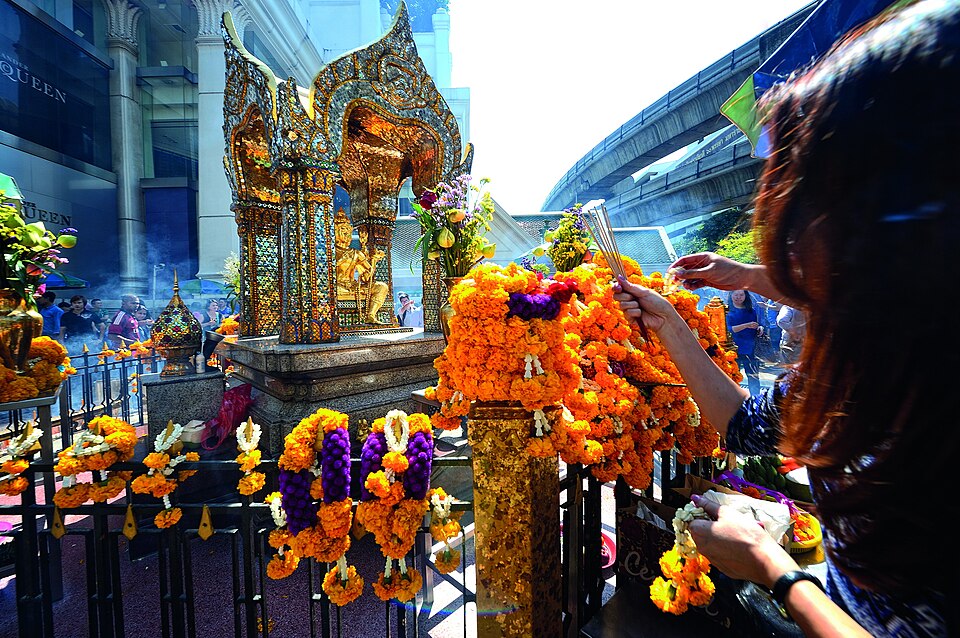
The Erawan Shrine is a small open pavilion on the corner of the Ratchaprasong junction, hemmed in by department stores and skywalks, holding a gilded four-faced image of Phra Phrom — the Thai form of Brahma. It was built in 1956 as part of the government-owned Erawan Hotel after the hotel's construction went badly wrong: cost overruns, injuries to labourers, and a shipload of Italian marble lost at sea. An astrologer advised that the foundation had been laid on an inauspicious date and that a shrine was needed to counter it. The image was designed and built by the Fine Arts Department and formally enshrined on 9 November 1956. What makes it worth crossing the city for is not the object but what happens around it: a Hindu god, in a Buddhist country, venerated as a guardian spirit by office workers, shopkeepers, gamblers and tourists, in continuous shifts from early morning to late at night, in the middle of the most commercial ground in Thailand. Incense smoke, marigold garlands, teak elephants and a resident troupe of costumed classical dancers, all at a traffic light. Nowhere else in Bangkok shows the working religion of the city so plainly in so small a space.
Checked 2026-08-25 · Source
The shrine is a single pavilion that takes ten paces to walk around, and the whole ritual is arranged around the fact that the image has four faces. Worshippers circle it clockwise and offer at each face in turn — incense, a candle, a garland — which is why the pavement circuit is always moving and why standing still in it is the one thing a visitor should not do. Around the edge are the offering stalls, the garland sellers and the teak elephants left as thanks for prayers answered, some of them small enough to hold and some as tall as a person. The dancers are the part people remember: a troupe in full costume, with musicians, performing a votive dance paid for by a worshipper whose wish was granted, so the performance is a transaction of gratitude rather than a show put on for the crowd. The foundation that runs the shrine sets rules for all of this, including what may be offered and at what hour, and those rules are set out under tickets below because they carry prices.
Checked 2026-08-25
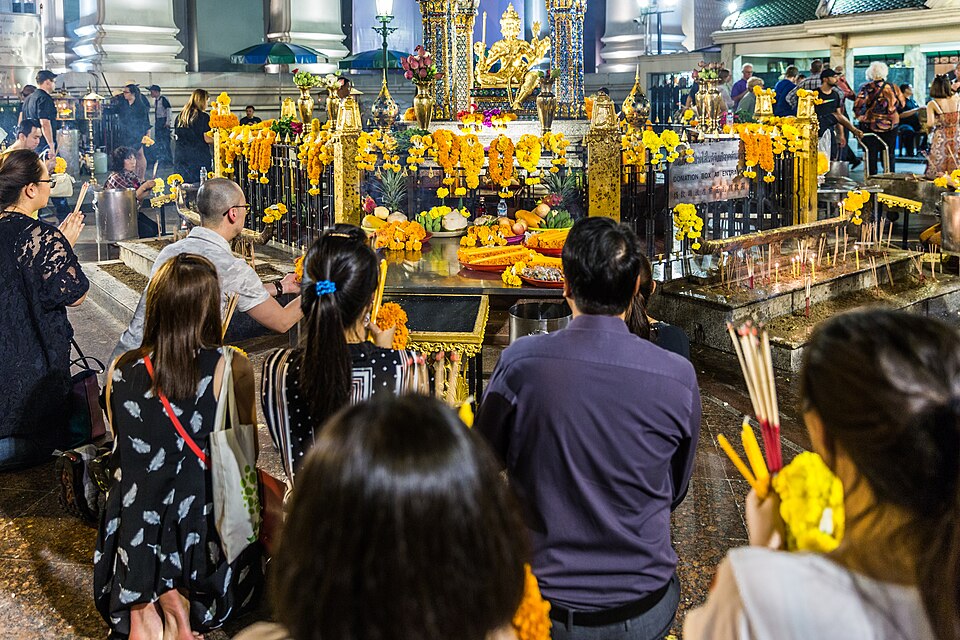
Twenty minutes, and that is not a short-changed figure — it is what the place takes. The shrine is one pavilion; a full clockwise circuit with a stop at each of the four faces, time to watch a dance through, and a look at the elephant offerings fills twenty minutes honestly and there is no second room to go to. No operator publishes a duration, so this is editorial judgement. Two reasons to allow more: a votive dance, when one is under way, is worth watching from beginning to end rather than for the thirty seconds most visitors give it; and the shrine sits at the foot of a skywalk that leads directly into the Ratchaprasong malls, so twenty minutes here is usually the start of a longer stop rather than a visit on its own.
Checked 2026-08-25
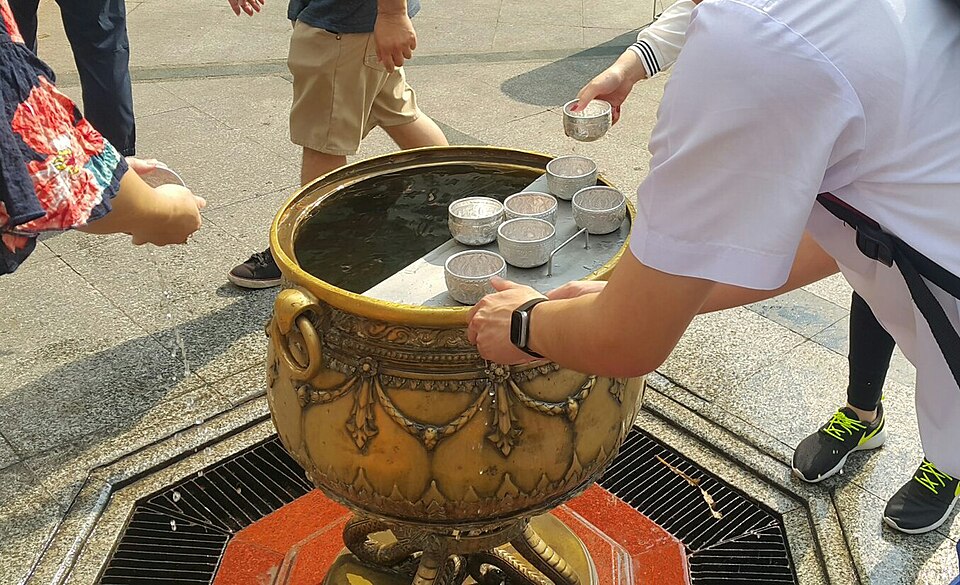
Between seven and eight in the morning. That hour does two things at once: the Ratchaprasong crossing is as quiet as it ever gets before the malls open, and it is the window in which the foundation permits the votive dances — its own published rule allows them between 07.00 and 08.00 — so the dancers are working while the crowd is not yet there. Later in the day the shrine is busy without interruption until late, and on an evening it can be difficult to complete a circuit at all. November to February is the season, and the reason is specific to this place rather than general: the pavilion is open to the sky with no shade over the circuit, and the combination of standing incense smoke and April heat on an unshaded pavement is genuinely unpleasant. Rain is less of a problem than it sounds — the pavilion is roofed and the skywalk above the corner is not far.
Checked 2026-08-25 · Source
No admission value is recorded, and the wording matters: the foundation that runs the shrine publishes neither a fee nor a statement that entry is free, so this page records nothing rather than declaring it free. What the operator does publish, on its own Thai-language announcement page, are the charges for optional offerings made at the shrine, and these are useful to know before arriving. A votive dance costs 500 baht per person, is permitted between 07.00 and 08.00, and may not run longer than fifteen minutes. A lion dance costs 1,000 baht per performance, is permitted between 10.00 and 17.00, and is limited to fifteen minutes and fifteen performers. Wooden elephant offerings cost 500, 1,000 or 2,000 baht depending on size, and elephants over forty inches are refused. The foundation also states that photography and interviews require written permission obtained from it in advance. Garlands, incense and candles are sold at the stalls around the shrine at prices the foundation does not publish.
Checked 2026-08-25 · Source
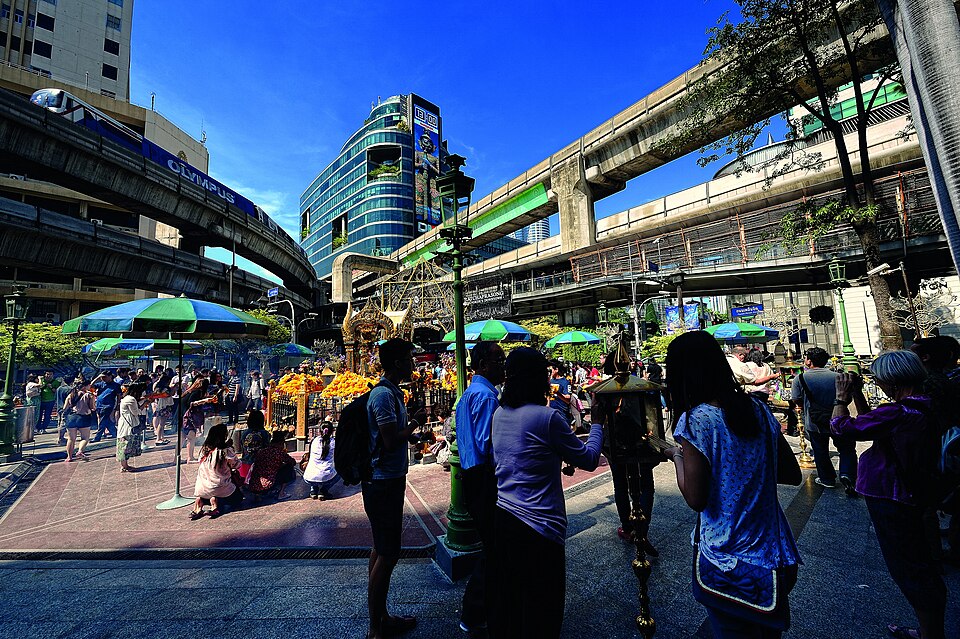
Take the BTS to Chit Lom and walk out along the skywalk, which sets a visitor down at the shrine's own corner without ever crossing traffic; that is the entire journey and there is no better version of it. The Ratchaprasong junction is one of the worst places in Bangkok to arrive by car — it is a permanent jam, there is nowhere to stop, and a taxi will spend longer at the lights than the visit takes. The skywalk itself connects the shrine directly to the Ratchaprasong malls in three directions, so the shrine is an easy addition to any errand on this side of the city rather than a trip of its own. Coming from the old quarter, the BTS from Siam or the MRT to Sukhumvit and a change is still faster than a taxi at almost any hour of the day.
Checked 2026-08-25

This is a place of worship with a difficult recent history and it should be entered accordingly. On 21 March 2006 a man destroyed the statue with a hammer and was beaten to death by bystanders; a replacement, made of plaster mixed with gold, bronze and other precious metals together with fragments of the original, was installed on 21 May 2006 at 11:39. On 17 August 2015 a bomb containing three kilograms of TNT was detonated at the shrine at 18:55, killing 20 people and injuring 125. People at the rail may be praying for reasons connected to those events. Keep out of the circling line rather than standing in it, do not step between a worshipper and a face of the image, and keep back from a dance rather than crowding to the front of it. Note the foundation's own published rule that photography and interviews require written permission in advance — the page records the rule as it is published, and anyone planning more than a discreet phone snap should ask the foundation first. Buy garlands and incense from the stalls at the shrine rather than from someone who approaches on the pavement, and treat any offer to release caged birds for merit as the tout it is. Dress modestly; this is not a temple with a doorway rule, but it is not a shopping mall either.
Checked 2026-08-25 · Source

Read the tickets section first: the foundation publishes a requirement that photography and interviews be authorised by it in writing in advance, and this guide reports that rule rather than working around it. Assuming a visitor has settled that question, the picture here is smoke and people, not architecture. The image is behind a rail, gilded and lit from below at night, and a frontal portrait of it is the least interesting frame available. The good ones are the incense haze catching low morning light across the circuit, the hands of someone lifting a garland, the dancers' costumes against the grey of the office towers behind them, and the reflection of the whole pavilion in the glass of the department store opposite. Early morning gives soft light and thin crowds; after dark the shrine is lit and the surrounding signage throws hard colour, which is either the shot or the problem depending on intent. Never photograph a person's face at prayer without asking them, and never use flash on the circuit.
Checked 2026-08-25 · Source
This page records no admission value, because the foundation that runs the shrine publishes neither a price nor a statement that entry is free. What it does publish are charges for optional offerings: a votive dance at 500 baht per person, a lion dance at 1,000 baht per performance, and wooden elephants at 500, 1,000 or 2,000 baht by size.
The foundation permits votive dances between 07.00 and 08.00, at 500 baht per person and no longer than fifteen minutes each, and lion dances between 10.00 and 17.00, at 1,000 baht per performance with a limit of fifteen minutes and fifteen performers. A dance happens when a worshipper pays for one, so none is guaranteed at any hour.
None are recorded here. The foundation's own Thai-language pages were read in full and publish no opening time, no closing time and no closed day. The 06:00 to 22:00 span that circulates on travel pages is aggregator-sourced and is not recorded.
Phra Phrom, the Thai form of Brahma, is venerated here as a guardian spirit within a Buddhist cosmology rather than in any Hindu congregational context. The shrine was raised in 1956 on an astrologer's advice, after the Erawan Hotel's construction ran into accidents and losses, and the image was enshrined on 9 November 1956.
No. The original was destroyed with a hammer on 21 March 2006 by a man who was then beaten to death by bystanders. The replacement, installed on 21 May 2006 at 11:39, is plaster mixed with gold, bronze and other precious metals, together with fragments of the original image.
The foundation publishes a rule that photography and interviews require written permission obtained from it in advance, and this page reports that rule as published rather than interpreting it. Anyone planning more than a discreet phone snap should contact the foundation first, and in any case should not photograph a worshipper's face without asking or use flash on the circuit.
Loading the interactive map…
The interactive map could not be loaded.
Last updated:
Source: OpenStreetMap contributors, Wikidata ·