The Democracy Monument stands on a traffic circle where Ratchadamnoen Avenue crosses Dinso Road, in Phra Nakhon district, roughly halfway between Sanam Luang and the Golden Mount. Field Marshal Plaek Phibunsongkhram commissioned it in 1939 to commemorate the 1932 revolution that turned Siam into a constitutional monarchy, and he meant the road and the monument together as a Thai answer to the Champs-Elysees and the Arc de Triomphe. The architect was Chitrasen Aphaiwong, brother of a leading member of Phibun's government; the Italian sculptor Corrado Feroci, later a Thai citizen under the name Silpa Bhirasri, executed the reliefs around the base. Christiani & Nielsen built it. Ground was broken on 24 June 1939, construction began that July, and the monument opened on 24 June 1940. The Fine Arts Department is its governing body.
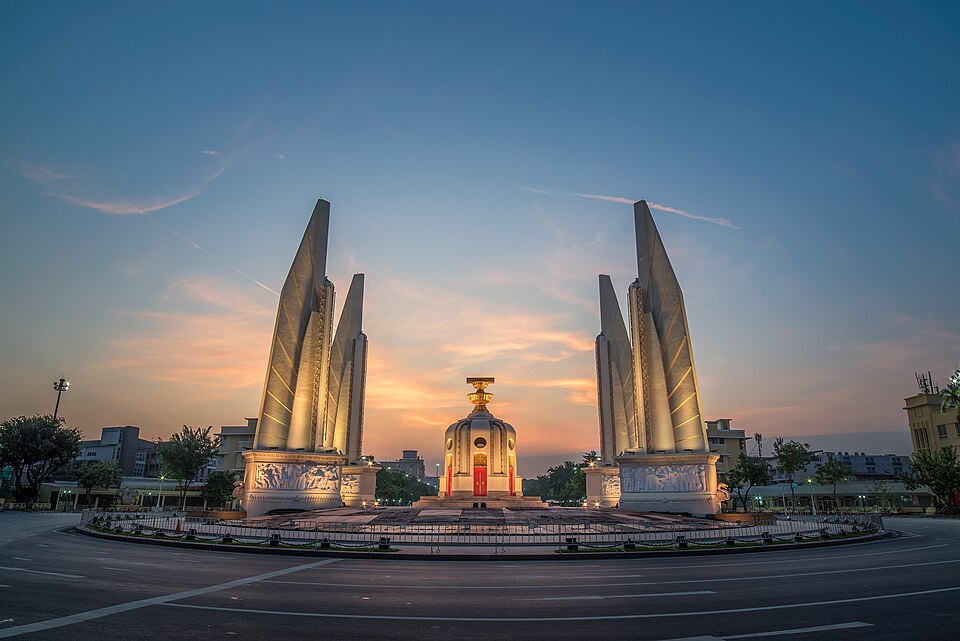
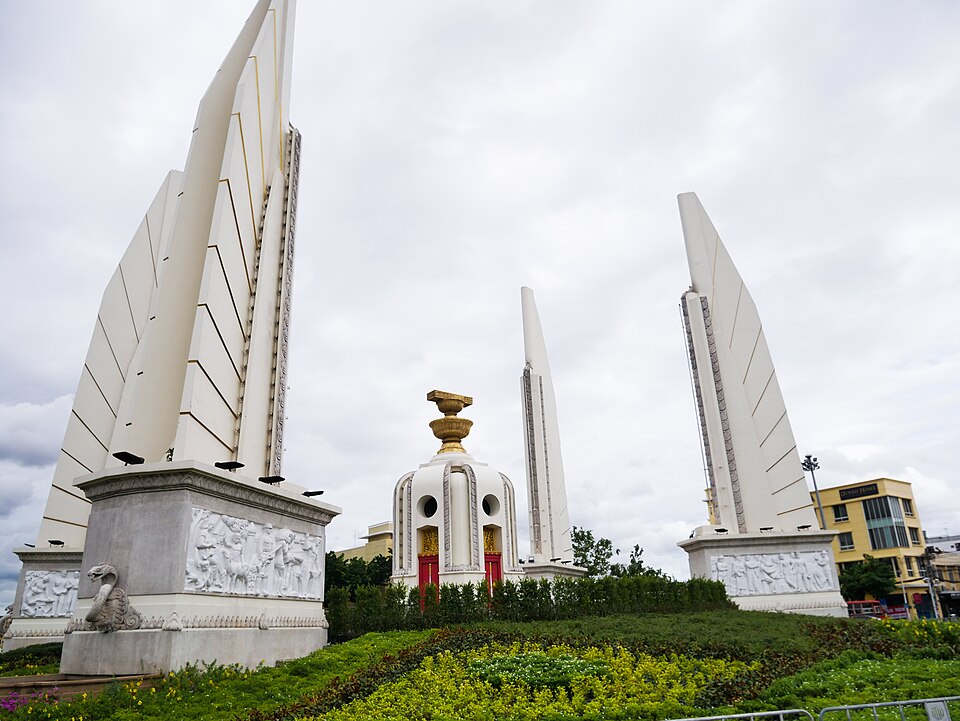
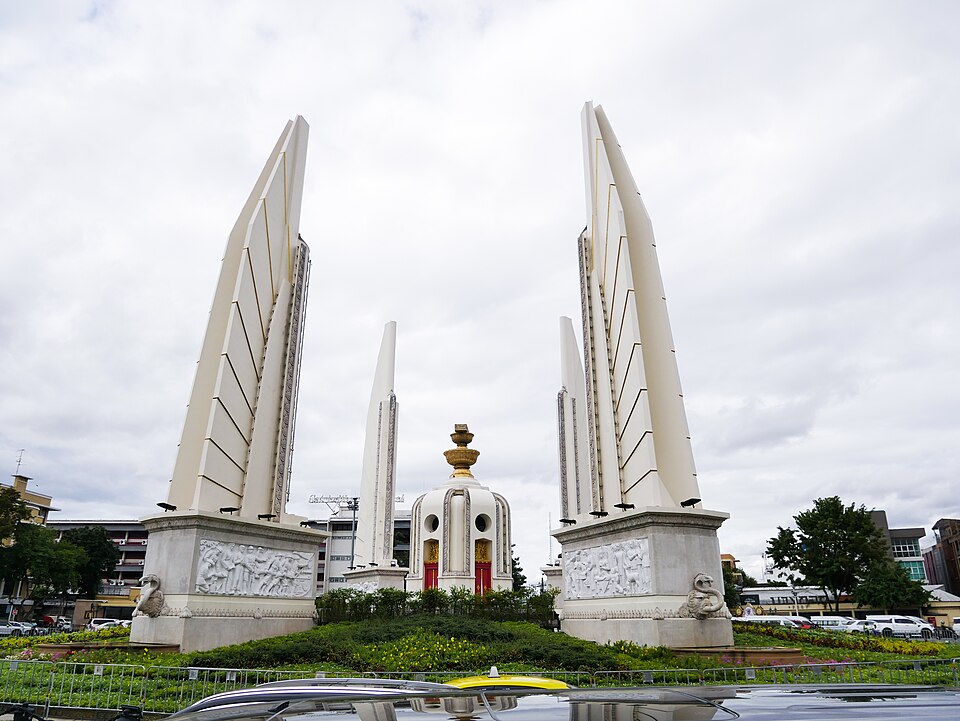
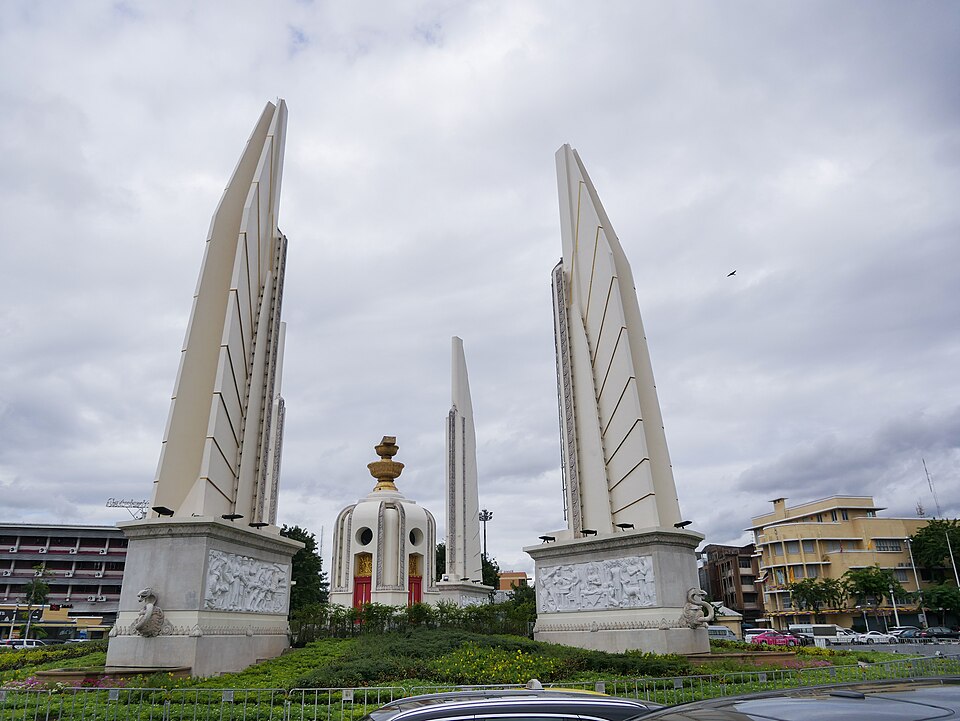
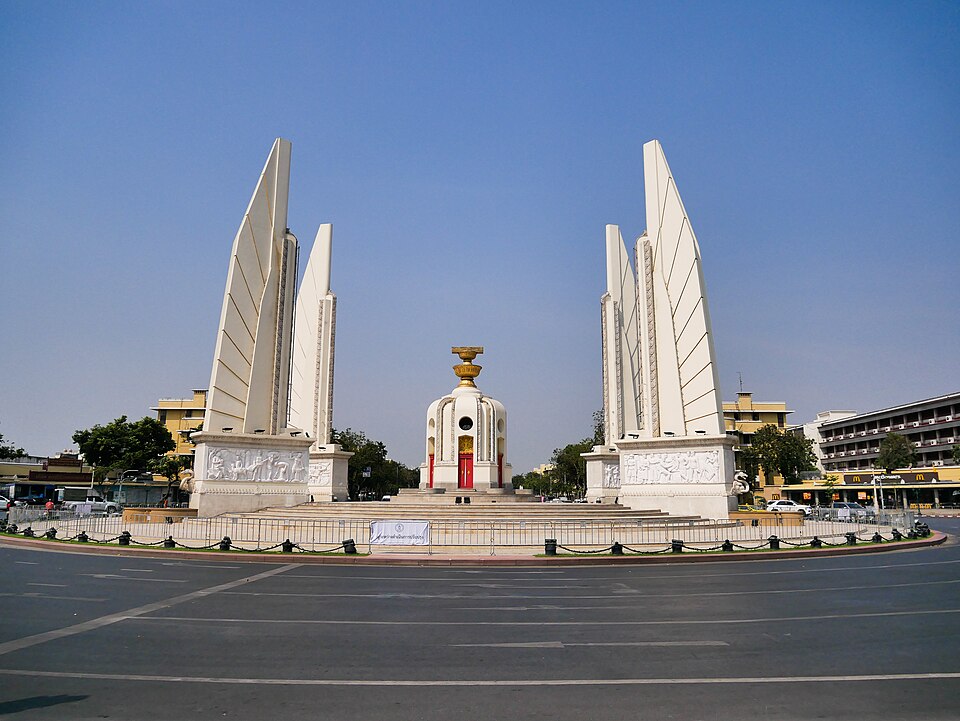
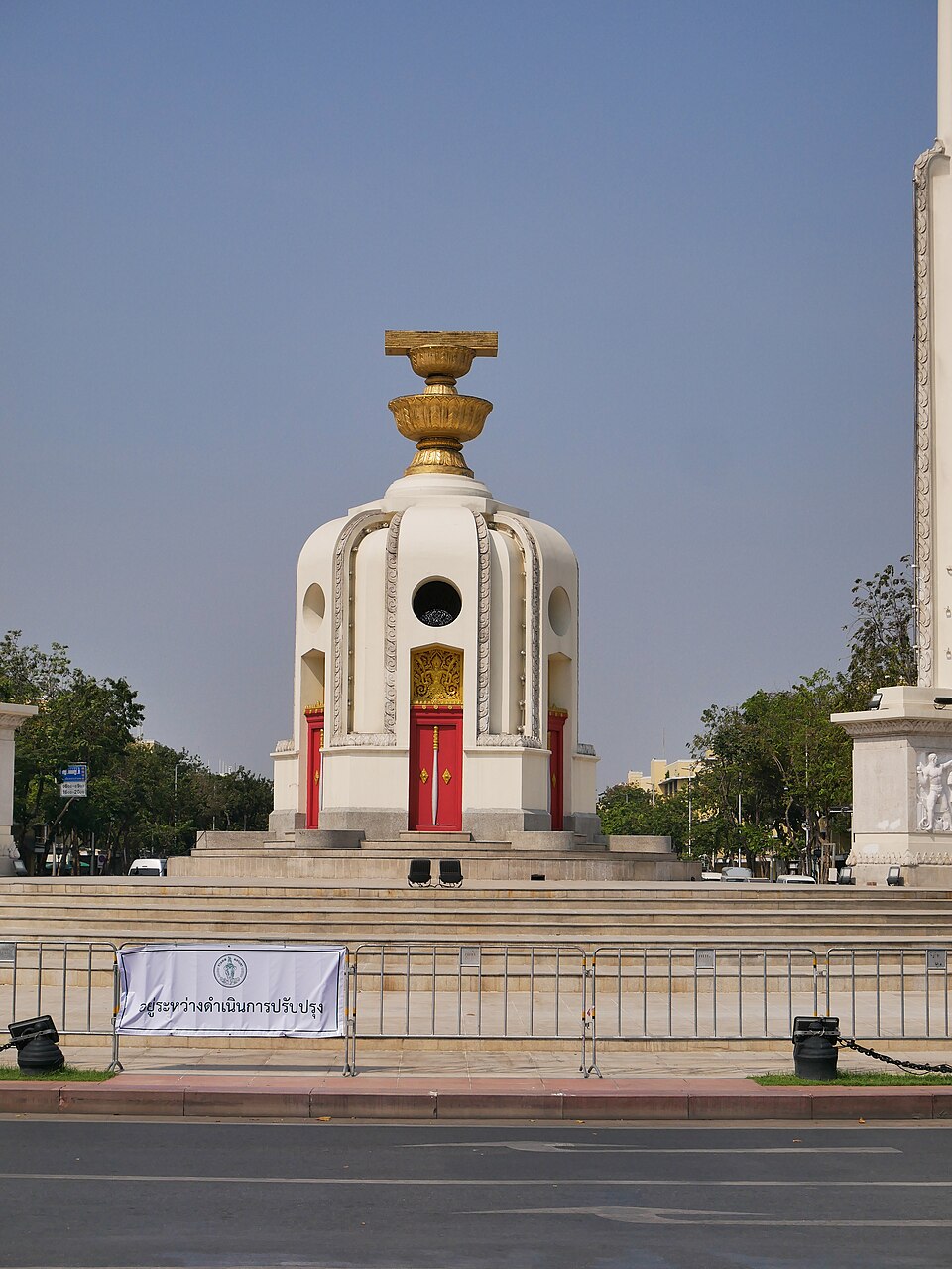
Almost every dimension of the Democracy Monument is a date written in stone. At the centre, a carved palm-leaf manuscript box holding the 1932 constitution rests on two golden offering bowls above a round turret. Four wing-like structures guard it, one for each of the four services that carried out the 1932 coup: army, navy, air force and police. The wings are 24 metres high, and 24 metres is also the radius of the base, because the coup took place on 24 June. The turret is 3 metres high for June, the third month of the traditional Thai calendar. Seventy-five small cannon originally ringed the outer edge for 2475 in the Buddhist calendar. The turret's six gates stand for the six proclaimed policies of the People's Party: independence, internal peace, equality, freedom, economy and education. Two of the wings carry outward-facing fountains shaped as naga, though the carving reads closer to a Western dragon than to a temple naga. The relief panels at the base are frankly propagandistic, with titles such as "Soldiers Fighting for Democracy", "Personification of the People" and "Personification of Balance and Good Life"; in them the armed forces are both the champions of democracy and the personification of the Thai people, and civilians appear only as grateful recipients.
Allow about twenty minutes at the Democracy Monument. The monument occupies the middle of a working traffic circle, so a visit means walking the pavement around the circle rather than standing beside the base, and twenty minutes is enough to complete that circuit, read the four relief panels from the outside and take photographs from two or three angles. Visitors who want to work through the symbolism deliberately, counting the wings and the gates, should allow half an hour. ssmtour records this as an editorial judgement; no operator publishes a suggested visit length for the monument.
Morning and late afternoon are the comfortable hours at the Democracy Monument, because the circle is unshaded and the traffic is loud. There is a second timing question, and it is political rather than meteorological: the monument has been the gathering point for the 1973 popular uprising, the 6 October 1976 massacre, Black May in 1992, the 2010 political protests, the 2013-2014 political crisis and the 2020-2021 protests. On a rally day the circle fills, the roads around it may close, and a casual visit becomes something else. Checking Thai news for planned demonstrations before setting out is worth the two minutes it takes.
ssmtour records no admission for the Democracy Monument, because there is nothing to record: the monument is a public traffic circle on a public avenue, with no gate, no ticket office and no operator-published fee. Claude checked the Fine Arts Department site at finearts.go.th, which is named as the monument's governing body, and the Bangkok Metropolitan Administration site at bangkok.go.th on 25 August 2026, and neither publishes an admission page or opening hours for it. Where a page on this site shows an admission that has been read from an operator, it names the page and the date; here there is no such page to name.
The Democracy Monument sits on Ratchadamnoen Klang, the ceremonial avenue that runs from Sanam Luang and the Grand Palace east towards the Golden Mount, and the easiest way to reach it is on foot from either end of that avenue or from the Khao San Road area a few blocks north. There is no rail station at the circle today. Democracy Monument MRT station, planned to serve the Purple Line and the Orange Line, will serve the area once it is completed; until then the nearest approaches are by bus along Ratchadamnoen, by taxi, or by the Chao Phraya express boat and a walk inland. Note that the monument is a landmark rather than a destination for most visitors: it is on the natural walking line between the old royal quarter and Wat Saket, and most people meet it in passing.
The first hazard at the Democracy Monument is the traffic. The monument is an island in a busy circle, and the reliefs are read from the pavement on the outside, not from beside the plinth; crossing to the island on impulse, between moving lanes, is the mistake visitors make here. The second is the calendar. This is one of Bangkok's principal protest sites, and on a demonstration day the circle can hold a crowd, the surrounding roads can be closed and a police presence is likely; visitors who do not want to be inside a political event should check the news first and keep clear of one in progress if it has begun. The third is expectation. The monument has no interior, no exhibition and no staff, so a visitor arriving expecting a museum will be disappointed in five minutes; it rewards someone who has read what the wings, the gates and the cannon count out. There is no dress code and no published photography restriction, but discretion around demonstrators, police lines and any memorial offerings left at the base is simple good manners.
The Democracy Monument is a difficult subject in the middle of the day and a good one early and late, when low sun rakes across the relief panels at the base and gives the carved figures some depth; at noon the panels flatten out and the white wings blow out against the sky. The four wings frame cleanly from the pavement diagonally opposite, where the whole structure fits in one shot without a lane of traffic across the foreground. For the reliefs themselves, work close and parallel to the panel rather than at an angle. The long axis of Ratchadamnoen Avenue is the other picture here: standing well back along the avenue compresses the monument against the road and shows what Phibun intended it to be, the focal point of a ceremonial boulevard. A long lens helps for that, and so does patience with buses.
Checked 2026-08-25
Common questions
What does the Democracy Monument commemorate?
The Democracy Monument commemorates the 1932 revolution that ended absolute monarchy in Siam and established a constitutional monarchy. Field Marshal Plaek Phibunsongkhram commissioned it in 1939; ground was broken on 24 June 1939 and the monument opened on 24 June 1940, the eighth anniversary of the coup.
Why are the wings of the Democracy Monument 24 metres high?
Because the 1932 coup took place on 24 June. The four wings are 24 metres high and the radius of the base is also 24 metres for the day; the central turret is 3 metres high for June, the third month of the traditional Thai calendar; and 75 cannon originally ringed the monument for the year 2475 in the Buddhist calendar.
Is there an admission charge at the Democracy Monument?
No admission is recorded for the Democracy Monument on this site. It is a public traffic circle with no gate and no ticket office, and neither the Fine Arts Department at finearts.go.th nor the Bangkok Metropolitan Administration at bangkok.go.th publishes an admission or an opening time for it, as checked on 25 August 2026.
How long should I allow for the Democracy Monument?
About twenty minutes is enough to walk the pavement around the circle, read the four relief panels and photograph the monument from two or three angles. Allow half an hour to work through the symbolism of the wings, the six gates and the cannon count deliberately. This is an editorial estimate, not an operator figure.
Who made the sculptures on the Democracy Monument?
The relief sculptures around the base are the work of the Italian sculptor Corrado Feroci, who later took Thai citizenship and the Thai name Silpa Bhirasri. The monument itself was designed by the architect Chitrasen Aphaiwong and built by the contractor Christiani & Nielsen.
Is the Democracy Monument still used for protests?
Yes. The circle has been a gathering point for the 1973 popular uprising, the 6 October 1976 massacre, Black May in 1992, the 2010 political protests, the 2013-2014 political crisis and the 2020-2021 protests. On a rally day the surrounding roads can close, so it is worth checking Thai news before visiting.
Nothing non-essential is set before you choose, in regions where consent is required. If you decline, ads still appear but they are non-personalised, and analytics is switched off entirely.

_%E0%B8%AD%E0%B8%99%E0%B8%B8%E0%B8%AA%E0%B8%B2%E0%B8%A7%E0%B8%A3%E0%B8%B5%E0%B8%A2%E0%B9%8C%E0%B8%9B%E0%B8%A3%E0%B8%B0%E0%B8%8A%E0%B8%B2%E0%B8%98%E0%B8%B4%E0%B8%9B%E0%B9%84%E0%B8%95%E0%B8%A2_%E0%B9%80%E0%B8%82%E0%B8%95%E0%B8%9E%E0%B8%A3%E0%B8%B0%E0%B8%99%E0%B8%84%E0%B8%A3_%E0%B8%81%E0%B8%A3%E0%B8%B8%E0%B8%87%E0%B9%80%E0%B8%97%E0%B8%9E%E0%B8%A1%E0%B8%AB%E0%B8%B2%E0%B8%99%E0%B8%84%E0%B8%A3_(1).jpg)
_%E0%B8%AD%E0%B8%99%E0%B8%B8%E0%B8%AA%E0%B8%B2%E0%B8%A7%E0%B8%A3%E0%B8%B5%E0%B8%A2%E0%B9%8C%E0%B8%9B%E0%B8%A3%E0%B8%B0%E0%B8%8A%E0%B8%B2%E0%B8%98%E0%B8%B4%E0%B8%9B%E0%B9%84%E0%B8%95%E0%B8%A2_%E0%B9%80%E0%B8%82%E0%B8%95%E0%B8%9E%E0%B8%A3%E0%B8%B0%E0%B8%99%E0%B8%84%E0%B8%A3_%E0%B8%81%E0%B8%A3%E0%B8%B8%E0%B8%87%E0%B9%80%E0%B8%97%E0%B8%9E%E0%B8%A1%E0%B8%AB%E0%B8%B2%E0%B8%99%E0%B8%84%E0%B8%A3_(2).jpg)
_%E0%B8%AD%E0%B8%99%E0%B8%B8%E0%B8%AA%E0%B8%B2%E0%B8%A7%E0%B8%A3%E0%B8%B5%E0%B8%A2%E0%B9%8C%E0%B8%9B%E0%B8%A3%E0%B8%B0%E0%B8%8A%E0%B8%B2%E0%B8%98%E0%B8%B4%E0%B8%9B%E0%B9%84%E0%B8%95%E0%B8%A2_%E0%B9%80%E0%B8%82%E0%B8%95%E0%B8%9E%E0%B8%A3%E0%B8%B0%E0%B8%99%E0%B8%84%E0%B8%A3_%E0%B8%81%E0%B8%A3%E0%B8%B8%E0%B8%87%E0%B9%80%E0%B8%97%E0%B8%9E%E0%B8%A1%E0%B8%AB%E0%B8%B2%E0%B8%99%E0%B8%84%E0%B8%A3_(3).jpg)
_%E0%B8%AD%E0%B8%99%E0%B8%B8%E0%B8%AA%E0%B8%B2%E0%B8%A7%E0%B8%A3%E0%B8%B5%E0%B8%A2%E0%B9%8C%E0%B8%9B%E0%B8%A3%E0%B8%B0%E0%B8%8A%E0%B8%B2%E0%B8%98%E0%B8%B4%E0%B8%9B%E0%B9%84%E0%B8%95%E0%B8%A2_%E0%B9%80%E0%B8%82%E0%B8%95%E0%B8%9E%E0%B8%A3%E0%B8%B0%E0%B8%99%E0%B8%84%E0%B8%A3_%E0%B8%81%E0%B8%A3%E0%B8%B8%E0%B8%87%E0%B9%80%E0%B8%97%E0%B8%9E%E0%B8%A1%E0%B8%AB%E0%B8%B2%E0%B8%99%E0%B8%84%E0%B8%A3_Democracy_Monument,Bangkok_(1).jpg)
_%E0%B8%AD%E0%B8%99%E0%B8%B8%E0%B8%AA%E0%B8%B2%E0%B8%A7%E0%B8%A3%E0%B8%B5%E0%B8%A2%E0%B9%8C%E0%B8%9B%E0%B8%A3%E0%B8%B0%E0%B8%8A%E0%B8%B2%E0%B8%98%E0%B8%B4%E0%B8%9B%E0%B9%84%E0%B8%95%E0%B8%A2_%E0%B9%80%E0%B8%82%E0%B8%95%E0%B8%9E%E0%B8%A3%E0%B8%B0%E0%B8%99%E0%B8%84%E0%B8%A3_%E0%B8%81%E0%B8%A3%E0%B8%B8%E0%B8%87%E0%B9%80%E0%B8%97%E0%B8%9E%E0%B8%A1%E0%B8%AB%E0%B8%B2%E0%B8%99%E0%B8%84%E0%B8%A3_Democracy_Monument,Bangkok_(2).jpg)