
_Siam_traditional_clothes.jpg)
.jpg)
.jpg)


4 min walk · เขตพระนคร
National Art Gallery
- Must see
- Art and culture venue
Language · 1 published
Museum · เขตพระนคร, Bangkok
พิพิธภัณฑสถานแห่งชาติ พระนคร
| Monday | Closed |
|---|---|
| Tuesday | Closed |
| Wednesday | 09:00 – 16:00 |
| Thursday | 09:00 – 16:00 |
| Friday | 09:00 – 16:00 |
| Saturday | 09:00 – 16:00 |
| Sunday | 09:00 – 16:00 |
Checked 2026-08-25 · Source
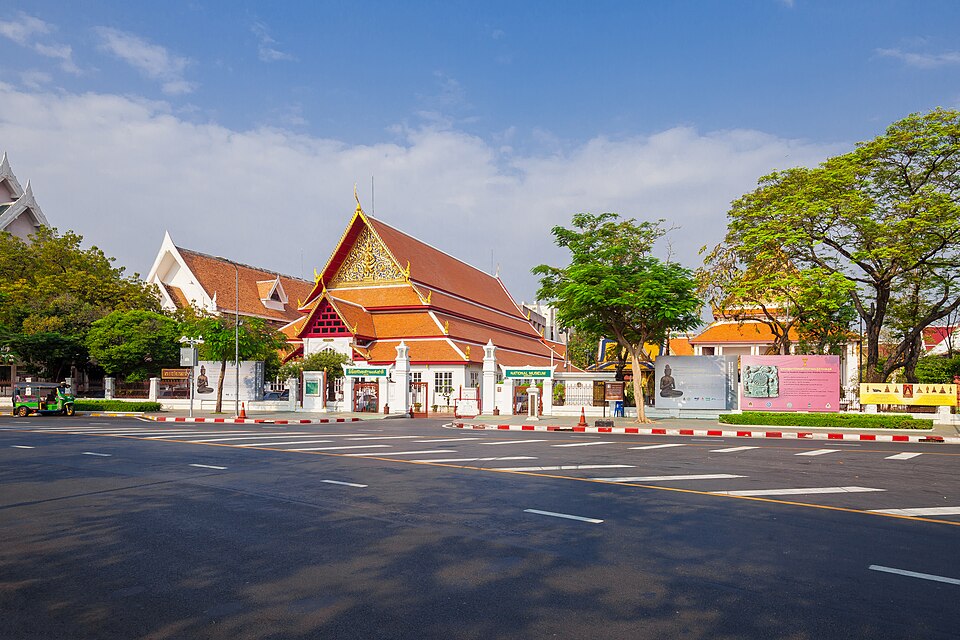
The Bangkok National Museum occupies the Wang Na, the front palace of the Second King, on Na Phra That Road beside Sanam Luang, and it is the head institution of Thailand's national museum service under the Fine Arts Department. The Thai government's visitor page calls it the largest museum in the country; the encyclopaedic reading calls it one of the largest in Southeast Asia and makes a stronger claim about its purpose, that this is the single place where the whole regional art-historical sequence is legible in order, from Dvaravati through Srivijaya and Sukhothai to the Khmer, Cham, Javanese and Gandharan material that shaped them. It holds the Ram Khamhaeng Inscription, itself on UNESCO's Memory of the World register since 2003. The sources disagree about how much it matters to a visitor: the travel press ranks it well down Bangkok's list, one guidebook placing it third of nine as a deep dive rather than a sight, while the institutional and academic sources treat it as the country's principal collection. Both readings are recorded here.
Checked 2026-08-25 · Source
The museum is a compound of buildings rather than a single hall, and that is the practical fact governing a visit. The Buddhaisawan Chapel, built as the front palace's own chapel, is the highest-value single room on the site and is frequently missed because it does not sit on the main gallery route. The Red House is a separate wooden residence standing in the grounds. The Siwamokkhaphiman and Prapat halls carry the historical and decorative-arts collections. The sequence most people come for is the arrangement of Buddha images by period, so that a Dvaravati face and a Sukhothai walking figure and Khmer stone stand within sight of one another; that ordering is the museum's real argument and it is legible only if the galleries are walked in sequence rather than sampled. Labelling varies in depth from building to building. The Ram Khamhaeng Inscription is the object here with the widest documentary claim attached to it.
Checked 2026-08-25 · Source
Allow 150 minutes. The Fine Arts Department publishes no expected visit length, so this is judgement, and it runs longer than most visitors budget because the museum is a multi-building complex rather than one circuit. Crossing between the Buddhaisawan Chapel, the Red House and the Siwamokkhaphiman and Prapat halls is done outdoors in the heat, and each crossing costs more time than the site plan suggests. Two and a half hours covers the main sequence at a reading pace with time inside the chapel. A visitor who wants only the Buddha-image galleries can do it in half that and lose little. The constraint that catches people is the closing time: the galleries shut at 16:00, earlier than every other major site in the old city, so this is a morning visit and cannot be tacked onto the end of a Grand Palace day.
Checked 2026-08-25

The museum opens Wednesday to Sunday and closes on Monday and Tuesday, and those closed days are the most important fact on this page: they turn a casual detour into a wasted walk across Sanam Luang. The hours themselves have two operator readings, both of them the Fine Arts Department's own. The current notice gives 09:00 to 16:00, Wednesday to Sunday, closed Monday and Tuesday. An older departmental notice, which advertises exhibitions running to 30 September 2021, gives 08:30 to 16:00 for the same days. The 09:00 opening is recorded on this page as the later of the two, but a visitor arriving at 08:30 may find the gate already open. Neither notice states a public-holiday rule and no operator page read here does, so a public holiday needs checking before travelling. Go at 09:00 on a weekday, since the galleries fill from late morning with school and tour groups. November to February for the season.
Checked 2026-08-25 · Source
The admission rates are not published on any Fine Arts Department page that could be read on 25 August 2026, and no figure is recorded here as a result. This is not for want of looking. The museum's departmental pages carry contact details, a calendar and general information but no fee; two departmental notices give hours only; the smart-museum and virtual-museum services that once held the rate table refuse connections, and one of those domains no longer resolves at all. Search summaries of those unreachable pages quoted three different foreigner prices, one of them a combined ticket, which is precisely why nothing is recorded. One Fine Arts Department fee page did load, but it prices the National Gallery, a different museum, at 30 THB for Thai nationals and 200 THB for foreigners, and that figure is not carried across to this one. Bring cash and expect to pay at the gate.
Checked 2026-08-25

The museum stands on Na Phra That Road, on the west side of Sanam Luang at the northern end of the Rattanakosin island. The Chao Phraya express boat at Tha Chang is the closest water approach and lies a short walk to the south-west; MRT Sanam Chai is about 1.5 kilometres away, which is a pleasant walk in the cool season and a punishing one in April. No car is needed. Walking up from the Grand Palace takes the length of Sanam Luang and is the natural way to arrive, though it crosses open ground with no shade. The same crossing in reverse at 16:00, when the museum shuts, lands at the palace's southern side in time to walk on to Wat Pho, which stays open into the evening. Thammasat University and the amulet market lie between the museum and the river, and the pavement runs continuously.
Checked 2026-08-25
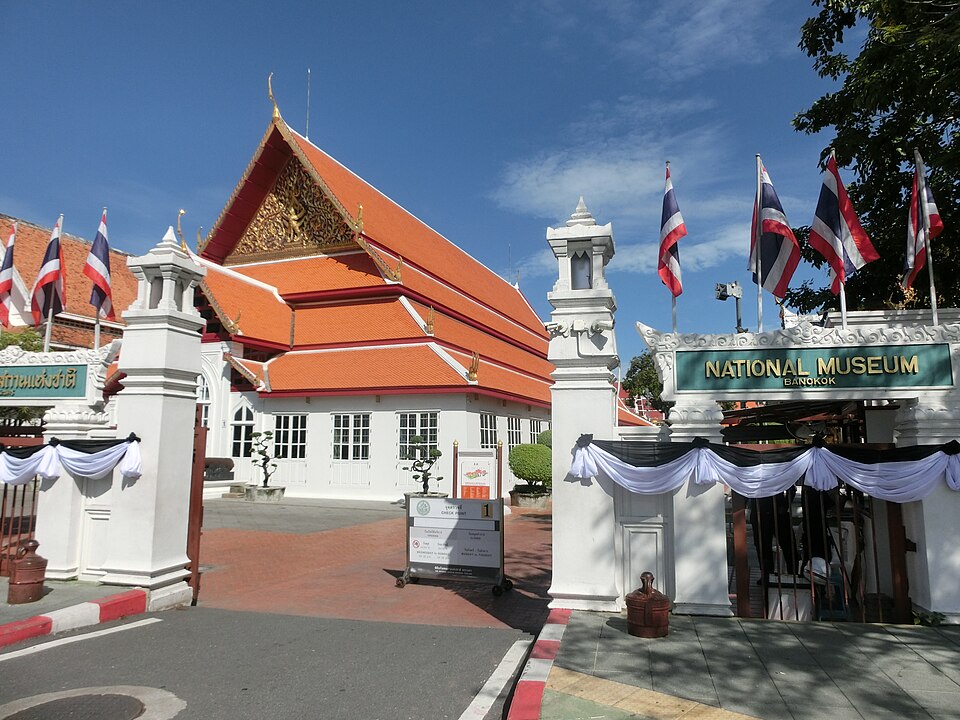
Monday and Tuesday. Nothing else on this page will cost a visitor more than turning up on a closed day. After that, the 16:00 close, which is two to three hours earlier than the temples and means the museum cannot serve as the afternoon half of a day beginning at the Grand Palace. Then the buildings: visitors who assume one entrance and one circuit walk the main halls and miss the Buddhaisawan Chapel entirely, so ask at the ticket desk for the site plan and find the chapel first rather than last. Air conditioning is inconsistent between buildings while the crossings between them are outdoors, which means dressing for both at once. The admission fee could not be established from the operator, so bring more cash than a guess would suggest. Labelling varies: some galleries are captioned thoroughly in English and others much less so, and the collection rewards a visitor who has read something about the Dvaravati and Sukhothai sequence beforehand.
Checked 2026-08-25

This is the one place in the Rattanakosin group where the photography is indoors and mostly difficult. Gallery lighting is low and mixed, cases are glazed and reflective, and flash is inappropriate in rooms holding religious images even where no sign forbids it. Work with what the building gives: the Buddha-image galleries are lit from above onto stone and bronze, which suits a close frame on a single face far better than a wide shot down a room full of pedestals. Press the lens against the glass to kill reflections in the cases. Outdoors the front-palace buildings are the better subject, since the Red House and the chapel exterior take late-morning light well and the courtyards are empty enough to frame a whole building, which is impossible at any of the temples. Check the rules at each building's door rather than assuming a single museum-wide policy, because a chapel in use is not a gallery.
Checked 2026-08-25
Monday and Tuesday. The museum opens Wednesday to Sunday, on the Fine Arts Department's own notice, and the closed days are the single most common reason for a wasted trip.
Not established. The admission rates are not published on any Fine Arts Department page that could be read on 25 August 2026; the departmental pages that loaded give hours and contact details only, and the museum services that once held the rate table refuse connections or no longer resolve. Unreachable pages were quoted second-hand at three different foreigner prices, so no figure is recorded. Bring cash for the gate.
About two and a half hours for the main sequence, because the collection is spread over several buildings with outdoor crossings between them. The Buddha-image galleries alone can be done in half that. The operator publishes no expected visit length.
The Ram Khamhaeng Inscription, which UNESCO added to the Memory of the World register in 2003. The museum also holds the fullest sequence of Thai and mainland Southeast Asian art in the country.
The sources disagree and both readings are kept. The Fine Arts Department's own page gives 1859. The encyclopaedic account gives a foundation in 1874 from Rama IV's antiquities, housed in the Wang Na front palace from 1887.
Both figures are the operator's. The current Fine Arts Department notice gives 09:00 to 16:00, Wednesday to Sunday; an older departmental notice, advertising exhibitions that ran to 30 September 2021, gives 08:30 to 16:00 for the same days. The later figure is recorded here, but the gate may open earlier.
Loading the interactive map…
The interactive map could not be loaded.
Last updated:
Source: OpenStreetMap contributors, Wikidata ·