.jpg)
.jpg)


3 min walk · เขตสาทร
Sathorn Unique Tower
- Must see
- Historic monument
Language · 1 published
Place of worship · เขตสาทร, Bangkok
วัดยานนาวา
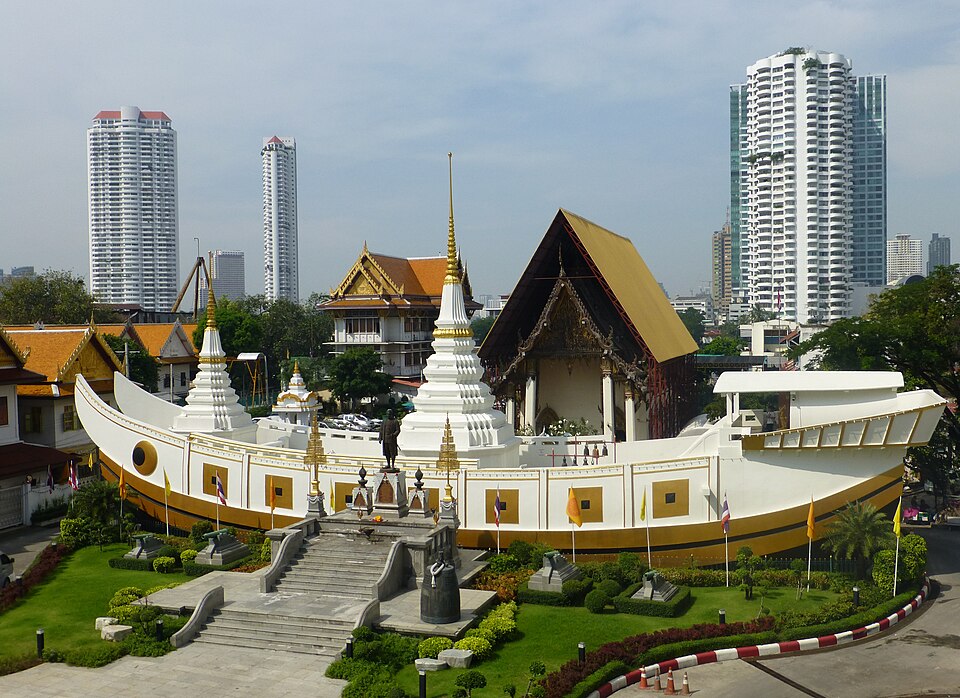
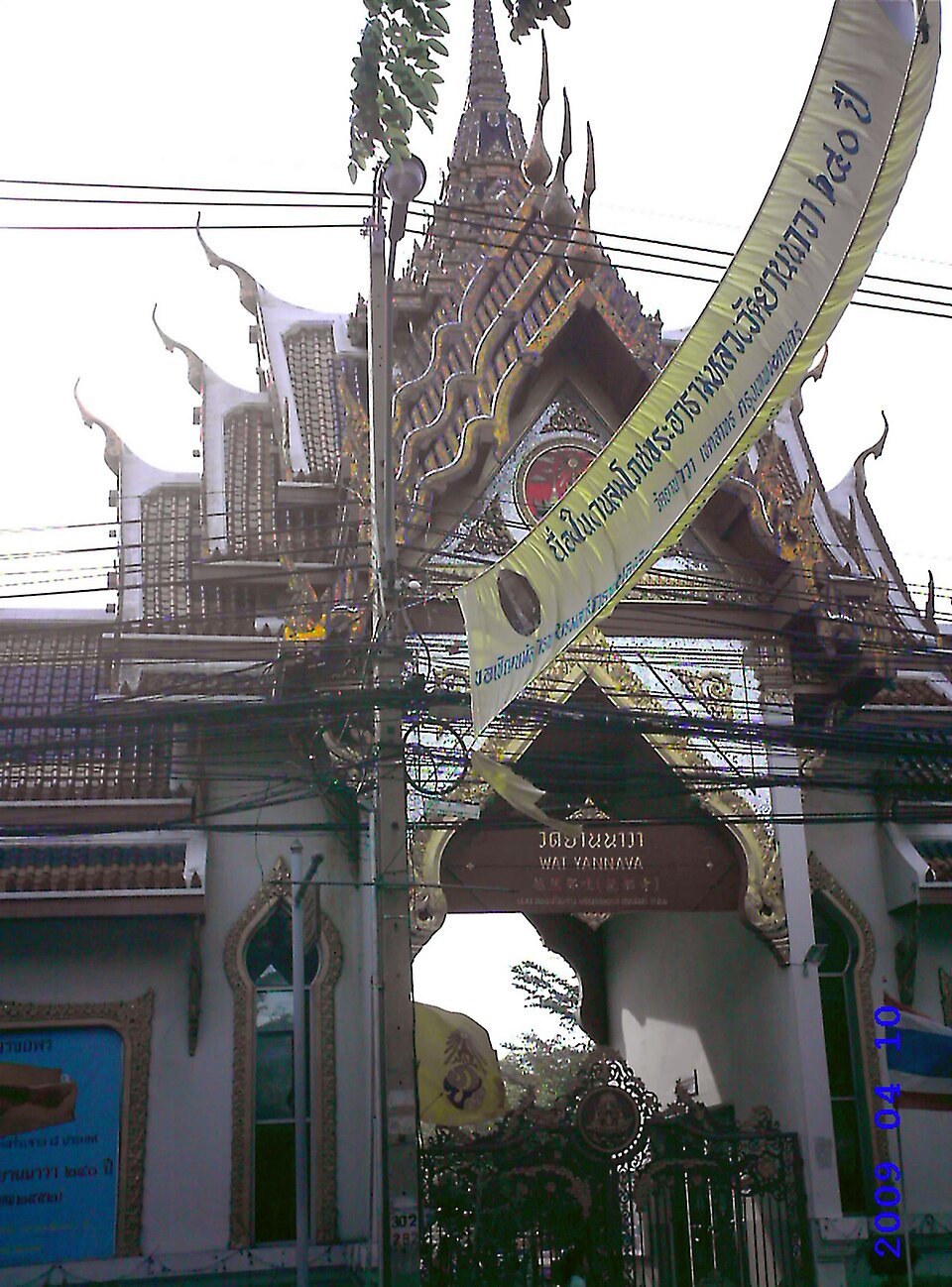
Wat Yannawa is the temple on Charoen Krung Road in Sathon whose principal monument is a full-size masonry Chinese junk with two chedis rising from its deck. King Rama III ordered it in place of an ordinary stupa because the junk was being driven out of Siamese trade by new kinds of ship and he wanted later generations to be able to see one. The two chedis stand for the masts and the altar for the wheelhouse; the hull measures about 21 wa 2 sok in length, roughly 43 metres. The temple is older than the boat and older than Bangkok, beginning in the Ayutthaya period as Wat Khok Khwai, the buffalo corral temple, named for the Tai Yai buffalo traders who lived around it, and renamed Wat Khok Krabue in the Thonburi era before Rama III gave it the name it carries now. It is a first-class royal temple of ordinary grade in the Mahanikaya order.
Checked 2026-08-25 · Source
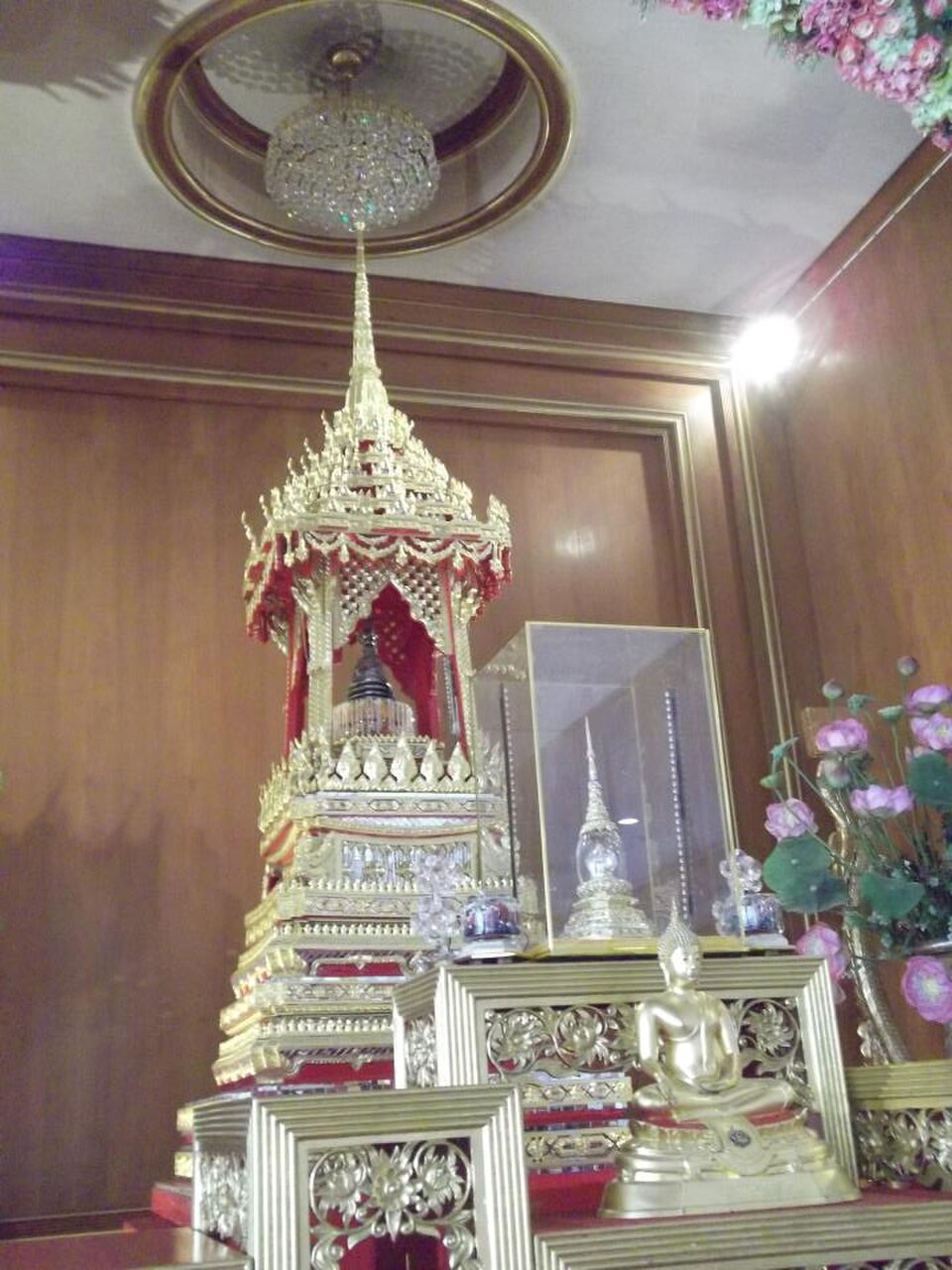
The sampao chedi is climbed rather than circled. The larger of the two chedis on the deck holds twenty wooden recesses and the smaller sixteen, and at the stern stand four Buddha images with replica Buddha footprints. The ubosot dates from the reign of Rama I and carries murals commissioned under Rama III showing the Loi Prathip royal lantern festival, including large krathong imagery that is rare in Thai mural painting and the reason the hall is worth entering rather than glancing into. A relic chamber holds Buddha relics presented from Sri Lanka. Two twentieth-century buildings complete the compound: the three-storey, five-spired Mahachetsadabodinthorn Hall and a three-storey Tripitaka library, both from 1987. There is a museum building on the grounds and a Chinese-style shrine with three figures of Guanyin, a reminder that this was always a trading temple on a trading river.
Checked 2026-08-25 · Source

Forty minutes is the right allowance. The junk takes fifteen minutes to walk around and climb, the ubosot murals reward another fifteen if the hall is open, and the remaining time covers the Guanyin shrine, the relic chamber and the walk out to the riverside edge of the compound. Wat Yannawa is a compact temple with one extraordinary object rather than a large complex, so a visitor who is also seeing Wat Pho or Wat Arun that day should treat it as the short stop rather than the long one, and its position beside a Skytrain station makes it easy to slot in.
Checked 2026-08-25
Early morning is best, both for light and for the temperature of the deck: the sampao is masonry, it is climbed in bare feet in some areas, and by midday the sun has been on it for hours. Morning is also when the temple is in ordinary use rather than in visitor use, which is the version worth seeing. No opening hours are published by the temple itself, so the safe assumption is the daylight pattern common to Thai temples and the safe plan is not to arrive at dusk expecting the halls to be unlocked. Buddhist holy days bring merit-making crowds and a livelier compound; a plain weekday morning brings almost nobody.
Checked 2026-08-25
No admission is recorded for Wat Yannawa. The temple publishes no website of its own, its official Facebook page carries no admission statement, the Ministry of Tourism directory entry is incomplete and states that its data is still being prepared, and the OpenStreetMap record holds no fee tag, so there is no operator-published price to record and none has been invented here. Thai temples of this kind ordinarily receive visitors without a gate charge and rely on donation boxes, but that is a general expectation rather than a sourced fact about this temple, and a visitor should carry small notes for the donation boxes and for candles and offerings.
Checked 2026-08-25
Wat Yannawa stands on Charoen Krung Road in Sathon district, hard against the east bank of the Chao Phraya at the point where the Taksin Bridge crosses. The nearest rail is Saphan Taksin on the BTS Silom Line, which sits at the bridge ramp on the Sathon and Bang Rak boundary; the temple is on the far side of Charoen Krung Road from the station and is one of the easiest major temples in Bangkok to reach without a taxi. Sathorn pier at the foot of the same station is the interchange for Chao Phraya express boats and cross-river ferries, so the temple works well as the first or last stop of a river day.
Checked 2026-08-25 · Source
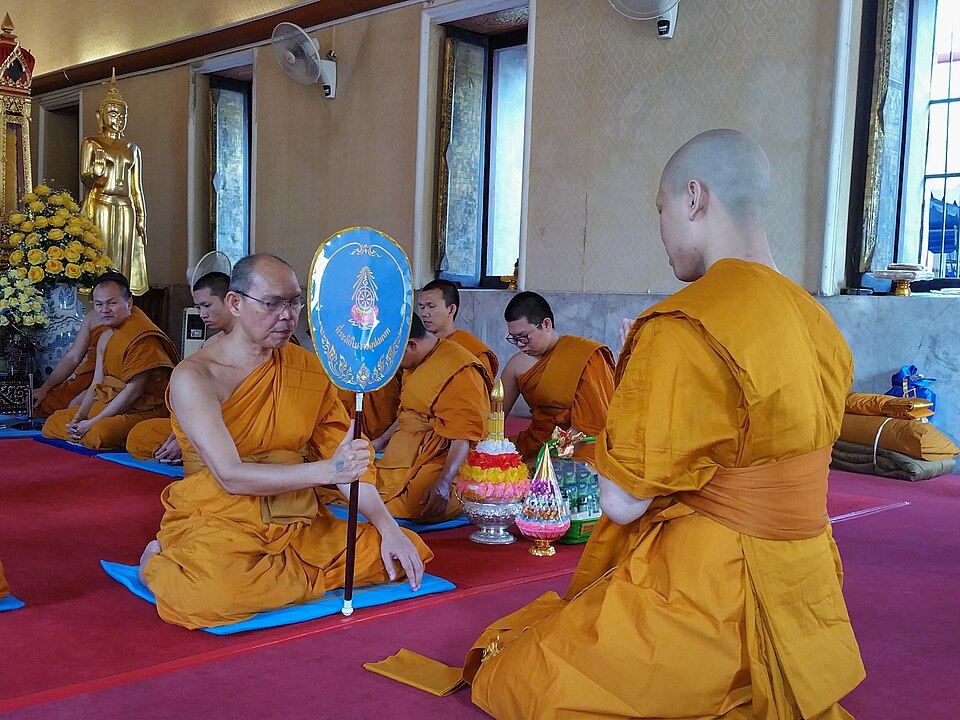
The sampao is a monument, not a viewing platform: its steps are steep, its stone is worn smooth and it becomes genuinely slippery in rain, so it is not a climb to make in flip-flops or while carrying a child. Ordinary temple conduct applies. Shoulders and knees covered, shoes off before entering the ubosot and the other halls, no feet pointed at a Buddha image, and no interruption of anyone making merit. The temple does not publish opening hours, so a hall found locked is normal and not a failed visit. The compound is beside a busy road under an elevated railway and the crossing to it deserves attention. Photography inside the halls is not restricted by any published rule, but the same rule applies as everywhere: put the camera down if a service is under way.
Checked 2026-08-25
The problem is that the boat is a boat and photographs badly from the angles a temple usually photographs well from. Shot square from the bow it turns into an unreadable wall of white; the frame that works is a three-quarter view from the stern quarter, low, with both chedis separated against the sky and the hull line running out of the corner. Early morning gives that side its light and the empty compound gives it a clean base. The stern Buddha images and the footprints reward a close frame with the deck receding behind them. Inside the ubosot the Loi Prathip murals are dim and high-contrast and need a steady hand rather than a flash, which should stay off. Late afternoon puts the river behind the temple and makes a silhouette worth trying from the western edge of the compound.
Checked 2026-08-25
It is a sampao chedi, a full-size masonry Chinese junk ordered by King Rama III to replace an ordinary stupa. He chose the shape because the junk was being made obsolete by new ship types and he wanted its form preserved; the two chedis on the deck represent masts and the altar the wheelhouse.
The Thai encyclopaedia entry gives the hull as about 21 wa 2 sok long, with a beam of 4 wa 3 sok and a height of 2 wa 3 sok. At two metres to the wa that is roughly 43 metres long and about 9.5 metres across.
No hours are recorded here, because Wat Yannawa publishes none. The temple has no website of its own, its Facebook page carries no hours, the Ministry of Tourism directory entry is marked as still being prepared, and OpenStreetMap holds no opening_hours tag for it.
No admission fee is recorded, because no operator-published price exists to record. There are donation boxes in the compound, so small notes are worth carrying, but no gate charge is stated by the temple in any source that was checked.
The temple predates Bangkok. It began in the Ayutthaya period as Wat Khok Khwai, the buffalo corral temple, named for the Tai Yai buffalo traders around it, was raised to royal status and renamed Wat Khok Krabue in the Thonburi era, and received its present name under King Rama III.
It stands on Charoen Krung Road in Sathon beside the Taksin Bridge approach. The nearest rail is Saphan Taksin on the BTS Silom Line, and Sathorn pier at the foot of that station connects to Chao Phraya express boats and cross-river ferries.
Loading the interactive map…
The interactive map could not be loaded.
Last updated:
Source: OpenStreetMap contributors, Wikidata ·