

.jpg)
.jpg)
3 min walk
Vasa Museum
- Must see
- Museum
Language · 1 published
Museum · Stockholm
Nordiska museet
| Monday | 10:00 – 17:00 |
|---|---|
| Tuesday | 10:00 – 17:00 |
| Wednesday | 10:00 – 17:00 |
| Thursday | 10:00 – 17:00 |
| Friday | 10:00 – 17:00 |
| Saturday | 10:00 – 17:00 |
| Sunday | 10:00 – 17:00 |
Checked 2026-08-26 · Source
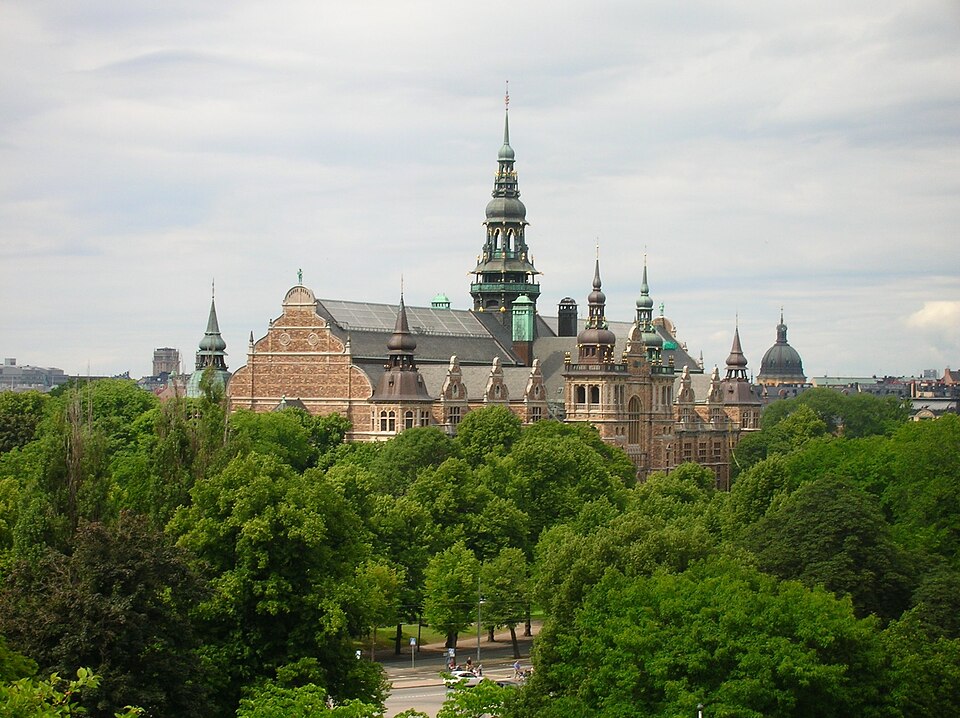
Nordiska museet is Sweden's largest museum of cultural history, and its subject is ordinary Nordic life rather than kings and battles. The museum was founded in 1873 by Artur Hazelius, who began by collecting the clothes, tools and furnishings of a rural Sweden he believed was about to disappear; the same man went on to found Skansen, the open-air museum a short walk further into Djurgården, in 1891. The collection now runs to more than one and a half million objects, from exclusive pieces to entirely everyday ones, covering life in Sweden and the Nordic countries from the sixteenth century to the present. Behind the exhibitions sit an archive of more than 4,500 metres of shelving, a photographic collection of roughly six million images, and a library of over 250,000 books and journals. The building on Djurgårdsvägen was designed for this purpose and has never served any other. Isak Gustaf Clason won the competition in 1883, and the museum opened to the public in 1907, six years after Hazelius died without seeing it finished. Its silhouette, 153 metres long under a spire that reaches 81 metres, is the reason the museum registers from across the water before a visitor knows what it holds.
Checked 2026-08-26 · Source
The interior is organised around one enormous room. The Great Hall runs 126.5 metres with a ceiling 24 metres above the floor, carried on 68 columns of Kolmården marble, and at its centre stands Carl Milles's six-metre oak figure of Gustav Vasa, unveiled in 1925 and marking the museum's chosen starting point of 1523. The hall itself is now an exhibition: The Arctic - While the Ice Is Melting fills it with a full-size mock-up of an iceberg that visitors walk into, split by a rift between past and present, built around the lives of the four million people who live in the Arctic today. The main permanent exhibition, Nordic Life, occupies the entire top floor across 27 rooms and moves through five hundred years as a walk through the seasons, from a cold midwinter forest in the early 1500s to a future forest at the far end, with real documented life stories from the collections as its characters. Table Settings and the 1940s Flat sit alongside them. Families have the Children's Playhouse, a farm interior of the 1890s, and the Time Vault. The archive and library on the ground floor are open to visitors on set days.
Checked 2026-08-26 · Source
This guide records two hours, which is the figure the museum's own visit-options page uses for seeing all of its exhibitions without hurrying. One hour is enough for a single exhibition, and the museum's suggestion for that hour is either Nordic Life on the top floor alone, or a fast pass through everything that covers ground without leaving time to look. The audio guide tracks are a useful clock: roughly 40 minutes for The Arctic, 40 minutes for Table Settings, and about 50 minutes for Nordic Life, which the museum itself signposts as a one-to-four-hour exhibition depending on how much of it a visitor reads. Half a day is the honest figure for the whole building including the introductory film, lunch in the Great Hall restaurant and the shop. With children the arithmetic changes rather than lengthens: the Children's Playhouse takes about 45 minutes on its own, and the Time Vault runs 45 to 90 minutes, so one of those plus a break is already a two-hour visit. Between mid-June and mid-August a free 15-minute introduction in English runs on weekdays at 11.00 and 15.00, and it cannot be reserved.
Checked 2026-08-26 · Source
The museum is open every day of the year, and its Swedish opening-hours page makes a point of including Christmas Eve. That removes the usual Stockholm problem of a Monday closure, but it also means the hours are short and identical on most days: 10.00 to 17.00. The single exception worth planning around is the Wednesday evening opening, 10.00 to 20.00, which runs from September to May and does not run in June, July or August. A Wednesday afternoon in October therefore buys several more hours than any other day of that week, and it is the one slot where a two-hour visit does not have to start before lunch. In the summer months every day closes at 17.00, so an afternoon arrival after another Djurgården museum leaves very little. Within a day, the first hour after opening is the quietest and the Great Hall takes morning light from its ceiling lanterns. The archive and library keep their own restricted hours, currently Wednesday and Thursday afternoons, and close entirely for a summer break, so a research visit needs checking against that page rather than the museum's.
Checked 2026-08-26 · Source
Admission is 170 SEK for an adult, charged per person and covering the whole museum including the permanent exhibitions. Seniors pay 150 SEK, as do students over 19. Children aged 3 to 18 pay 75 SEK, and the museum states that they enter free on weekdays during the autumn and spring terms. School visits led by a teacher are free but have to be booked ahead. Tickets are sold at the door as well as online, so a walk-up visit is normal rather than an exception. Admission is free to holders of the Stockholm Go City card, an ICOM card, an ICOMOS card and the Stockholm Key of Honour, and the museum also accepts entrance passes bought through Go City Stockholm and GetYourGuide. A guide or personal assistant accompanying a visitor always enters free. One practical point catches people out: the museum is cash-free. Payment is by credit or debit card, or by Swish, and nowhere on site takes notes or coins. The shop and the restaurant can both be visited without buying a ticket at all.
Checked 2026-08-26 · Source
The address is Djurgårdsvägen 6-16, on Royal Djurgården, immediately across the road from the Vasa Museum and a few minutes past the Djurgården bridge. No car is needed and one is a liability here. Tram 7 and bus 67 both stop at Nordiska museet/Vasamuseet, which is the door; buses 76 and 69 stop at Djurgårdsbron, a short walk back over the bridge. The Djurgården ferry from Slussen, Hammarby Sjöstad or the Viking terminal lands at Allmänna Gränd, further down the island, and the walk from there passes Gröna Lund. The nearest metro is Karlaplan on the red line, which leaves a walk of roughly fifteen minutes through Östermalm and over the bridge. Parking near the museum is limited to a small number of spaces, with accessible parking on the northern side facing Strandvägen, and the museum warns that Djurgårdsbron itself may be closed to general traffic at certain times, with exceptions only for taxis, public transport and permit holders. From Östermalmstorg or Nybroplan the walk along Strandvägen takes about twenty-five minutes and is the pleasantest approach.
Checked 2026-08-26 · Source
Backpacks are not allowed into the exhibitions. The lockers on Level 1 are free but measure 31 by 33 by 37 centimetres, which holds a bag up to about A3; anything larger cannot be stored anywhere in the building and cannot be left unattended, so arriving straight from a station with luggage does not work here. Plan the day so the suitcase is elsewhere. The cash-free rule is the second trap, and it is absolute: card or Swish only, in the shop and restaurant as well as at the ticket desk. Wednesday evening opening is the third, because it exists from September to May and not in summer, and a visitor who read about it out of season will find the doors shut at 17.00. Lifts reach all the exhibition floors and a ramp serves the restaurant and some galleries; there are accessible entrances at Level 1 to the right of the main entrance and in the courtyard, an accessible toilet with a 90-centimetre door opposite the shop, and wheelchairs to borrow from reception. Handrails are present in many but not all staircases. Only assistance and guide dogs may come in.
Checked 2026-08-26 · Source
Photography for personal use is welcome throughout the museum, and the museum asks only two things: no flash and no tripod. That rules out the long exposure the Great Hall would otherwise reward, so the hall has to be shot handheld, which in practice means a fast lens, a raised ISO, and bracing against one of the marble columns rather than trying to hold steady in open floor. The light in the hall comes from the glass lanterns overhead and is at its most even in the middle of the day; late afternoon in winter leaves it dim enough that anything moving will blur. The Gustav Vasa statue is best taken from the gallery levels rather than from the floor, where the six-metre figure foreshortens badly, and the Jubilee Bridge across the top floor gives a clean line down the length of the hall. Outside, the east portal with Odin at its gable takes afternoon light, while the courtyard entrance and Outi Pieski's Two Directions portal face away from it and read better in flat weather. Professional shoots inside or outside the building need written approval from the museum in advance.
Checked 2026-08-26 · Source
Yes. The museum states that it is open every day of the year, including Christmas Eve. Standard hours are 10.00 to 17.00. From September to May there is a late opening on Wednesdays until 20.00; in June, July and August every day closes at 17.00. The archive and library keep separate and much shorter hours and close for the summer, so a research visit has to be checked against the opening-hours page rather than assumed from the museum's.
An adult ticket is 170 SEK per person and covers the whole museum. Seniors and students over 19 pay 150 SEK, and children aged 3 to 18 pay 75 SEK, with free entry for children on weekdays during the autumn and spring terms. Tickets are sold on site as well as online. The museum is cash-free: payment is by card or Swish only.
Two hours is the working figure, and it matches the museum's own suggestion for seeing all of its exhibitions. One hour covers a single exhibition, such as Nordic Life on the top floor, whose audio guide runs about 50 minutes. Half a day covers the whole building with the introductory film, lunch and the shop. With children, the Children's Playhouse alone takes about 45 minutes and the Time Vault 45 to 90 minutes.
No. Tram 7 and bus 67 stop directly outside at Nordiska museet/Vasamuseet, buses 76 and 69 stop at Djurgårdsbron, and the Djurgården ferry lands at Allmänna Gränd. The nearest metro station is Karlaplan on the red line, about fifteen minutes' walk away. Parking by the museum is limited to a few spaces, and the museum warns that Djurgården bridge may be closed to general traffic at times.
Yes, for personal use, but the museum asks visitors not to use flash or a tripod. Professional photography inside or outside the building requires the museum's approval in advance, arranged through its booking address, and press photography goes through the press contact.
No. Backpacks have to go in the free lockers on Level 1. Those lockers are 31 by 33 by 37 centimetres, so they hold a bag up to roughly A3 in size. Larger luggage cannot be stored in the museum at all and cannot be left unattended, so a visit straight off a train with a suitcase is not workable.
Loading the interactive map…
The interactive map could not be loaded.
Last updated:
Source: OpenStreetMap contributors, Wikidata ·