.jpg)


4 min walk
Bavaria
- Must see · Heritage site
- Historic monument
Language · 1 published
Historic monument · Munich

| Monday | 10:00 – 23:30 |
|---|---|
| Tuesday | 10:00 – 23:30 |
| Wednesday | 10:00 – 23:30 |
| Thursday | 10:00 – 23:30 |
| Friday | 10:00 – 24:00 |
| Saturday | 09:00 – 24:00 |
| Sunday | 09:00 – 23:30 |
Checked 2026-08-26 · Source
Theresienwiese is a flat, largely unplanted open ground of about 100 acres in Munich's Ludwigsvorstadt-Isarvorstadt, a short walk from the old town, and for most of the year it is exactly that: an empty field waiting for something to be built on it. What gets built on it in September is the Oktoberfest, which the City of Munich runs as organiser and which its own site calls the festival of the City of Munich. In 2026 it runs from 19 September to 4 October, sixteen days. The ground took its name from the very first festival in October 1810, held for the wedding of Crown Prince Ludwig of Bavaria and Therese of Saxe-Hildburghausen; it was Theresiens Wiese, Therese's meadow, and the shortened Bavarian form Wiesn is now the ordinary name for the festival itself rather than the field. The site is not reserved for Oktoberfest alone — the Frühlingsfest uses it in spring and the Tollwood festival in winter — but the fairground layout, the tent plots and the street names are all set out for the sixteen days in autumn. Two permanent structures anchor it: the Bavaria statue in front of the Ruhmeshalle on the western rise, and the neo-Gothic St Paul's church to the north, which the operator gives as 320 feet high.
Checked 2026-08-26 · Source
The Wiesn is fenced, entered through numbered gates, and laid out as streets rather than as a single hall. Fourteen large tents stand along the main axis — Schottenhamel, Hofbräu, Hacker, Paulaner, Löwenbräu, Augustiner, Bräurosl, Marstall, Ochsenbraterei, Schützen, Armbrustschützen, Fischer-Vroni, Käfer Wiesn-Schänke and Kufflers Weinzelt — and seventeen small ones, the chicken and sausage roasteries, cheese and wine rooms, café tents and the Wirtshaus im Schichtl. The small tents matter more than their name suggests: they take walk-ins when the big houses are shut for overcrowding, and their beer is often cheaper. Rides and showmen fill the parallel Schaustellerstraße, from the Ferris wheel and the Toboggan down to the Teufelsrad and Hau den Lukas, and the sales booths that sell fish rolls, balloons and gingerbread hearts run between them. The southernmost 3.5 hectares are fenced off separately as the Oide Wiesn, the historic fair kept on from the 2010 bicentenary and permanent since 2011: three large traditional tents plus a museum tent, historic rides including the Kettenflieger Kalb of 1919, and shooting and throwing booths. In the western area, below the Bavaria, the copper-coloured Service Centre houses the round-the-clock police station and the visitor services attached to it.
Checked 2026-08-26 · Source

Allow four hours. Neither the City of Munich nor the Oktoberfest site publishes a suggested visit length, so four hours is this guide's judgement rather than an operator figure, and it is built from what the ground actually costs in time. Walking the fairground end to end without stopping takes about twenty-five minutes, and doing it once in each direction, with detours into the side streets, absorbs an hour on its own. A seat in a tent is not a quick thing: getting one without a reservation means arriving before the tables fill, and once seated the whole rhythm of ordering, waiting and being served runs on the band's schedule rather than yours, so budget two hours from sitting down to standing up. The Oide Wiesn is a separate ticketed enclosure with its own gate queue and deserves forty-five minutes if it is on the plan at all. Climbing into the Bavaria adds thirty to forty minutes including the staircase and the wait at the door. Two hours is enough only for a walk through with something eaten standing up. A full day — arriving at ten and leaving after dark — is a real option on a quiet weekday, but it is a day, not an item on a list of other sights.
Checked 2026-08-26
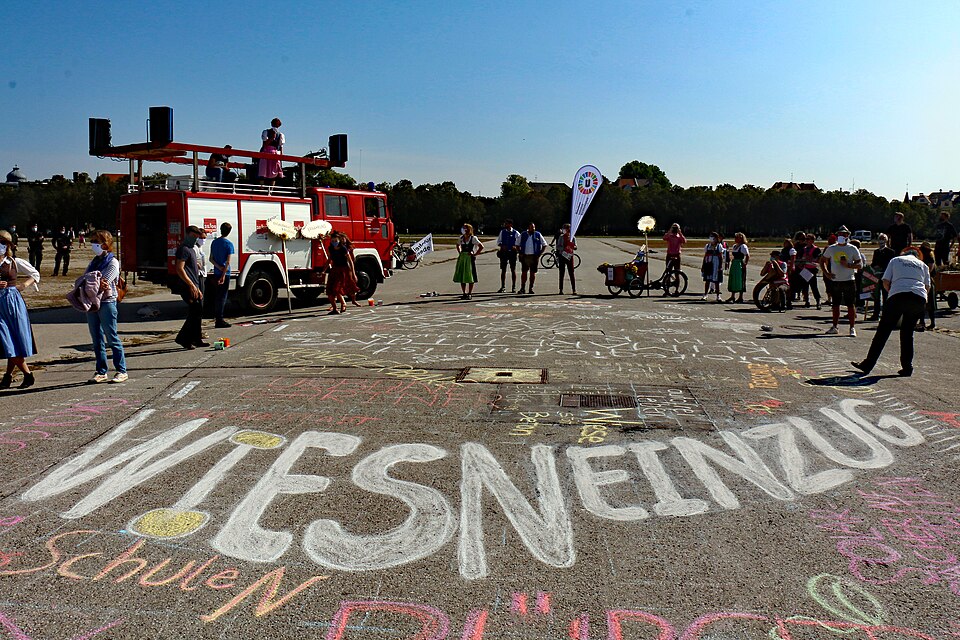
The festival grounds open at 10.00 Monday to Thursday and close at 23.30; Friday runs 10.00 to midnight, Saturday 9.00 to midnight, and Sunday 9.00 to 23.30. On the opening Saturday the tents open at 9.00, non-alcoholic drinks other than beer are served from 10.00, and the mayor taps the first barrel at noon — nothing alcoholic is poured before that. The operator publishes a day-by-day visitor barometer, and it is blunt about the pattern: weekday mornings from 10.00 to 15.00 are quiet, the two Mondays are quiet into the evening as well, and every Saturday and Sunday is busy from opening, with the middle weekend and the 3 October public holiday the heaviest days of the run. The hour to avoid regardless of the day is roughly 16.00 to 18.00, when reserved tables change over; the operator states plainly that the main entrances of the large tents are usually closed then and that a visitor without a reservation has little chance of getting in. Waiting in that queue is not worth it. The two Tuesdays are family days, busier in the afternoon at the food stalls and children's rides than in the tents themselves.
Checked 2026-08-26 · Source
There is no admission charge and no ticket for the Oktoberfest. The operator is explicit: anyone can walk through the grounds without one, and the queues at the gates are bag checks, not ticket checks. The large and small tents are also free to enter and need no reservation, with one practical exception — when a tent is closed for overcrowding, which the operator says can happen from early afternoon at weekends, only reserved tables get in. The one enclosure that charges is the Oide Wiesn: 4 euros per person from age 15, free for children up to 14, half price with a valid disability pass, free for the companion of a pass marked B, and free for everyone after 21.00, though only through the exits. That ticket also covers the cultural programme in its tents. Rides are paid for individually at each cash desk, usually in tokens. Note a contradiction on the operator's own pages about Oide Wiesn rides: the admission page says 1 euro per ride, the Oide Wiesn page says 1.50 euros; both figures are the operator's and this guide does not pick between them. Beer in 2026 runs from 14.80 to 15.90 euros a litre, with wheat beer at Kufflers Weinzelt at 18.40; the Schottenhamel and Paulaner prices were still subject to approval when this was checked.
Checked 2026-08-26 · Source
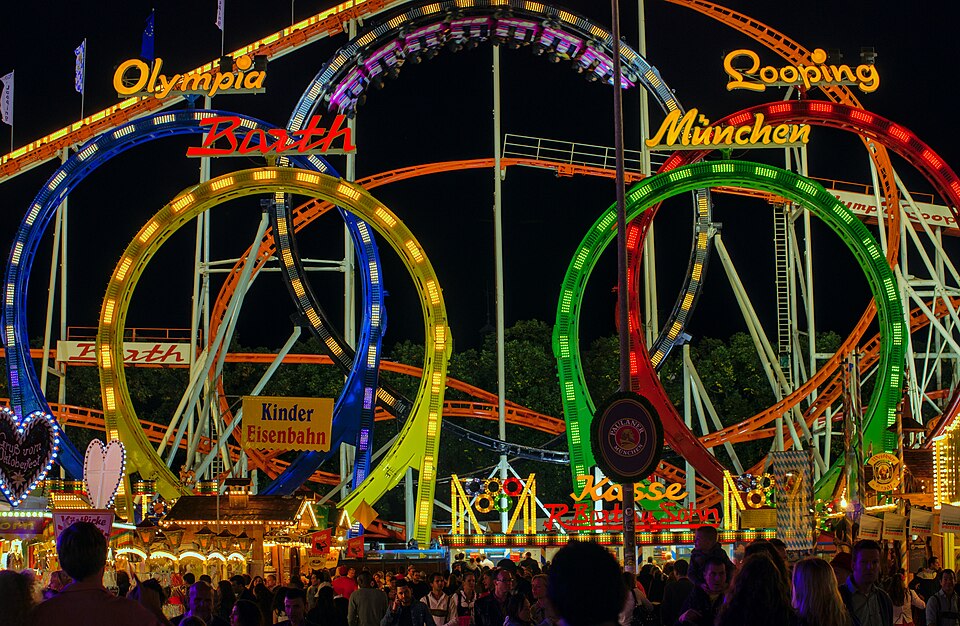
Come by public transport; the operator's parking page is a warning, not a guide. U4 and U5 run to Theresienwiese station, on the ground's eastern edge, in a few minutes from Hauptbahnhof, Karlsplatz or Odeonsplatz, and one stop further to Schwanthalerhöhe. U3 and U6 reach Goetheplatz in about five minutes from Marienplatz or Sendlinger Tor, with Poccistraße one stop on; both are a few minutes' walk from the eastern and southern gates. All eight S-Bahn trunk lines stop at Hackerbrücke — two minutes from Hauptbahnhof, five from Marienplatz — and it is a ten-minute walk from there to the main entrance. MetroBus 53, 58/68, 62 and city bus 134 serve the edges, as do trams 18/19/29 to Holzapfelstraße or Hermann-Lingg-Straße and trams 16/17 to Hackerbrücke. Theresienwiese station is the most crowded of them; with children the operator recommends Goetheplatz, Poccistraße or Schwanthalerhöhe instead. A car is not merely unnecessary, it is a liability: there is no parking at the grounds, the surrounding streets are resident-only and cars there are ticketed and towed, and the whole area inside the Mittlerer Ring is an environmental zone requiring a green sticker, with older diesels banned outright. Park and Ride at an outer U-Bahn or S-Bahn station is the only workable approach.
Checked 2026-08-26 · Source

The bag rule is the one that catches visitors at the gate. Bags may not exceed 3 litres in volume or 20 by 15 by 10 centimetres — a small handbag or a mini rucksack, and nothing larger, whatever is inside it. Anything bigger goes to the paid luggage store at entrances P1, P5, P8 and P10, at 5 euros a piece, with no guarantee of space and queues when it is busy. Glass bottles may not be brought onto the grounds at all; other drinks may, but not into the tents or beer gardens. Gas sprays, corrosive or staining substances and anything usable as a blade are refused. Walking aids, medical devices and umbrellas are allowed and get tagged at the check. Pushchairs are permitted until 18.00 on ordinary days but banned entirely on Saturdays and on 3 October; back carriers are always allowed. On crowded days the operator advises avoiding Wirtsbudenstraße and using Schaustellerstraße, Matthias-Pschorr-Straße and the side streets, and entering by a side gate rather than the main one. Around 600 police officers and more than 2,000 security staff work the site, with a round-the-clock police station in the Service Centre below the Bavaria; the emergency number is 110.
Checked 2026-08-26 · Source

The picture everyone wants is the fairground from above, and there are two ways to get it. The Ferris wheel gives the wide view and moves, so it costs a ride and a steady hand. The Bavaria gives the better one: the bronze is the only large statue in Germany with an accessible interior, and a steep winding staircase leads to a platform inside the head with two benches and small openings looking straight down over the festival. It opens daily 9.00 to 18.00 from 28 March to 19 October, last entry 17.30, extended to 20.00 during the Oktoberfest, and costs 5 euros, 4 reduced, free under 18. The Ruhmeshalle behind it is free but shuts for safety for the duration of the festival, and access is by staircase only. From ground level, the classic frame is the eastern approach with St Paul's spire behind the tent roofs. The light works twice: late afternoon rakes along the tent fronts from the west, and the fifteen minutes after sunset balance the ride lighting against a sky that still has colour in it — after that the rides burn out and the sky goes black. Carry one small body and one lens; the 3-litre bag limit at the gates settles the kit question for you.
Checked 2026-08-26 · Source
No. The Oktoberfest charges no admission and issues no ticket for the grounds, and the large and small beer tents are free to enter as well. The queues at the gates are security bag checks. The only paid enclosure is the Oide Wiesn in the south of the site, at 4 euros per person from age 15, free for children up to 14 and free for everyone after 21.00 through the exits. Rides are paid for individually at each cash desk.
The festival grounds open 10.00 to 23.30 Monday to Thursday, 10.00 to midnight on Friday, 9.00 to midnight on Saturday and 9.00 to 23.30 on Sunday. On the opening Saturday the tents open at 9.00, non-alcoholic drinks other than beer are served from 10.00, and the first barrel is tapped at noon. In the large tents the last beer and the last music come at 22.30, in the small tents at 23.00; Käfer Wiesn-Schänke and Kufflers Weinzelt stay open to 1.00 with last drinks at 00.30.
Between 14.80 and 15.90 euros across the tents, which the operator gives as an average rise of 2.38 percent on 2025, when the range was 14.50 to 15.80. Wheat beer at Kufflers Weinzelt is 18.40. The prices at the Schottenhamel Festhalle and the Paulaner Festzelt were still subject to approval when this page was checked. Non-alcoholic drinks average 11.13 euros a litre for bottled water, 12.35 for lemonade and 12.84 for Spezi. The tent proprietors set these prices, not the city.
Allow four hours. Neither the city nor the Oktoberfest site publishes a suggested visit length, so this is judgement rather than a recorded figure. An hour goes on walking the fairground and its side streets, two hours on a tent if you actually sit down and eat, and the rest on a ride or the Oide Wiesn. Two hours covers a walk through with something eaten standing up. Add thirty to forty minutes for the climb inside the Bavaria statue.
In practice, no. The operator states there are no parking spaces anywhere in the vicinity, that the surrounding streets between Landsberger Straße, Schwanthalerstraße, Lindwurmstraße and Ganghoferstraße are reserved for residents, and that cars parked there are ticketed and towed. The whole area inside and including the Mittlerer Ring is an environmental zone needing a green sticker, and diesels of Euro 4/IV and older have been banned from it since February 2023. Park and Ride at an outer U-Bahn or S-Bahn station, then the train, is the recommended approach.
Up to 3 litres in volume, or no larger than 20 by 15 by 10 centimetres — a small handbag or a mini rucksack. Security staff at the entrances check size and contents and tag each bag with a colour that changes daily. Larger luggage must go to the paid store at entrances P1, P5, P8 or P10 for 5 euros, with no guaranteed capacity. Glass bottles are banned from the grounds entirely, and pushchairs are barred on Saturdays and on 3 October.
Loading the interactive map…
The interactive map could not be loaded.
Last updated:
Source: OpenStreetMap contributors, Wikidata ·