
.jpg)


3 min walk
Nymphenburg Porcelain Museum
- High
- Museum
Language · 1 published
Historic monument · Munich
Schloss Nymphenburg

| Monday | 09:00 – 18:00 |
|---|---|
| Tuesday | 09:00 – 18:00 |
| Wednesday | 09:00 – 18:00 |
| Thursday | 09:00 – 18:00 |
| Friday | 09:00 – 18:00 |
| Saturday | 09:00 – 18:00 |
| Sunday | 09:00 – 18:00 |
Also recorded: 10:00 – 16:00
Checked 2026-08-26 · Source
Nymphenburg is the summer palace of the Bavarian electors and later kings, in the west of the city, out beyond the Residenz, and still run by the Bavarian Palace Administration. It was begun as a thank-offering: Elector Ferdinand Maria and Henriette Adelaide of Savoy waited about ten years for an heir, and when Max Emanuel was born in 1662 a site on the edge of the court lands was chosen for a new building. Construction started in 1664 to plans by the north Italian architect Agostino Barelli, who also designed Munich's Theatine Church, and by 1679 the first version — a single cubic pavilion with a court church, outbuildings and a small walled garden — was close to finished. Everything else grew outward from that pavilion. Max Emanuel added flanking pavilions from 1701, linked to the centre by galleries; after his return from exile in 1715 Joseph Effner and Dominique Girard drew up an overall plan, and Karl Albrecht added the crescent, intended as the core of a planned town. The result reads as one symmetrical composition rather than a single house, which is why the walk from the gate to the ticket office takes longer than a first-time visitor expects. King Maximilian I Joseph died here in 1825, and Ludwig II was born here on 25 August 1845.
Checked 2026-08-26 · Source
The ticketed route through the main palace is twenty-one numbered rooms on the upper floor, and it is short enough to walk twice. It opens in the Great Hall, the double-height ceremonial room decorated under Elector Maximilian III Joseph by Johann Baptist Zimmermann and Francois Cuvillies the Elder, then runs north through an antechamber, a bedchamber and a cabinet into the Karl Theodor rooms, which hold Max Emanuel's Great Gallery of Beauties, the Coat of Arms Chamber and the North Gallery. The south side mirrors it: antechambers, a bedchamber, the Chinese Lacquer Cabinet and the South Gallery. Beyond them the Queen's Apartment carries the room most visitors come for, King Ludwig I's Gallery of Beauties in the salon, followed by the study, the lady-in-waiting's chamber, the audience room, a bedchamber and King Maximilian II's bathroom. The Palace Chapel is entered separately from the cour d'honneur, through the second northern pavilion. The ticket also reaches two collections in the southern Cavaliers' Building: the Marstallmuseum, with more than forty Wittelsbach coaches and sleighs including the coronation coach of Emperor Karl VII and the state vehicles of Ludwig II, and above it the Museum of Nymphenburg Porcelain, the Baeuml Collection. The park holds four separate pavilions of its own.
Checked 2026-08-26 · Source
The Bavarian Palace Administration publishes no recommended visit duration for Nymphenburg, so the figures here are judgement rather than a quoted number. The state rooms alone are one hour: twenty-one rooms on a single floor, no stairs between them, and no queue inside once past the ticket check. Add the Marstallmuseum and the porcelain collection above it and two hours is honest, because the carriages take longer to look at than rooms do and the walk across the cour d'honneur between the two eats ten minutes. Two and a half hours is the figure to plan for if the palace and the museums are both on the list, and that is the duration recorded for this page. The park changes the arithmetic entirely. Amalienburg, Badenburg, Pagodenburg and the Magdalenenklause are spread across a landscape garden that takes half an hour to cross on foot in one direction, so a combination ticket used in full is a half day, four to five hours, and closer to five if the canal and the Great Lake are walked rather than cut across. In winter the park palaces are shut and the whole complex closes at four, which compresses everything into a short afternoon.
Checked 2026-08-26
The year splits in two. From April to 15 October the palace, the Marstallmuseum and the Museum of Nymphenburg Porcelain open daily from 9am to 6pm; from 16 October to March they open daily from 10am to 4pm. There is no weekly closing day, but all objects are closed on 1 January, on Shrove Tuesday and on 24, 25 and 31 December. Last admission and last ticket sales in every building are thirty minutes before closing, so a winter arrival at half past three is the final one of the day. The Palace Chapel keeps the summer hours only, and the four park palaces are open April to 15 October and closed from 16 October to March, which is the single strongest argument for coming in the warm half of the year. The park itself keeps longer hours than the buildings: the main gate opens at 6am and closes at 6pm from January to March and in November and December, at 8pm in April and October, and at 9.30pm from May to September, with the other gates shut half an hour earlier. Note for 2026 that the Great Parterre fountain is out of service while the water wheel in the Green Pump House is repaired.
Checked 2026-08-26 · Source
Admission is charged, and the 2026 tariff is seasonal. The combination ticket called Nymphenburg costs 20 euros regular and 18 euros reduced from 1 April to 15 October, and 16 euros regular and 14 euros reduced from 16 October to 31 March; it covers the palace, the Marstallmuseum with the porcelain museum, and the four park palaces, which are closed in winter. Bought separately, Nymphenburg Palace alone is 10 euros regular and 9 euros reduced — the figure recorded for this page — the Marstallmuseum with the porcelain museum is 8 and 7 euros, and the Parkburgen ticket for the four park pavilions is 6 and 5 euros. Children under 18 are admitted free. Tickets are sold at the cash desks of each sight and online through the palace ticket shop up to one day before the visit, and only a limited number are held back for the ticket offices each day. The palace is sold with timed slots: admission is possible up to one hour after the chosen time, and there is no limit on how long a visitor stays inside. The Marstallmuseum and the park buildings need no time slot. The audio guide costs 3.50 euros, or 2.50 per person for groups of fifteen or more.
Checked 2026-08-26 · Source
No car is needed. The Bavarian Palace Administration gives two public transport routes into the palace: S-Bahn to Laim and then a bus to the Schloss Nymphenburg stop, or U-Bahn to Rotkreuzplatz and then a tram to the same stop. Both put a visitor at the head of the canal, and the walk from the stop along the water to the cour d'honneur is part of the visit rather than an approach to it — the palace comes into view across the basin the way it was meant to. Drivers arrive from the A8, A96, A95 or A9 following the brown Schloss Nymphenburg signs, and there are about 450 free parking spaces at the palace plus eight coach spaces, which is unusual for central Munich and makes this one of the few Munich sights where a car is not a liability. Five designated disabled bays sit in the car park in front of the palace, roughly 200 metres from the ticket office over paved gravel and cobblestones with no inclines. The palace has a separate step-free entrance to the left of the main door and a lift to the exhibition floor; the Marstallmuseum is step-free on the ground floor. Cyclists are pointed to the city's own cycling information.
Checked 2026-08-26 · Source
Two things are missing in 2026 and both are worth knowing before arrival. The Chinese Lacquer Cabinet in the Electress's Apartment, room 13 on the palace route, stays closed to visitors until autumn 2026 for restoration work; the other state rooms are open without restriction. The fountain in the Great Parterre is out of service for the year because the water wheel in the Green Pump House needs repair, and the pumps for the fountain in front of the palace cannot be run either, so the classic view is of still water. Tickets for the Parkburgen are not sold at the park palaces themselves — buy them at the palace or Marstallmuseum ticket offices, or online, before walking out into the park. There are no regular guided tours anywhere in the complex; the audio guide, in ten languages, is the substitute. Bulky items may not be taken into the palace and lockers are provided, food and drink are not allowed in the museum rooms, and dogs are barred from all buildings and must be leashed in the park. In storms the park may be closed for safety, and the administration asks visitors to stay out at Beaufort 9 and above.
Checked 2026-08-26 · Source
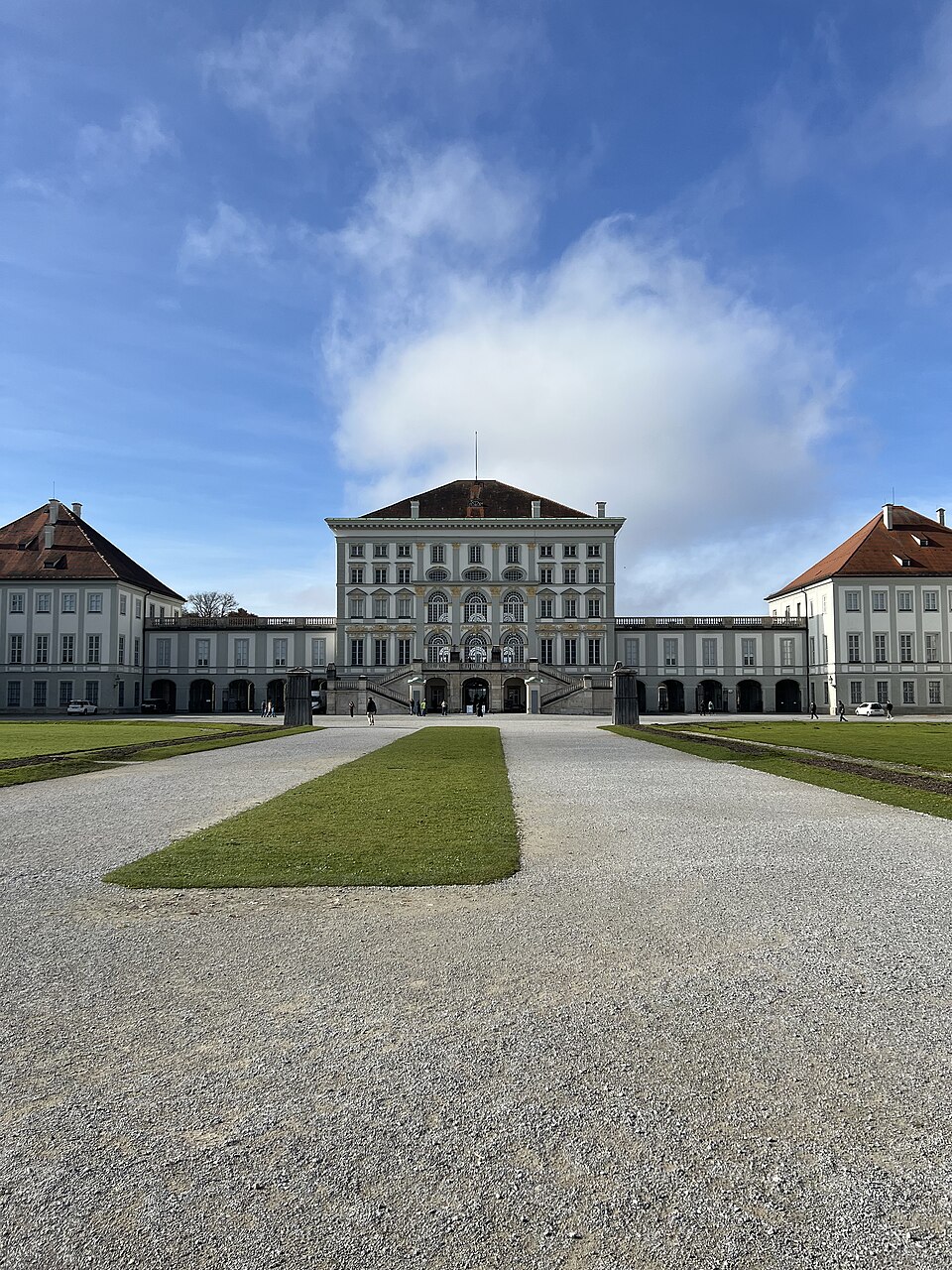
Private photography needs no permit, with conditions the administration states plainly: ordinary hand-held cameras only, and no additional lighting and no tripod. Anything beyond private use — photo and film shoots intended for further use, and flying a drone or multicopter over the grounds — requires advance approval and is charged. Wedding shoots inside the buildings are not possible at all, which catches out couples who have seen the Great Hall. For a visitor working within those limits, the two rooms worth slowing down in are the Great Hall, where the ceiling is the subject and a hand-held camera at 1/30 second against a doorframe does better than any attempt from the middle of the floor, and King Ludwig I's Gallery of Beauties, which is lit unevenly and rewards standing to one side of each portrait rather than square on. Outside, the strongest exterior is not from the cour d'honneur but from the far end of the canal on the town side, where the whole crescent compresses into one line; morning light falls on that face. The park side takes the afternoon. The Great Parterre fountain will not be running in 2026, so plan the composition around the parterre rather than the jet.
Checked 2026-08-26 · Source
Yes, there is no weekly closing day. From April to 15 October the palace, the Marstallmuseum and the Museum of Nymphenburg Porcelain open daily 9am to 6pm, and from 16 October to March daily 10am to 4pm. All objects are closed on 1 January, on Shrove Tuesday and on 24, 25 and 31 December. Last admission and ticket sales in every building are thirty minutes before closing time.
Nymphenburg Palace on its own costs 10 euros regular and 9 euros reduced. The Nymphenburg combination ticket, which adds the Marstallmuseum with the porcelain museum and the four park palaces, is 20 euros regular and 18 euros reduced from 1 April to 15 October, and 16 euros regular and 14 euros reduced from 16 October to 31 March. The Marstallmuseum alone is 8 and 7 euros, the Parkburgen ticket 6 and 5 euros. Children under 18 enter free.
The Bavarian Palace Administration does not publish a recommended duration. As a working figure, the twenty-one state rooms take about an hour, adding the Marstallmuseum and the porcelain collection brings it to roughly two and a half hours, and using a combination ticket in full — including the four pavilions spread across the park — makes it a half day of four to five hours, most of that spent walking.
Yes. Only tickets with time slots are sold for Nymphenburg Palace. Admission is possible up to a maximum of one hour after the chosen time, and there is no limit on how long a visitor stays inside once admitted. The Marstallmuseum and the park buildings can be visited without a time slot. Online tickets can be bought up to one day before the visit, and only a limited number are held back for the ticket offices each day.
No. Amalienburg, Badenburg, Pagodenburg and the Magdalenenklause open from April to 15 October and are closed from 16 October to March, and the Palace Chapel keeps the summer hours only. The park itself stays open all year, with the main gate open 6am to 6pm from January to March and in November and December. A winter combination ticket costs less for that reason.
Yes. The palace administration gives two routes: S-Bahn to Laim and then a bus to the Schloss Nymphenburg stop, or U-Bahn to Rotkreuzplatz and then a tram to the same stop. Drivers who do come will find about 450 free parking spaces at the palace and eight coach spaces, along with five designated disabled bays about 200 metres from the ticket office.
Loading the interactive map…
The interactive map could not be loaded.
Last updated:
Source: OpenStreetMap contributors, Wikidata ·