
_01.jpg)
_02.jpg)
_03.jpg)

4 min walk
Brandenburg Gate
- Must see · Heritage site
- Historic monument
Language · 1 published
Historic monument · Berlin
Denkmal für die ermordeten Juden Europas

| Monday | Closed |
|---|---|
| Tuesday | 10:00 – 18:00 |
| Wednesday | 10:00 – 18:00 |
| Thursday | 10:00 – 18:00 |
| Friday | 10:00 – 18:00 |
| Saturday | 10:00 – 18:00 |
| Sunday | 10:00 – 18:00 |
Checked 2026-08-26 · Source
The Memorial to the Murdered Jews of Europe is Germany's central Holocaust memorial, and it is two things at one address rather than one. Above ground is the Field of Stelae, Peter Eisenman's grid of grey concrete blocks covering 19,073 square metres between Ebertstrasse and the former ministerial gardens. Below it, reached by a staircase or a lift from the south-east corner, is the Information Centre, 800 square metres of exhibition documenting the persecution and murder of Europe's Jews and the places where it was carried out. Both are free.
The memorial commemorates the up to six million Jewish victims of the Holocaust. It was resolved by the German Bundestag on 25 June 1999 after eleven years of public argument that began with the journalist Lea Rosh's proposal in August 1988, and it cost 27.6 million euros in federal funds. The last stele was set in place on 15 December 2004, the memorial opened ceremonially on 10 May 2005 and was handed to the public two days later.
The Foundation's own figures give the stele count as 2,710 in its facts table and 2,711 in its construction history; the discrepancy is on the operator's page and is left as found here rather than resolved. The exhibition below draws close to half a million visitors a year.
Checked 2026-08-26 · Source
The field is walkable from all four sides and has no gate, no entrance and no route. Every stele is 0.95 metres wide and 2.38 metres long, and the gaps between them are also 0.95 metres, wide enough for one person and not two. Heights run from ground level to 4.7 metres: 811 stelae stand between 0.2 and 2 metres, 916 between 2 and 3.5 metres, and 872 between 3.5 and 4.7 metres, with 112 flush with the ground at the edges and along the public walkway. Each block leans between half a degree and two degrees. The tallest weigh about sixteen tonnes, the average about eight. Forty-one trees, pines and limes among them, mark the transition towards the Tiergarten.
The Information Centre underneath is arranged as a sequence of rooms rather than a chronology: a foyer, the Room of Dimensions, the Room of Families, the Room of Names, the Room of Sites, and a portal listing memorial sites across Europe. The ceiling repeats the stele grid overhead as coffers. All exhibition texts are in German and English. There is a free cloakroom, a reading room that shuts 45 minutes before the exhibition does, and a donation box at the exit.
Checked 2026-08-26 · Source
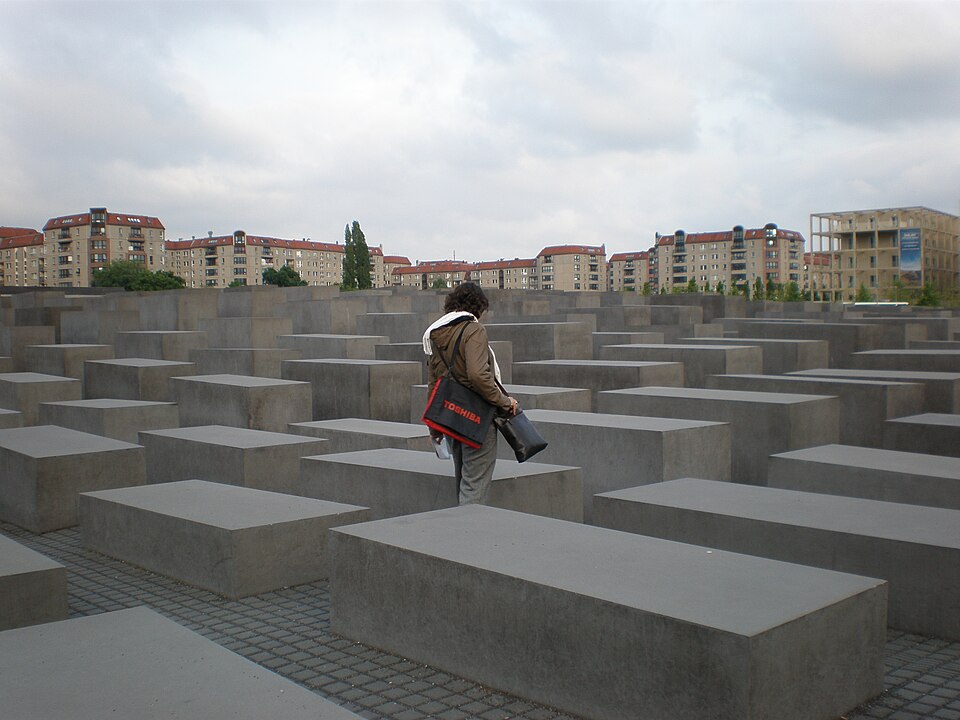
The Foundation recommends about one hour for the exhibition, and about ninety minutes for anyone using an audio guide, which runs 75 to 90 minutes. Neither figure includes the field above, and neither includes the queue.
Ninety minutes is the honest planning number for a first visit: twenty to thirty minutes walking the field, an hour below ground, and whatever the security check costs on the day. The Foundation states plainly that there may be waiting times, that their length depends on the day's events, and that registered groups holding a reserved slot are given precedence over individual visitors — so a mid-morning arrival in summer can lose fifteen minutes before reaching the stairs. The current wait is posted on site and nowhere else.
The field itself takes as long as it takes and cannot usefully be rushed; walking one corridor from end to end is the whole experience, and most people walk several. Anyone arriving with a fixed two-hour window should enter the exhibition first and keep the field for afterwards, because the exhibition has a last admission and the field does not. A visit that also takes the 45-minute guided tour of the field should be budgeted at two and a half hours.
Checked 2026-08-26 · Source
The Field of Stelae is accessible 24 hours a day, all year, with no ticket and no gate. The Information Centre beneath it opens Tuesday to Sunday, 10.00 to 18.00, with last admission 45 minutes before closing — 17.15, not 17.55. It is closed every Monday, with two published exceptions, 25 May and 29 December.
The other closures are worth writing down: 16 to 23 November, 24 to 26 December, and 31 December from 16.00. The Foundation has also closed the exhibition early in extreme heat — on 27 and 28 June 2026 it shut at 14.00 with last admission at 13.15 — so a heatwave is a reason to check the site the morning of a visit. The exhibition was shut for renovation from 12 January to 30 April 2026 and reopened on 1 May 2026 with the same regular hours, which the Foundation confirmed in its own announcement of 24 April 2026; some pages on the operator's site still carry the old closure banner.
For the hour rather than the day: the low winter sun and the hour before dusk do most for the field, and the exhibition is quietest immediately at opening. A free guided tour in English runs on the first Sunday of each month at 14.00, and one in German on the third Sunday at 14.00.
Checked 2026-08-26 · Source
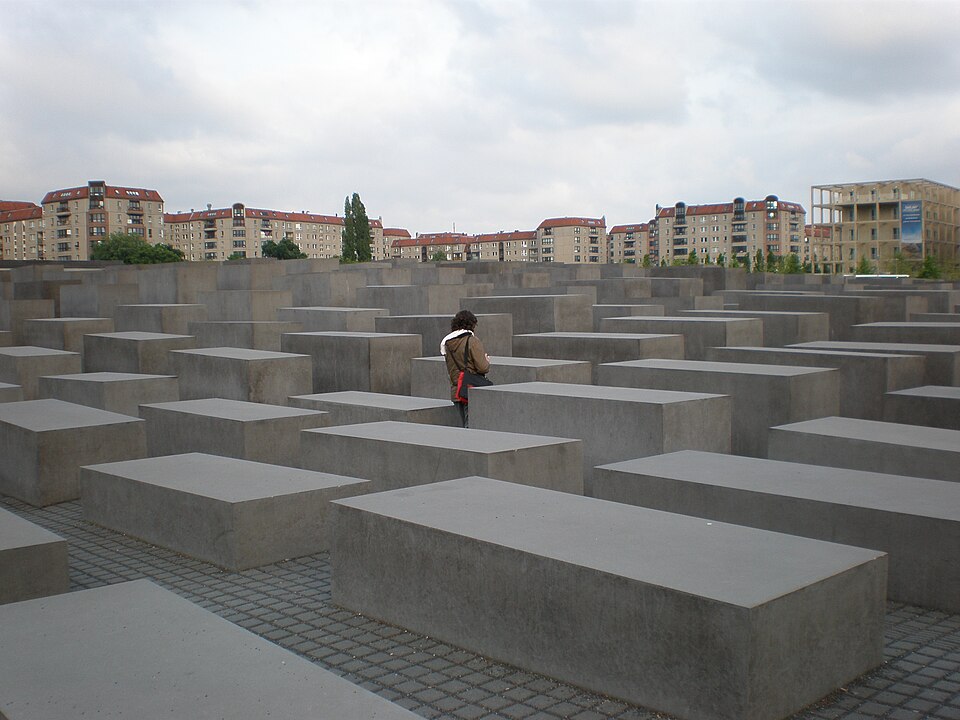
Admission is free. There is no ticket for the Field of Stelae and no ticket for the Information Centre, and that has been the case since the memorial opened in 2005. A donation box stands at the exhibition exit and the Foundation states that donations go towards the upkeep of the Information Centre; a bank transfer is also possible.
Two things are charged for. The audio guide costs 3 euros, reduced to 2 euros, and the reduction applies only to school groups — not to students, seniors or anyone else. It needs no advance booking and is collected at the reception desk in the Information Centre. There are two versions: a curatorial tour in German, English and Dutch, and an audio translation of the exhibition texts in French, Hebrew, Italian, Polish, Portuguese, Russian and Spanish. The desk takes cash, EC cards and Visa or Mastercard.
The other charge is the guided tour of the field, 45 minutes for up to 25 people, in any of nine languages and more on request. The Foundation's guided-tour page prints 85 euros, or 60 reduced, for 2026, and 90 euros, or 65 reduced, for 2027, with the higher prices applying to bookings made from 3 August 2026. It is booked through the visitor service, not bought at the door.
Checked 2026-08-26 · Source

The address is Cora-Berliner-Strasse 1, 10117 Berlin, on the south side of the field; that is where the stairs and the lift to the Information Centre are, and where guided tours meet. No car is needed and a car is a liability here: the Foundation states there are no parking spaces on site.
The nearest stops it names are Behrenstrasse/Wilhelmstrasse, S+U Brandenburger Tor and Ebertstrasse. Brandenburger Tor is the useful one for most visitors, on the S-Bahn and the U5, and the walk from the Brandenburg Gate south along Ebertstrasse to the north-west corner of the field takes about five minutes. Potsdamer Platz sits a similar distance to the south. The field's edges meet the pavement directly, so there is no approach and no forecourt — a visitor walking down Ebertstrasse is simply in it.
Coaches can set down and pick up at the marked spaces in Hannah-Arendt-Strasse, and park on Strasse des 17. Juni, on either side between the Brandenburg Gate and the Soviet War Memorial. Wheelchair users enter the field by thirteen marked axes, sloping at most 8 per cent, marked with grooved paving and floor pictograms at the pavement edge.
Checked 2026-08-26 · Source
Entry to the Information Centre is through a security gate, and it sets the practical rules. Bags larger than about 55 by 40 by 20 centimetres cannot be taken in or stored, and suitcases are refused outright; lockers are at Friedrichstrasse and Potsdamer Platz stations and the Hauptbahnhof. The cloakroom inside is free. Anything the security staff class as dangerous is held at the entrance and returned on the way out. The Foundation asks that mobile phones be switched off in the exhibition, not silenced.
The published visitor regulations for the field are short and specific. It is crossed on foot and slowly. Jumping from stele to stele is not permitted, nor is noise, nor bringing dogs or other pets — assistance dogs excepted in the Information Centre — nor bicycles, smoking or alcohol. Political demonstrations, flags and other symbols, begging and any sporting activity are named as disturbing the memory of the place. Visiting the field is at the visitor's own risk, year round: the ground undulates, the paving is uneven and the corridors are dark after nightfall.
The Foundation recommends the exhibition for visitors aged 14 and over. External guides, tour leaders and teachers are asked not to conduct tours inside it; the Foundation's own visitor consultants answer questions instead.
Checked 2026-08-26 · Source

Photography for private purposes is allowed both in the field and in the Information Centre, but flash is prohibited below ground. Photographs, film and television recordings for commercial purposes need the prior written consent of the Foundation, requested through the photo and filming permission form on its site, and press coverage or visitor surveys inside the exhibition need separate approval.
Beyond the rules, the field is harder to photograph well than it looks. The 0.95-metre gaps mean a wide lens or nothing: from inside a corridor, the frame is two grey walls and a strip of sky, and that austerity is the picture rather than a failure of one. Low sun raking along the east–west corridors at the start and end of the day is what separates the blocks; overcast noon flattens the whole field into one grey mass and is the least useful light there is. The best vantage on the mass of it is from the raised pavement on the edges, looking across the wave of the upper surface.
One line in the visitor regulations settles a common temptation: jumping from stele to stele is not permitted, which rules out the balancing and leaping shots the field attracts. Photographing people inside the field is possible without doing that, and quieter.
Checked 2026-08-26 · Source
No. Both the Field of Stelae and the Information Centre beneath it are free, and no ticket is issued for either. The Foundation notes that donations are welcome and keeps a donation box at the exhibition exit, with the money going towards the upkeep of the Information Centre; a bank transfer is also possible. The only charges are the audio guide, at 3 euros or 2 euros for school groups, and the booked 45-minute guided tour of the field.
The Field of Stelae is accessible 24 hours a day, every day of the year. The Information Centre underneath opens Tuesday to Sunday, 10.00 to 18.00, and last admission is 45 minutes before closing, at 17.15. It is closed every Monday apart from 25 May and 29 December, closed 16 to 23 November and 24 to 26 December, and closes at 16.00 on 31 December. The reading room shuts 45 minutes before the exhibition does.
The Foundation recommends about one hour for the exhibition, or about 90 minutes with an audio guide, whose two tours run 75 to 90 minutes. Neither figure covers the field above or the security queue. Ninety minutes is a realistic total for a first visit — twenty to thirty minutes in the field, an hour below — and two and a half hours if the 45-minute guided tour of the field is added. The Foundation warns that waiting times vary by day and that booked groups are admitted ahead of individual visitors.
Yes, for private purposes, in the field and in the Information Centre alike — but without flash below ground. Photographs, film and television recordings for commercial purposes require the prior written consent of the Foundation, which takes requests through the photo and filming permission form on its website, and press coverage or visitor surveys inside the exhibition need separate approval. The visitor regulations also forbid jumping from stele to stele, which rules out the balancing shots the field attracts.
No car is needed, and driving is the worst option: the Foundation states that there are no parking spaces on site. The stops it names as nearest are Behrenstrasse/Wilhelmstrasse, S+U Brandenburger Tor and Ebertstrasse, and the walk south from the Brandenburg Gate along Ebertstrasse takes about five minutes. Coaches may set down at the marked spaces in Hannah-Arendt-Strasse and park on Strasse des 17. Juni, between the Brandenburg Gate and the Soviet War Memorial.
Entry is through a security gate. Suitcases are refused, and bags larger than roughly 55 by 40 by 20 centimetres can neither be carried in nor stored, so lockers at Friedrichstrasse station, Potsdamer Platz or the Hauptbahnhof are the answer for anyone arriving with luggage. A free cloakroom handles smaller items. Dogs are not admitted apart from assistance dogs, food, alcohol and glass bottles are not permitted, and the Foundation asks that mobile phones be switched off inside the exhibition.
Loading the interactive map…
The interactive map could not be loaded.
Last updated:
Source: OpenStreetMap contributors, Wikidata ·