Museum · Berlin
Berlin Wall Memorial
Gedenkstätte Berliner Mauer (Dokumentationszentrum)
Photograph
,_Gedenkst%C3%A4tte_Berliner_Mauer_--_2021_--_9368.jpg)
Opening hours
| Monday | 08:00 – 22:00 |
|---|---|
| Tuesday | 08:00 – 22:00 |
| Wednesday | 08:00 – 22:00 |
| Thursday | 08:00 – 22:00 |
| Friday | 08:00 – 22:00 |
| Saturday | 08:00 – 22:00 |
| Sunday | 08:00 – 22:00 |
Checked 2026-08-26 · Source
- Today
- Open today, 08:00 – 22:00
- Visit duration
- 2 hours
- Accessibility
- Not recorded
- Price
- Free entry
- Standing
- Must see
- Rank
- Rank 10 of 17,948
What it is
The Berlin Wall Memorial occupies 1.4 kilometres of Bernauer Strasse, the street where the border between Wedding and Mitte ran directly along the front doors of the East Berlin houses. That geometry made the street notorious. In the first days after 13 August 1961 residents fled from their own windows, some sliding down ropes, some jumping into the nets of the West Berlin fire brigade, and the first deaths caused by the border regime happened here. Ten people died in the area the memorial now covers, all of them in the 1960s; the Berlin Wall Foundation records at least 140 dead at the Wall as a whole.
The memorial exists because a handful of people refused to let the last long section be broken up for souvenirs. One day before reunification, on 2 October 1990, the East Berlin magistrate placed the stretch of border crossing the Sophien Cemetery under monument protection, and Pastor Manfred Fischer of the Reconciliation Parish spent the following months arguing with wall peckers and turning demolition crews away. The competition-winning monument was inaugurated on 13 August 1998, the Documentation Center opened on 9 November 1999, and in 2006 the Berlin Senate made Bernauer Strasse the central site of remembrance for the divided city. The expansion that produced the site as it stands today was completed in 2014.
Checked 2026-08-26 · Source
What's inside
The site has four parts, on both sides of the street, and no ticket links them because none of them is ticketed.
The outdoor exhibition runs along the former border strip on what was the East Berlin side, in four themed areas: the Wall and the death strip, the destruction of the city, building the Wall, and everyday life at the Wall. Corten steel marks what is no longer there, including the demolished border houses, the dynamited Church of Reconciliation and the escape tunnels, while archaeological windows expose older layers underneath, among them an excavated stretch of Bergstrasse that the Wall still divides. The Window of Remembrance carries the names, dates and photographs of the Wall's victims. The Chapel of Reconciliation and the Rye Field, sown here since 2005, stand on the same ground.
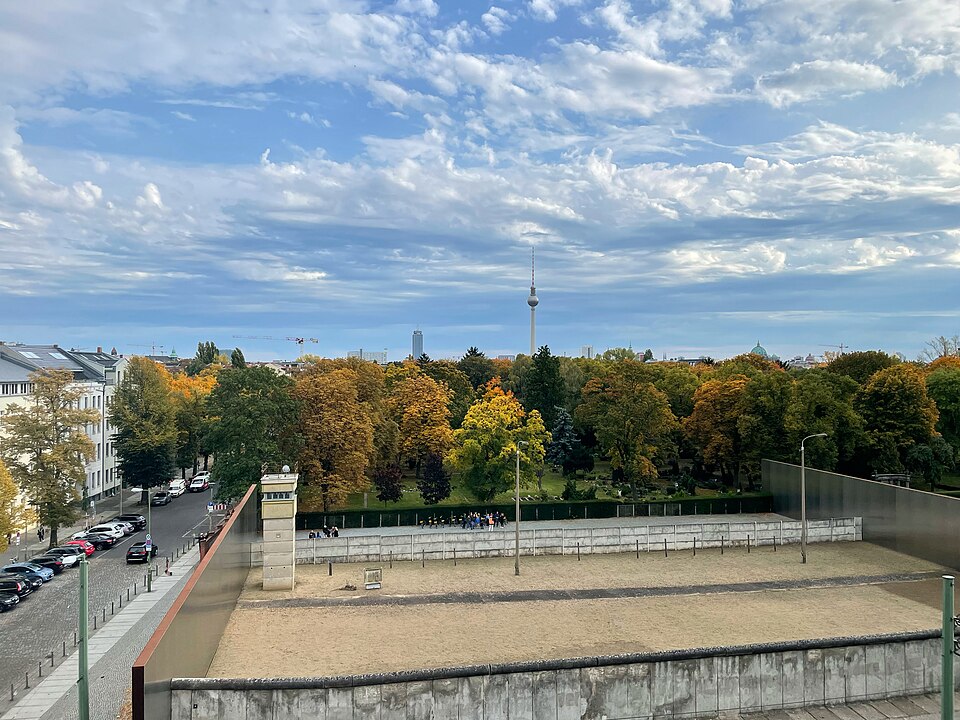
Across the street, on what was West Berlin, are the Visitor Center at Bernauer Strasse 119 and the Documentation Center at number 111. The Visitor Center is where a visit should begin: an orientation desk, area flyers and a film room. The Documentation Center holds the 420-square-metre permanent exhibition "1961 | 1989. The Berlin Wall", an Archive of Memory of contemporary witnesses, and the observation tower that looks down on the preserved strip. A fourth exhibition, "Border and Ghost Stations in Divided Berlin", sits inside Nordbahnhof S-Bahn station.
Checked 2026-08-26 · Source
How long to spend
The foundation publishes no suggested visit length, so the figure below is judgement rather than a quoted fact, built from the two durations it does publish: its public overview tours last around an hour, and the outdoor exhibition runs 1.4 kilometres end to end.
Two hours is the honest planning figure for the whole site and it is what this guide records. That covers the introductory film in the Visitor Center, the core 500 metres of outdoor exhibition between Gartenstrasse and Strelitzer Strasse, the observation tower, and the permanent exhibition in the Documentation Center at a pace that lets you read rather than skim.
An hour is enough if you accept a narrower visit: the film, the preserved strip opposite the Documentation Center, the tower and the Window of Remembrance, and nothing further east. Three hours is not excessive if you walk the full 1.4 kilometres, stop at the incident markers, and sit down in the Archive of Memory, and a joined public tour adds an hour on top of whatever you do alone. Reading the outdoor panels is slow work in cold or wet weather because there is almost no shelter along the strip, so budget generously in winter.
Checked 2026-08-26
Season and crowds
The two halves of the site keep different hours, and the difference is the single most useful thing to know before setting out.
The outdoor exhibition on the memorial grounds is accessible Monday to Sunday, 8 a.m. to 10 p.m. The Visitor Center and the Documentation Center open Tuesday to Sunday, 10 a.m. to 6 p.m., and are closed on Mondays; the last ascent to the observation tower is 5.45 p.m. The foundation states that regular opening hours apply on public holidays. The Nordbahnhof ghost station exhibition can be visited during the station's own opening hours.
The introductory films run to a fixed clock in the Visitor Center. In German, "Die Berliner Mauer" with English subtitles starts on the hour and "Eingemauert" at quarter past; in English, "The Berlin Wall" with German subtitles starts on the half hour and "Walled In" at quarter to. Arrive a few minutes before one of those four marks rather than after. The foundation warns that the film room can be closed at short notice for internal events and names +49 (0)30 213085-123 as the number to call; it lists 5 August and 10 September 2026 as full-day closures of that room.
A weekday morning is the quietest time to walk the strip, and low winter sun reaches into the excavated cellars that midday flattens.
Checked 2026-08-26 · Source
Tickets
Admission to all exhibitions on Bernauer Strasse is free. That covers the outdoor exhibition, the Visitor Center and its film room, the permanent exhibition and observation tower in the Documentation Center, and the Nordbahnhof ghost station display. Individual visitors and small groups do not need to register in advance, and the introductory film can be watched without booking.
Only the guided programme is charged. A public tour costs 5 euros, or 3 euros at the reduced rate; a tour running longer than 90 minutes costs 7 euros, reduced 4 euros; a workshop costs 12 euros, reduced 8 euros. Public overview tours are free for schoolchildren and require no registration, and the foundation states that they last around an hour and are conducted with audio guides. Children under seven, people with severe disabilities, medically recognised accompanying persons and media representatives go free.
Group offers must be booked in advance and are priced as a fixed sum per booking rather than per head: 80 euros for a group tour, 50 euros reduced; 120 euros for a group tour of 90 minutes or longer, 75 euros reduced; 150 euros for a workshop, witness talk or educator training, 95 euros reduced. Payment on site is by cash or card, and groups can arrange to be invoiced.
Checked 2026-08-26 · Source
,_Gedenkst%C3%A4tte_Berliner_Mauer_--_2021_--_9371.jpg)
Getting there
No car is needed and the foundation actively discourages driving. The address is Bernauer Straße 119, 13355 Berlin.
Nordbahnhof is the station to aim for. S-Bahn lines S1, S2, S25 and S26 stop there, as does tram M10, and bus 247 stops at S Nordbahnhof/Gartenstr. Leave the station by the Gartenstrasse / Bernauer Strasse exit and the Visitor Center is directly across the road; the foundation's own directions for visually impaired visitors describe roughly fifteen metres from the crossing to the door, and note a temporary covered walkway outside the exit while construction continues. On the U-Bahn, U6 stops at Naturkundemuseum and U8 at Bernauer Straße; the U8 station sits at the far end of the memorial from Nordbahnhof, which makes it a reasonable place to finish rather than to start.
The core of the outdoor exhibition, about 500 metres of it, lies between Gartenstrasse and Strelitzer Strasse, so arriving at Nordbahnhof puts you at the dense end and lets you walk east through the thinner sections.
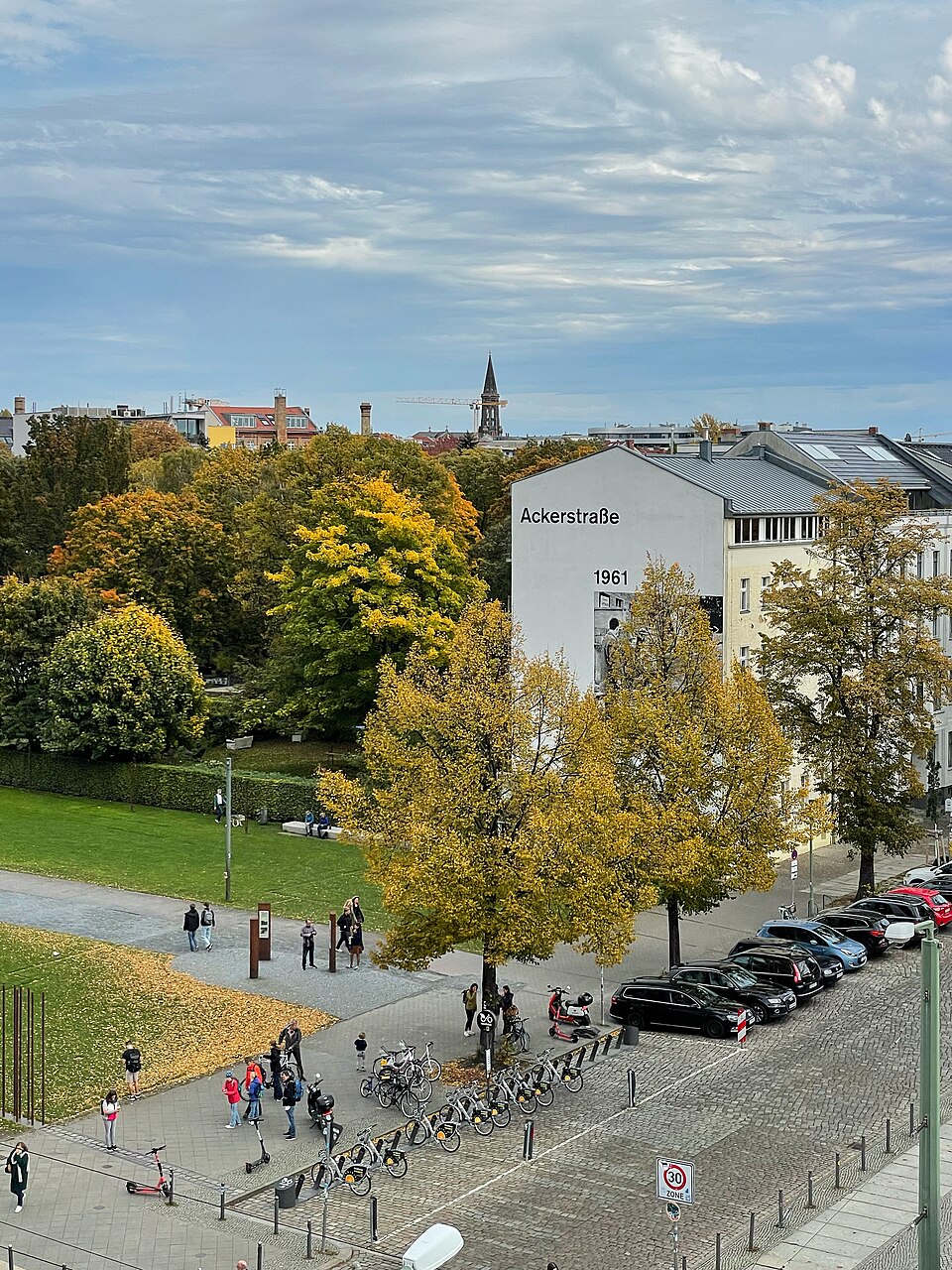
Parking in Gartenstraße is strictly prohibited, especially on the cycle lane. Coaches park on Ackerstrasse. Two public disabled bays sit directly behind the Visitor Center, reached from Gartenstrasse, and two more are on Ackerstrasse about 150 metres from the Documentation Center.
Checked 2026-08-26 · Source
What to watch out for
The Monday trap is the one that wastes journeys. The grounds are open every day, so a Monday visitor can walk the whole strip, but the Visitor Center and the Documentation Center are shut, which means no film, no permanent exhibition and no observation tower. Check before you commit a Monday morning to it.
The foundation's own pages give two different accounts of accessibility and both are recorded here rather than blended. Its accessibility section says the outdoor exhibition is mostly barrier-free, with the core area between Gartenstrasse and Strelitzer Strasse the easiest going; its frequently asked questions say the outdoor grounds are only partially accessible to people with disabilities. Both agree that the Visitor Center, the Documentation Center and the seminar rooms are barrier-free. A Euro key operates the Documentation Center lift and the accessible toilets, and either centre will lend one against an identity document. Wheelchairs, mobile seats and seat sticks are lent free at the Visitor Center desk, and both buildings have changing facilities, though you bring your own nappies and wipes.
Eating, drinking and smoking are not allowed in either building; lockers and a cloakroom are available. Dogs may walk the grounds on a lead, but only assistance dogs come inside.
Checked 2026-08-26 · Source
Photography
The rules are explicit and worth reading before you lift a camera. Photography and filming in the exhibitions are permitted for private use only. Tripods and selfie sticks are not allowed. Professional film and video work has to be cleared with the foundation's press department first, and the site states a fine of 500 euros for each act of infringement.
Within those limits the site rewards patience. The picture the memorial is known for is taken from the observation tower in the Documentation Center, looking down on the one preserved stretch where the wall, the patrol path and the inner barrier still stand in sequence; from ground level that arrangement collapses into a single line of concrete and cannot be read at all. The last ascent is 5.45 p.m., so the tower is unavailable for the best of a summer evening.
Low sun is what makes the outdoor exhibition photograph well. It rakes across the patrol path, throws the wall's shadow onto the open ground, and reaches into the excavated cellars of the border houses that flat midday light turns into grey rectangles. The Window of Remembrance is a wall of portraits of the dead, and photographing it in front of people who have come to remember someone deserves a moment's restraint.
Checked 2026-08-26 · Source
Common questions
Does the Berlin Wall Memorial charge admission?
No. The Berlin Wall Foundation states that admission to all exhibitions on Bernauer Strasse is free, which covers the outdoor exhibition, the Visitor Center and its film room, the permanent exhibition and observation tower in the Documentation Center, and the ghost station exhibition inside Nordbahnhof. Only the guided programme is charged: a public tour costs 5 euros, reduced 3 euros, and a tour running longer than 90 minutes costs 7 euros, reduced 4 euros. Individual visitors do not need to book anything in advance.
Is the memorial open on Mondays?
Partly. The outdoor exhibition on the memorial grounds is accessible Monday to Sunday, 8 a.m. to 10 p.m., so the preserved border strip, the monument, the Window of Remembrance and the Chapel of Reconciliation can all be seen on a Monday. The Visitor Center and the Documentation Center, however, open Tuesday to Sunday only, 10 a.m. to 6 p.m., so on a Monday there is no introductory film, no permanent exhibition and no access to the observation tower. The foundation states that regular opening hours apply on public holidays.
How long does a visit take?
Allow two hours for the whole site. The foundation publishes no suggested visit length, so that is a planning judgement rather than a quoted figure: it is built from the two durations it does publish, namely that its public overview tours last around an hour and that the outdoor exhibition runs 1.4 kilometres. Two hours covers the film, the core 500 metres of outdoor exhibition, the observation tower and the indoor permanent exhibition at a readable pace. An hour is workable if you stay near the Documentation Center; three hours suits walking the full length.
Do I need to book in advance?
Not as an individual or a small group. The foundation states that no advance registration is needed to visit the exhibitions or to watch the introductory film, and that its public overview tours require no registration either. Group offers are different: they must be booked in advance through the request form on the foundation's site, and they are priced as a fixed sum per booking rather than per person, from 80 euros for a group tour to 240 euros for a simulation game or project day. Payment on site is by cash or card, and groups can be invoiced.
How do I get there, and do I need a car?
No car is needed. Nordbahnhof is the closest station and is served by S-Bahn lines S1, S2, S25 and S26, by tram M10, and by bus 247 at the stop S Nordbahnhof/Gartenstr. Leaving by the Gartenstrasse / Bernauer Strasse exit puts you directly across the road from the Visitor Center at Bernauer Straße 119. On the U-Bahn, U6 stops at Naturkundemuseum and U8 at Bernauer Straße, at the far end of the memorial. Parking in Gartenstraße is strictly prohibited; coaches park on Ackerstrasse.
Can I take photographs at the memorial?
Yes, for private use only. The foundation permits photography and filming in the exhibitions for private purposes but does not allow tripods or selfie sticks, requires professional film and video work to be cleared with its press department in advance, and states a fine of 500 euros for each act of infringement. The view most worth the effort is from the observation tower in the Documentation Center, which looks down on the one stretch where the wall, patrol path and inner barrier survive in sequence; the last ascent is 5.45 p.m.
Where it is
Loading the interactive map…
The interactive map could not be loaded.
Nearby
In Berlin
Same category
Fit it into a plan
External links
Last updated:
Source: OpenStreetMap contributors, Wikidata ·