.jpg)
1 min walk
Museum of Sacred Art and Crypt
- Must see · Heritage site
- Museum
Language · 11 published
Historic monument · Macau
大三巴牌坊 Ruínas de São Paulo
Reviewed by Elena Voss · SSMTour Travel Editor

| Monday | 09:00 – 18:00 |
|---|---|
| Tuesday | 09:00 – 14:00 |
| Wednesday | 09:00 – 18:00 |
| Thursday | 09:00 – 18:00 |
| Friday | 09:00 – 18:00 |
| Saturday | 09:00 – 18:00 |
| Sunday | 09:00 – 18:00 |
Checked 2026-08-31 · Source
Read from the OpenStreetMap access tags; anything not listed has no tag recorded.
Set the group type to family in the planner and the day window contracts to about three quarters of a solo day.
The Ruins of St. Paul's are the surviving granite facade of the Church of Mater Dei and the remains of St. Paul's College in Macau. The seventeenth-century complex was destroyed by fire in 1835, leaving the richly carved facade as its defining monument. The site connects Portuguese religious architecture, Jesuit history, and Macau's role in cultural exchange across East Asia. It forms part of the Historic Centre of Macau, inscribed by UNESCO as a World Heritage site. Paul's, known locally as 大三巴牌坊, constitute the surviving facade of the Church of Mater Dei and the ruins of St. Paul's College. This seventeenth-century Portuguese religious complex was destroyed by fire in 1835, leaving only the intricately carved granite facade standing. The site represents a significant monument of Macau's colonial heritage and Christian missionary history in East Asia. It forms part of the Historic Centre of Macau, which UNESCO inscribed on its World Heritage List. The Ruins of St. Paul's forms part of the Historic Centre of Macau, which UNESCO inscribed on the World Heritage List.
Checked 2026-08-26 · Source
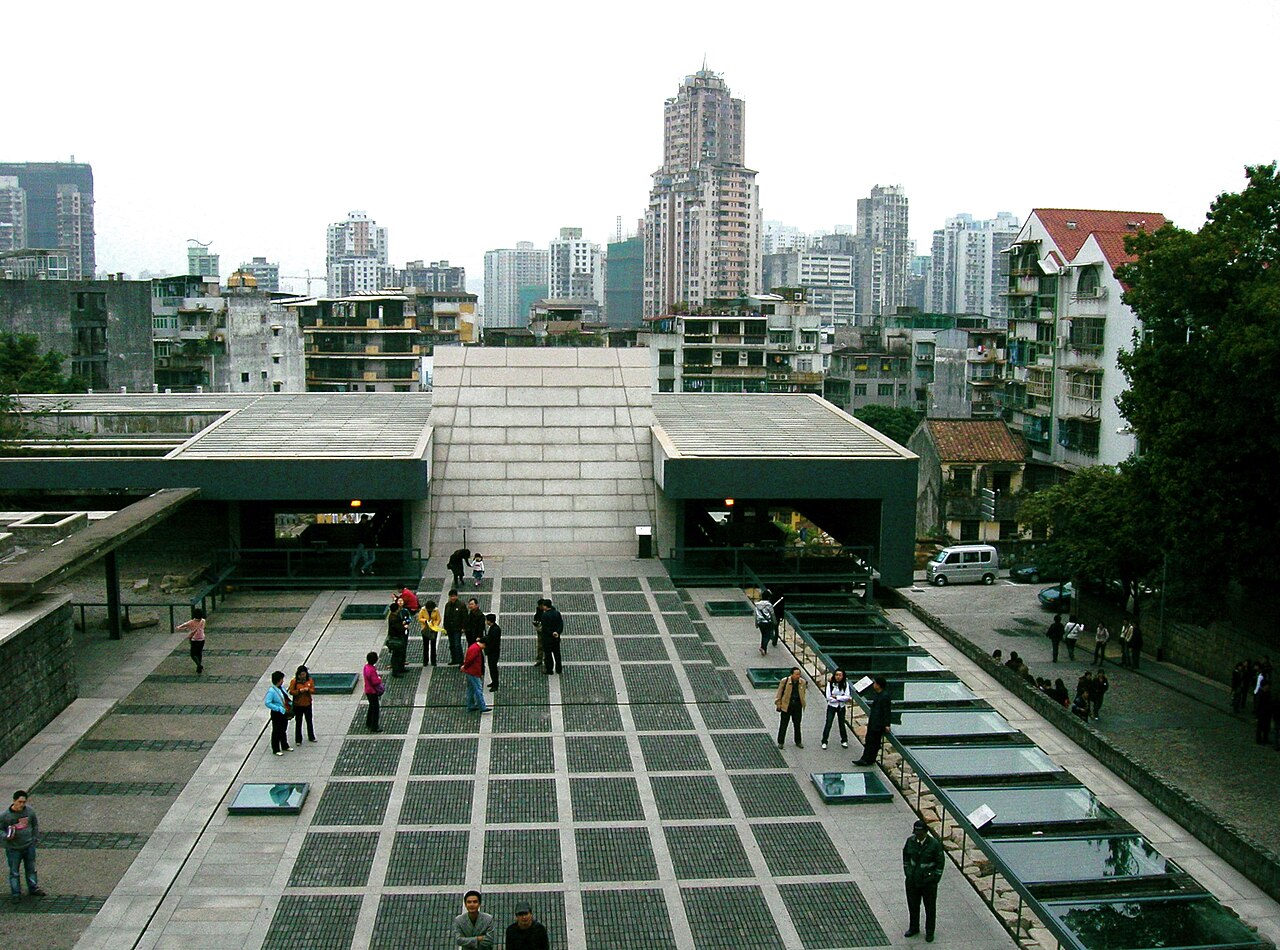
The main sight is a facade approximately twenty-three metres wide and arranged in five tiers. Its granite surface combines European Renaissance forms with Oriental motifs, including biblical scenes, Chinese characters, Japanese chrysanthemums, and Portuguese sailing ships. Behind it are church and college foundations, while a small crypt museum presents religious artefacts such as paintings and sculptures. Walk close to the stonework to study details that are easy to miss from the busy square below. Visitors encounter the imposing granite facade standing approximately twenty-three metres across five tiers. The structure features elaborate carvings blending European Renaissance and Oriental decorative motifs. Biblical scenes, Chinese characters, Japanese chrysanthemums, and Portuguese sailing ships adorn the stonework. Behind the facade lie the remains of the college and church foundations. A small museum occupies the former crypt, displaying religious artefacts including paintings and sculptures. The site offers interpretive displays explaining the Jesuit mission and the building's architectural significance.
Checked 2026-08-26 · Source
A quick visit for photographs can take fifteen to twenty minutes. Allow forty-five minutes to an hour if you want to examine the carvings, read the displays, and visit the crypt museum. The staircase and crowded approach can slow movement, particularly at busy times. The monument works well as part of a longer walk through Macau's Historic Centre, where nearby streets and heritage buildings extend the cultural experience.
Checked 2026-08-26 · Source
The facade is an outdoor landmark visible throughout the day. Early morning brings cooler conditions and fewer visitors, while weekends, public holidays, Chinese New Year, and Christmas can make the surrounding lanes especially busy. Macau's summers are hot and humid; winters are milder. Evening illumination gives the facade a different mood, although the stone's smallest details are easier to read in daylight.
Checked 2026-08-26 · Source
The exterior facade has historically been free to view, and the crypt museum has also operated without an admission charge. Treat the facade as a public monument reached on foot through the Historic Centre. Separate nearby attractions, including Monte Fort, can have their own arrangements. The surrounding district is filled with shops and food businesses, so carry a practical payment method for purchases during the walk.
Checked 2026-08-26 · Source
The monument stands on the Macau Peninsula, close to Senado Square and other Historic Centre sights. Public buses stop within walking distance, while taxis and ride-hailing services can bring visitors to the base of the staircase. From the ferry terminal or border gate, onward transport is needed. Once in the heritage district, walking is the most natural way to connect the Ruins of St. Paul's with surrounding landmarks through narrow, signposted streets.
Checked 2026-08-26 · Source
The stone staircase can become slippery in rain and congested during peak periods. The exposed facade offers little shade, so warm-weather visitors benefit from water and sun protection. Keep belongings secure in dense crowds and move carefully through the narrow lanes, where vendors and pedestrians share limited space. The historic stairs create substantial mobility challenges, and evening light can make surface details harder to see.
Checked 2026-08-26 · Source
The clearest frontal view is from the base of the staircase, although crowds are part of the scene at busy times. Early morning and late afternoon light can bring out the carved granite. A wide-angle lens helps fit the tall facade into the frame, while a telephoto lens reveals details in the upper tiers. Monte Fort offers a higher viewpoint. Night lighting changes the mood, but daylight is better for close architectural study.
Checked 2026-08-26 · Source
The surviving monument is the granite facade of the Church of Mater Dei, together with church and college foundations and a crypt museum.
They preserve Macau's Portuguese religious and Jesuit heritage and form part of the UNESCO-listed Historic Centre of Macau.
The carvings include biblical scenes, Chinese characters, Japanese chrysanthemums, Portuguese sailing ships, and other blended European and Oriental motifs.
Allow fifteen to twenty minutes for a brief visit, or forty-five minutes to an hour for the carvings and crypt museum.
Public buses stop nearby, and taxis can reach the base of the staircase; the site is also walkable from Senado Square.
The steep historic staircase creates significant mobility challenges, especially in wet weather or dense crowds.
Loading the interactive map…
The interactive map could not be loaded.


Last updated:
Source: OpenStreetMap contributors, Wikidata ·