

9 min walk
Galileo Galilei Planetarium
- Must see
- Historic monument
Language · 11 published
Entertainment venue · Buenos Aires
Jardín Japonés
| Monday | 10:00 – 18:30 |
|---|---|
| Tuesday | 10:00 – 18:30 |
| Wednesday | 10:00 – 18:30 |
| Thursday | 10:00 – 18:30 |
| Friday | 10:00 – 18:30 |
| Saturday | 10:00 – 18:30 |
| Sunday | 10:00 – 18:30 |
Checked 2026-08-31 · Source
Read from the OpenStreetMap access tags; anything not listed has no tag recorded.
Set the group type to family in the planner and the day window contracts to about three quarters of a solo day.
The Buenos Aires Japanese Gardens, known locally as Jardín Japonés de Buenos Aires, constitute a public garden space in the Argentine capital. Established through cultural exchange between Argentina and Japan, the gardens represent one of the largest Japanese-style garden installations outside Japan. The site occupies a portion of the Parque Tres de Febrero complex in the Palermo neighborhood. The gardens serve as a cultural landmark reflecting Japanese landscape design traditions adapted to an Argentine setting, maintained as a destination for both local residents and international visitors seeking contemplative green space within the metropolitan environment.
Checked 2026-08-31 · Source
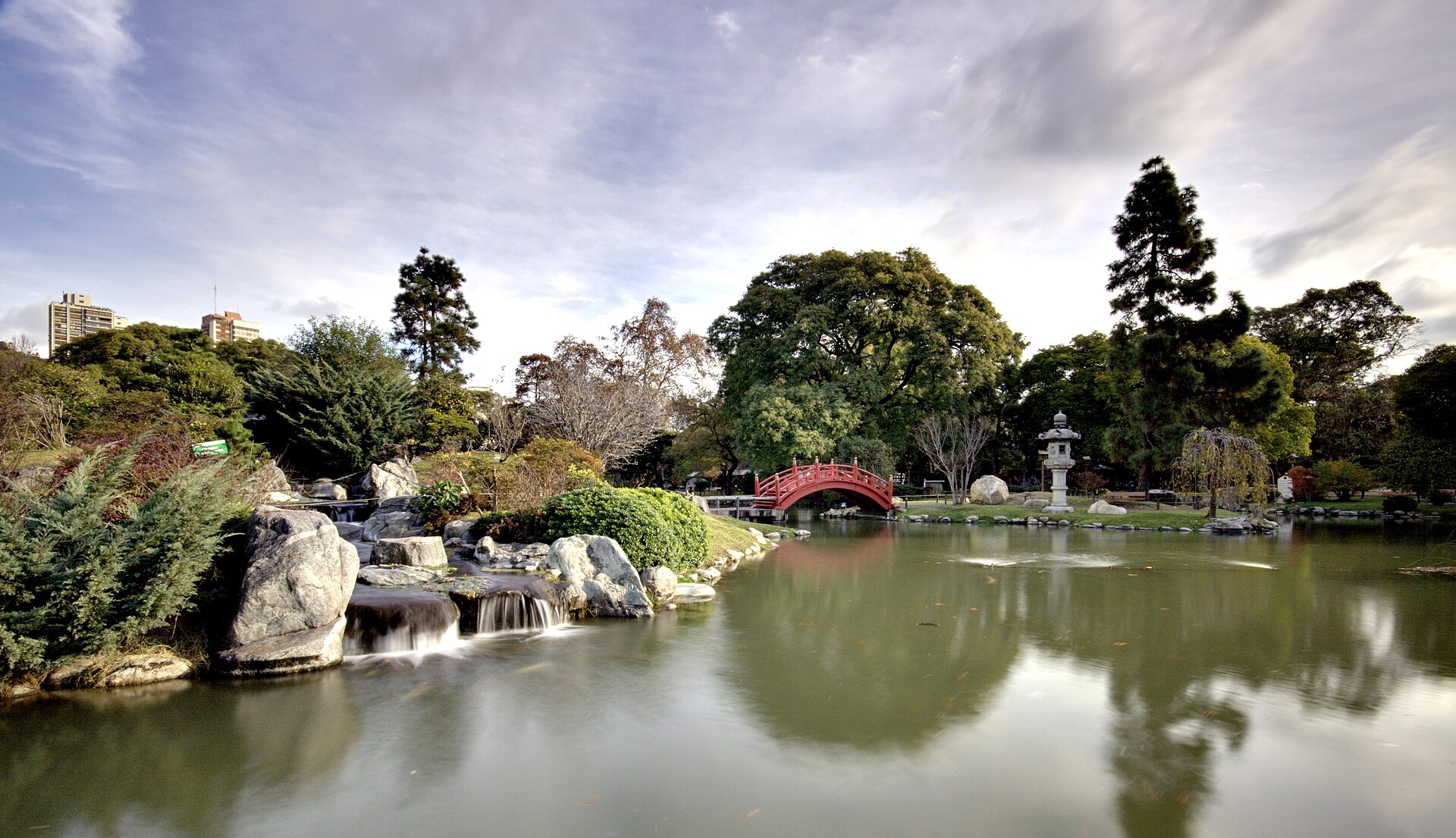
The gardens incorporate traditional Japanese landscape elements including bridges, water features, stone arrangements, and manicured plantings. A central lake dominates the composition, crossed by characteristic arched bridges. Pavilions and structures in Japanese architectural style provide focal points throughout the grounds. Koi fish inhabit the water features. The overall design follows principles of borrowed scenery and controlled vistas typical of Japanese garden tradition, creating sequential spatial experiences as visitors progress through the circuit.
Checked 2026-08-31 · Source
Visitor duration varies substantially based on individual engagement patterns. Casual circuit completion requires approximately forty-five to sixty minutes at moderate pace. Photography enthusiasts, sketch artists, and those seeking meditative stillness typically extend visits to ninety minutes or beyond. The compact footprint relative to larger botanical institutions means exhaustive exploration remains achievable within half a day. Seasonal variations in foliage and light conditions may influence desired duration. Visitors combining the gardens with adjacent Parque Tres de Febrero attractions should allocate accordingly, though the Japanese Gardens function as a self-contained experience not requiring extended commitment.
Checked 2026-08-31 · Source
Daily 10:00–18:30, including Saturdays, Sundays and public holidays. The ticket office operates 10:00–18:00. There are no regular closure days, and the garden remains open during rain. The gardens experience highest visitor density during weekend periods and Argentine public holidays, particularly spring months when surrounding parklands attract increased leisure activity. Summer afternoons may prove uncomfortable given limited shade coverage in certain sectors. Autumn provides favorable conditions for photography with deciduous color changes. Winter visitation offers reduced crowding though diminished horticultural display. Morning hours generally provide superior light quality for visual documentation and cooler temperatures during warmer seasons. Visitors should verify current operational status before travel planning as seasonal adjustments or special events may affect accessibility.
Checked 2026-08-31 · Source
General admission is ARS 8,000 for Argentine residents presenting DNI and ARS 24,000 for non-residents. The gardens have historically operated with admission fees distinguishing general entry from potential preferential rates for residents, seniors, students, or children, though specific categories and verification requirements remain unverified. Group arrangements or guided service supplements, if available, lack confirmed pricing structure. Visitors should anticipate carrying sufficient local currency as electronic payment infrastructure may be limited. Budget-conscious travelers might consider integration with broader Palermo park visitation to optimize expenditure distribution across multiple attractions within the same travel radius.
Checked 2026-08-31 · Source
Enter at Av. Casares 3500, between Av. Berro and Av. del Libertador, in Parque 3 de Febrero. Subway Line D serves Plaza Italia station; from there, the operator describes an approximately eight-block walk alongside Ecoparque. Bus lines 10, 15, 37, 59, 60, 67, 93, 95, 102, 108, 110, 118, 128, 130, 141, 160 and 188 serve the area. The gardens situate within Palermo, accessible via Buenos Aires public transit network. Multiple bus corridors serve the surrounding Parque Tres de Febrero area. The nearest Subte stations require supplementary walking or transfer to surface transport. Taxi and rideshare services provide direct access with drop-off points near principal entrances. Cycling infrastructure in adjacent park sectors supports bicycle arrival. On-foot approaches from nearby Palermo residential and commercial zones involve traversing substantial parkland. Visitors should consult current transit applications for routing as service patterns undergo periodic modification. Signage from major park access points generally indicates Japanese Gardens directionality.
Checked 2026-08-31 · Source
Ramps provide step-free routes, but the operator describes some as assisted ramps. An elevator is available. Accessible toilets are available. A tactile map uses relief, textures, contrasting colours and Braille references. The gardens feature water-adjacent walkways without continuous protective barriers in all sectors, requiring attention particularly for accompanying children. Paved surfaces may become slippery following rainfall or routine irrigation. Peak visitation creates congestion at bridge crossings and narrow path segments. Sun exposure is significant in open areas; protective measures advisable during extended stays. The contemplative purpose of the space suggests visitors moderate noise levels and respect designated quiet zones. Personal belongings require standard urban vigilance given public accessibility. Wildlife interactions, principally avian and aquatic species, should observe non-feeding protocols to maintain ecological balance and animal health.
Checked 2026-08-31 · Source
The garden design presents numerous composed vantage points leveraging water reflections, structural framing, and vegetation backdrops. Morning directional light enhances east-facing compositions; afternoon conditions favor western exposures. Overcast skies reduce harsh shadow contrast beneficial for detailed botanical documentation. Tripod usage may attract scrutiny; discreet support equipment advisable. The iconic red bridge and central pavilion constitute heavily reproduced subjects; patient timing yields less populated captures. Seasonal variation dramatically alters chromatic palette and atmospheric quality. Respect for other visitors' experience should govern positioning and duration at congested viewpoints.
Checked 2026-08-31 · Source
No. The garden remains open during rain, although guided tours are cancelled in rainy conditions.
Children under 12 enter free when they present DNI and are accompanied by an adult.
Argentine citizens and permanent residents over 65 enter free when they present Argentine DNI.
Yes. Visitors presenting a Certificado Único de Discapacidad enter free.
Pets are prohibited, except officially credentialed companion animals.
They run at 11:00 on Saturdays, Sundays and public holidays. Places are limited and allocated in arrival order; advance registration is not required.
Loading the interactive map…
The interactive map could not be loaded.


Last updated:
Source: OpenStreetMap contributors, Wikidata ·