

2 min walk
One Pillar Pagoda
- Must see
- Place of worship
Language · 11 published
Museum · Hanoi
Bảo tàng Hồ Chí Minh
| Monday | Closed |
|---|---|
| Tuesday | 08:00 – 16:30 |
| Wednesday | 08:00 – 16:30 |
| Thursday | 08:00 – 16:30 |
| Friday | Closed |
| Saturday | 08:00 – 16:30 |
| Sunday | 08:00 – 16:30 |
Checked 2026-08-31 · Source
Read from the OpenStreetMap access tags; anything not listed has no tag recorded.
Set the group type to family in the planner and the day window contracts to about three quarters of a solo day.
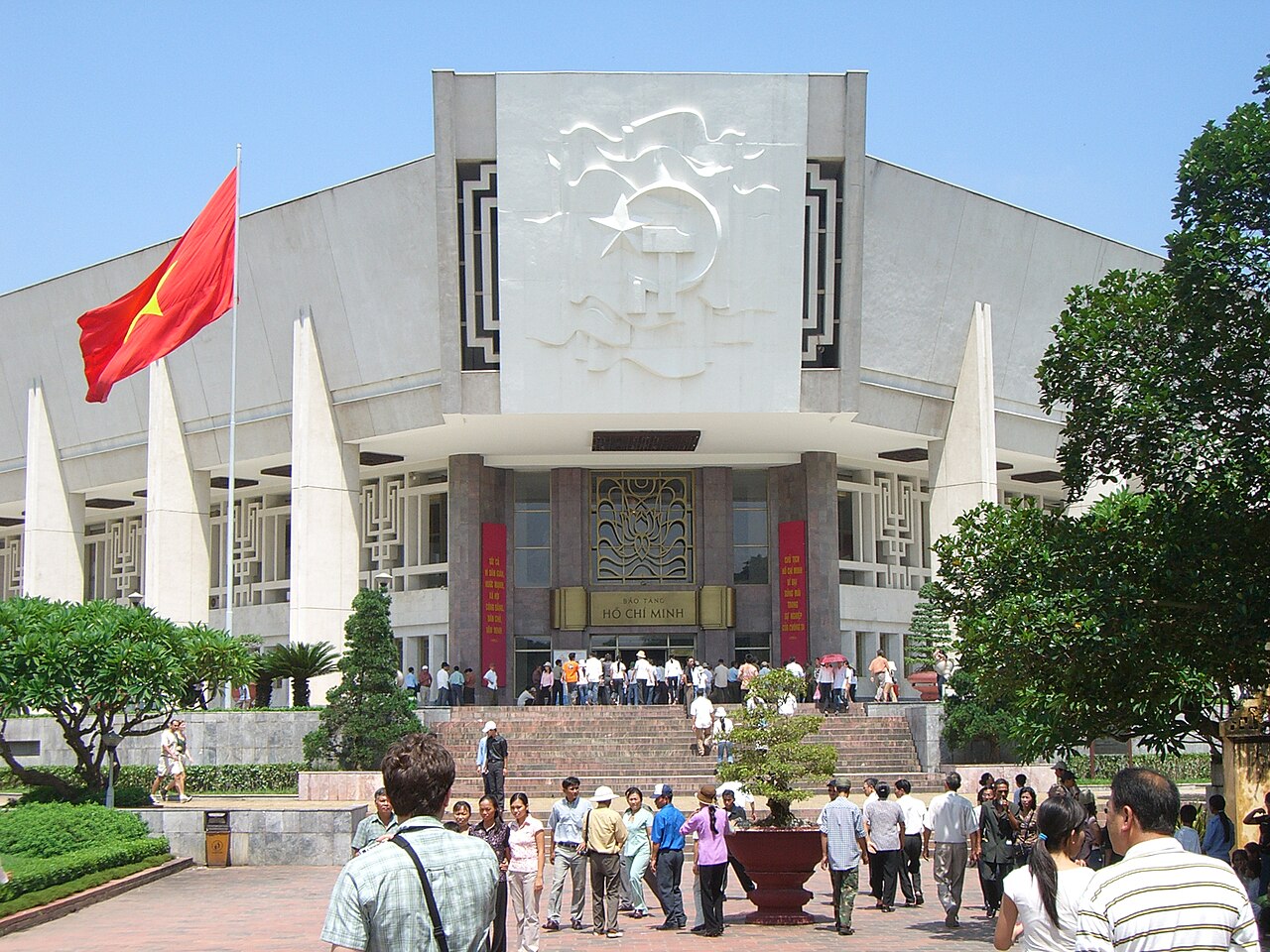
The Ho Chi Minh Museum is a major state museum in Hanoi dedicated to the life and legacy of Ho Chi Minh, the founding father of modern Vietnam. Located near Ba Dinh Square, it occupies a prominent position in Vietnam's political and cultural landscape. The building features distinctive modernist architecture with symbolic design elements. As one of Hanoi's significant visitor destinations, it serves both commemorative and educational functions. The museum operates under state management and forms part of a broader complex of Ho Chi Minh-related sites in the capital. Its collections and exhibitions focus on revolutionary history and national identity construction.
Checked 2026-08-31 · Source
The museum contains exhibitions chronicling Ho Chi Minh's biography, from his early years through his revolutionary activities and leadership of Vietnamese independence movements. Displays include documentary photographs, personal artifacts, historical documents, and artistic representations. Thematic sections address his political philosophy, international travels, and role in shaping the Democratic Republic of Vietnam. The presentation incorporates ideological narrative framing characteristic of state memorial institutions. Some exhibition areas employ symbolic architectural spaces and artistic installations. The collection emphasizes his contributions to national liberation and socialist construction.
Checked 2026-08-31 · Source
Visitor duration varies considerably based on individual engagement with ideological and historical content. A thorough examination of all exhibition floors and documentary materials typically requires between ninety minutes and two and a half hours. Casual visitors passing through main galleries may complete a circuit in forty-five to sixty minutes. The multi-level layout necessitates vertical circulation through staircases or elevators. Photography restrictions in certain areas may reduce time spent. Visitors with limited interest in detailed revolutionary history should allocate approximately one hour. Those studying exhibit texts comprehensively or attending to audiovisual components should plan for extended stays.
Checked 2026-08-31 · Source
Tuesday–Thursday, Saturday and Sunday: 08:00–12:00 and 14:00–16:30. Closed Monday and Friday. The museum closes for a midday break from 12:00 to 14:00. On-site ticket sales run 08:00–11:30 and 14:00–16:00 on opening days. Visitors should verify current opening schedules through official channels before planning attendance. Morning visits may offer marginally quieter conditions before peak tourist arrivals congregate at adjacent Ba Dinh Square sites. Midday periods typically experience higher visitor density, particularly when domestic tour groups and international tourists coincide. Afternoon timing may suit those combining this museum with other nearby political landmarks. Seasonal weather patterns in Hanoi affect comfortable transit to the site. Rainy season conditions from May through October may influence practical visiting decisions. Advance confirmation of operational status remains essential.
Checked 2026-08-31 · Source
General international visitor admission is VND 40,000. Vietnamese visitors, visitors with disabilities and ICOM members enter free. Tickets are sold at Museum Door 1 and the gate at 19 Ngọc Hà. The museum operates as a state institution with established admission policies. Vietnamese citizens and certain designated groups may receive differential pricing under state museum regulations. International visitors typically face standard foreign tourist rates at comparable state cultural institutions. Payment methods and currency requirements should be verified in advance. Combination ticketing with adjacent Ho Chi Minh-related sites may be available. Budget planning should incorporate potential variable costs without assuming specific price points.
Checked 2026-08-31 · Source
The entrance is at 19 Ngọc Hà, Ba Đình, Hanoi. The museum lists bus routes 09 (Bờ Hồ–Bờ Hồ), 14 (Bờ Hồ–Cổ Nhuế), 33 (Mỹ Đình Bus Station–Xuân Đỉnh) and 45 (Times City–Nam Thăng Long Bus Station) as serving the museum. Direct ticket purchase is available at Museum Door 1 and the gate at 19 Ngọc Hà. The museum occupies a central location in Hanoi's Ba Dinh district, proximate to Ho Chi Minh Mausoleum and Presidential Palace grounds. Multiple transit options serve this established tourist zone. Taxi and ride-hailing services provide direct access with recognizable destination naming. Public bus routes traverse surrounding thoroughfares with stops requiring short walking distances. Bicycle and motorbike transport follow standard Hanoi traffic patterns.
Checked 2026-08-31 · Source
The OpenStreetMap record for the exact museum way is tagged wheelchair=yes. The museum grants free admission to visitors with disabilities. Respectful conduct is obligatory at this politically significant site commemorating Vietnam's founding leader. Appropriate dress covering shoulders and knees demonstrates cultural awareness. Photography prohibitions apply in designated exhibition zones; compliance with posted restrictions and staff instructions is mandatory. Security screening operates at entrance points. Bag restrictions may apply. The ideological nature of presentations requires visitors to recognize state-sponsored historical interpretation. Crowd management challenges arise during peak periods and commemorative dates. Physical accessibility considerations affect certain architectural levels. Air conditioning inconsistency may affect comfort. Adjacent site coordination demands attention to separate entry protocols for mausoleum and palace complex components.
Checked 2026-08-31 · Source
Photography policies divide between permitted and prohibited zones throughout exhibition spaces. Main halls and architectural features generally allow non-flash imaging. Specific galleries containing sensitive documentary materials or state-designated restricted content ban all recording devices. Visitors must observe posted signage and verbal staff instructions without negotiation. Tripod and professional equipment use typically requires advance institutional permission. Smartphone photography predominates among general visitors. Respect for fellow visitors and exhibition flow should guide imaging behavior. Memorial and ceremonial spaces demand particular decorum. Final determinations rest with on-site personnel. Presumption of permission risks equipment confiscation or visitor ejection from state premises.
Checked 2026-08-31 · Source
The museum is closed on Monday and Friday.
Yes. It closes from 12:00 to 14:00 between its morning and afternoon sessions.
International visitors pay VND 40,000; Vietnamese visitors enter free.
Tickets are sold at Museum Door 1 and at the gate at 19 Ngọc Hà.
The museum lists routes 09, 14, 33 and 45.
The museum officially opened on 19 May 1990.
Loading the interactive map…
The interactive map could not be loaded.

Last updated:
Source: OpenStreetMap contributors, Wikidata ·