
148 min walk
Milas Museum
- Must see
- Museum
Language · 11 published
Historic monument · Muğla
Reviewed by Elena Voss · SSMTour Travel Editor

This place is a Archaeological site.
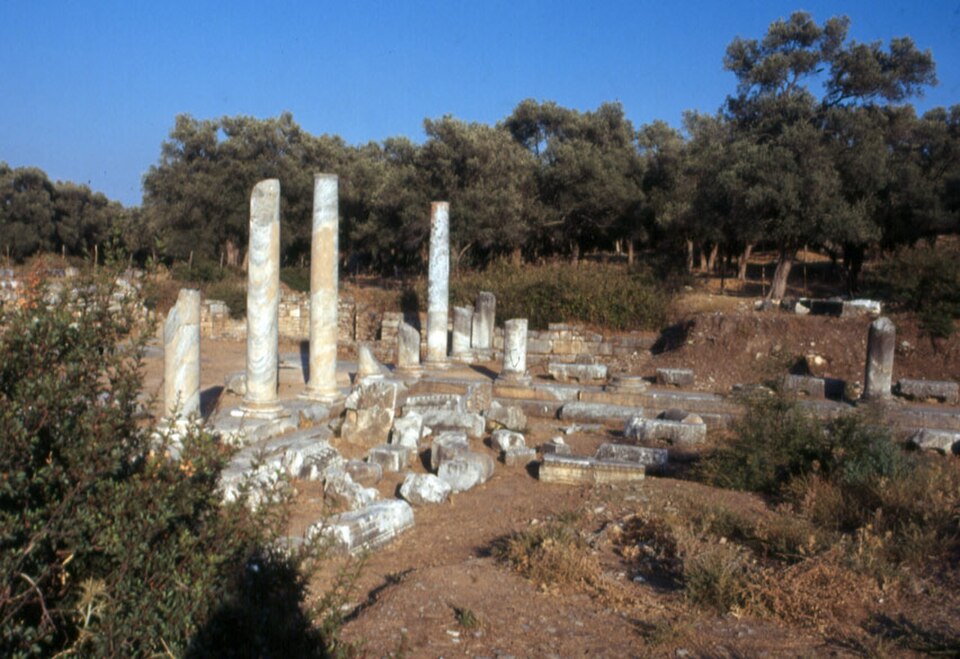
The Temple of Zeus Lepsynos is Euromus’s defining monument, standing outside the ancient city rather than within its central civic area. Built in the 2nd century AD in the Corinthian order, it preserves a clear expression of Roman-period monumental architecture in the landscape of ancient Caria. Its isolated position makes the temple more than a single ruin to tick off: the setting helps explain how a sanctuary related to the settlement, nearby hills and the wider archaeological site. Begin by looking at the temple as a complete composition, then notice how its columns and surviving architectural lines hold their presence in an open rural setting.
Checked 2026-09-02 · Source
The temple’s peripteral plan can be read directly from its surviving arrangement: six columns mark each short side and eleven each long side. That count gives the monument a useful visual rhythm when you walk around it and compare the ends with the longer sides. Euromus extends beyond the temple into an archaeological landscape containing an agora, theatre, bath, city walls, chapel, and north and south necropolises. The theatre is set against the western hillside, while fortification walls and towers continue towards the hill. Together, these remains reveal a settlement with civic, religious, defensive and funerary spaces rather than one isolated building.
Checked 2026-09-02 · Source
Plan around 60 to 90 minutes for the temple and the remains immediately around it. This gives enough time to study the Corinthian architecture, trace the peripteral footprint, and view the monument from several distances without turning the visit into a rushed stop. If your aim is to explore the broader Euromus landscape, allow nearer to two hours. The agora, theatre, bath, chapel, walls and necropolises are distributed across different parts of the site, and the theatre and fortifications lead the visit towards sloping ground. A longer visit therefore depends as much on walking pace and terrain as on the temple itself.
Checked 2026-09-02 · Source
No verified opening schedule is recorded for this guide, so this section does not assign daily hours, seasonal times or closure days. The remains are outdoors, and the wider site includes a western hillside theatre and fortification walls continuing towards the hill; daylight is therefore relevant if you plan to walk beyond the temple. Choose a time that suits the light and the conditions, with enough daylight for the landscape you intend to cover. Treat the temple and the wider Euromus remains as an outdoor archaeological visit rather than a predictable indoor museum circuit.
Checked 2026-09-02 · Source
The Turkish Museums listing gives a base adult admission of 200 TL for Turkish citizens aged 8 and over, and €3 for foreign visitors aged 8 and over. It also states that Turkish citizens aged 0–18 and Turkish citizens aged 65 and over enter free. The free-entry categories are explicitly tied to Turkish citizenship, so they should not be extended automatically to foreign visitors. These published base charges are the practical admission information recorded for the site and should be read together with the nationality and age conditions attached to each category.
Checked 2026-09-02 · Source
The responsible public body places Euromus in Kızılcakuyu Mahallesi, Selimiye, Milas, on the Milas–Söke highway, approximately 12 kilometres from Milas. Its listing also identifies the site within Selimiye Mahallesi. This makes the highway approach and the Milas connection the key orientation points when planning a visit. Use the exact site name and locality when setting out, because the archaeological remains are associated with a village area rather than a dense urban centre. Euromus can be treated as a countryside excursion from Milas and combined with other stops in the Milas area.
Checked 2026-09-02 · Source
What is clear from the site description is that Euromus is an open-air archaeological landscape, with the theatre on a western hillside and fortification walls and towers continuing towards the hill. Plan for outdoor walking and potentially uneven ground as you move beyond the temple. Secure footwear is sensible, and daylight matters for a wider circuit. Keep attention on the surface while moving between the monument and the more spread-out remains.
Checked 2026-09-02 · Source
The temple offers unusually legible photographic structure: its peripteral plan, Corinthian order and contrasting short and long sides give each viewpoint a different architectural emphasis. A close view can isolate column details, while a wider frame can place the monument in the open landscape outside the ancient city. Photograph the six-column ends and the eleven-column sides separately if you want the plan to read clearly, then turn towards the western hillside theatre and the fortification line to connect the temple with Euromus as a whole. Move carefully while composing shots on outdoor ground.
Checked 2026-09-02 · Source
The temple dates from the 2nd century AD.
The temple was built in the Corinthian order.
Its peripteral plan has six columns on each short side and eleven on each long side.
The archaeological site includes the agora, theatre, bath, city walls, chapel, and north and south necropolises.
The temple stands outside the ancient city; the theatre is set against the western hillside, and the fortification walls and towers continue towards the hill.
After an interruption of about 40 years, excavation and restoration work resumed in 2011 under the direction of Muğla Sıtkı Koçman University archaeologist Abuzer Kızıl.
Loading the interactive map…
The interactive map could not be loaded.

Last updated:
Source: OpenStreetMap contributors ·