
2 min walk · Selçuk
State Agora of Ephesus
- Notable
- Historic monument
Language · 11 published
Historic monument · Selçuk, İzmir
Odeon (Konser Salonu)

| Monday | 08:00 – 18:45 |
|---|---|
| Tuesday | 08:00 – 18:45 |
| Wednesday | 08:00 – 18:45 |
| Thursday | 08:00 – 18:45 |
| Friday | 08:00 – 18:45 |
| Saturday | 08:00 – 18:45 |
| Sunday | 08:00 – 18:45 |
Checked 2026-09-02 · Source
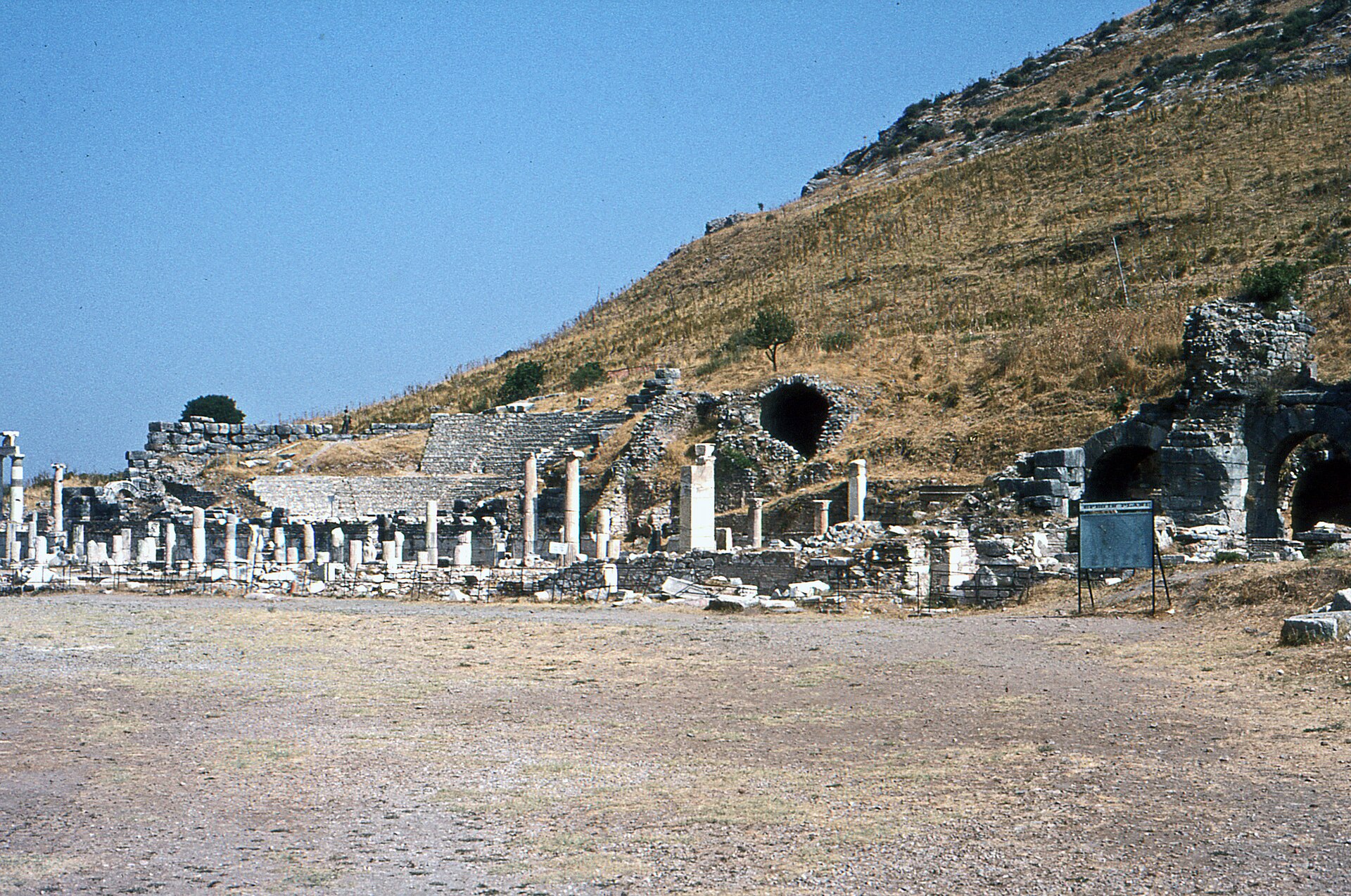
The Bouleuterion at Ephesus is a compact civic auditorium associated with the city council and also known as the Odeon. Unlike a monument identified only as a theatre, this building belonged to Ephesus’s political and ceremonial centre, where council business and public presentation shared one setting. Official tourism information places its construction in the 2nd century AD and names the wealthy Ephesian citizen Publius Vedius Antonius as its patron. The surviving semicircular arrangement makes the building’s civic purpose easier to understand within the ancient city. Efes Bouleuterion’u, kent meclisinin toplantıları için kullanılan ve Odeon olarak da adlandırılan yapıdır. Yapı, Efes’in resmi turizm sayfasına göre MS 2. yüzyılda inşa edilmiştir. It was the meeting place of Ephesus’s city council and is also known as the Odeon. The Bouleuterion was built in the 2nd century AD, according to Ephesus’s official tourism information. It was commissioned by the wealthy Ephesian citizen Publius Vedius Antonius.
Checked 2026-09-02 · Source
The remaining structure centres on a semicircular auditorium with seating for approximately 1,400 people. The name Bouleuterion-Odeon reflects its two connected roles: a meeting place for Ephesus’s council and a venue for presentations or performances. Historical information describes the building as covered by a timber roof, so the ancient interior was more enclosed than the open ruin seen today. The curved seating, surviving stonework and relationship with the Basilica Stoa are the details to read on site. Together they show how this auditorium fitted into Ephesus’s public centre.
Checked 2026-09-02 · Source
Allow about 20 minutes for the Bouleuterion itself. That gives enough time to examine the semicircular seating, consider the council-hall and Odeon identities, and place the building beside the Basilica Stoa and nearby civic remains. Visitors focused on ancient architecture may want longer to study the surviving masonry and take photographs from more than one viewpoint. The Bouleuterion is only one stop in Ephesus, so the complete archaeological visit requires substantially more time for the ancient streets, terraces and other public buildings. Treat this estimate as monument time, not total site time.
Checked 2026-09-02 · Source
The Bouleuterion follows the access arrangement of the wider Ephesus archaeological site. The operator’s information lists daily access from 08:00, with ticket-office closing at 18:45. It separately lists the lower ticket office as open from 08:00 to 19:00 and the upper ticket office from 08:00 to 18:00. The selected entrance therefore matters when planning a late visit. No separate timetable is published for the Bouleuterion itself. The two Ephesus entrances are approximately 3 kilometres apart, so choose the gate with the wider archaeological route in mind.
Checked 2026-09-02 · Source
The Bouleuterion is encountered within the wider Ephesus archaeological site, but that relationship does not establish an independent fee for the auditorium. The practical record therefore contains no admission charge for this POI. Plan the visit around the archaeological site’s access arrangements, while treating any price not directly established for the Bouleuterion by the operator as unverified rather than as a ticket fact.
Checked 2026-09-02 · Source
The Bouleuterion lies inside the Ephesus ruins at Selçuk in İzmir, rather than at a separate modern address. Ephesus has lower and upper entrances approximately 3 kilometres apart, making the choice of gate significant for the day’s route. Inside the site, approach the Bouleuterion from the southern side through the Basilica Stoa and follow the ancient civic area rather than looking for a separate street entrance.
Checked 2026-09-02 · Source
Access to the Bouleuterion-Odeon is limited rather than fully step-free. The approach from the southern Basilica Stoa reaches five door openings by four steps, and the interior seating area has no complete step-free access. The wider Ephesus route consists of ancient marble and stone surfaces, so the ground requires attention when moving between monuments. Visitors with limited mobility should account for both the entrance steps and the historic surfaces before choosing this stop. The four-step approach is the key access detail specific to the Bouleuterion.
Checked 2026-09-02 · Source
Photograph the Bouleuterion as part of Ephesus’s civic centre, not merely as an isolated curve of seats. From the Basilica Stoa approach, include the semicircular auditorium and surrounding architecture to show where the council hall stood in relation to nearby public buildings. Wider frames communicate the monument’s urban position, while closer views record the stepped seating and surviving masonry. The timber roof belongs to the historical reconstruction described in the source material; it is not a surviving cover over the present auditorium. Keep the four-step entrance and five openings legible when documenting the approach.
Checked 2026-09-02 · Source
It was the meeting place of Ephesus’s city council and is also known as the Odeon.
The Bouleuterion was built in the 2nd century AD, according to Ephesus’s official tourism information.
It was commissioned by the wealthy Ephesian citizen Publius Vedius Antonius.
The Odeon had seating capacity for approximately 1,400 people.
Historical information describes the building as covered by a timber roof.
It is approached from the southern Basilica Stoa through five door openings, reached by climbing four steps.
Loading the interactive map…
The interactive map could not be loaded.
Last updated:
Source: OpenStreetMap contributors, Wikidata ·