

2 min walk · Selçuk
Library of Celsus
- Must see
- Historic monument
Language · 11 published
Historic monument · Selçuk, İzmir
Hadrian Tapınağı
Reviewed by Elena Voss · SSMTour Travel Editor
| Monday | 08:00 – 18:45 |
|---|---|
| Tuesday | 08:00 – 18:45 |
| Wednesday | 08:00 – 18:45 |
| Thursday | 08:00 – 18:45 |
| Friday | 08:00 – 18:45 |
| Saturday | 08:00 – 18:45 |
| Sunday | 08:00 – 18:45 |
Checked 2026-09-02 · Source
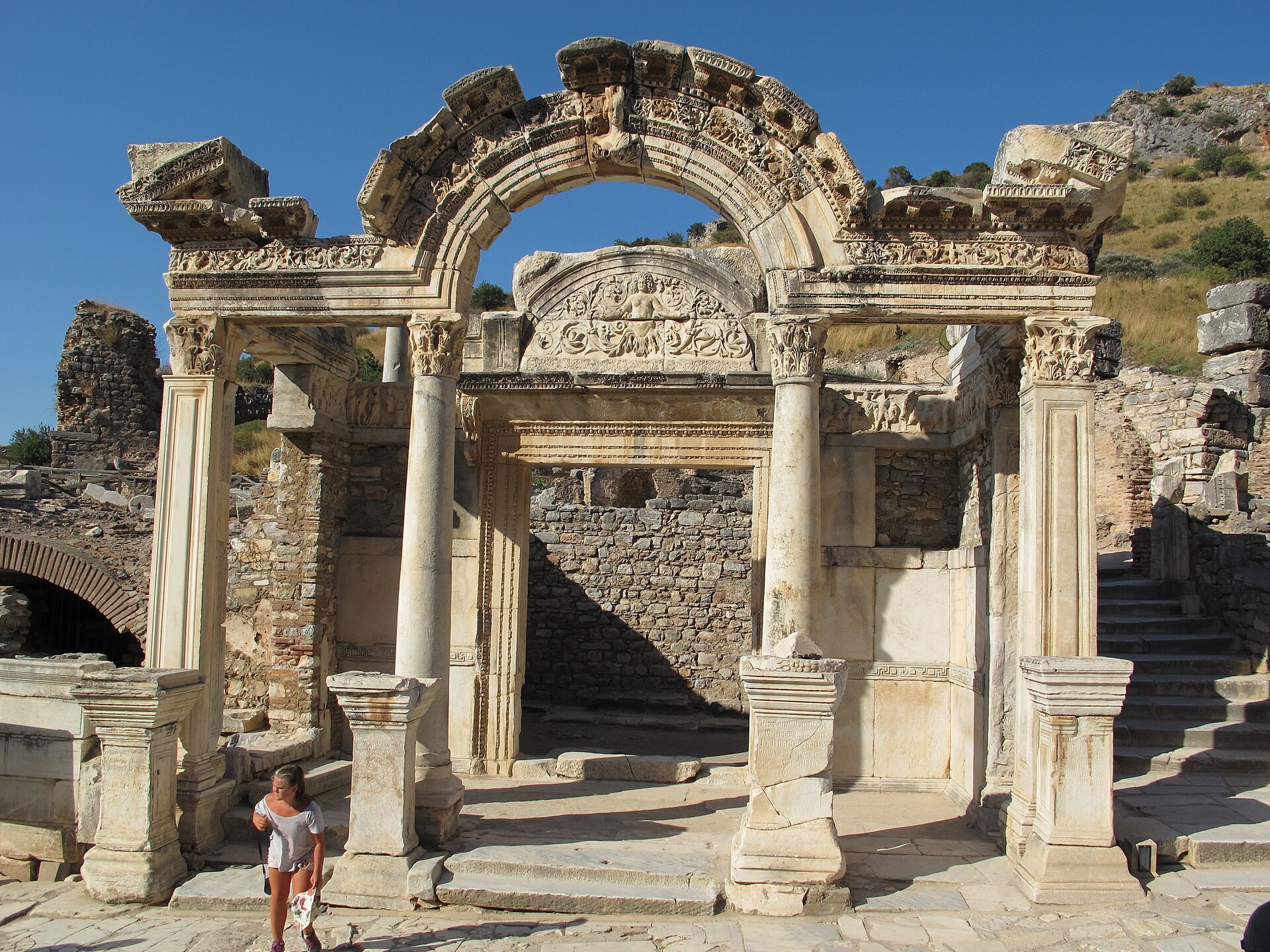
The Temple of Hadrian is a Roman Imperial monument on Curetes Street inside the Efes Archaeological Site at Selçuk in İzmir. Associated with Emperor Hadrian, it is recognised as one of Ephesus’s representative Roman Imperial buildings. The temple is encountered along the ancient street rather than visited as a separate modern attraction. Its position gives the monument particular value: the façade can be understood alongside the paving, terraces and other remains that formed the central urban route. This is a fixed landmark within the ancient city of Ephesus, not an isolated object relocated to a museum. The surrounding archaeological setting is therefore essential to seeing what makes the Temple of Hadrian distinctive.
Checked 2026-09-02 · Source
The Temple of Hadrian is viewed from Curetes Street, with the surviving decorated façade providing the main focus. Examine the architectural details at close range, then step back mentally to place the building within the ancient street and the Roman remains around it. The monument is one stop in a much larger archaeological landscape. The same Efes site contains the Library of Celsus, Great Theatre, Terrace Houses, Prytaneum and ancient harbour. Those nearby and distant structures give the temple context as part of a preserved city, where a visitor follows an urban route rather than moving through a single enclosed exhibit.
Checked 2026-09-02 · Source
Allow approximately 20 to 30 minutes for the Temple of Hadrian itself. That time is enough to study the façade, photograph its details and look along Curetes Street at the monument’s relationship with neighbouring ruins. A complete visit to Efes takes considerably longer because the temple is integrated into an extensive ancient-city route with several major monuments. Do not calculate the day from the temple alone: the distance between the site’s entrances and the number of structures on the route can substantially extend the visit. Visitors interested in Roman urban planning should allow extra time for comparison and observation.
Checked 2026-09-02 · Source
The Efes Archaeological Site is listed as open daily from 08:00 to 18:45, and the Temple of Hadrian follows the site’s hours and closure status. Morning suits this exposed walking route because visitors can begin before the day becomes hottest and reach Curetes Street early in the circuit. Late afternoon can produce warmer light on the stone, but leave enough time to complete the route before closing. The lower ticket office is listed from 08:00 to 19:00, while the upper ticket office is listed from 08:00 to 18:00. These office hours differ, so the chosen entrance matters for late visits.
Checked 2026-09-02 · Source
No admission price is recorded for this guide fragment. Access should therefore be understood through the archaeological site’s own admission arrangements without attaching an unsupported amount or free-entry claim. The research does record different ticket-office hours: the lower office is listed from 08:00 to 19:00 and the upper office from 08:00 to 18:00. That distinction is relevant when planning a late arrival or selecting where to begin the archaeological route.
Checked 2026-09-02 · Source
The Temple of Hadrian stands on Curetes Street inside Efes, approximately 3 km from Selçuk. Regular minibuses serve the archaeological site from Selçuk, while Selçuk connects to İzmir by bus and train. TCDD Taşımacılık operates rail services, and the İzmir–Selçuk suburban line is operated by İZBAN. Efes has two entrances, known as the lower and upper gates, about 3 km apart. Choose the gate with the full route in mind: the entrance affects how you approach Curetes Street and how far you continue if you also want the Great Theatre, Terrace Houses or ancient harbour.
Checked 2026-09-02 · Source
The Temple of Hadrian is part of an exposed archaeological walk, so plan for ancient marble, cobbled surfaces, slopes and steps across the route. The two Efes entrances are roughly 3 km apart and should not be treated as interchangeable when organising transport or the order of the visit. Curetes Street can become busy around its principal monuments, making it important to stop without obstructing other visitors. Secure footwear, sun protection and water are sensible preparations for the site circuit. Visitors should also distinguish the temple’s exterior viewing point from the wider route, whose ground conditions determine the practical demands of the visit.
Checked 2026-09-02 · Source
Use Curetes Street as the defining frame for photographs of the Temple of Hadrian. A close composition can emphasise the decorated façade; a wider view should include the ancient paving and neighbouring Roman remains to show the monument’s place within Ephesus. Morning light is useful for studying details and may leave more space before the route becomes busy. Late-afternoon light can warm the stone, provided sufficient time remains before closing. Compose from a safe standing position on the archaeological route, and avoid stopping where people need to pass along the street.
Checked 2026-09-02 · Source
It stands on Curetes Street inside the Efes Archaeological Site in Selçuk, İzmir.
The monument is part of the ancient city of Ephesus, a Roman-period archaeological site within the Efes Archaeological Site.
It is an Imperial Roman monument associated with Emperor Hadrian and forms part of Ephesus’s representative Roman Imperial architecture.
The Efes Archaeological Site also includes the Library of Celsus, Great Theatre, Terrace Houses, Prytaneum and the ancient harbour.
Efes has two entrances, known as the lower and upper gates, which are about 3 km apart.
Yes. Ephesus was inscribed on the UNESCO World Heritage List in 2015.
Loading the interactive map…
The interactive map could not be loaded.
Last updated:
Source: OpenStreetMap contributors, Wikidata ·