
.jpg)


2 min walk
Stadelhoferplatz
- High
- Nature site
Language · 1 published
Art and culture venue · Zurich
Opernhaus
| Monday | 12:00 – 18:00 |
|---|---|
| Tuesday | 12:00 – 18:00 |
| Wednesday | 12:00 – 18:00 |
| Thursday | 12:00 – 18:00 |
| Friday | 12:00 – 18:00 |
| Saturday | 12:00 – 18:00 |
| Sunday | Closed |
Checked 2026-08-26 · Source
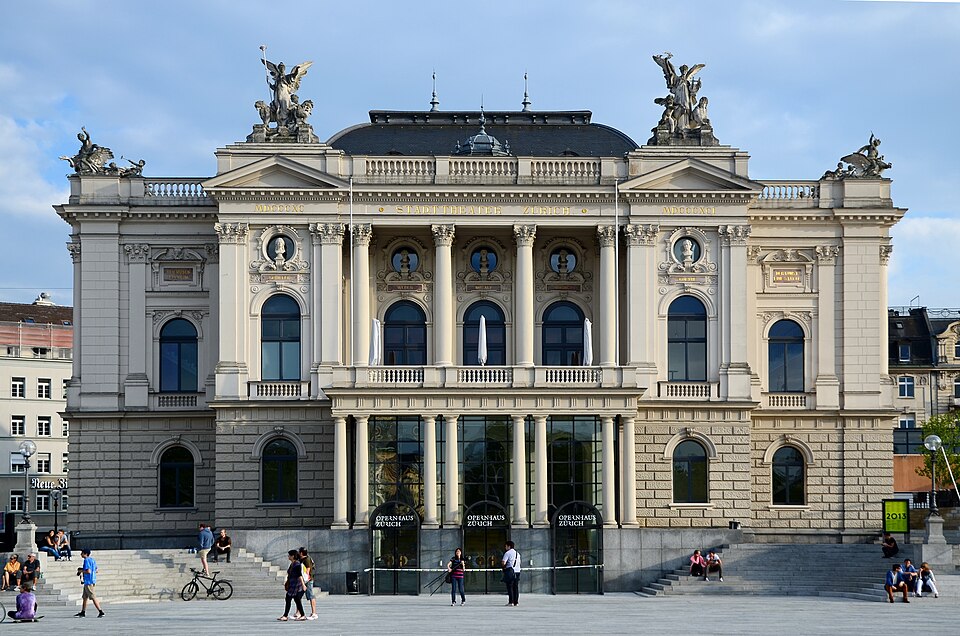
The Zurich Opera House is the working home of an opera company, a ballet company and an orchestra, on the lake side of Sechselaeutenplatz a few minutes from Bellevue. Its house tells you it is descended from a shareholders' theatre rather than a court one: the Actien-Theater, founded by theatre-loving citizens as a joint stock company, opened in 1834 with Mozart's Die Zauberfloete. That building burnt down in 1890 and was replaced by one designed by Fellner and Helmer, financed almost entirely by private money and inaugurated in 1891 under the name Stadttheater with Wagner's Lohengrin. Drama and musical theatre separated in Zurich in 1921, and the house has been called the Opera House only since 1964. The joint stock company survived all of it: the institution is still run by Opernhaus Zuerich AG, with around 2,500 private shareholders, and the canton of Zurich has been the main subsidiser since 1995. Around 800 employees from 40 nations put on 15 to 17 new productions and more than 300 performances a year, which is a heavy schedule for a house seating roughly 1,100. What that means for a visitor is simple: this is a place you attend, on a specific evening, for a specific work, and not a monument you wander through.
Checked 2026-08-26 · Source
The Fellner and Helmer auditorium seats approximately 1,100, which is small by the standards of the repertoire it plays, and the whole building was renovated between 1982 and 1984. That renovation also brought the extension on Uto-Quai, which holds rehearsal stages, ballet studios, the workshops, dressing rooms, offices and the Bernhard Theater. The second, studio stage, the Studiobuehne, is inside the main building: its entrance is above the box office, and it sits on the third floor. Almost all operas are performed in the original language with German and English surtitles, and the house is candid that the architecture means not every seat reads them equally well, so the box office will advise on that by telephone. Cloakrooms open immediately to the right and left of the main entrance and cost nothing, the charge being included in the ticket, and jackets, coats, large bags and backpacks are meant to go into them. Opera glasses can be borrowed in the entrance foyer against a deposit. The restaurant, cafe and bar Lulu on Sechselaeutenplatz has been run by Michel Peclard since the summer of 2024, and Lulu also serves the opera house bars before performances and at intervals, with orders payable online in advance so a drink is waiting.
Checked 2026-08-26 · Source

Plan an evening rather than a slot. The house publishes a running time for every production and the spread across the 2026/27 season is wide: Oiseaux Rebelles runs about two hours with one interval after roughly 35 minutes, La rondine two hours and 25 minutes with one interval after about an hour and a quarter, Die Fledermaus about three hours with one interval after roughly 50 minutes, and Tannhaeuser about four hours and a quarter with two intervals, the first after about an hour and the second after about two hours 45. Three hours is the honest planning figure for an unspecified evening, and a Wagner night needs the whole evening and then some. Add time in front of that. Coats, bags and backpacks have to be handed in at the cloakroom, and the performance starts on time whatever the queue is doing, so half an hour before curtain is comfortable and ten minutes is not. If a meal at Lulu or a drink ordered ahead for the interval is part of the plan, the whole thing becomes a four to five hour commitment. Check the running time on the production's own page before booking a late train.
Checked 2026-08-26 · Source

The season, not the week, decides this. There is a long summer break with no performances: for 2026 the ticket counter closed on Monday 13 July and stays shut through 26 August, reopening on Thursday 27 August 2026, and the same page still carries an older line giving the 2025 break as 14 July to 27 August. The playing season runs from late August to early July around that gap. Within the season the calendar carries opera, ballet, philharmonic concerts, recitals and chamber concerts, with Sunday matinees as well as evening performances, so a Sunday afternoon is a real option and not a fallback. Two dates a month are Opernhaus Days, on which every ticket for that evening's main stage performance is half price, sold online, by telephone and at the box office from noon on the day itself, maximum four per person; when the day falls on a Sunday, selling starts at noon on the Saturday. The AMAG Volksvorstellungen are a separate cheap series, tickets from CHF 15 to 75, on sale one month before each performance from noon. Both reward deciding late; a first night or a gala rewards deciding early.
Checked 2026-08-26 · Source
You pay per person for a specific performance, and what you pay depends on the price band of that production and on which of the five seating categories you sit in. The published table runs from Preise A at CHF 102, 86, 75, 48 and 21 for categories one to five, through Preise D at 208, 183, 162, 97 and 37, to Preise G at 335, 265, 235, 103 and 43; gala prices reach 395 down to 50. Cheaper bands exist: Preise H is 75 down to 15, philharmonic concerts P are 105 down to 40 and Q 135 down to 45, and song recitals are a flat CHF 65 in every category. Children aged six to 16 accompanied by an adult pay the Legi prices, CHF 40, 30, 25, 23 and 18 in the lower bands. Students with a school or university photo identity card get the same Legi prices online from a week before, and any seats left go at the box office from 90 minutes before the start for CHF 22, the same last-minute price a Kulturlegi pass buys. Club Jung members aged 16 to 26 pay CHF 18. AHV and IV recipients get 50 per cent off Sunday afternoon performances.
Checked 2026-08-26 · Source

No car is needed and the house says as much. Trams 11 and 15 stop at Opernhaus, directly outside; tram 4 towards Tiefenbrunnen from the main station also stops there. Trams 2, 4, 5, 8 and 9 reach Bellevue, a few minutes away on foot. From Zurich main station the S-Bahn to Zuerich Stadelhofen is the quickest route, and the opera house is a short walk from that station. From the airport, take the S-Bahn straight to Stadelhofen, or to the main station and then tram 4 towards Tiefenbrunnen to the Opernhaus stop. Timetables are at vbz.ch and sbb.ch. If you must drive, the Parkhaus Utoquai at Faerberstrasse 6, the Parkhaus Hohe Promenade on Raemistrasse and the Parkhaus Opera are all a few minutes' walk away. Visitors with limited mobility can be driven in and out along Schillerstrasse, between the Neue Zuercher Zeitung and the opera house, leaving about 100 metres to the box office across Sechselaeutenplatz; marked disabled bays are in the Opera car park, with a passenger lift up to the box office hall. Inside, a lift serves every floor and the levels are free of thresholds. The visitor address is Sechselaeutenplatz 1, 8008 Zurich.
Checked 2026-08-26 · Source

Arrive late and you do not get in. Performances start on time and latecomers are seated only at the interval; until then they watch on a screen in the foyer. Tickets are effectively final: no replacement is issued for a performance you miss, returns are not normally accepted, and the only route out is to leave the ticket at the box office for resale on commission, at a fee of CHF 10 per seat and with no guarantee it sells, or to donate it to Club Jung for a young person to use. Read the seating plan before choosing a cheap seat: grey seats on it are listening places with no view of the stage, and because of the shape of the auditorium the German and English surtitles are not equally visible from every seat, which the box office will discuss on +41 44 268 66 66. Cloakrooms are reached only by stairs, so ask staff for help if that is a problem. The Studiobuehne on the third floor has no lift and cannot admit wheelchair users at all, while the main auditorium has four wheelchair spaces in category four and two in the parquet gallery, bookable only by telephone or in person. There is no dress code, though the room is dressed up.
Checked 2026-08-26 · Source

Do not plan on photographs inside. The opera house states plainly that for copyright reasons pictures, sound and video recordings are not permitted, and that covers the auditorium and the performance rather than only the stage during the music. Treat the camera as something that stays in a pocket once you are through the door, and note that large bags and backpacks are supposed to go to the cloakroom anyway. That leaves the outside, which is the better subject in any case. The Fellner and Helmer facade of 1891 faces the open expanse of Sechselaeutenplatz, so unlike most European opera houses it can be photographed whole, from far enough back to get the full elevation without a lens that distorts it. The square is at its best when the building is lit and the sky still has colour in it, which on a winter evening coincides neatly with the audience arriving; in summer that moment falls well after curtain. From the lake side, the water and the Uto-Quai frontage give a second angle. If the interior is what you wanted, the house publishes a virtual tour and a photo gallery on its own site, which is the only sanctioned way to see the auditorium in a picture.
Checked 2026-08-26 · Source
The opera house publishes no public guided tour of the building and no daytime opening of the auditorium or foyers. Guided tours that go on stage and into the props, tailoring and make-up workshops are listed only for school classes, by registration. For everyone else the house offers a virtual tour and a photo gallery on its own site. The ticket counter hall at Sechselaeutenplatz 1 and the Lulu restaurant, cafe and bar are reachable without a ticket.
It depends on the production's price band and on which of the five seating categories you choose. The published table runs from Preise A at CHF 102, 86, 75, 48 and 21 down the categories, through Preise D at 208, 183, 162, 97 and 37, to Preise G at 335, 265, 235, 103 and 43, with gala prices from 395 to 50 and the cheap H band from 75 to 15. Song recitals are a flat CHF 65. Students, children aged six to 16 with an adult and Legi holders pay from CHF 40 down to 18; last-minute seats at the box office 90 minutes before the start are CHF 22, and Club Jung members aged 16 to 26 pay CHF 18.
It varies by production and the house publishes the running time for each one. In the 2026/27 season Oiseaux Rebelles runs about two hours with one interval, La rondine two hours 25 minutes, Die Fledermaus about three hours, and Tannhaeuser about four hours and a quarter with two intervals. Three hours is a reasonable planning figure for an unspecified evening, plus half an hour before curtain for the cloakroom, since performances start on time.
The counter sells Monday to Saturday from 12.00 noon until the start of the performance, and from 12.00 to 18.00 on days without a performance. Telephone sales run Monday to Saturday 12.00 to 18.00 on +41 44 268 66 66. On Sundays the counter opens only 1.5 hours before the performance, or one hour for small formats, so no fixed Sunday hours are published. For the 2026 summer break the counter was closed from Monday 13 July to 26 August inclusive and reopens on Thursday 27 August 2026, with telephone service Monday to Friday 10.00 to 14.00 during the break; the same page also still carries an older line giving the break as 14 July to 27 August 2025.
No. The opera house states that for copyright reasons pictures, sound and video recordings are not permitted. The exterior on Sechselaeutenplatz has no such restriction, and the house publishes a virtual tour and a photo gallery of the interior on its own site.
No. The house recommends public transport: trams 11 and 15 stop at Opernhaus, trams 2, 4, 5, 8 and 9 stop at Bellevue a few minutes away, and the S-Bahn from the main station or the airport reaches Zuerich Stadelhofen, also a short walk. If you do drive, the Parkhaus Utoquai at Faerberstrasse 6, the Parkhaus Hohe Promenade on Raemistrasse and the Parkhaus Opera are all within a few minutes' walk, and marked disabled bays in the Opera car park have a lift up to the box office hall.
Loading the interactive map…
The interactive map could not be loaded.
Last updated:
Source: OpenStreetMap contributors, Wikidata ·