
.jpg)


2 min walk
St. Peter
- Must see
- Place of worship
Language · 1 published
Place of worship · Zurich
| Monday | 10:00 – 18:00 |
|---|---|
| Tuesday | 10:00 – 18:00 |
| Wednesday | 10:00 – 18:00 |
| Thursday | 10:00 – 18:00 |
| Friday | 10:00 – 18:00 |
| Saturday | 10:00 – 18:00 |
| Sunday | 12:00 – 18:00 |
Also recorded: 10:00 – 17:00, 12:00 – 17:00
Checked 2026-08-26 · Source
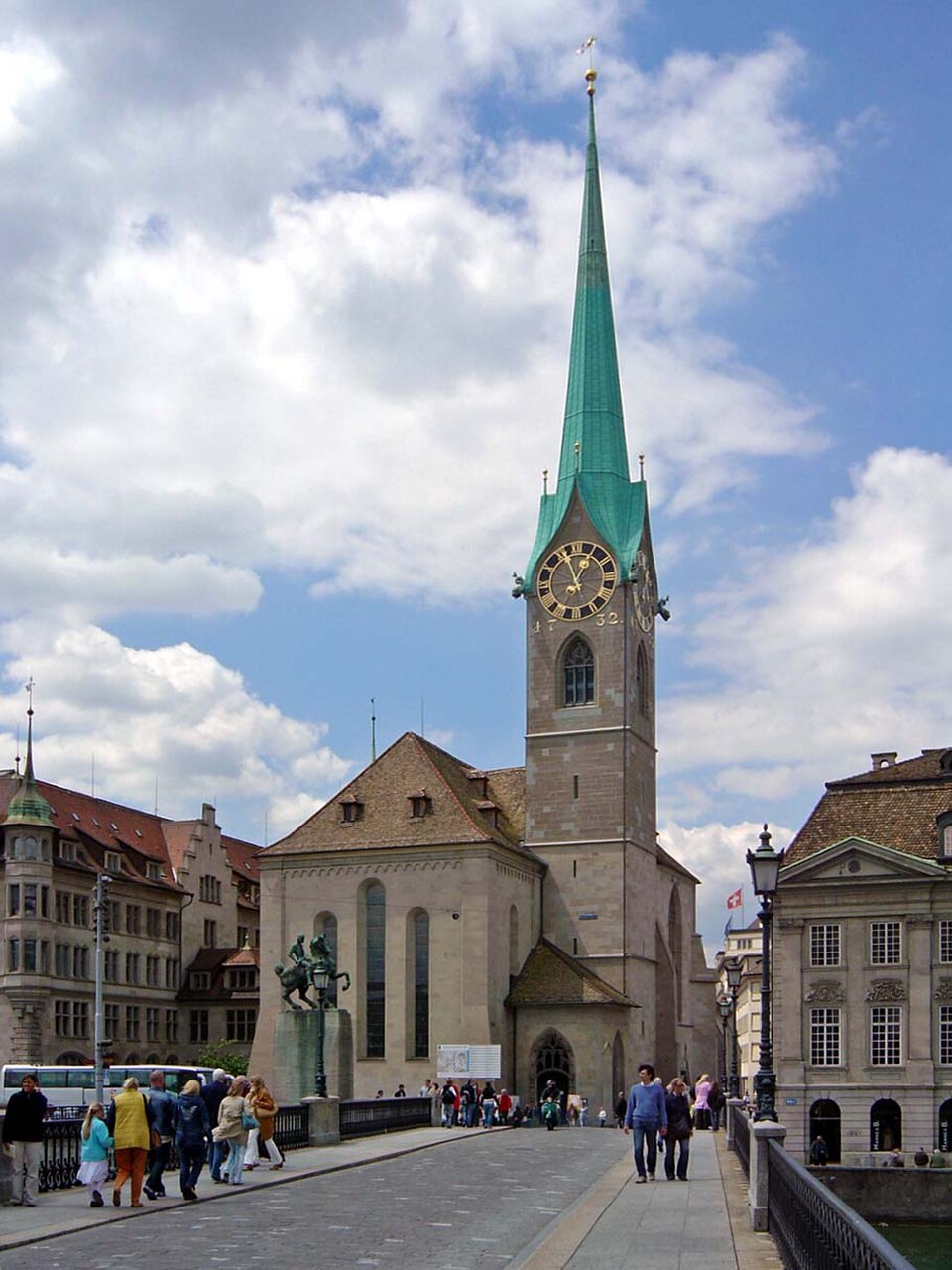
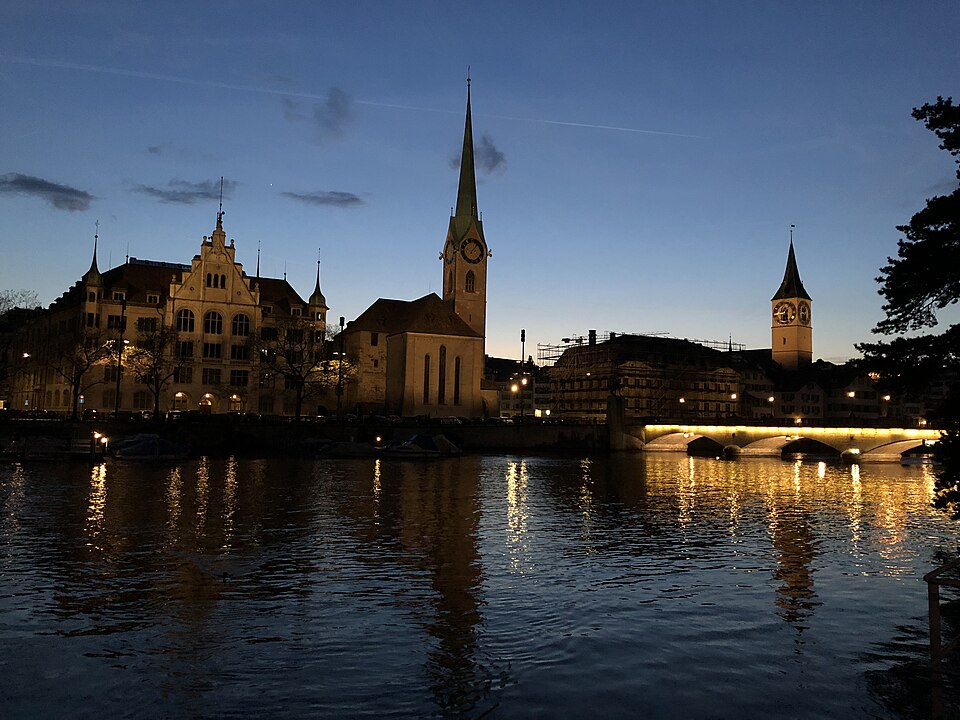
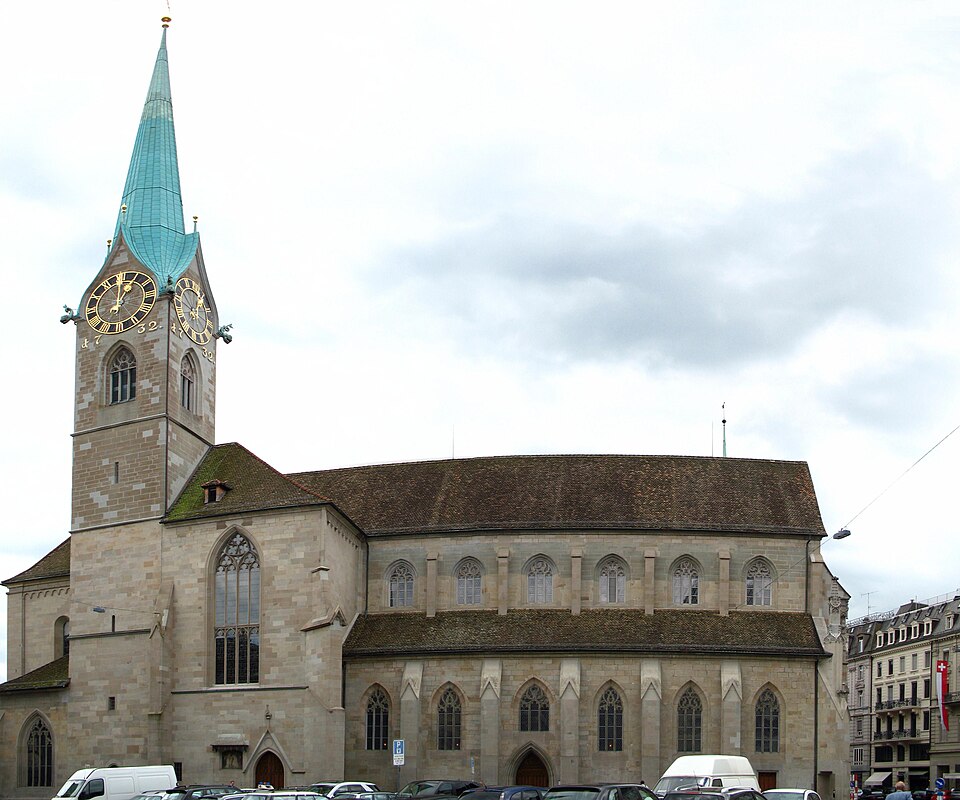
Fraumünster is a working Reformed parish church on the Münsterhof in Zurich's old town, run by the Evangelisch-reformierte Kirchgemeinde Zürich; the address fraumuenster.ch redirects to the parish's own pages, which are the source for everything practical below. The parish dates the foundation to 853, when, according to the oldest surviving Zurich charter, King Louis the German established an abbey for women here for his daughter Hildegard. A first church was consecrated on this spot in 874, laid out as a three-aisled basilica with a transept and three apses. What stands today is the product of long and repeatedly interrupted campaigns: the south tower belongs to the first half of the twelfth century and the north tower to roughly 1220 to 1230, while from about 1250 the choir and transept were rebuilt first in Romanesque and then in Gothic forms, so both idioms still read in the same room. The nave followed through the fourteenth and fifteenth centuries under difficult finances. The middle aisle and towers were altered in the eighteenth century, and Gustav Gull's twentieth-century restoration gave the church its present appearance. In 1524 the last abbess, Katharina von Zimmern, handed abbey and church to the Zurich council, ending the convent and turning Fraumünster into a Reformed city church.
Checked 2026-08-26 · Source
The glass is why most visitors come. Five windows by Marc Chagall fill the choir, completed in 1970 and executed with the glass painter Charles Marq in Reims; the rosette in the south transept followed in 1978. The parish names each one by colour and position: the red Prophets window on the left side of the choir, with Elijah carried up in a fiery chariot; the blue Jacob window at the left front, showing the ladder dream and the wrestling angel; the green Christ window in the centre; the yellow Zion window at the right front, where the new Jerusalem descends and David sings; and the blue Law window on the right side, with Moses above and Isaiah below. Across the building, the north transept holds Augusto Giacometti's Himmlisches Paradies of 1945, around nine metres high and his last large work in glass. Behind the organ, the great west window is by the English glass painter Clement Heaton, made in 1914 to close a major renovation and built on colour and four angels rather than narrative. Beyond the windows there is the Marienkapelle, its wall paintings layered from the early fourteenth century to the edge of the Renaissance, an enlarged watercolour copy of the lost founding fresco of about 1300 above the graves of the first abbesses Hildegard and Berta, a shop in the transept, and the crypt museum.
Checked 2026-08-26 · Source
Allow forty-five minutes. The parish publishes no suggested visit length, so this is the guide's judgement rather than a figure read off its site, and it is built from what there is to see. The nave is crossed in a couple of minutes. The choir, where the five Chagall windows are, repays standing still for a quarter of an hour, and most people spend longer there than they expect to. Then there is the Giacometti window in the north transept, the Heaton window behind the organ, the wall paintings in the Marienkapelle, and the crypt museum, which the ticket already covers and which is a compact multimedia room rather than a large collection. Thirty minutes is enough if the Chagall glass is the only reason for coming and the crypt is skipped. An hour suits a visitor who reads the crypt panels properly and follows the free short guide or the Altstadtkirchen Zürich app tour. Two hours only makes sense on one of the parish's guided tours, which are booked and paid for separately. One arithmetic point matters more than the estimate: last admission is fifteen minutes before closing, so arriving at 17.50 in summer buys ten minutes inside, not forty-five.
Checked 2026-08-26
Fraumünster publishes two regular schedules. From 1 March to 31 October it is open 10.00 to 18.00; from 1 November to 28 February, 10.00 to 17.00. Last admission is fifteen minutes before closing in both seasons, and the parish reserves the right to change hours at short notice. There is no weekly closing day, but Sunday works differently: the service is at 10.00 and the church normally opens to visitors at 12.00, so a Sunday morning arrival will find sightseeing closed even though the building is in use. Thursday carries its own interruption. The parish states that from 25 June the church is shut to visitors on Thursdays from 11.30 to 13.15 for the Orgel am Mittag recital, which itself runs from 12.15 to 12.45. Alongside these, the parish keeps a dated list of exceptional hours where a concert, wedding or funeral shortens or shifts the day, and that list is the thing to check before setting out rather than any third-party listing. Inside, light matters more than crowds. The Chagall glass is in the choir and is at its strongest in the morning; the Giacometti window in the north transept and Heaton's west window behind the organ come into their own later in the day.
Checked 2026-08-26 · Source
Tourist visits carry what the parish calls an entry and information fee of CHF 5, given in its FAQ as five francs, euros or dollars. For groups of five or more it drops to CHF 4 per person. Payment is by cash, TWINT or card, tickets are sold on site only, and there is no online advance sale, so booking ahead is not possible. Young people up to sixteen, students with a Legi and holders of a Kulturlegi enter free, and anyone who comes regularly to sit quietly can request a free personal visitor card at reception. The fee covers the crypt museum, a short printed guide in several languages, the Altstadtkirchen Zürich app tour, and a CHF 5 reduction on entry to the Kunsthaus collection, which holds a representative group of Chagall works. A combined ticket with Grossmünster is CHF 8 for adults instead of CHF 10, and CHF 2 for young people aged six to sixteen and for students; it covers the Karlsturm at Grossmünster as well as the Fraumünster fee. One inconsistency is worth flagging rather than smoothing over: the same FAQ that states the fee also says that access for reflection, prayer and viewing is free. Both sentences are the parish's own, and they are reported here as published.
Checked 2026-08-26 · Source
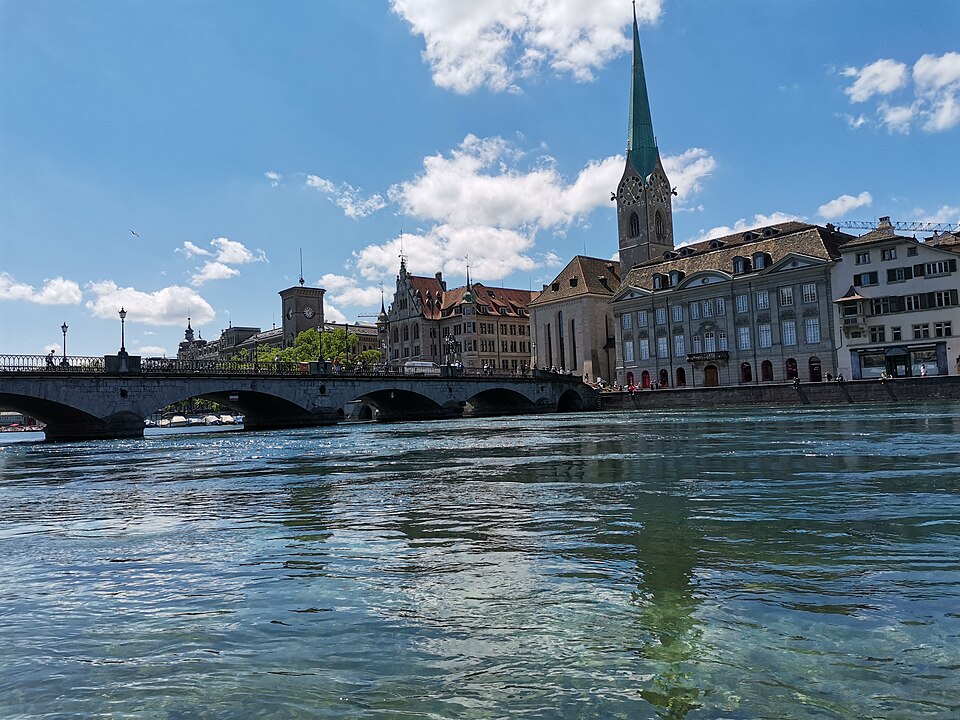
The church stands at Münsterhof 2, 8001 Zürich, on the west bank of the Limmat in the old town; the parish office is nearby at Kämbelgasse 2 and the telephone number is +41 44 250 66 44. No car is needed, and a car is the wrong tool for this particular address. The parish's own directions are a tram to Paradeplatz or to Helmhaus and two minutes on foot to the Münsterhof, with connections and fares on zvv.ch. Driving is restricted: the parish states that approach by car is permitted between 05.00 and 12.00, that parking with a permit is available, and that blue-zone spaces sit nearby at the Stadthaus. Deliveries for events in the church may enter after 12.00, but only with an access permit for the restricted zone. That permit costs CHF 10, is valid for the whole calendar day, must be displayed behind the windscreen, and is obtained either at Bahnhofquai 5, counter ZVO, Monday to Friday 06.30 to 16.00, or immediately online at parkkarten.ch. Since the 2013 rebuild, the historic north portal is again a main way in and out, which turned the church back towards the Münsterhof; the square itself was redesigned in 2014 and 2015 and is now quieter and largely given over to people on foot.
Checked 2026-08-26 · Source
The house rules here are firmer than at most churches, and they are published rather than improvised. Large items of luggage may not be brought into the nave; prams and buggies can be left with the till staff, while walking aids and wheelchairs are admitted. Eating and drinking inside are forbidden. Animals are not allowed except assistance dogs. Sitting on the floor, including on the choir steps, is not permitted, and writing or drawing is allowed only with pencils or coloured pencils on a firm pad. Audio devices are not issued to children under six. Visitors are asked to avoid loud conversation. Groups of up to thirty may simply arrive without booking, but from eleven people a group must bring its own whisper system, and an outside guide needs accreditation before explaining anything inside the church. On accessibility the parish is specific: entrance, nave, shop and exit are barrier-free; a few steps with a handrail lead up to the choir where the Chagall windows are; the crypt is not wheelchair accessible, though access to the choir area for wheelchair users is in planning. An accessible toilet is immediately right of the main entrance, and a hearing loop plus additional hearing aids are available. One more thing can catch a visitor out: the crypt sometimes closes at short notice on individual days because of high humidity.
Checked 2026-08-26 · Source
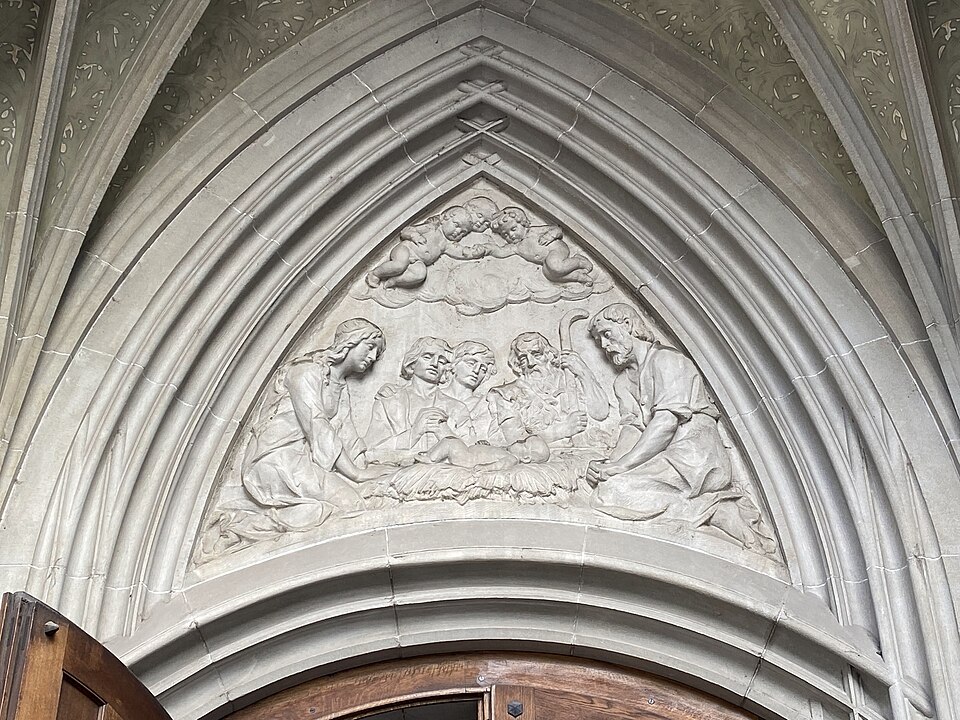
Photography is allowed under conditions the parish sets out plainly. Pictures without flash and without a tripod are permitted for private purposes, outside services. The Chagall windows are protected by copyright, and that is the reason for the rest: photographing with a tripod, or for professional, journalistic or commercial purposes, is not permitted. The parish also asks visitors to refrain from excessive group selfies and from private photo shoots inside the building, so a portrait session in front of the choir is out of the question. What remains is handheld work in a dim interior against very bright glass, which is the real difficulty. Metering for the room blows the windows out to white; metering for the windows drops the stonework to black. Expose for the glass and accept the silhouette, or bracket and choose afterwards. From the crossing a wide lens takes all five choir windows in a single frame, while a longer lens is better for individual panels, and the parish's own descriptions by colour and position make it easy to label the frames later. Giacometti's window in the north transept is roughly nine metres tall and needs a step back and a vertical frame. With flash ruled out, the fix is a steady grip and a braced elbow rather than a faster shutter.
Checked 2026-08-26 · Source
Tourist visits carry an entry and information fee of CHF 5, quoted by the parish as five francs, euros or dollars, and CHF 4 per person for groups of five or more. Payment is cash, TWINT or card; tickets are sold on site only and there is no online advance sale. Young people up to sixteen, students with a Legi and Kulturlegi holders enter free. The fee includes the crypt museum, a short guide in several languages, the Altstadtkirchen Zürich app tour and a CHF 5 reduction at the Kunsthaus. The same FAQ also states that access for reflection, prayer and viewing is free.
From 1 March to 31 October the church is open 10.00 to 18.00, and from 1 November to 28 February 10.00 to 17.00. Last admission is fifteen minutes before closing, and the parish reserves the right to change hours at short notice. On Sundays the service is at 10.00 and the church normally opens to visitors at 12.00. From 25 June the church is closed to visitors on Thursdays from 11.30 to 13.15 for the midday organ recital. The parish also publishes a dated list of exceptional hours.
Allow forty-five minutes. The parish publishes no suggested visit length, so this is the guide's editorial judgement: it covers the nave, a proper stop in the choir for the five Chagall windows, the Giacometti and Heaton windows, the Marienkapelle wall paintings and the crypt museum. Thirty minutes is enough for the Chagall glass alone with the crypt skipped, and an hour suits anyone reading the crypt panels or following the app tour. Remember that entry stops fifteen minutes before closing.
Yes, for private purposes and outside services, without flash and without a tripod. The Chagall windows are protected by copyright, so photography with a tripod or for professional, journalistic or commercial purposes is not permitted. The parish additionally asks visitors to avoid excessive group selfies and private photo shoots inside the church. Since flash is ruled out, expose for the glass rather than for the interior and accept a darker frame around the windows.
Partly. The parish states that the entrance, the nave, the shop and the exit are barrier-free, but a few steps with a handrail lead up to the choir where the Chagall windows are, and access to the choir area for wheelchair users is described as in planning. The crypt museum is not wheelchair accessible. An accessible toilet is immediately to the right of the main entrance. A hearing loop and additional hearing aids are available, audioguides with an alternative keypad serve visually impaired visitors, and a tour with text and images is offered for hearing-impaired visitors.
Yes, but not in the morning. The Sunday service is at 10.00 and the parish states that the church normally opens to visitors at 12.00, so sightseeing before noon is not possible even though the building is open for worship. After 12.00 the usual seasonal hours apply, closing at 18.00 from 1 March to 31 October and at 17.00 from 1 November to 28 February, with last admission fifteen minutes earlier. Dated exceptions are published on the parish's visit page.
Loading the interactive map…
The interactive map could not be loaded.
Last updated:
Source: OpenStreetMap contributors, Wikidata ·