


.jpeg)

1 min walk
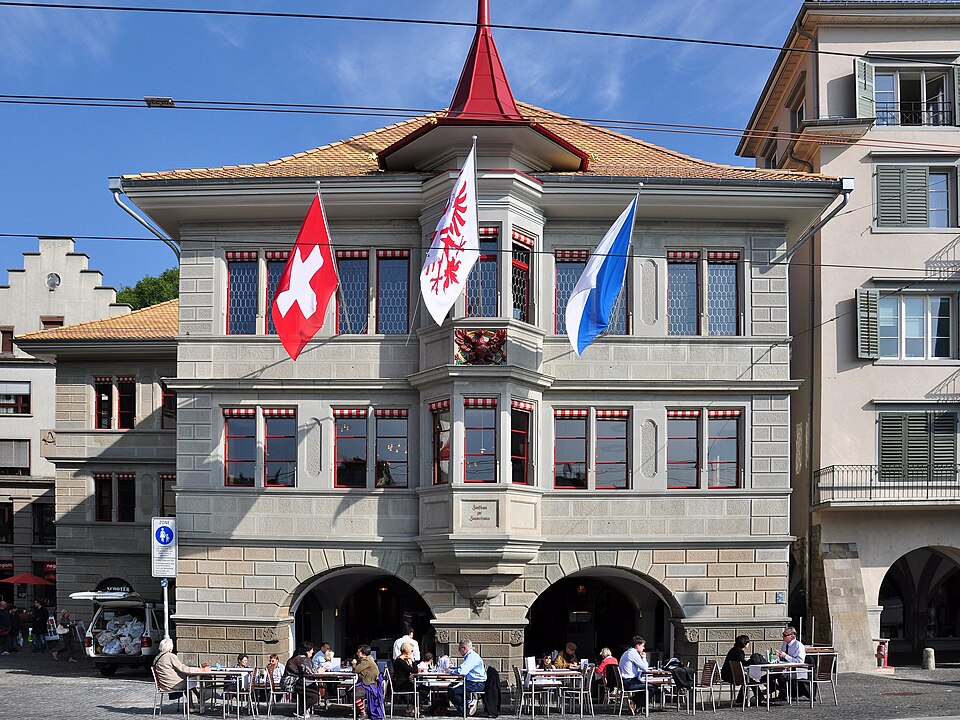
Helmhaus
- Must see
- Museum
Language · 1 published
Place of worship · Zurich
| Monday | 10:00 – 18:00 |
|---|---|
| Tuesday | Closed |
| Wednesday | 10:00 – 18:00 |
| Thursday | 10:00 – 18:00 |
| Friday | 10:00 – 18:00 |
| Saturday | 10:00 – 18:00 |
| Sunday | 12:00 – 18:00 |
Closed to visitors between 11:30 – 13:15
Checked 2026-08-26 · Source
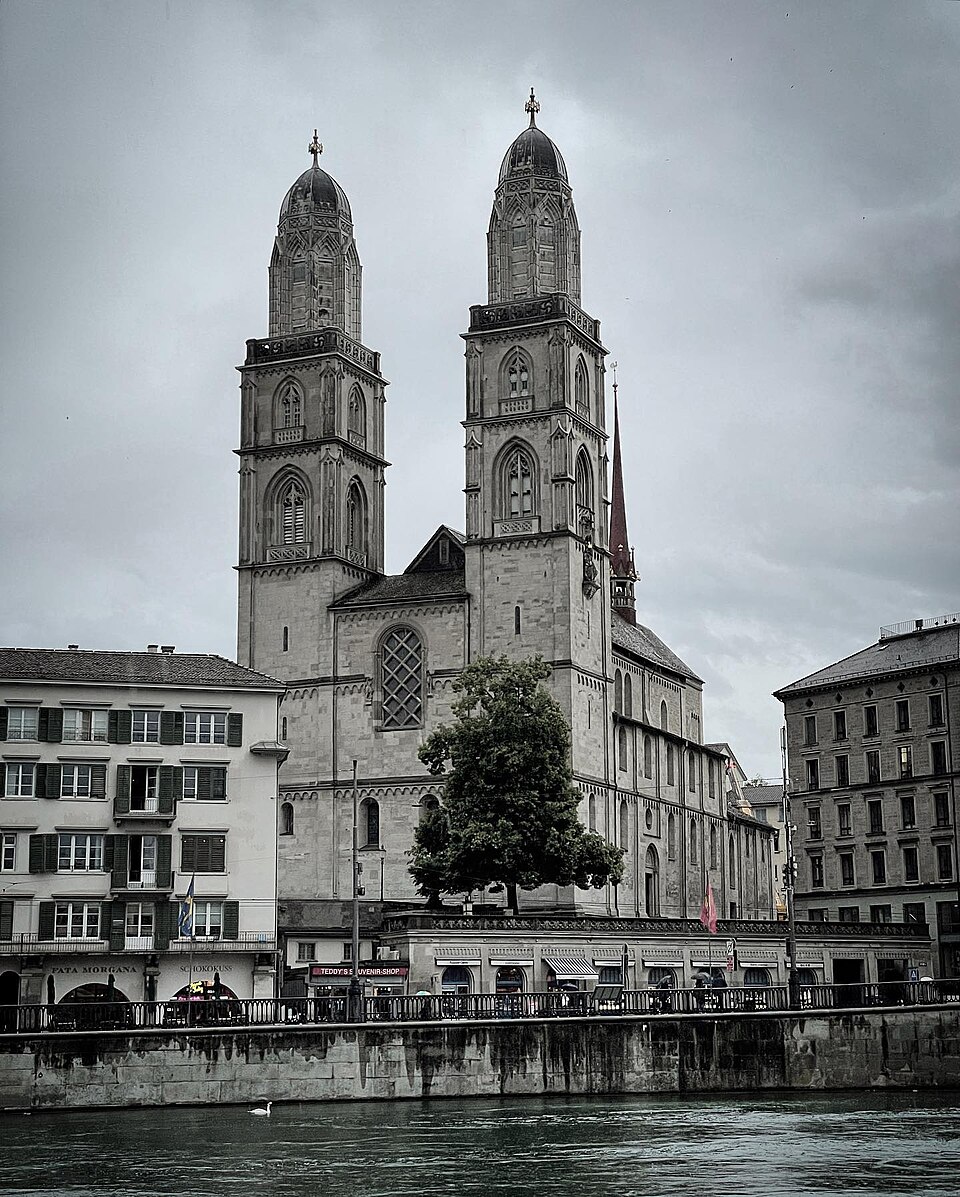
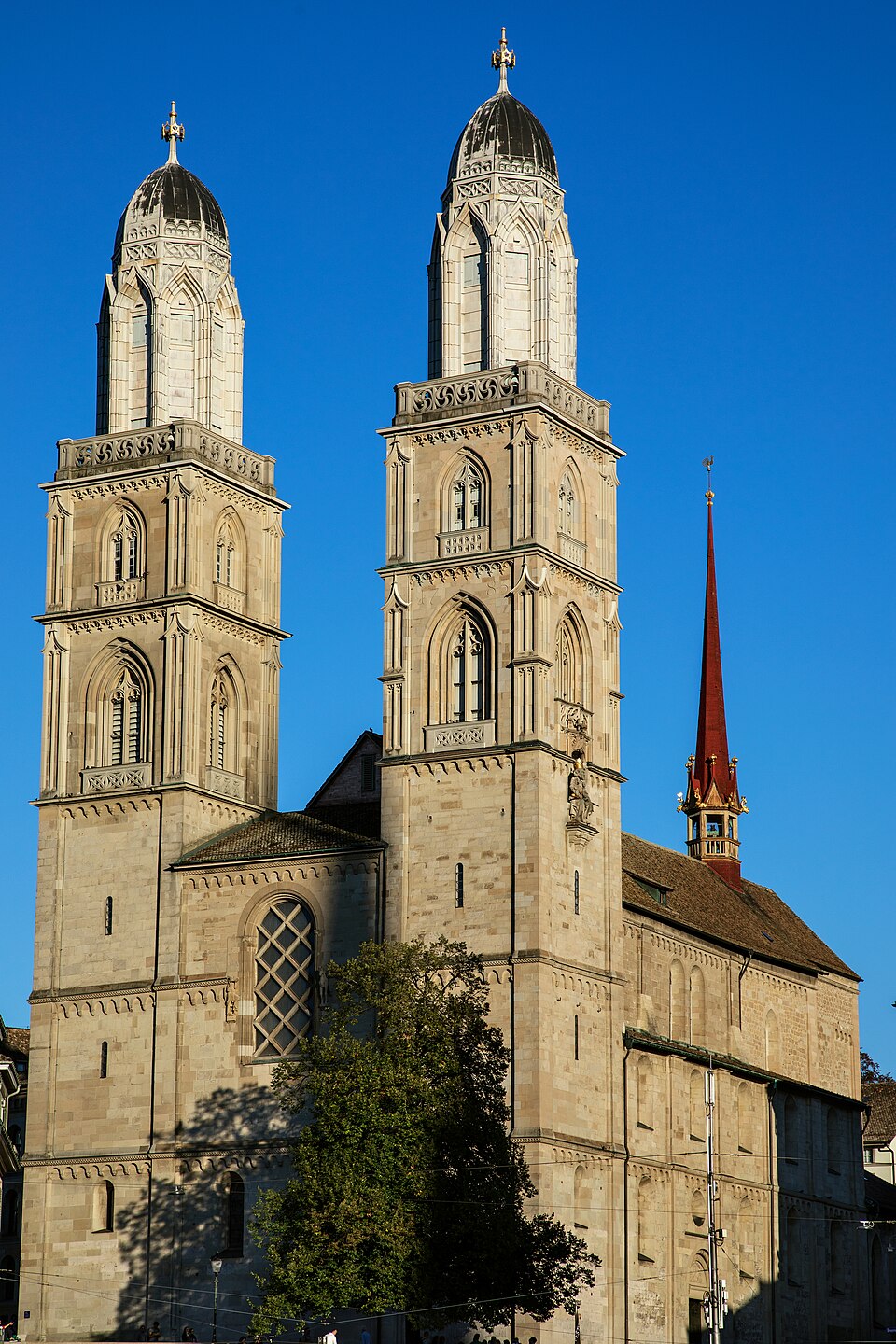
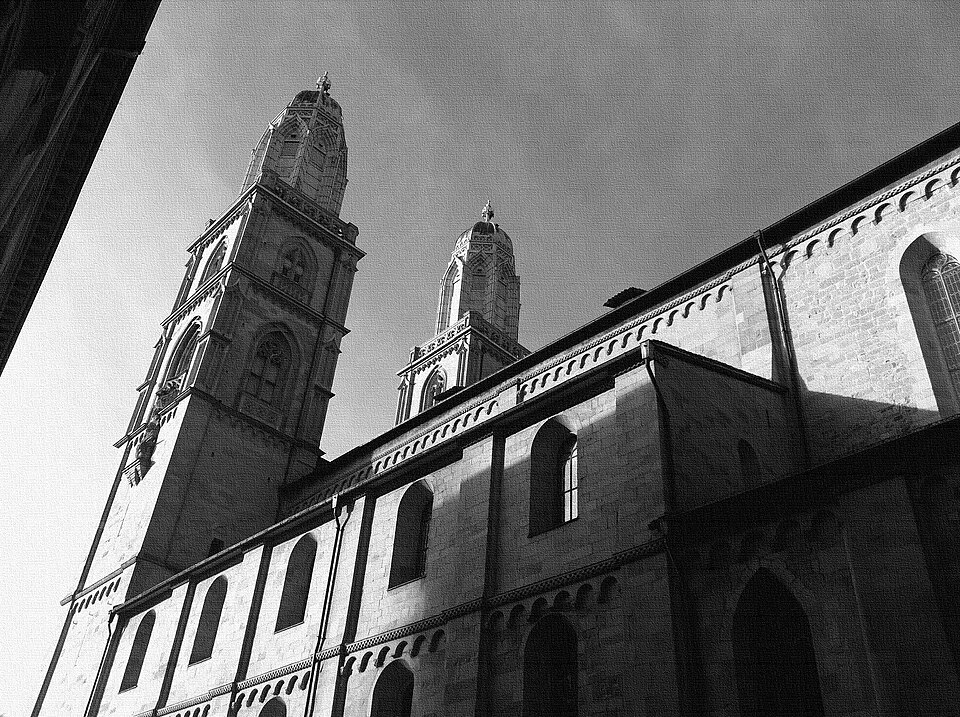
The Grossmünster is the Protestant Reformed church that stands on the right bank of the Limmat in Zurich's old town, at Zwingliplatz 7, and its twin towers with their blunt neo-Gothic caps are the shape most people picture when they picture Zurich at all. Until the Reformation it was two things at once: the church of a collegiate chapter of canons and an ordinary parish church. The name is younger than the building. In the early sources the church is called simply the Zurich church; Grossmünster appears only in the fourteenth century, from the Latin monasterium, and most likely to tell it apart from the smaller Fraumünster across the river.
Its founding story belongs to Zurich's own city legend. The martyrs Felix and Regula are said to have carried their severed heads to the spot where they wished to be buried, and Charlemagne to have found their graves later and founded a church and a chapter here. The church itself says plainly that the legend is not historically secured, while noting that it shaped the standing of the place and its pilgrim traffic for centuries.
What makes the building matter beyond Zurich happened in 1519, when the city council appointed Huldrych Zwingli as people's priest here. The Swiss Reformation is usually dated from that appointment, which is why the church calls itself a key site of it.
Checked 2026-08-26 · Source
The nave is severe, as a church stripped of its altars and images in the 1520s should be, and the colour in it is modern. Augusto Giacometti made the three choir-loft windows in 1933; they tell the Christmas story, with Mary dominant and the infant almost lost at the hem of her blue cloak. Sigmar Polke won the competition for the remaining windows in 2005 and 2006, ahead of a field that included Olafur Eliasson and Katharina Grosse. His seven western windows are sliced agate, standing for the earth's own prehistory, and five so-called prefigurations in traditional glass follow eastwards towards Giacometti: the Son of Man, the ascent of Elijah, King David, the scapegoat and the sacrifice of Isaac.
The crypt is the oldest part of the church. Its faded fourteenth and fifteenth-century murals, attributed to Hans Leu the Elder, show the martyrdom of Felix and Regula, and the original seated figure of Charlemagne taken down from the south tower stands there. Next door, the remains of the Chapel of the Twelve Apostles hold fresco fragments and a model of the original building.
Beyond the church itself are the late twelfth-century cloister, with a garden of historic ornamental plants and Romanesque grotesques on its arcades; the Schriftensammlung, whose centrepiece is a hand-coloured Froschauer Bible; and the Karlsturm, the climbable tower.
Checked 2026-08-26 · Source

Allow about seventy-five minutes for the church and the tower together, and treat that as a working figure rather than a rule: the operator publishes no suggested visit length, so this is a visitor's estimate built from the parts.
The nave takes twenty to twenty-five minutes if you actually look at the windows, which means walking the length of the church twice, once westwards along Polke's agate panes and once back towards Giacometti's choir. The crypt and the remains of the Chapel of the Twelve Apostles add ten to fifteen minutes. The Schriftensammlung is small and rewards fifteen minutes rather than five, because the interest is in single printed pages rather than in a sequence of rooms. The cloister is a five-minute detour unless you sit down in it, which is what it is for.
The tower is the variable. There is no lift and 187 steps, some of it narrow enough that two-way traffic has to negotiate, so budget twenty-five to thirty minutes from the cash desk back to the nave, more when the staircase is busy. Cut the tower and forty-five minutes is enough for the whole church. Add a guided tour and you are at two hours.
Checked 2026-08-26
Between 1 March and 31 October the church is open 10:00 to 18:00; from 1 November to 28 February it closes an hour earlier, at 17:00. Last entry is five minutes before closing, and the last tower ascent is a full hour before the church closes, which is the deadline that actually governs a late afternoon.
Two closures need planning around. The Grossmünster is closed on Tuesdays while students of the Zurich University of the Arts take organ lessons in it — the wording on the operator's page is that the church remains closed on Tuesdays — so treat Tuesday as a lost day and check the extraordinary-hours list before assuming otherwise. On Sundays the German service is at 10:00 and visitors are not admitted until midday; the operator's German page gives that opening as 12:00 and its English page as 12:30, so allow for the later of the two.
Since 15 August the church has also been closed to visitors on Saturdays between 11:30 and 13:15 for an organ concert. The operator maintains a running list of one-off changes — whole days closed, mornings only, afternoons only — and updates it at short notice. Read that list for your date rather than trusting the regular hours alone.
Checked 2026-08-26 · Source
Walking into the church costs nothing. The operator states that the Grossmünster is free of charge for quiet contemplation and for sightseeing, and that includes the nave, the crypt with its Charlemagne figure, the Chapel of the Twelve Apostles and the cloister.
Two things are ticketed, and one ticket covers both: the climb up the Karlsturm and the Schriftensammlung. Adults pay CHF 5, and CHF 2 is charged for children and young people from six to sixteen, students with a card, Kulturlegi holders and pensioners; under-sixes go free. Groups of five or more pay CHF 4 a head, and school classes CHF 1 per child and per accompanying adult. The same ticket also takes CHF 5 off the Kunsthaus Zürich collection on the same day, bringing it to CHF 11 instead of CHF 16.
If the Fraumünster is also on your list, the combined ticket is the better buy: CHF 8 for an adult instead of CHF 10, CHF 2 for under-seventeens and students, covering the Karlsturm here and the information fee for the Fraumünster with its Chagall windows and crypt museum.
Tickets are sold only at the tower desk inside the church. Nothing can be reserved in advance. Cash, credit card and Twint are all accepted.
Checked 2026-08-26 · Source

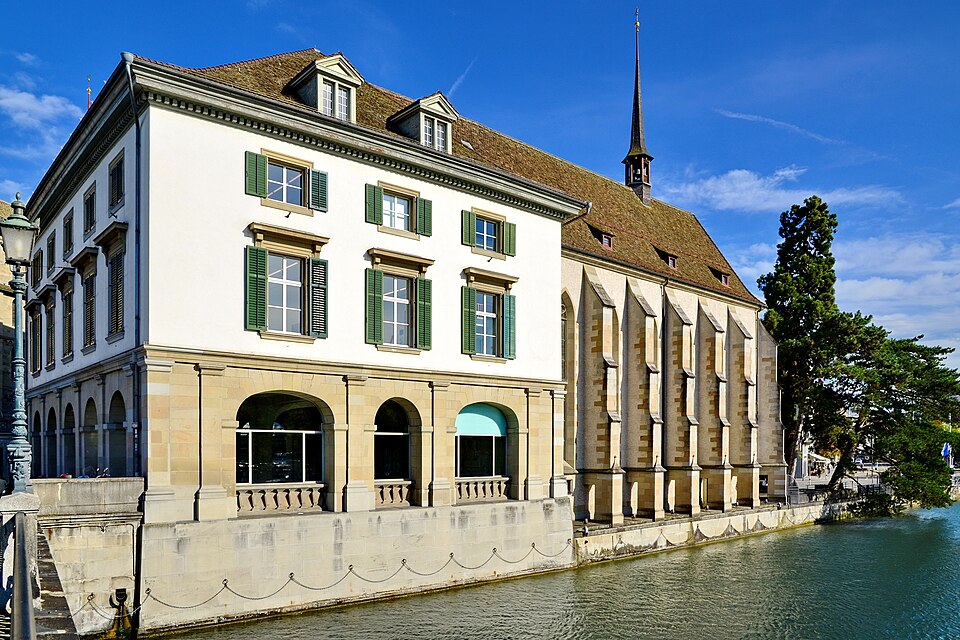
The church is at Zwingliplatz 7, on the Limmat's right bank in the middle of the old town, and it is a walking destination. The nearest tram stop is Helmhaus, on the bridgehead a couple of minutes away, and Zürich Stadelhofen station is about ten minutes on foot. From the main station the walk along the river is fifteen to twenty minutes and is the better approach, because the towers stay in view for most of it.
Do not drive. The operator states that vehicle access is permitted only between 05:00 and 12:00, and that parking nearby exists only with a permit; deliveries for events inside the church may enter after midday, but only with an access permit for the restricted zone. In practice that means the surrounding lanes are shut to visitor traffic for the whole of a normal sightseeing afternoon. Leave the car outside the centre and use the tram, or do not bring one at all.
Approaching on foot from the Fraumünster side, cross by the Münsterbrücke and the entrance is straight ahead on the square. The ground floor of the church is wheelchair accessible; the gallery, the choir, the crypt and the tower are not.
Checked 2026-08-26 · Source

The tower is where most plans come undone. Since 3 August 2026 the Karlsturm has been on reduced hours — closed Monday to Thursday, open Friday to Sunday — so a midweek visit gets the church but not the view. Even on an open day the ascent is not guaranteed: only a limited number of people can be on the platform, and the staff turn people away when it fills. There is no lift, there are 187 steps and some passages are narrow. Large bags and umbrellas may not be taken up.
The crypt closes to visitors on rainy days, to protect murals that damp would finish off. That is worth knowing before you plan a wet afternoon around it.
Inside the church, eating and drinking are not allowed, animals are turned away except guide dogs, and large luggage stays outside — prams can be left with the cash-desk staff but not in the entrance lobby. Children and young people remain the responsibility of the adults with them; sitting on the floor or on the choir steps is not permitted, and only pencils and crayons on a firm backing may be used for writing or drawing. Restoration work is under way, and the operator states that the church and tower stay open through it.
Checked 2026-08-26 · Source
Photography is allowed for private purposes only, without flash and without a tripod, and not during services. The operator asks visitors to refrain from excessive group selfies and from private photo shoots, and professional, editorial or commercial photography is not permitted at all. One point catches people out: the Polke windows are protected by copyright, so a picture of them is a private souvenir and nothing more.
Practically, the interior is dark and the interest is in glass, which means shooting the windows against the light. Giacometti's three choir-loft windows sit at the east end and take morning light; Polke's agate panes are in the west and read best in the afternoon, when the sun is behind them and the stone slices glow rather than go grey. Without a tripod, brace against a pillar or a pew end and expect to raise the ISO.
Outside, the twin towers are hard to frame from Zwingliplatz because you are too close and too low. The postcard view is from the far bank near the Limmatquai or from the Münsterbrücke, with the river in the foreground; late afternoon light falls on the tower faces from the west.
Checked 2026-08-26 · Source
Nothing. The operator states that admission to the Grossmünster is free of charge for quiet contemplation and for visits, and that covers the nave, the crypt and the cloister. Two things are ticketed: climbing the Karlsturm and entering the Schriftensammlung. One CHF 5 adult ticket covers both, with CHF 2 for children and young people aged six to sixteen, students, Kulturlegi holders and pensioners, and free entry for children under six. Groups of five or more pay CHF 4 each. Tickets are sold at the tower desk inside the church only, cannot be reserved, and can be paid in cash, by card or with Twint.
The operator's own visitor page says so: the church remains closed on Tuesdays during organ lessons given by the Zurich University of the Arts. The same page separately lists individual Tuesdays as closed under its extraordinary opening hours, and elsewhere says only that the tower is not accessible to groups and school classes on Tuesdays because of the organ lessons. Those statements do not sit together cleanly, so plan on Tuesday being closed and check the extraordinary-hours list on the operator's page for your date before travelling. No opening time for a Tuesday is recorded here, because the operator publishes none.
Later than on other days, because the German-language service is at 10:00 and visitors are admitted only once it is over. The operator's German page gives that opening as 12:00 and its English page as 12:30; both are the church's own wording and they disagree, so allow for 12:30 if the visit is tight. Closing is unchanged at 18:00 in summer and 17:00 in winter. The Karlsturm follows the same pattern, opening at midday on Sundays rather than at 10:00 — though at present the tower is open only from Friday to Sunday in any case.
Not at the moment. Since 3 August 2026 the Karlsturm has been running special hours — closed Monday to Thursday, open Friday to Sunday. On the days it does open, the last ascent is one hour before the church closes, so 17:00 in summer and 16:00 in winter. There are 187 steps, no lift and some narrow passages, and large bags and umbrellas may not be carried up. The operator warns that only a limited number of people can be on the platform at once and that the ascent cannot be guaranteed when it is busy. The platform is at 50 metres and looks over the city, the lake and, in clear weather, the Glarus Alps.
About seventy-five minutes covers the church and the tower at an unhurried pace. The operator publishes no suggested length, so this is an estimate from the parts: twenty to twenty-five minutes in the nave for the Polke and Giacometti windows, ten to fifteen in the crypt and the Chapel of the Twelve Apostles, fifteen in the Schriftensammlung and around twenty-five to thirty for the tower stairs and the platform. Skipping the tower brings it down to about forty-five minutes. A guided tour adds an hour or more; the free short tours led by volunteers, usually offered from Friday to Sunday when guides are on site, last ten to fifteen minutes.
No, and bringing one is actively awkward. The operator states that vehicle access to the church is permitted only between 05:00 and 12:00 and that the parking spaces nearby require a permit, which rules out driving for a normal sightseeing afternoon. The church sits in the pedestrian old town at Zwingliplatz 7. Take the tram to Helmhaus, a couple of minutes away, or walk the ten minutes from Zürich Stadelhofen station; from the main station the riverside walk is fifteen to twenty minutes. The ground floor is wheelchair accessible, but the gallery, the choir, the crypt and the tower are not.
Loading the interactive map…
The interactive map could not be loaded.
Last updated:
Source: OpenStreetMap contributors, Wikidata ·