

_07.jpg)
1 min walk
Lindenhof-Keller
- Must see
- Historic monument
Language · 1 published
Viewpoint · Zurich

| Monday | 00:00 – 23:59 |
|---|---|
| Tuesday | 00:00 – 23:59 |
| Wednesday | 00:00 – 23:59 |
| Thursday | 00:00 – 23:59 |
| Friday | 00:00 – 23:59 |
| Saturday | 00:00 – 23:59 |
| Sunday | 00:00 – 23:59 |
Checked 2026-08-26 · Source
Lindenhof is a flat gravelled terrace on a moraine hill above the left bank of the Limmat, and the City of Zurich describes it as the city's oldest green space. It is a square rather than a monument: there is no building to enter, no gate, no ticket desk and nothing roped off. What a visitor stands on is the levelled crown of the hill where Zurich began.
The city's own account runs from the Celts, who founded an early fortified settlement here, through the Roman military post established from 15 BC, when the settlement spreading down both banks of the Limmat was called Turicum. A castrum wall of the fourth century ran along the western edge of the terrace. In the ninth century the hill carried a Frankish royal palace, and travelling nobles used the palace buildings as a staging place. After the death of the last Zähringer imperial bailiff in 1218 the city council had the palace fortress pulled down as a symbol of the old centre of power, and the top of the hill was levelled.
Patrician families used part of the terrace as a burial ground into the fourteenth century. It became a public park from 1422, the year the planting of fifty-two lime trees is first recorded, and the gravel surface under the trees that a visitor walks on today was laid out after the large archaeological excavations of 1937 and 1938.
Checked 2026-08-26 · Source
The terrace holds a handful of objects and one long-running habit, and the City of Zurich names all of them.
The Lindenhof fountain carries a figure by Gustav Siber (1864-1927) recalling the legend of the women of Zurich who in 1292 are said to have assembled on the hill in battle dress and, by feigning a fighting army, deterred the troops of Duke Albrecht I of Habsburg.
A sandstone block near it is most probably the plinth of an eighteenth-century William Tell statue, one of several put up in 1780 to ornament the baroque layout; that statue was destroyed by persons unknown on the night of 1 December 1800.
Set into the wall of the Pfalzgasse at the ascent to the terrace is a copy of the gravestone of Lucius Urbicus, son of the local head of customs. The inscription on it is the reason the Roman name for Zurich, Turicum, is known at all.
Under the limes there are tables where chess is played, and the city records pétanque tournaments and theatre performances held here regularly. A playground and an accessible toilet are on site. One lime was planted in 1971 to mark the introduction of women's suffrage. The trees themselves have a history: after a severe storm in 1861 a mixed planting of chestnut, tree of heaven and acacia was so unpopular that limes replaced it after only fifteen years.
Checked 2026-08-26 · Source
Thirty minutes is the figure this guide records, and it is an editorial judgement rather than a published one, because neither the City of Zurich nor Zurich Tourism states a visit duration for a public square.
Thirty minutes covers the honest content of the place: the climb up through the lanes, a slow circuit of the terrace along the parapet, the fountain, the sandstone block and the Lucius Urbicus stone at the Pfalzgasse ascent, and long enough at the eastern edge for the view to resolve from a panorama into individual buildings. A visitor moving briskly and only wanting the view is finished in ten minutes.
The number goes the other way easily. The terrace is one of the few places in central Zurich with shade, benches and no obligation to buy anything, so it absorbs an hour comfortably if the weather is good. Watching a chess game to its end, or waiting out the twenty minutes between arriving in flat midday light and the sun dropping far enough west to light the far bank, are both reasonable ways to spend longer here. Plan thirty minutes into an old town walk and let it stretch if the day allows.
Checked 2026-08-26
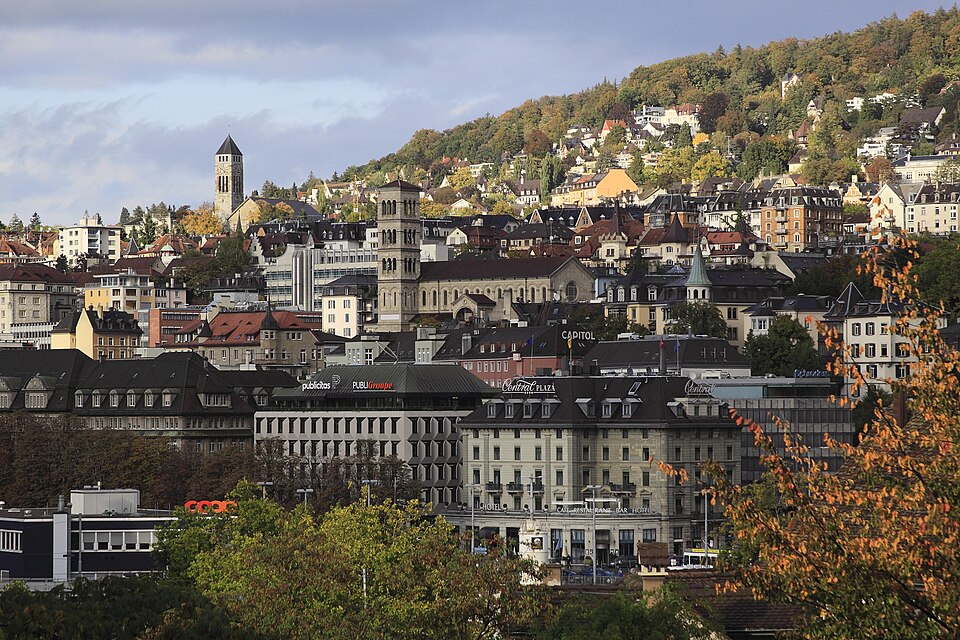
Zurich Tourism records Lindenhof as always open. All seven weekdays are listed, no closing day is given, no midday break is recorded, and no seasonal variation is published; the City of Zurich, which maintains the terrace as a public park, publishes no hours for it either. In practice that means the hill is reached whenever the lanes below it are walkable.
Time of day matters more than season. The terrace faces east and north-east across the Limmat, so through the morning the sun is behind the buildings a visitor has come to look at and the far bank sits in its own shadow. Late afternoon and the hour before sunset put the sun behind the viewer and light the Grossmünster, the City Hall and the university slopes directly. That is also when the square is busiest with residents rather than visitors.
Summer gives dense shade under the limes and the chess and pétanque are at their most active. Winter strips the canopy and opens sightlines that the leaves close off from May onwards, which is a real argument for a cold visit. Rain is the one condition that empties the place: the surface is gravel, there is no shelter on the terrace, and the tree cover keeps dripping long after the rain has stopped.
Checked 2026-08-26 · Source
There is nothing to buy. Lindenhof is a public park maintained by the City of Zurich, and the city's page for it lists no admission charge, no ticket, no booking and no opening restriction. Zurich Tourism's entry for the square likewise carries no price and no booking widget. This guide records it as free per person on that basis.
There is also nothing to book. No guided tour is sold by the operator for the terrace itself, no timed entry exists, and no part of the square is reserved or fenced. Walk-up is the only way in and it is available at any hour.
That has a practical consequence worth naming for anyone holding a Zürich Card or a similar city pass: there is no discount to claim here and no counter at which to show it, so a pass bought for other attractions neither adds nor removes anything at Lindenhof. It is one of the few sights in central Zurich that costs a visitor nothing at all, which is a reasonable argument for putting it early in a day and deciding afterwards what to pay for.
If a temporary event on the square ever charges, that is the event's own arrangement and not the terrace's; the ground itself remains free to enter.
Checked 2026-08-26 · Source
The address is Lindenhof, 8001 Zürich. Zurich Tourism gives the nearest public transport stop as Rennweg, and records the terrace as 533 metres and seven minutes on foot from Zürich Hauptbahnhof, and 8.9 kilometres and nineteen minutes from Zurich Airport.
No car is needed and a car is a hindrance. The square sits inside the old town on the left bank, the lanes approaching it are narrow and largely closed to through traffic, and there is no parking on the terrace. Arriving by train and walking is the shortest and simplest route: cross the Limmat from the station side, work up through the streets behind Rennweg, and the hill is reached by one of several stepped alleys, the Pfalzgasse among them.
Approaching from the river, the Schipfe lane along the water's edge brings a visitor to the foot of the hill and a flight of steps up; Zurich Tourism lists Schipfe as sixty-four metres away, which gives an idea of how tightly this quarter is packed.
Zurich Tourism rates the terrace as partially accessible for a manual or electric wheelchair and fully accessible for a stroller, and the City of Zurich lists an accessible toilet on site.
Checked 2026-08-26 · Source

The commonest disappointment here is an expectation problem. Lindenhof is one of the most important archaeological zones in Zurich, and almost none of it is visible. The Celtic settlement, the Roman fort, the fourth-century castrum wall and the ninth and eleventh-century palace buildings are all below the gravel; the city's archaeology service reaches them only through small excavations dug when a diseased or storm-damaged tree has to be replaced. A visitor arriving to see a Roman fort will find a tree-shaded square with a view, and should come for that instead.
The climb is the second thing to plan for. Every obvious approach involves steps through medieval lanes, and the accessibility rating of partial rather than full for wheelchairs reflects exactly that. Anyone with limited mobility should look for the gentler route in from the Rennweg side rather than the stairs from the Schipfe.
There is no café, kiosk or shop on the terrace itself, so bring what is wanted; everything is a few minutes back down the hill. The chess tables are used by regulars playing real games, and a board in play is not a photo prop or an invitation to join. And the gravel is loose enough to be poor going in thin-soled shoes after rain.
Checked 2026-08-26
The view is the picture, and Zurich Tourism names what is in it: the Old Town, the Grossmünster, the City Hall, the Limmat, the university and the Swiss Federal Institute of Technology on the slope above it. From the eastern parapet all of that stacks into a single frame, with the river as the horizontal line holding it together.
Light decides everything. Morning puts the sun beyond the far bank and every façade a visitor wants is in shadow, which makes for a flat, hazy result. From mid-afternoon the sun swings behind the terrace and lights the Grossmünster's twin towers and the roofs below them straight on; the last hour before sunset is the strongest, and blue hour with the towers lit works from the same spot.
A wide lens gets the whole sweep but the buildings shrink to nothing in it; something around a short telephoto, framing the Grossmünster and the roofs beside it, is the picture most visitors actually want.
Turning around is worth doing too. The limes overhead, the gravel, the fountain figure and the chess tables give a shaded, human frame that no amount of skyline does, and in winter the bare canopy makes a graphic ceiling over the whole terrace.
Checked 2026-08-26 · Source
No. Lindenhof is a public park maintained by the City of Zurich, and the city's page for it lists no admission charge, no ticket and no booking of any kind. There is no counter, no barrier and no gate on the terrace, so a visitor simply walks up one of the lanes and is there. A city pass such as the Zürich Card buys nothing here because there is nothing to buy.
Zurich Tourism records Lindenhof as always open. All seven weekdays are listed on its entry, no closing day is given, no midday break is recorded and no seasonal hours are published. The City of Zurich, which maintains the square, publishes no opening hours for it either. In practice the terrace can be reached at any hour, day or night, and the only constraint is the walk up through the old town lanes.
Thirty minutes is the figure this guide records, as an editorial judgement rather than a published one — no operator states a visit duration for a public square. That covers the climb, a circuit of the terrace, the fountain, the sandstone block and the Lucius Urbicus stone at the Pfalzgasse ascent, and enough time at the eastern edge for the view to become individual buildings. Ten minutes is enough for the view alone, and an hour passes easily on a good day.
On foot, and no. Zurich Tourism records the terrace as 533 metres and about seven minutes' walk from Zürich Hauptbahnhof, and gives Rennweg as the nearest public transport stop. Zurich Airport is listed as 8.9 kilometres and nineteen minutes away. A car is of no use: the surrounding old town lanes are narrow and largely closed to through traffic, and there is no parking on the square itself.
Partly. Zurich Tourism rates the terrace as partially accessible for a manual wheelchair, an electric wheelchair and a Scewo BRO, and fully accessible for a stroller. The limiting factor is the approach rather than the square, since several of the obvious routes up are flights of steps through medieval lanes; the gentler way in is from the Rennweg side. The City of Zurich lists an accessible toilet on site, and the surface on top is level gravel.
No, not on the surface. The city's archaeology service describes the Lindenhof hill as an outstanding find site whose remains — the Celtic oppidum, the Roman post, the fourth-century castrum wall on the western edge and the ninth and eleventh-century palace buildings north of the fountain — lie under the gravel. They are reached only through small excavations dug when a tree has to be replaced, most recently in 2020, 2014 and 2008. Come for the terrace and the view, not for visible ruins.
Loading the interactive map…
The interactive map could not be loaded.
Last updated:
Source: OpenStreetMap contributors ·