

61 min walk
Urubamba
- High
- Activity
Language · 11 published
Activity · Cusco
Valle Sagrado de los Incas

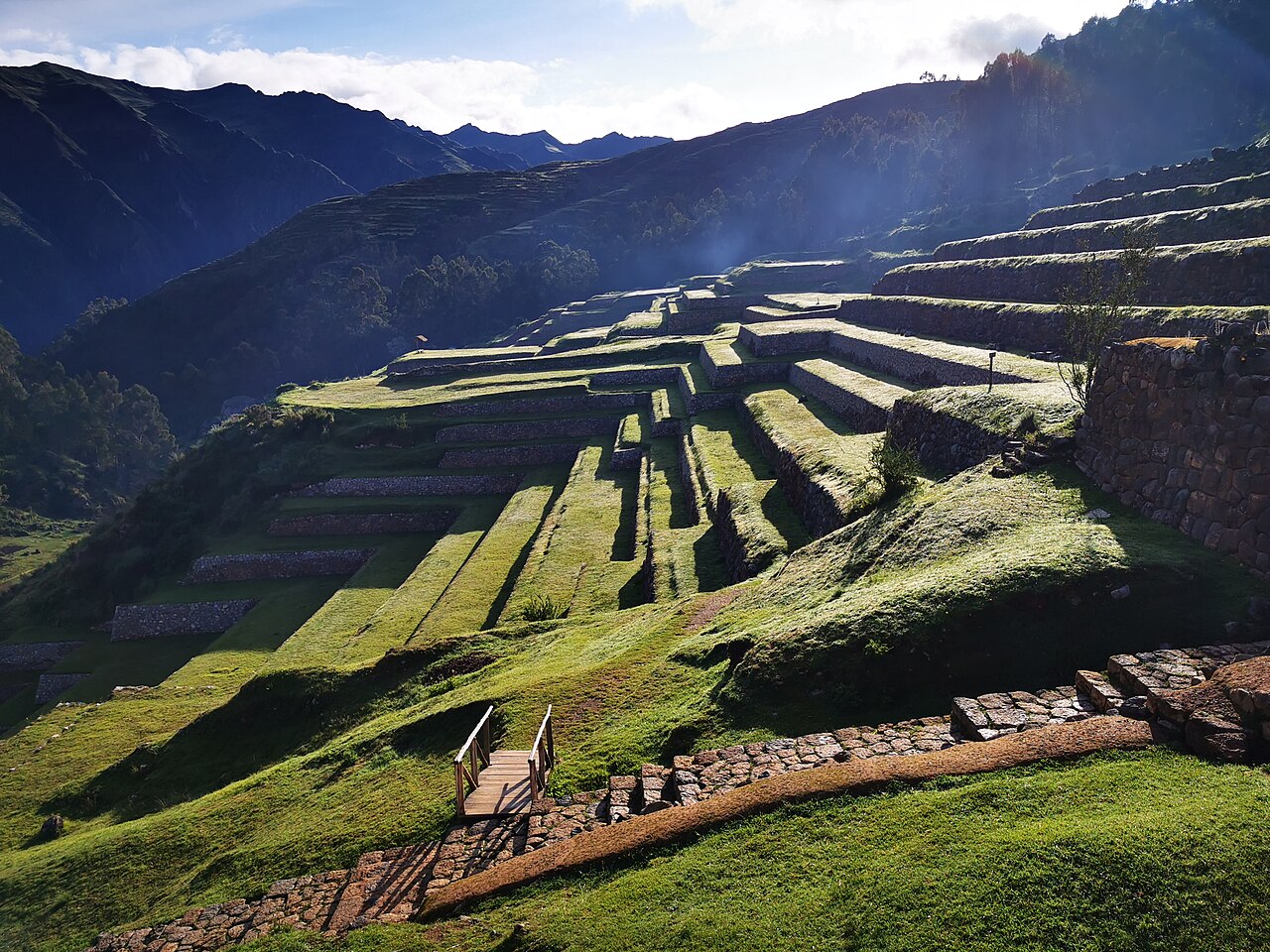
The Sacred Valley of the Incas, locally Valle Sagrado de los Incas, is the Urubamba River corridor northwest of Cusco. This broad valley between Pisac and Ollantaytambo served as a vital agricultural, spiritual, and administrative zone for the Inca Empire. The terrain encompasses terraced hillsides, colonial towns, and archaeological complexes at varying elevations. The Peruvian government tourism portal at cosituc.gob.pe indicates official regional promotion. The valley functions as Cusco's essential regional archaeological and cultural day-trip corridor, intentionally ranked below the city core in this editorial sequence.
Checked 2026-08-26
The valley contains multiple significant archaeological sites and settlements. Pisac features extensive terraced ruins and a colonial town with market activity. Ollantaytambo preserves Inca urban planning and a major ceremonial fortress. Chinchero combines archaeological remains with textile traditions. Moray displays circular agricultural terraces. Maras contains salt-evaporation ponds operated communally. Urubamba and Calca serve as valley service towns. The corridor distributes visitor activity across these nodes. Each location offers distinct architectural and cultural emphasis. The valley floor and side valleys contain additional unmarked or lesser-documented sites requiring local guidance.
Checked 2026-08-26
A comprehensive valley circuit demands a full day minimum. Single-site visits from Cusco require partial days. The Pisac-Ollantaytambo traverse with intermediate stops constitutes the standard full-day itinerary. Multi-day stays in valley towns permit deeper exploration and altitude adjustment. Ollantaytambo functions as the rail gateway to Machu Picchu, encouraging overnight stays. Independent travellers using public transport require additional time between nodes. Organised tours optimise routing but constrain individual site duration. Self-driven itineraries allow flexible pacing subject to road conditions and daylight constraints at altitude.
Checked 2026-08-26
Dry season conditions from May to September generally facilitate valley travel with reduced precipitation. Wet season months present variable rainfall and potential transport disruption. Morning departures from Cusco optimise daylight hours given the approximately one-hour transit to valley entry points. Altitude varies significantly between valley floor and surrounding ridges, creating microclimatic variation. Visitors should consult current local conditions before departure, as weather patterns affect road accessibility and site conditions throughout the corridor. Sacred Valley of the Incas also earns time in a cusco itinerary because WIKIDATA_EDITORIAL reconciliation for the ranked entry; identity and coordinates were verified without a nearby fallback. Its value becomes clearer when the stop is compared with the surrounding streets and the other ranked places nearby. Check the operator's own site for the travel date before relying on a schedule or fare.
Checked 2026-08-26
Access mechanisms vary across valley sites. Some locations participate in the Cusco Tourist Ticket system; others maintain independent fee structures. The partial tourist ticket covers specific archaeological complexes. Salt ponds at Maras historically operated with separate community-collected fees. Visitors should verify current fee structures at official tourist information points in Cusco or at individual site entrances. Cash payment in Peruvian soles predominates. International payment methods may not be accepted at smaller or community-managed sites. Receipts should be requested for all transactions. Check the operator's own site for the travel date before relying on a schedule or fare.
Checked 2026-08-26
Road access connects Cusco to the valley via multiple routes. The paved road to Pisac offers one entry point; the Chinchero-Urubamba route provides another. Colectivo shared vehicles depart from designated Cusco terminals for Pisac, Urubamba, and Ollantaytambo. Taxis and private transport can be arranged. Organised tours include transport from central Cusco. The valley road network permits sequential site visits. Ollantaytambo hosts the rail terminal for Machu Picchu-bound services. Road conditions vary; landslides may affect routes during wet periods. Journey times extend during peak visitor periods.
Checked 2026-08-26
Altitude affects visitors acclimatising from lower elevations; the valley floor sits below Cusco but surrounding sites rise significantly. Sun exposure intensifies at altitude regardless of temperature. Unpaved access roads to Moray and Maras require careful transit. Market areas attract persistent vendor attention. Archaeological sites lack comprehensive guardrails or barriers; steep drops exist at terraces and cliff edges. Water and sanitation facilities vary in quality between sites. Political demonstrations occasionally block regional roads. Petty theft occurs at transport terminals and crowded markets. Travel insurance should cover altitude-related medical evacuation.
Checked 2026-08-26
Morning and late afternoon light quality benefits landscape and architectural photography. The terraced hillsides at Pisac and Moray respond strongly to side-lighting conditions. Salt ponds at Maras create abstract patterns from elevated viewpoints. Permission requirements for commercial or tripod use are not uniformly posted; visitors should inquire locally. Drone operation faces regulatory restrictions near archaeological sites and requires explicit authorisation. Interior photography may be restricted in colonial church interiors at Chinchero and other towns. Weather conditions change rapidly; protective equipment advisable. Respect local community members' preferences regarding direct photography.
Checked 2026-08-26
The valley constitutes Cusco's essential regional archaeological corridor. Visitors with limited time should prioritise the city core. A single valley day trip remains feasible for those with two or more full days in the region.
Independent travel is possible using colectivo transport from Cusco terminals. Self-driven vehicles permit flexible routing. However, archaeological interpretation benefits from qualified guides, and remote sites require navigation assistance.
Ollantaytambo accommodates overnight stays and serves as the Machu Picchu rail gateway. Valley towns offer lower altitude than Cusco. Return to Cusco suits single-day itineraries.
The Maras salt-evaporation ponds continue communal operation. Access and fee structures are community-managed. Visitors should verify current visiting conditions locally.
The valley floor sits below Cusco's elevation, but surrounding archaeological sites rise significantly. Altitude adjustment remains relevant for visitors. Individual site elevations vary throughout the corridor.
Layered clothing accommodates temperature variation between valley floor and elevated sites. Sun protection is essential at altitude. Rain protection advisable during wet season months. Sturdy footwear recommended for uneven archaeological terrain.
Loading the interactive map…
The interactive map could not be loaded.

Last updated:
Source: OpenStreetMap contributors, Wikidata ·