

1 min walk
Temple Mount
- Must see
- Place of worship
Language · 11 published
Place of worship · Jerusalem
Read from the OpenStreetMap access tags; anything not listed has no tag recorded.
Set the group type to family in the planner and the day window contracts to about three quarters of a solo day.
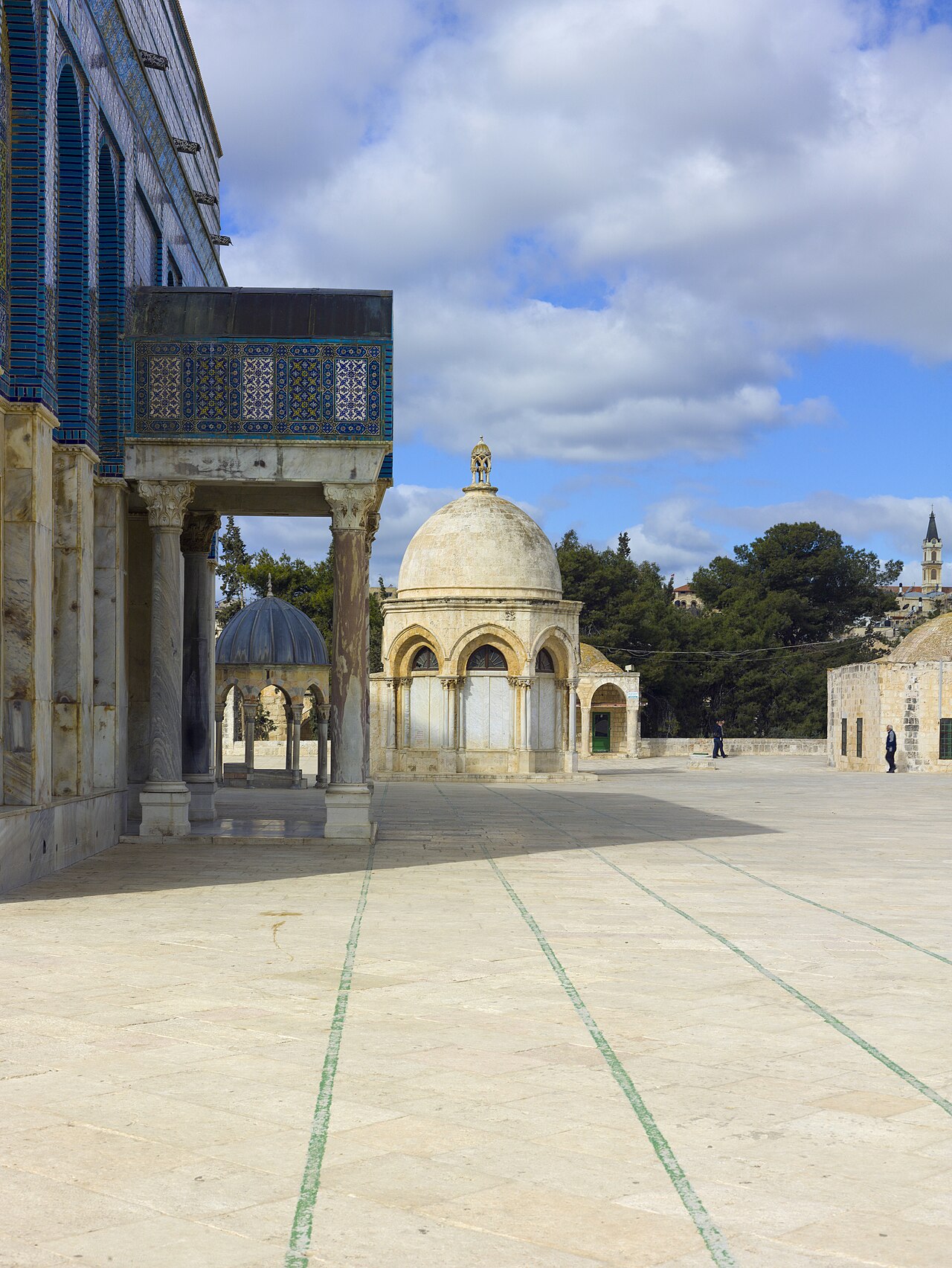
The Dome of the Rock is an Islamic shrine located on the Temple Mount in the Old City of Jerusalem. Completed in 691 CE, it is one of the oldest surviving Islamic monuments. The structure features a distinctive golden dome and elaborate mosaic decoration. The site holds profound significance for Muslims, Jews, and Christians alike. Muslims believe it marks the spot from which the Prophet Muhammad ascended to heaven during his Night Journey. The building stands on a platform sacred to multiple faith traditions, making it a focal point of religious and political complexity in Jerusalem.
Checked 2026-08-26
The interior contains the Foundation Stone, a large rock venerated in Islamic tradition as the place of Muhammad's ascension and in Jewish tradition as the site of the Holy of Holies. The shrine's interior features Byzantine-influenced mosaics, marble paneling, and Kufic inscriptions from the Quran. The octagonal plan creates a centralized space around the rock. Decorative elements include ceramic tiles added during Ottoman renovations. The space functions as a place of individual prayer rather than congregational worship. Non-Muslim visitors have historically faced restrictions regarding interior access, with policies subject to change.
Checked 2026-08-26
Visitors typically allocate between thirty minutes and two hours for the Temple Mount platform area, depending on access conditions and personal interest. The Dome of the Rock itself may not permit interior entry for all visitors, limiting engagement to exterior observation. Those able to enter should add fifteen to thirty minutes. The broader Temple Mount complex warrants additional time for circumambulation and contemplation of surrounding structures including the Al-Aqsa Mosque. Security procedures at entry points can substantially extend total visit duration. Morning visits may encounter shorter processing queues. Combine with adjacent Old City quarters for a full day.
Checked 2026-08-26
Access to the Temple Mount platform, where the Dome of the Rock stands, is subject to variable scheduling controlled by religious authorities and security considerations. Entry restrictions frequently apply during Muslim prayer times, particularly Fridays and religious holidays. Seasonal factors affect visitor comfort, with summer heat being intense and winter bringing cooler temperatures. Political and security situations cause unpredictable closures. Prospective visitors must consult current official guidance before attempting access. Timing flexibility is essential. Early arrival improves chances of successful entry when restrictions are in effect. Check the operator's own site for the travel date before relying on a schedule or fare.
Checked 2026-08-26
Access to the Temple Mount platform has historically been without charge, though this policy is subject to modification. No reliable ticketing infrastructure is documented in the provided sources. Donation requests or guided tour arrangements may apply for certain visitor categories. Any payment requirements would be determined by the Waqf administration or Israeli authorities with jurisdiction. Visitors should carry identification for security screening. Commercial tour operators may charge separately for guided services. Independent verification of current financial requirements is essential before visiting. Budget for contingency expenses given access uncertainty. Check the operator's own site for the travel date before relying on a schedule or fare.
Checked 2026-08-26
The Dome of the Rock occupies the Temple Mount platform within Jerusalem's walled Old City. Multiple gates provide access, with specific entry points designated for non-Muslim visitors subject to prevailing regulations. The Old City is walkable from surrounding Jerusalem areas. Public buses and light rail serve stops near the Old City walls, requiring subsequent pedestrian approach. Private vehicle access to the immediate vicinity is severely restricted. Taxi and rideshare services can approach outer Old City locations. Navigation through crowded, narrow streets demands patience. Signage may be inadequate; advance route familiarization is advisable. Security checkpoints affect all approaches.
Checked 2026-08-26
Dress modestly covering shoulders and knees; religious site standards apply strictly. Behavior should be respectful regardless of personal beliefs. Photography restrictions may be enforced, particularly regarding worshippers. Political speech or provocative conduct risks detention or exclusion. Security screening is mandatory and thorough. Tensions between visitor groups and authorities can escalate without warning. Solo female travelers may encounter specific scrutiny. Mobile phone use may be restricted in certain zones. Water and sun protection are essential given exposed location. Exit routes may differ from entry points. Monitor surroundings for sudden crowd movements or security responses. Travel insurance should cover evacuation contingencies.
Checked 2026-08-26
Photography policies at the Dome of the Rock and Temple Mount are inconsistently enforced and subject to change without notice. Exterior photography of the golden dome is widely practiced from the platform and surrounding vantage points. Interior photography is generally prohibited or heavily restricted. Images of worshippers require particular sensitivity and often explicit permission. Tripods and professional equipment may attract security attention. Drone operation is strictly forbidden in this sensitive airspace. Sharing locations in real-time on social media carries personal security implications. Respect immediate instructions from authorities regarding camera use. Quality exterior shots are achievable during varied lighting conditions throughout the day.
Checked 2026-08-26
Access policies for non-Muslims vary and are subject to change. The Temple Mount platform has historically permitted non-Muslim visitors during designated hours, but interior entry to the Dome of the Rock itself has often been restricted. Current regulations must be verified before visiting.
No. They are distinct structures on the Temple Mount platform. The Dome of the Rock is an octagonal shrine with a golden dome, while Al-Aqsa Mosque is a separate prayer hall located to the south. Both hold Islamic significance but serve different functions.
The location is sacred to Jews as the site of the ancient Temples, to Muslims as the place of Muhammad's ascension, and to Christians within the broader holy city context. This overlapping significance contributes to its contested status.
Modest dress covering shoulders and knees is required. This applies to all visitors regardless of faith. Specific requirements may be enforced at entry points. Conservative attire demonstrates respect and facilitates access.
The site operates under heightened security. All visitors undergo screening. Political tensions can cause sudden closures or access restrictions. Visitors should remain alert, follow instructions, and monitor travel advisories from their home governments.
Official sources including the Waqf administration, Israeli authorities, or your country's embassy should be consulted directly. Online information may be outdated. Flexibility in travel plans is essential given the unpredictable nature of site access.
Loading the interactive map…
The interactive map could not be loaded.

Last updated:
Source: OpenStreetMap contributors ·