


3 min walk
The New Collection
- Notable
- Museum
Language · 1 published
Museum · Munich
| Monday | Closed |
|---|---|
| Tuesday | 10:00 – 20:00 |
| Wednesday | 10:00 – 20:00 |
| Thursday | 10:00 – 18:00 |
| Friday | 10:00 – 18:00 |
| Saturday | 10:00 – 18:00 |
| Sunday | 10:00 – 18:00 |
Checked 2026-08-26 · Source
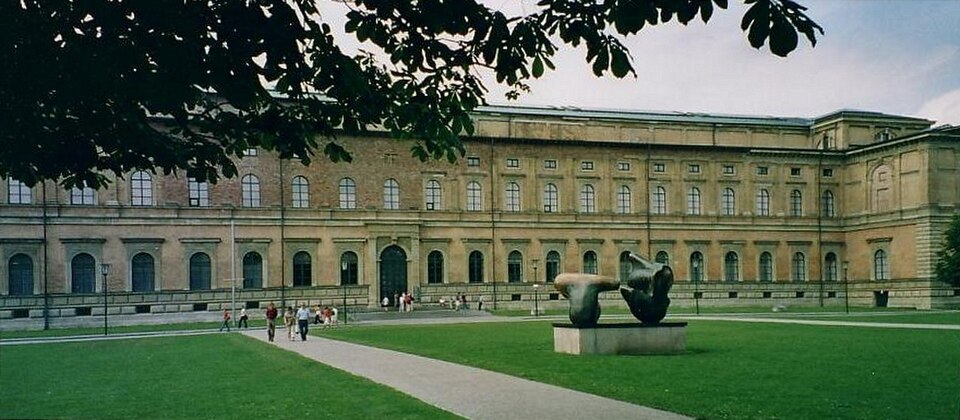
The Alte Pinakothek is Munich's gallery of Old Master painting, covering the fourteenth to the eighteenth century, and it is one of the oldest purpose-built picture galleries anywhere. The collection began as the Wittelsbach family's pictures; King Ludwig I ordered Leo von Klenze to build a gallery for them, and construction ran from 1826 to 1836. What Klenze produced was a long, plain, free-standing block, 150 metres by 50, lit through skylights rather than windows, and it was copied across Europe afterwards.
Aerial bombing gutted it: incendiaries took the roof and the upper halls in 1943, the exhibition rooms burned out in April 1944, and in December 1944 a mine tore a forty-five-metre hole through the middle of the building. Demolition was seriously discussed. In 1952 Bavaria decided instead to rebuild under Hans Döllgast, who refused to reconstruct what had been lost. He filled the breach in plain rubble brick, set half a brick back from the surviving wall, so the wound stays legible from the south side to this day. The gallery reopened on 7 June 1957.
More than 800 paintings hang here, drawn from a state collection of several thousand. The Rubens holding alone runs to seventy-two pictures, the largest permanent group of his work in the world.
Checked 2026-08-26 · Source
The building is entered at ground level and the collection proper is upstairs. The upper gallery is where the reputation sits: a run of top-lit halls, the walls hung in red and green silk, arranged by school rather than by date, so a visitor walks from German painting into Netherlandish, Flemish, Italian, Spanish and French rooms in turn.
The museum's own list of masterpieces gives a fair idea of the range. Albrecht Dürer's Self-Portrait with Fur-Trimmed Robe of 1500 and Albrecht Altdorfer's Battle of Alexander at Issus of 1529 anchor the German rooms. Rogier van der Weyden's St Columba Altarpiece and Pieter Bruegel the Elder's Land of Cockaigne carry the Netherlandish ones. Rubens is everywhere, from the Honeysuckle Bower double portrait of himself and Isabella Brant to the enormous Fall of the Damned and Great Last Judgement. Rembrandt appears twice in the list, with the 1629 Self-Portrait and a Resurrection of Christ. The Italian rooms hold Leonardo's Madonna of the Carnation, Raphael's Canigiani Holy Family, Botticelli's Lamentation and Tintoretto's Venus and Mars.
One caveat matters for planning. The Neue Pinakothek has been shut for renovation since 2019, with reopening planned for 2029, and a selection of its nineteenth-century masterpieces is displayed on the ground floor of the Alte Pinakothek's east wing. That is extra material inside the same ticket.
Checked 2026-08-26 · Source
The museum publishes no recommended visit length, so this is judgement rather than a quoted figure. Two hours is the honest working number for a first visit: enough to walk the whole upper gallery at a steady pace, stop properly in front of fifteen or twenty pictures, and come back to two or three of them before leaving.
Under ninety minutes the visit becomes a march. The upper floor is long — the building is 150 metres end to end — and the Flemish rooms alone, with seventy-two Rubens paintings, will absorb half an hour from anyone who does not deliberately walk past them. Add the nineteenth-century display in the ground-floor east wing and half an hour disappears again before the Old Masters have been reached.
Three hours suits anyone who came to Munich partly for this. Four is not excessive if the intention is to sit with individual works, and the upper halls have light folding chairs available from the information desk for exactly that.
The Tuesday and Wednesday closing time of 8 p.m. is what makes a long visit comfortable, because it removes the pressure of a 6 p.m. sweep. On the other five open days, arriving after about 4.30 p.m. leaves too little time to justify the ticket.
Checked 2026-08-26
The one day to avoid is Monday, when the museum is closed outright. Beyond that the operator names the fixed annual closures: the museums of the Bavarian State Painting Collections are generally shut on 1 May, 24 December, 25 December and 31 December. Anyone planning around Christmas should check the museum's own holiday overview rather than assuming a normal week.
Sunday is the cheapest day and therefore the busiest. Admission drops to one euro per museum on Sundays, which fills the upper gallery with local visitors and school-age families, and the rooms in front of the best-known Rubens and Dürer paintings stay three deep for much of the afternoon. If the price matters more than the quiet, take it; if the quiet matters more, do not.
Tuesday and Wednesday are the useful days. Both stay open until 8 p.m. rather than 6 p.m., and the last two hours are the emptiest the building gets, because the tour groups and the school parties have gone. Arriving at 10 a.m. on any open day is the other good option — the first hour is consistently thinner than the middle of the day.
Season matters less than the day of the week here, since the whole visit is indoors and top-lit.
Checked 2026-08-26 · Source
Standard admission to the permanent exhibition is 9 euros, reduced 6 euros. The museum states that admission is free for children and young people under eighteen, and that students and visitors over sixty-five pay the reduced rate. Groups of at least fifteen also receive the reduced rate, provided the whole group's entry is paid together.
On Sundays admission falls to 1 euro per museum, and that rate applies across the Pinakotheken, Museum Brandhorst and the Sammlung Schack.
A combined ticket at 12 euros covers the Pinakotheken, Museum Brandhorst and the Sammlung Schack. Two operator pages describe it slightly differently and both are printed here rather than blended: the Alte Pinakothek page states that the combined ticket is only available at the museum ticket office, while the FAQ describes it as a day ticket valid for admission to several museums on one day, during each museum's own opening hours. Both pages agree that it does not cover special exhibitions charged separately.
An annual ticket costs 90 euros, reduced 60 euros, and includes special exhibitions. It is sold digitally through the online shop; a printed card has to be bought at a museum ticket office.
Regular tickets can be bought at the door on the day, in cash or by card, or in advance through the online ticket shop. Separate prices may apply to special exhibitions.
Checked 2026-08-26 · Source

The address is Barer Strasse 27, 80333 Munich, but the entrance a visitor uses is on Theresienstrasse, on the north side of the building, not on the long south façade that faces the lawn. People regularly walk the length of the south front looking for a door that is not there.
Public transport is what the museum recommends, and the site is well covered. Trams 27 and 28 stop at Pinakotheken, immediately outside. Bus 100, the museum line, and bus 58 on the CityRing use the same stop. On the U-Bahn, U2 serves Königsplatz and Theresienstrasse, U3 and U6 serve Odeonsplatz and Universität, and U4 and U5 serve Odeonsplatz; all of those are a walk of a few hundred metres through the Kunstareal.
No car is needed and a car is a liability here. The museum states plainly that there are no parking spaces available in the immediate vicinity of the museums, which is why it recommends public transport. The one exception is accessible parking on the north side of the Alte Pinakothek, reached from Arcisstrasse and Barerstrasse: ring the bell at the gate and show a disabled parking permit.
The main entrance itself is barrier-free, and four lifts reach every exhibition area as well as the café and the shop.
Checked 2026-08-26 · Source
The bag rule catches people out. Only bags up to DIN A4 size — no larger than 30 by 20 by 10 centimetres — may be carried into the galleries. Backpacks and anything bigger go to the cloakroom or into a locker. The cloakroom charges 1 euro per person for a jacket and bag, the lockers take a 1 or 2 euro coin as a deposit, and the museum warns that only a limited number of lockers exist and that larger luggage may not fit at all. Come with coins, and ideally come without a rucksack. Arriving straight from the Hauptbahnhof with a suitcase is a bad plan.
The second thing to check before travelling is the day. Monday is closed, and 1 May, 24, 25 and 31 December are closed as well.
The café and the shop keep slightly different hours from the galleries. The shop runs daily 10 a.m. to 6 p.m. and to 8 p.m. on Tuesday and Wednesday; the café closes earlier, at 5.30 p.m., and at 7 p.m. on Tuesday and Wednesday.
There is no bookable audio guide handset. The guide is a free web app, Alte Pinakothek Unframed, used on a visitor's own phone, so bring headphones and a charged battery.
Checked 2026-08-26 · Source

Photography for private purposes is allowed, and the operator sets two conditions: no tripod and no flash. That holds across the Pinakothek museums, the Museum Brandhorst and the Sammlung Schack. Editorial and commercial photography and filming are possible too, but they are arranged through the press office rather than decided at the door.
The no-flash rule is less of a restriction than it sounds, because the upper gallery is daylit through skylights and is one of the better-lit picture galleries to photograph in. Between roughly 11 a.m. and 3 p.m. on a bright day the halls carry enough light to shoot handheld without pushing the sensitivity far. Late on a Tuesday or Wednesday, after the daylight has gone and the artificial lighting is doing the work, the same rooms are much darker, so anyone photographing seriously should come in the middle of the day.
Varnished Old Masters reflect badly. Standing square in front of a picture puts the skylight straight back into the lens; a step to one side and a slight angle solves most of it.
The building itself is the better subject anyway. Döllgast's rebuilt south façade, with its plain brick patch and open staircase, reads best in late afternoon light from the lawn.
Checked 2026-08-26 · Source
Monday. The museum is open Tuesday to Sunday, and the operator also names fixed annual closures for the Bavarian State Painting Collections: 1 May, 24 December, 25 December and 31 December. Around Christmas and public holidays it is worth checking the museum's own holiday overview rather than assuming a normal week, since additional holiday closures are published there.
Standard admission to the permanent exhibition is 9 euros and the reduced rate is 6 euros. Entry is free for children and young people under eighteen, and students and visitors over sixty-five pay the reduced rate. On Sundays admission is 1 euro per museum. A combined ticket for the Pinakotheken, Museum Brandhorst and the Sammlung Schack costs 12 euros, and an annual ticket is 90 euros, reduced 60 euros.
The museum does not publish a recommended length, so this is a planning estimate rather than an official figure. Two hours covers the whole upper gallery at a steady pace with proper stops in front of fifteen or twenty pictures. Three hours suits anyone who came to Munich partly for the Old Masters, and the ground-floor nineteenth-century display adds around half an hour on top of whichever figure applies.
The Neue Pinakothek has been closed since 2019 for renovation, with reopening planned for 2029. During that time the operator displays a selection of its main nineteenth-century works on the ground floor of the Alte Pinakothek's east wing, and others at the Sammlung Schack. A visitor holding an Alte Pinakothek ticket therefore sees that nineteenth-century selection without paying anything extra.
Yes, for private purposes, without a tripod and without flash. The same rule applies in the Pinakothek museums, the Museum Brandhorst and the Sammlung Schack. Editorial and commercial photography and filming are possible but must be arranged in advance through the press area rather than agreed at the entrance. The upper gallery is lit through skylights, so the no-flash rule is easy to work with in daylight hours.
No car is needed and none is recommended: the museum states that there are no parking spaces available in the immediate vicinity. Trams 27 and 28, bus 100 and bus 58 all stop at Pinakotheken outside the door, and U2, U3, U6, U4 and U5 stations are a short walk away. The postal address is Barer Strasse 27, but the visitor entrance is on Theresienstrasse, on the north side of the building.
Loading the interactive map…
The interactive map could not be loaded.
Last updated:
Source: OpenStreetMap contributors, Wikidata ·