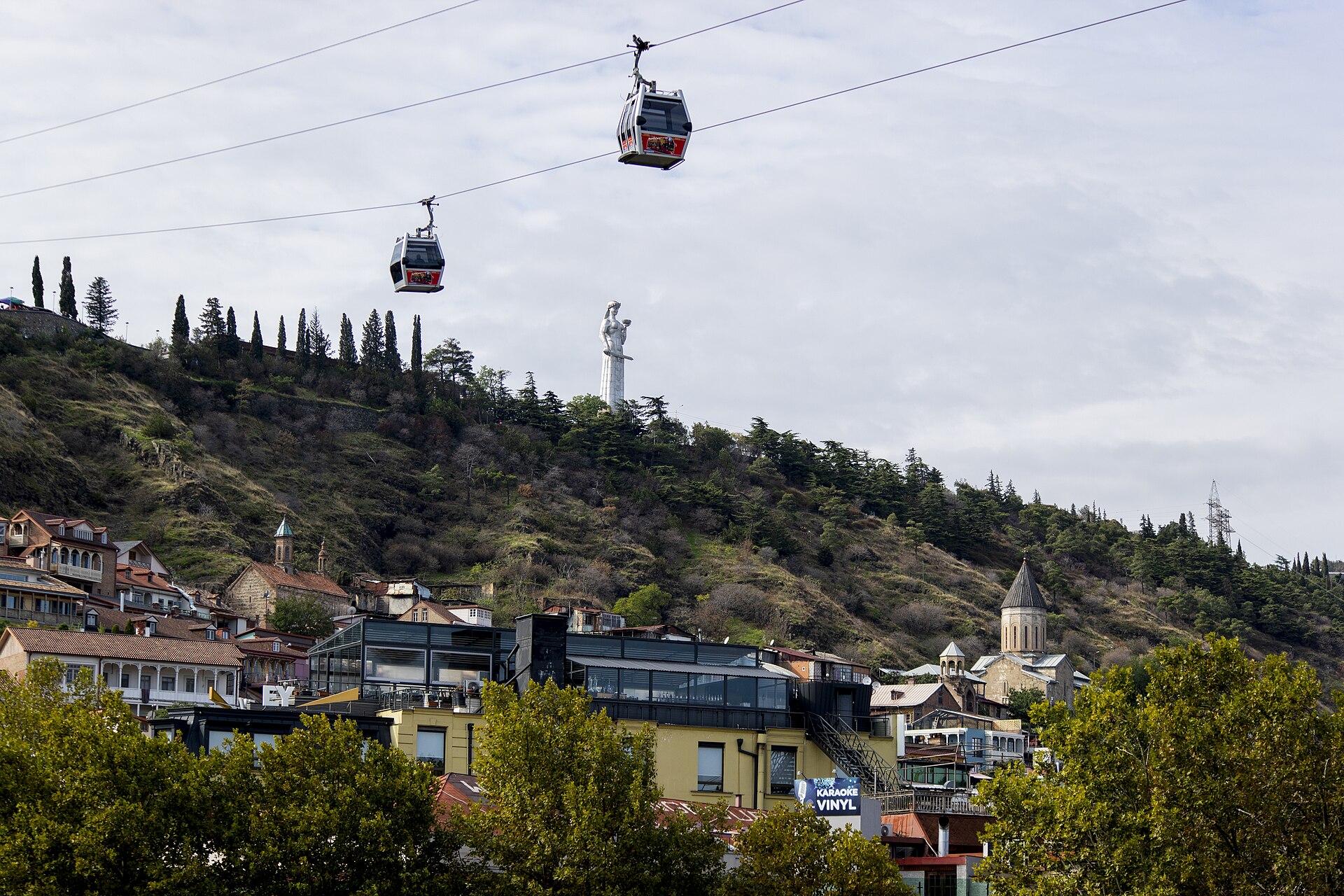
Mother of Georgia, known locally as Kartlis Deda, is a monumental aluminium statue standing on Sololaki Hill overlooking Tbilisi. Erected in 1958, the figure holds a bowl of wine in one hand and a sword in the other, symbolizing the Georgian traditions of hospitality and resistance to enemies. The monument has become an iconic visual emblem of the capital, visible from numerous points across the city. It replaced an earlier copper version dating to 1883.
The statue itself is the primary feature, with no enclosed interior accessible to visitors. The surrounding hilltop area offers panoramic viewpoints across Tbilisi's varied architectural landscape, encompassing the Old Town, Narikala Fortress, and the modern city. The monument platform provides space for observation and contemplation. Visitors typically combine this stop with exploration of the adjacent Sololaki district and its characteristic balconied houses. No additional visitor facilities are documented at the monument site itself. A flexible visit lets travellers connect Mother of Georgia with the rest of the day without treating one room, viewpoint or photograph as the whole experience. The useful pace depends on personal interest and conditions on arrival.
A visit to Mother of Georgia requires approximately thirty to sixty minutes for most travelers, depending on photography interests and desire to absorb the views. The duration extends considerably when incorporated into a broader walking route through the Sololaki and Old Town areas. Many visitors allocate half a day to explore the hilltop vicinity comprehensively, including Narikala Fortress and the botanical garden approaches. Evening visits may extend timing due to sunset observation and the illuminated cityscape.
The monument occupies an open hilltop accessible at all times in principle, though practical visiting depends on individual transport arrangements and personal safety considerations after dark. Seasonal variations in Tbilisi's climate affect comfort significantly, with summer heat and winter cold both presenting challenges. Morning and late afternoon typically offer favorable light conditions for viewing and photography. Fog or low cloud may obscure visibility unpredictably throughout the year. The strongest visit keeps attention on what is distinctive here while leaving room for the next stop. That approach makes Mother of Georgia useful in both a focused first visit and a slower return to the city. Check the operator's own site for the travel date before relying on a schedule or fare.
No admission mechanism is visibly present at this open-air monument, suggesting no entry fee applies for basic access to the viewpoint area. Any guided tour arrangements or special access provisions would involve separate commercial transactions. Visitors should verify current conditions independently before travel, as municipal policies may change without widespread notification. Budget-conscious travelers typically treat this as a no-cost stop within broader Tbilisi exploration. Mother of Georgia also earns time in a tbilisi itinerary because Independent traveler stop frozen before production reconciliation; exact local identity verified without a proxy. Its value becomes clearer when the stop is compared with the surrounding streets and the other ranked places nearby. Check the operator's own site for the travel date before relying on a schedule or fare.
The monument crowns Sololaki Hill, accessible by multiple approaches. The most common route involves walking from the Old Town or Sololaki district, following steep streets and pathways. The Funicular of Tbilisi operates to a nearby upper station, though its operational status and schedules require independent verification. Road access exists for private vehicles and taxis, though parking availability is constrained. Signage in central Tbilisi generally directs visitors toward the general hilltop area. Physical fitness considerations apply given the elevation gain.
The hilltop location exposes visitors to weather conditions without shelter. Wind intensity exceeds lower elevations significantly. Pathway surfaces vary in quality and may prove slippery when wet or icy. Limited lighting after dark creates navigation challenges and personal security considerations. The monument platform edges lack comprehensive barriers in all areas. Crowding occurs during peak tourist periods and sunset hours. Visitors with mobility limitations should assess route difficulty carefully, as steep gradients and uneven surfaces predominate in surrounding approaches.
The monument offers exceptional vantage points for cityscape photography, with the statue itself serving as both subject and framing element. Morning light illuminates the eastern-facing Old Town favorably. Sunset creates dramatic atmospheric conditions across the Mtkvari River valley. Night photography captures the illuminated urban spread below. The aluminium surface presents reflective challenges under direct sunlight. Wide-angle lenses accommodate both the statue scale and expansive backgrounds. Tripod stability may prove problematic in windy conditions. Respect for other visitors' space supports productive sessions.
Checked 2026-08-26
Common questions
Is Mother of Georgia the same as Kartlis Deda for Mother of Georgia in Tbilisi?
Yes. Kartlis Deda is the Georgian language name, translating directly to Mother of Georgia or Mother of Kartli.
Can you enter inside the statue for Mother of Georgia in Tbilisi?
No interior access is documented. The monument is a solid sculptural structure without visitor entry provisions.
Does the funicular go directly to the statue for Mother of Georgia in Tbilisi?
The Funicular of Tbilisi serves the upper hill area nearby, requiring additional walking to reach the monument itself.
What do the wine bowl and sword represent for Mother of Georgia in Tbilisi?
These symbolize Georgian hospitality toward friends and defense against enemies, respectively, reflecting traditional cultural values.
Is this location suitable for visitors with limited mobility for Mother of Georgia in Tbilisi?
The steep approaches and uneven surfaces present significant challenges. Individual assessment of capability is essential.
Are there restaurants or facilities at the monument for Mother of Georgia in Tbilisi?
No facilities are documented at the site itself. The surrounding Sololaki and Old Town districts contain various commercial establishments.
Nothing non-essential is set before you choose, in regions where consent is required. If you decline, ads still appear and analytics is switched off entirely.