

.jpg)

.JPG)
4 min walk
Church of the Holy Ghost
- High
- Place of worship
Language · 1 published
Historic monument · Copenhagen
Rundetårn
| Monday | 10:00 – 20:00 |
|---|---|
| Tuesday | 10:00 – 20:00 |
| Wednesday | 10:00 – 20:00 |
| Thursday | 10:00 – 20:00 |
| Friday | 10:00 – 20:00 |
| Saturday | 10:00 – 20:00 |
| Sunday | 10:00 – 20:00 |
Also recorded: 10:00 – 18:00
Checked 2026-08-26 · Source
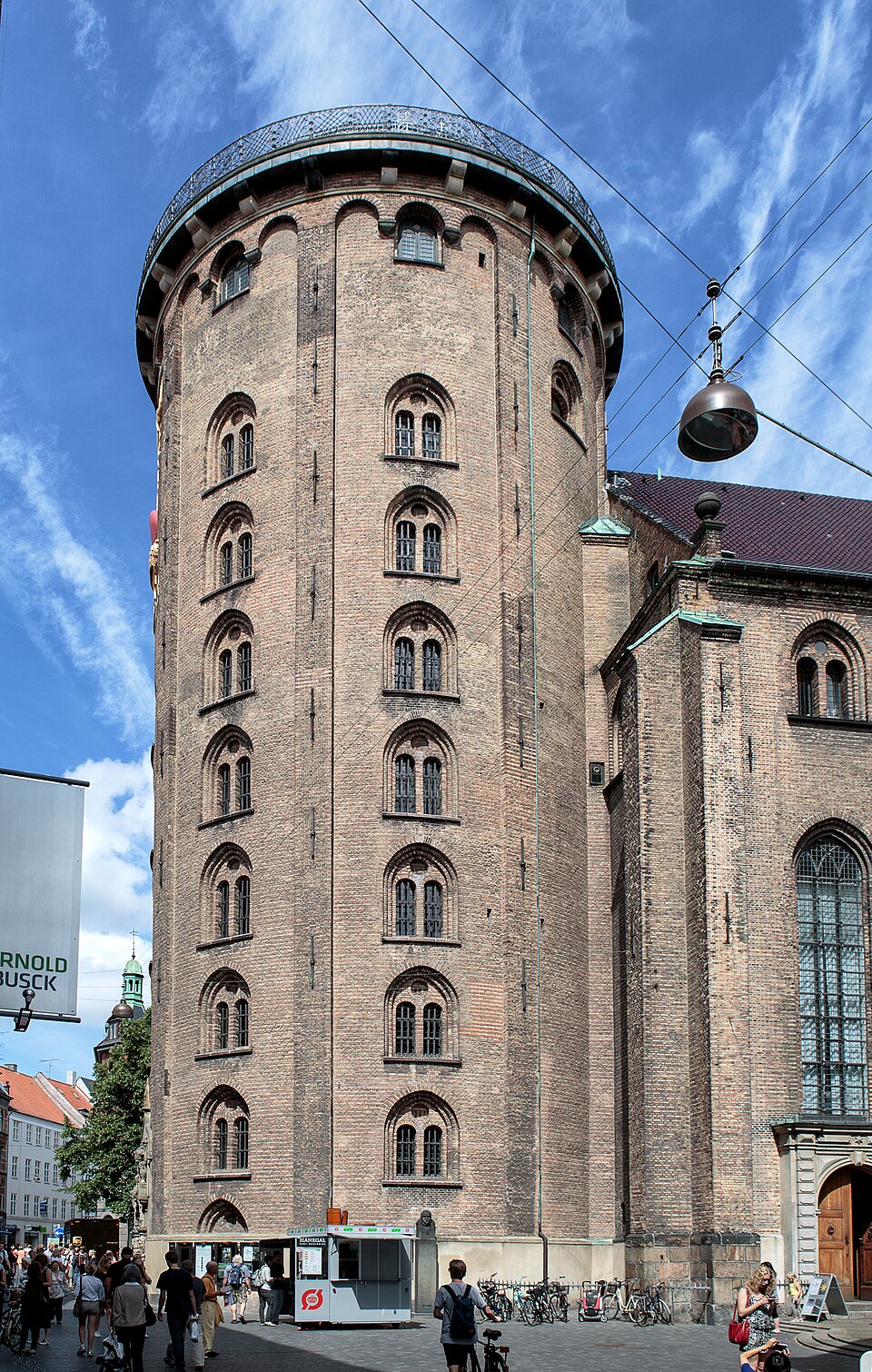
Rundetaarn, the Round Tower, is a seventeenth-century observatory tower on Købmagergade in the medieval core of Copenhagen, and the thing that makes it unusual is that it has no staircase for most of its height. A brick ramp spirals up around a hollow core instead, and that ramp is the only route to the top. The foundation stone was laid on 7 July 1637 and the tower was finished five years later as the first part of the Trinity Complex, a single building designed to hold three separate institutions: the university observatory at the top, the University Library on the floor above the church, and Trinity Church itself at ground level. King Christian IV built it, laid its walls in alternating red and yellow brick as a royal signal, and sketched the gilded rebus that still sits on the facade, a puzzle that reads as a prayer to lead God and right teaching into the king's heart. The tower measures 34.8 metres from the street to its viewing platform and weighs some 5,914 tonnes. It is still a working observatory building, the oldest in Europe, and it is still entered from a shopping street rather than from a museum forecourt.
Checked 2026-08-26 · Source
Four things are worth stopping for on the way up, and the ramp connects all of them. Halfway up, on the floor above Trinity Church, is the Library Hall, 811 square metres under a ceiling 3.85 metres high. It held the University of Copenhagen's book collection from 1657 until 1861, and the Danish three-age system of Stone, Bronze and Iron was worked out in it; the National Museum of Denmark grew out of the collection kept there. Since 1987 it has been an exhibition space, and it also holds the shop and a coffee counter. One floor higher is the Bell Loft, its roof rebuilt in Pomeranian pine after the Copenhagen fire of 1728 and finished in 1731; the front part is open, with a small display on the history of the tower and the church. Towards the upper end of the ramp is the planetarium, first built by the astronomer Ole Rømer, moved to its present vertical mounting in 1822 and driven by a clockwork that is wound once a week; it shows where the planets are at that moment. Along the way, a glass floor lets you look straight down the hollow core, once the zero point from which Danish elevations were measured.
Checked 2026-08-26 · Source

Allow about an hour. The Round Tower publishes no suggested visit length, so this is a working estimate rather than a figure from the operator, but it holds up against the building's own dimensions. The ramp's outer edge runs 281 metres over 7.3 turns at a gradient of ten per cent, which most people walk in ten to fifteen minutes without hurrying; the two staircases at the top add 28 wooden steps and 31 stone ones. Coming down again is quicker. What fills the rest of the hour is everything the ramp passes: the exhibition in the Library Hall, the small display in the Bell Loft, the planetarium, the glass floor over the core, and however long you stay on a platform of 104.5 square metres deciding which of Copenhagen's spires is which. Note that the tower's own two pages disagree on the ramp's length: the Measure and Weight page gives 281 metres for the outer line, while the accessibility note on the Visit Us page calls it approximately 200 metres. Add a further twenty minutes at peak times, when the ticket office pauses sales to keep the ramp below capacity.
Checked 2026-08-26
Opening hours run on two seasons. From 1 April to 30 September the tower is open every day from 10:00 to 20:00; from 1 October to 31 March it is open every day from 10:00 to 18:00. There is no weekly closing day and no midday break. The tower states it is open 362 days a year, closing only on 24 and 25 December and 1 January, with an early close at 15:00 on 31 December. That long summer evening is the useful part: the platform stays open well past the point where most Copenhagen museums have emptied, and the last two hours before 20:00 are the quietest of the day as well as the best lit. Mornings just after opening are the other calm window. The middle of the day in summer is when the queue and the capacity pauses appear. Winter has its own reason to come after dark. The Observatory at the top was closed through most of 2026 for restoration, was re-inaugurated on 12 August 2026, and the tower says it opens fully to the public, with manned observation evenings, in October.
Checked 2026-08-26 · Source

Admission is 60 DKK for adults and 40 DKK for students on presentation of a valid student card. Children and young people aged 0 to 17 go free, and those aged 11 and under must be with an adult. A holder of an ICOM card gets a discount. A visitor who needs a carer can bring one free on presentation of an officially issued companion card, Danish or foreign, and pays the ordinary fee themselves. The current exhibition in the Library Hall is covered by the ordinary ticket unless the hall is shut for an exhibition change or a private event. Two details catch people out. First, there is no advance booking: entry tickets are sold only at the ticket office inside the door, and the Danish webshop sells tickets to events and concerts, nothing else. Second, the Round Tower has not been part of the Copenhagen Card since 1 April 2024, so a card that covers most of the city will not cover this. Card payment is preferred; cash is accepted in Danish kroner or in euro notes, but not euro coins, and any change comes back in kroner.
Checked 2026-08-26 · Source
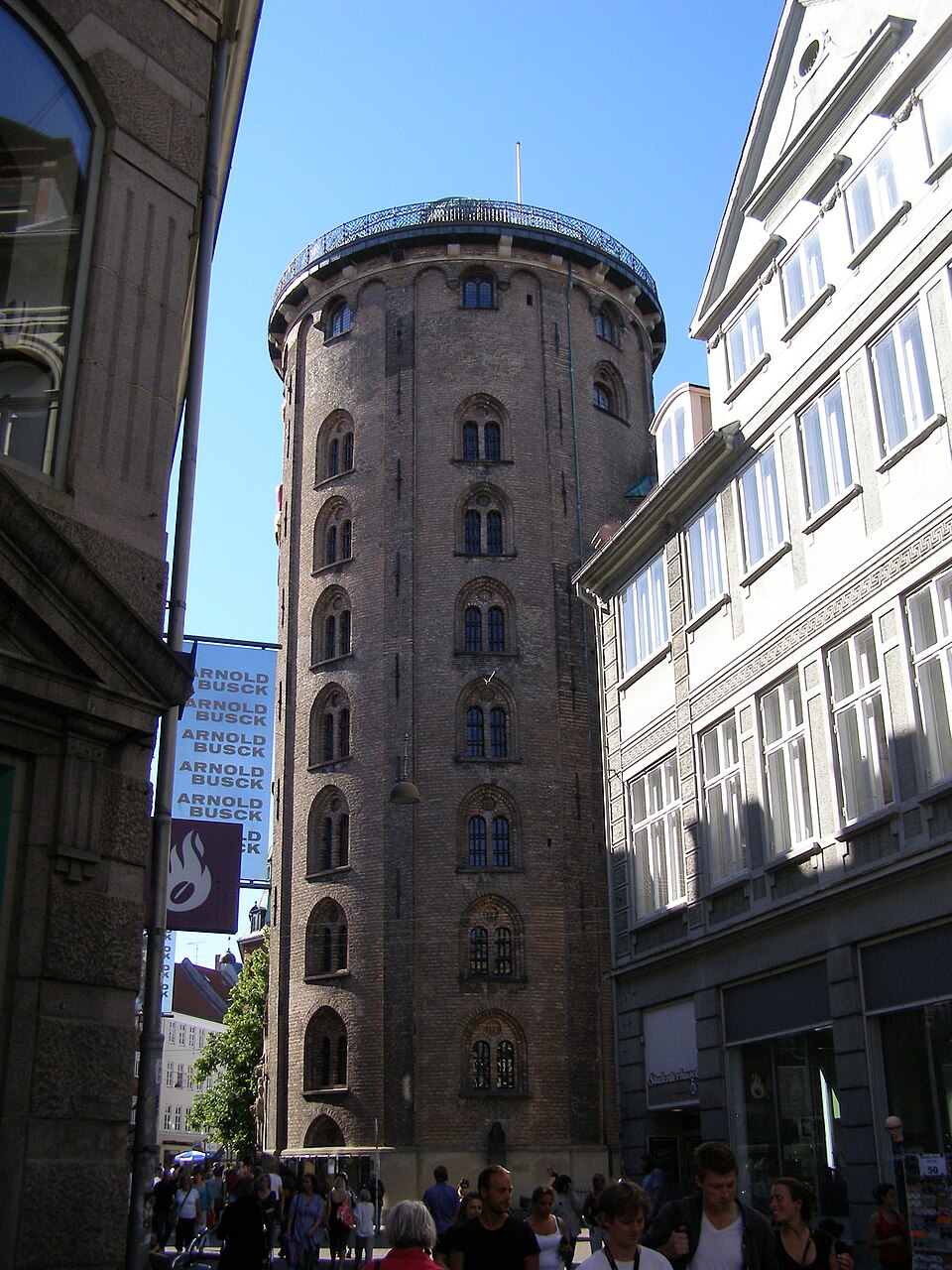
The address is Købmagergade 52A, 1150 Copenhagen K, and the door opens directly onto the pavement of a pedestrianised shopping street, which is the first thing to understand about arriving. Købmagergade carries no through traffic, so no car reaches the entrance and the tower publishes neither parking advice nor a nearby car park. A car is not needed and is a hindrance; every practical approach is on foot, by bicycle or by public transport into the medieval quarter, and the whole of central Copenhagen sits within a walk of twenty minutes or so. Nørreport, the busiest interchange in the country for metro, S-train and regional services, stands at the northern end of the same street, and Kongens Nytorv is a short walk to the south-east. The Round Tower's own site gives only an address and a link to a map, so treat any more detailed route as somebody else's directions rather than the operator's. One arrival rule does come from the tower itself: large luggage and suitcases cannot be brought inside and there is no left-luggage facility, so do not route a station-to-airport day through the entrance.
Checked 2026-08-26 · Source
The ramp is the whole building and it is also the whole problem. There is no lift, the incline is continuous, and beyond the ramp two flights of stairs, one wide and wooden and one narrow and stone, lead to the platform. The tower is a listed building from 1642 with uneven surfaces, and it says plainly that it is not well suited to wheelchairs: the Library Hall and its events can be reached, but a non-powered chair will struggle with the gradient, and the platform itself is out of reach. Prams and pushchairs cannot go to the top either and are parked just past the ticket booth or beside the wooden stairs, at the owner's risk. Capacity is managed, so at busy hours the ticket office pauses sales and a queue forms; the tower puts the usual wait at under twenty minutes. A traffic light controls movement on and off the viewing platform and can hold you for a minute or two. Dogs are not admitted except guide and service dogs. Own food and drink may be carried in but not eaten in the Library Hall or the café. Smoking is banned in the tower and on the platform. Guided tours are not being offered; free audio stories replace them.
Checked 2026-08-26 · Source
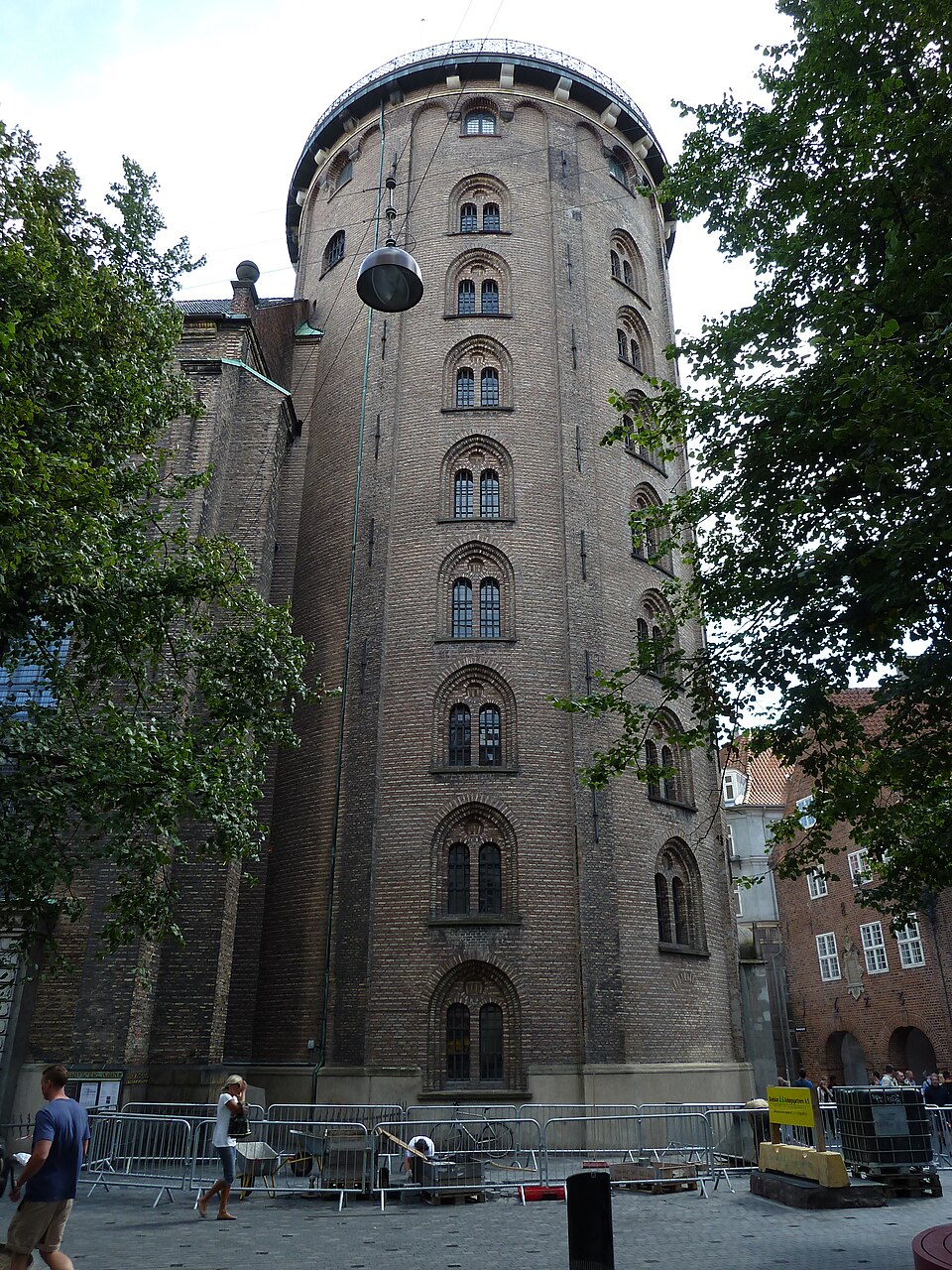
Photography for private use is allowed, with the qualification that it means a phone or a smaller camera in the hand. Setting up equipment, or running anything that amounts to a photo session, needs permission from the Round Tower first, and the tower states that it does not wish to serve as a backdrop for commercial product marketing or for wedding photography. Anyone shooting film or stills beyond a personal record is expected to contact the tower for approval before arriving. What that leaves is a good hour of hand-held work. The platform gives a full 360 degrees over the roofs of the old city, with the Øresund and the Swedish coast on the horizon on a clear day, and Caspar Fincke's wrought-iron lattice around the edge carries Christian IV's cypher and the initials of his motto, which makes a foreground worth using rather than shooting past. Inside, the light is harder and more interesting: the windows down the outer wall of the ramp throw bands across the brickwork, the glass floor over the hollow core looks straight down, and the Library Hall under its high ceiling is the one large, evenly lit room in the building.
Checked 2026-08-26 · Source
Adults pay 60 DKK and students with a valid student card pay 40 DKK. Children and young people from 0 to 17 enter free, and anyone aged 11 or under must be accompanied by an adult. An ICOM card earns a discount, and a visitor who depends on a carer may bring one free on presentation of an officially issued companion card. The ticket also covers whatever is showing in the Library Hall, unless the hall is closed for an exhibition change or a special event.
No. The Round Tower states that entry tickets are sold directly at its own ticket office and that there is no pre-purchase; only tickets to events and concerts can be bought ahead, through the Danish-language webshop. Card payment is preferred, though cash is taken in Danish kroner or in euro notes, with no euro coins accepted and change given only in kroner. Note also that the tower stopped being part of the Copenhagen Card on 1 April 2024.
From 1 April to 30 September the tower is open daily from 10:00 to 20:00, and from 1 October to 31 March daily from 10:00 to 18:00. There is no weekly closing day and no midday break. The tower describes itself as open 362 days a year: it closes on 24 and 25 December and on 1 January, and on 31 December it closes early, at 15:00.
About an hour is a reasonable allowance, though the Round Tower publishes no figure of its own, so this is an estimate rather than an operator statement. The climb itself is short: the ramp's outer line runs 281 metres over 7.3 turns at a ten per cent gradient, followed by 28 wooden and 31 stone steps. The rest of the hour goes on the Library Hall exhibition, the Bell Loft display, the planetarium, the glass floor over the hollow core and the platform. At peak times add up to twenty minutes of queueing.
Only partly. There is no lift, and the single route upward is the ascending spiral ramp, which ends at two flights of stairs leading to the viewing platform. The tower says directly that it is not well suited to wheelchair users: exhibitions and events in the Library Hall can be reached, but the incline is hard going for a non-powered chair and the platform cannot be reached at all. Prams and pushchairs cannot go up either and are left just past the ticket booth or beside the wooden stairs, at the owner's risk. Guide dogs and service dogs are admitted.
The Observatory was closed for most of 2026 while its dome was taken down by crane and its 1929 refracting telescope was restored in Germany. The dome went back up on 21 May 2026, the telescope was reinstalled in late June, and the Observatory was re-inaugurated by King Frederik X on 12 August 2026; from the following day visitors have been able to look inside the building during a normal visit. The tower says the Observatory opens fully, with manned observation evenings, in October. Its own pages disagree on which winter evenings are staffed, one saying Tuesday and Wednesday and another Monday and Tuesday, so check before making a special trip.
Loading the interactive map…
The interactive map could not be loaded.
Last updated:
Source: OpenStreetMap contributors, Wikidata ·