Parque Bicentenario (Vitacura)
Parque Bicentenario
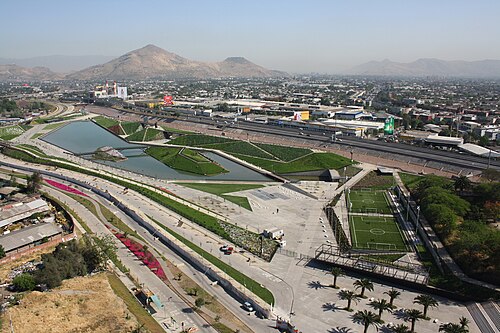
Parque Bicentenario de Vitacura is a major landscaped public park situated along the Mapocho River in the Vitacura commune of eastern Santiago, Chile.
- Must see
- Nature site
- Santiago
Language · 11 published
Country guide
Chile is a narrow strip between the Andes and the Pacific, the southernmost country in the world and the closest to Antarctica. Its 756,102 km² are arranged almost entirely along one north–south line, with Peru and Bolivia at the top and the Drake Passage at the bottom, so nearly every journey here is a journey up or down. The 2024 census counted 18.5 million people. Santiago is the capital and largest city. Chile also administers Pacific islands far offshore, among them Juan Fernández and Easter Island, which means two places under the same flag can sit an ocean apart.
Every city catalogued in this country so far, ranked by how much there is to see.
Photograph · Omnespsx (D•ES) · CC BY-SA 4.0
Ranked by importance — sitelinks, pageviews and heritage status, not editor preference.
100 places match
Category
Typical visit duration
Parque Bicentenario
Parque Bicentenario de Vitacura is a major landscaped public park situated along the Mapocho River in the Vitacura commune of eastern Santiago, Chile.
Parque Quinta Normal
Parque Quinta Normal is a historic public park in Santiago, Chile. Established in the nineteenth century, it represents one of the city's oldest green spaces and has evolved into a significant cultural destination.
Parque Forestal
Parque Forestal is a linear urban park in central Santiago, Chile. It runs alongside the Mapocho River, forming a green corridor through the city centre.
The Japanese Garden of Santiago, known locally as Jardín Japonés de Santiago, is a restored terraced garden situated within Metropolitan Park on Cerro San Cristóbal.
Mapulemu Botanical Garden, locally known as Jardín Botánico Mapulemu, is a dedicated botanical garden situated within the broader Metropolitan Park system on Cerro San Cristóbal in Santiago, Chile.
Parque Araucano is a large urban park situated in the eastern sector of Santiago, within the Las Condes commune. The park serves as a significant green space in a densely developed area of the Chilean capital.
Parque Inés de Suárez is a substantial neighbourhood park located in the Providencia district of Santiago, Chile. Named after the Spanish conquistadora Inés de Suárez, the park serves as an important green space within this densely populated urban area.
Plaza de la Constitución is a ceremonial public square in central Santiago, Chile. The space serves as the formal forecourt to Palacio de La Moneda, the presidential palace.
Cerro Santa Lucía
Plaza Baquedano, known locally by that name, is a major public square in Santiago, Chile. It functions as a critical urban junction connecting the city centre with the districts of Providencia, Bellavista, and Parque Bustamante.
Parque de la Familia is a large public park located on the west side of the Mapocho River in Santiago, Chile. The park serves as a significant recreational space for residents and visitors seeking outdoor leisure in an urban setting.
El Arrayán Nature Sanctuary, known locally as Santuario de la Naturaleza El Arrayán, is a foothill nature reserve situated on the northeastern metropolitan edge of Santiago, Chile.
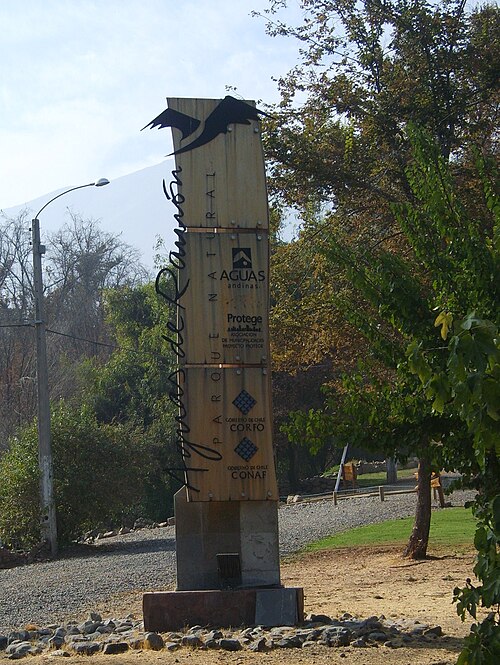
Parque Natural Aguas de Ramón
Parque Natural Aguas de Ramón is a protected natural area on Santiago's eastern foothills, part of the Chilean Coastal Range. The park preserves Mediterranean sclerophyll forest, a biome adapted to hot, dry summers and mild, wet winters.
Parque Natural Quebrada de Macul
Parque Natural Quebrada de Macul is a natural park located in the eastern foothills of Santiago, Chile.
Parque Nacional La Campana
Parque O'Higgins
Santuario de la Naturaleza campo dunar de la punta de Concón
Parque Los Dominicos
Parque Nacional Las Palmas de Cocalán
Plaza de los Héroes
Reserva Nacional Río Los Cipreses
Santuario de la Naturaleza Yerba Loca
Parque Balmaceda
Parque Nacional Río Clarillo
Santuario de la Naturaleza Acantilados Federico Santa María
Santuario de la Naturaleza Cascada de las Ánimas
Parque Cultural Las Condes
Santuario de la Naturaleza Laguna El Peral
Santuario de la Naturaleza Palmar El Salto
Monumento Natural El Morado
Reserva Nacional Lago Peñuelas
Parque Bustamante
Parque de las Esculturas
Parque Urbano Bicentenario de la Infancia
Parque Bicentenario Cerrillos
Parque Natural San Carlos de Apoquindo
Plaza a la Aviación
Parque Violeta Parra
Parque Almagro
Salto de Apoquindo
Humedal Urbano Estero Reñaca
Laguna Lo Encañado
Plaza Vasca
Reserva Nacional Río Blanco
Bien Nacional Protegido Río Olivares
Reserva Nacional Roblería del Cobre de Loncha
Santuario de la Naturaleza Playa Sur de Tunquén
Caleta Abarca
Parque Metropolitano Sur Cerro Chena
Cerro Chino
Plaza Elvira Matte
Laguna de Batuco
Santuario de la Naturaleza Playa Tunquén y Quebrada Seca
Parque Mapocho Río Tramo 2
Humedal Urbano Sistema de Lagunas de Llolleo Ojos de Mar
Parque Municipal de La Granja República de Brasil
Parque Santiago Bueras
Parque Llano Subercaseaux
Source: OpenStreetMap contributors, Wikidata ·
A 10–16 day visit should pair Santiago with one major region, such as the Atacama, the Lake District or a Patagonian gateway. Chile’s length makes combining north and far south in a short itinerary transfer-heavy.
Chile’s consular service publishes the visa rules used for entry. Nationality, travel purpose and length of stay determine the requirement, and any application should be made through the official consular channel.
Santiago is the central international and domestic hub. Flights connect the desert, lake and Patagonian gateways, while long-distance buses cover mainland corridors and remote parks require a confirmed final transfer.
October through April is the broad operating window for many central and southern journeys. Atacama conditions, central-valley heat and Patagonian wind are distinct, so the least flexible regional leg should set the calendar.
Chile uses the Chilean peso (CLP). Current withdrawal costs and merchant acceptance are Not recorded; review the amount in pesos and any conversion offered before completing payment.
Chile uses 133 for police, 131 for ambulance and 132 for fire. Power is 220 V with Type C and L plugs, while nationwide tap-water guidance remains Not recorded.