

3 min walk
Diên Hồng Park
- Must see
- Nature site
Language · 11 published
Nature site · Hanoi
Vườn hoa Lý Thái Tổ
| Monday | 00:00 – 23:59 |
|---|---|
| Tuesday | 00:00 – 23:59 |
| Wednesday | 00:00 – 23:59 |
| Thursday | 00:00 – 23:59 |
| Friday | 00:00 – 23:59 |
| Saturday | 00:00 – 23:59 |
| Sunday | 00:00 – 23:59 |
Checked 2026-08-31 · Source
Read from the OpenStreetMap access tags; anything not listed has no tag recorded.
Set the group type to family in the planner and the day window contracts to about three quarters of a solo day.
Ly Thai To Park, locally known as Vườn hoa Lý Thái Tổ, is a public park in central Hanoi situated near Hoan Kiem Lake. The park features a prominent statue of Emperor Ly Thai To, founder of the Ly Dynasty and the city of Thang Long, the historical predecessor to modern Hanoi. The green space serves as a recreational area for residents and visitors, offering a setting for relaxation and cultural appreciation in the heart of the capital. The park holds significance as a commemorative site honoring early Vietnamese statehood.
Checked 2026-08-31 · Source
The park's central feature is the large bronze statue of Ly Thai To standing on a pedestal, visible from surrounding streets. Landscaped gardens with trees, flower beds, and paved walkways fill the grounds. Benches provide seating for visitors. The open plaza design accommodates pedestrian traffic and informal gatherings. No buildings or enclosed structures are present within the park boundaries. The monument faces toward Hoan Kiem Lake, creating a sightline between the park and this iconic water feature. Seasonal plantings may vary throughout the year.
Checked 2026-08-31 · Source
A typical visit to Ly Thai To Park requires between fifteen and thirty minutes for casual observation of the statue and brief rest. Visitors incorporating the park into a broader walking circuit of Hoan Kiem Lake district may allocate less focused time. Those interested in photography or seeking quiet seating might extend their stay. The compact dimensions allow efficient viewing without extensive commitment. Many travelers treat this as a brief stop rather than a primary destination, combining it with nearby attractions in the Old Quarter and lake area during a half-day exploration.
Checked 2026-08-31 · Source
Daily, continuous public-space access; no visitor timetable. No weekly closure day. Hanoi authorities describe the site as an open public garden and documented active public use through August 2026. The park functions as an open public space without apparent gating, suggesting daytime accessibility. Early morning and evening hours coincide with local exercise traditions and cooler temperatures, potentially offering more atmospheric conditions. Midday visits during summer months may prove uncomfortable due to direct sun exposure over the open plaza. Rainy season conditions from May to October could affect ground conditions and comfort. Visitors should verify current operational status through local sources before planning dedicated visits, as municipal maintenance schedules remain unknown.
Checked 2026-08-31 · Source
Free general access; no park admission ticket. Hanoi's public cultural performances at the park are also free. Public parks in Vietnamese cities typically operate without admission fees for basic access. No ticketing infrastructure is visible at this location. Visitors should carry personal funds for incidental purchases such as refreshments from nearby vendors. Any special events or temporary exhibitions would require separate verification of potential charges. The absence of controlled entry points suggests free general access aligns with comparable urban green spaces in Hanoi. Travelers should confirm current policies locally, as municipal fee structures can change without widespread notification to international visitors.
Checked 2026-08-31 · Source
Transerco identifies bus routes 02, 40, 24, 03A, 09A, 09B and 35A as serving stops near the National Museum of History at 1 Tràng Tiền, which it describes as very close to the Lý Thái Tổ monument. Approach the park from Đinh Tiên Hoàng, Lê Thạch, Lê Lai or Ngô Quyền. Ly Thai To Park occupies a central position in Hoan Kiem District, accessible on foot from Hoan Kiem Lake's eastern shore. The location sits within Hanoi's dense urban core where walking proves practical for nearby hotel guests. Motor taxi and ride-hailing services serve the broader district, though final approaches may require walking due to traffic restrictions. No dedicated parking facilities are associated with the park itself. Cyclo and electric bus tours of the Old Quarter may include proximity passage.
Checked 2026-08-31 · Source
The ceremonial plaza has a level surface; recessed water jets are designed not to obstruct visitor movement. Stone-paved paths connect the garden with Lê Lai, Lê Thạch and Đinh Tiên Hoàng streets. The public-body improvement plan includes a public toilet and tourist-information centre. Motorcycle traffic surrounding the park demands vigilance when crossing adjacent streets, as pedestrian right-of-way conventions differ from Western norms. Open sun exposure provides limited natural shade during midday hours; visitors should prepare accordingly. The statue pedestal and paved surfaces may become slippery during rainfall. Evening illumination quality varies and may affect visibility. As an unguarded public space, standard urban precautions regarding personal belongings apply. No drinking fountains or public restrooms are evident within the park boundaries; facilities require seeking nearby commercial establishments. Construction or maintenance activity in this developing district may temporarily alter access routes.
Checked 2026-08-31 · Source
The Ly Thai To statue presents a straightforward photographic subject with clear sightlines from multiple angles. Morning and late afternoon light offers preferable conditions over harsh midday illumination. The monument's scale relative to human figures requires distance for complete framing. Background elements include surrounding trees and occasional urban activity. Hoan Kiem Lake visible behind the statue enables composed shots linking the park to its geographic context. Tripod use may attract attention in this public space. Night photography depends on available artificial lighting of variable quality. Respectful distance from any ceremonial activity should be maintained.
Checked 2026-08-31 · Source
It is named after Lý Thái Tổ, an emperor of Vietnam's Lý dynasty.
It is an open public garden and civic cultural space beside Hoàn Kiếm Lake, not an enclosed museum.
The park is bounded by Đinh Tiên Hoàng, Lê Thạch, Lê Lai and Ngô Quyền streets.
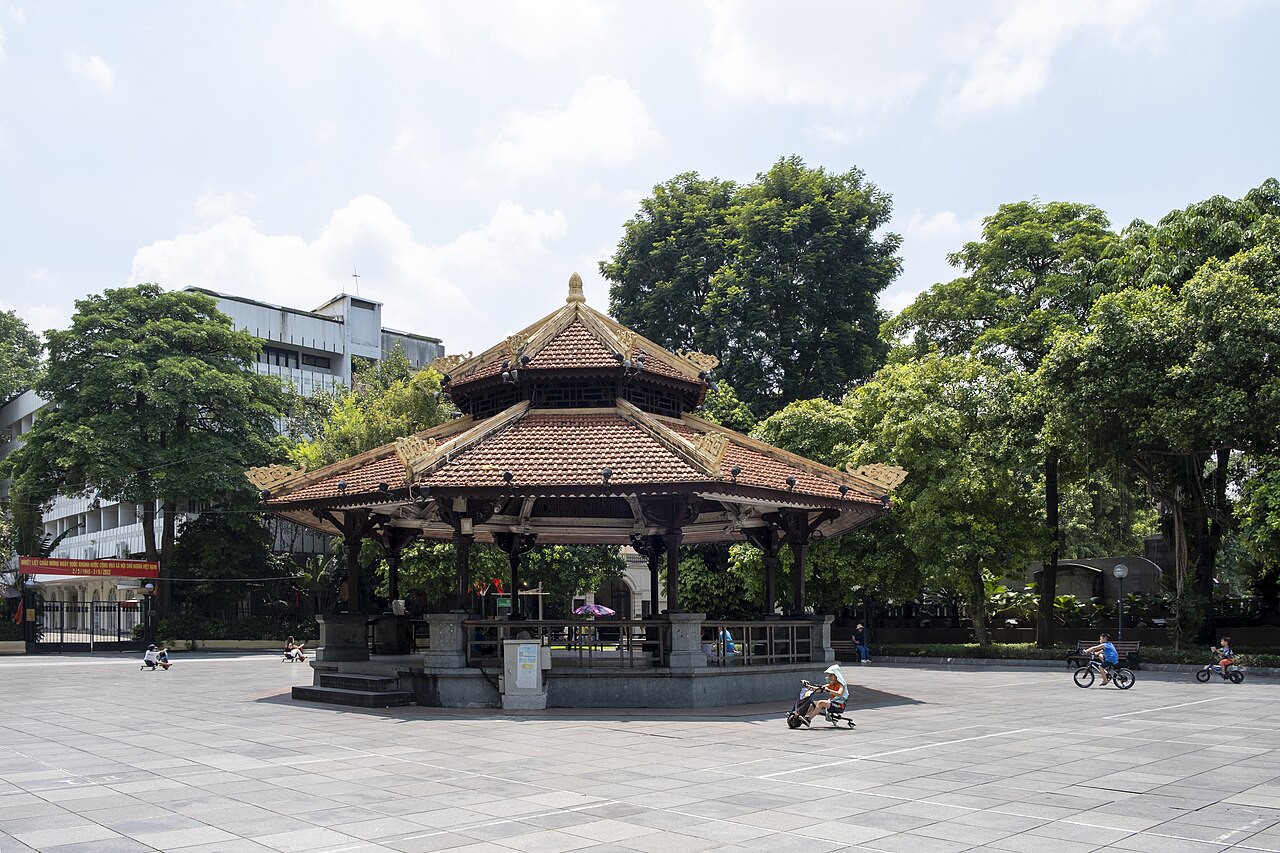
The municipal layout divides it into the ceremonial plaza around the Lý Thái Tổ monument, the Octagonal House performance area and the rear garden.
The Octagonal House hosts Hanoi's Weekend Music programme on Sunday afternoons; the published programme time is 15:30–17:00.
The park links Hoàn Kiếm Lake with Diên Hồng Garden, the State Bank square and nearby civic and historic buildings, including the Government Guest House and Hanoi's municipal offices.
Loading the interactive map…
The interactive map could not be loaded.


Last updated:
Source: OpenStreetMap contributors, Wikidata ·