


_10.jpg)

2 min walk · เขตดุสิต
Abhisek Dusit Throne Hall
- Must see
- Historic monument
Language · 1 published
Historic monument · เขตดุสิต, Bangkok
พระที่นั่งวิมานเมฆ
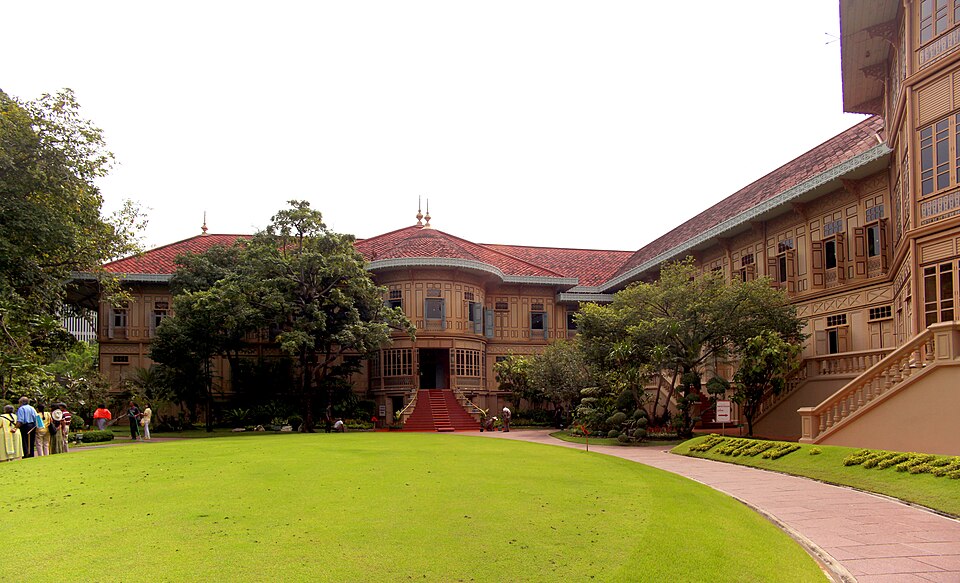
Vimanmek Mansion is a former royal villa in the Dusit Palace complex in Dusit district, and it cannot currently be visited. The Bureau of the Royal Household closed it to visitors on 21 July 2016, and in 2018 and 2019 the building was taken apart entirely so that its deteriorating wood and metal pilings could be replaced with steel pilings and a concrete foundation. In July 2019 an official in the Office of His Majesty's Principal Private Secretary said the mansion would be rebuilt exactly as it looked, with a large fishpond added to its north, and also disclosed that it would be permanently closed and not reopened to the public; the works were estimated at 81 million baht. Any traveller reading about Vimanmek is therefore reading about a building, not planning a stop. What it was, and what is being rebuilt, is remarkable enough to explain the interest: an L-shaped golden-teak residence of 72 rooms, sixty metres by twenty, three levels with an octagonal four-level residential wing, commonly described as the world's largest golden teakwood mansion. King Chulalongkorn had it created in 1900 by dismantling the Munthatu Rattanaroj Residence at Phra Chuthathut Palace on Ko Sichang and reassembling it in his new Dusit Garden, and it was inaugurated on 27 March 1901.
Checked 2026-08-25 · Source
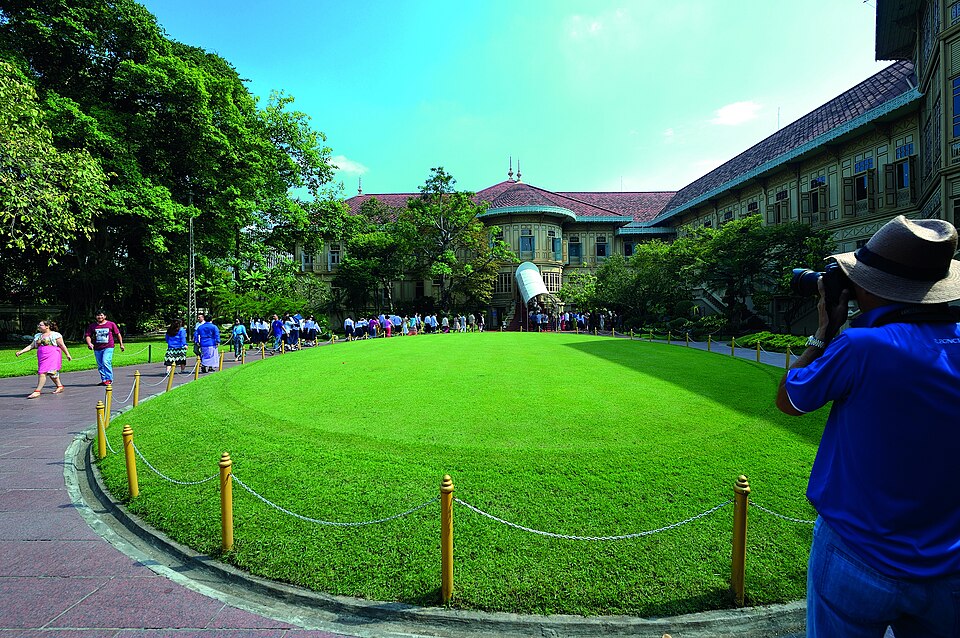
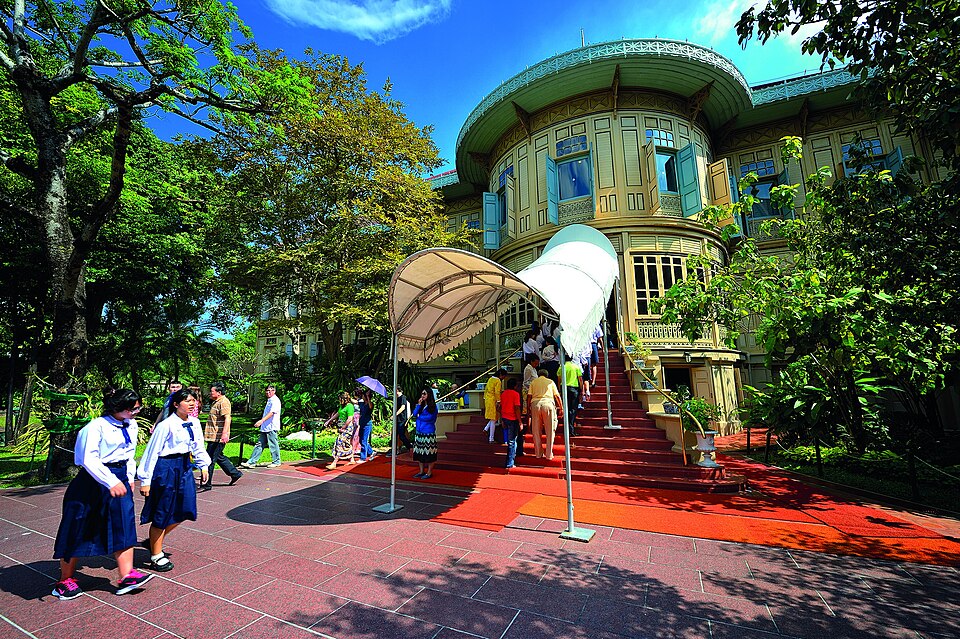
Vimanmek was the first permanent residence in Dusit Garden, the royal garden King Rama V laid out after his 1897 visit to Europe, and the building carries that moment directly. The interior combined European neoclassical decoration with traditional Thai motifs and the early twentieth-century modernisation the king was importing; the exterior is Victorian, and it counts among the best Thai examples of the gingerbread house, using elaborate fretwork on windows and air passages, with the window and ventilator pattern known as kanom pang khing. The lowest level is brick and cement, the upper levels golden teak, and the roof is cream and red in Thai style. Each room was given a distinctive colour — light blue, green, pink, ivory or peach — and displayed belongings of King Rama V and of other noblemen. The king used it as his residence for five years, until Amphorn Sathan Residential Hall was completed in 1906, after which the mansion declined into a store: by 1932 the Bureau of the Royal Household was using it only for storage. Its museum life began in 1982, when Queen Sirikit asked King Rama IX, on the occasion of Bangkok's Royal Bicentennial, to restore it as a museum commemorating King Rama V through his photographs, artworks and handicrafts and as a showcase of Thai national heritage. That museum is what closed in 2016. What sits on the site now is a foundation, and the timbers themselves were reported stored in tents on the grounds of the adjacent parliament.
Checked 2026-08-25 · Source
This page carries 45 minutes for Vimanmek Mansion, and that number is a category default rather than a measurement — the value a historical site is given when nothing specific has been established. No honest visit duration can be given for a building that no visitor has entered since July 2016, and none is published by anyone with standing. Treat the 45 minutes as a placeholder that keeps the planner arithmetic consistent, not as advice. In practice the time a traveller should allow today is none: there is nothing to enter, and the mansion should be treated as closed rather than scheduled.
Checked 2026-08-25
No best season and no best hour are recorded for Vimanmek Mansion, and neither is applicable while it is closed. Bangkok's cool dry months matter for anything walked outdoors, but that guidance belongs to places a visitor can actually reach; recommending a month for a building that admits nobody would be advice with nothing behind it. Should the Bureau of the Royal Household ever announce a reopening, this section will be rewritten against whatever the operator publishes at that point. No such announcement has been found.
Checked 2026-08-25
No admission is being sold for Vimanmek Mansion, because the mansion does not admit visitors, and no price is recorded on this page. The absence is not for want of looking. The old Bureau of the Royal Household museum host at palaces.thai.net now redirects to royalgrandpalace.th, which covers only the Grand Palace, Wat Phra Kaew, the Arts of the Kingdom Museum and the Queen Sirikit Museum of Textiles, and does not mention Vimanmek or Dusit Palace at all. royaloffice.th returned HTTP 403 to every attempt. vimanmek.com resolves but serves an empty placeholder page. A Thai-language search for the mansion's admission and opening arrangements returned Wikipedia, a Pantip discussion thread, the SAC museum database and Chulalongkorn University's culture office — none of them the operator. Where a third-party site still quotes a Vimanmek ticket price, it is quoting a figure from before July 2016.
Checked 2026-08-25
Nothing is recorded here about reaching Vimanmek Mansion, and the honest answer is that the trip should not be made. The mansion stands within the Dusit Palace complex in Dusit district, north-east of the historic centre, and no operator publishes visitor access information for it — no entrance, no gate hours, no instruction on which side of the complex a visitor should approach. Whether a car is needed has not been established for the same reason. Travellers who are in Dusit for other reasons will find the mansion's site inside a closed royal precinct rather than at a public street frontage, and should not plan a journey around seeing it.
Checked 2026-08-25
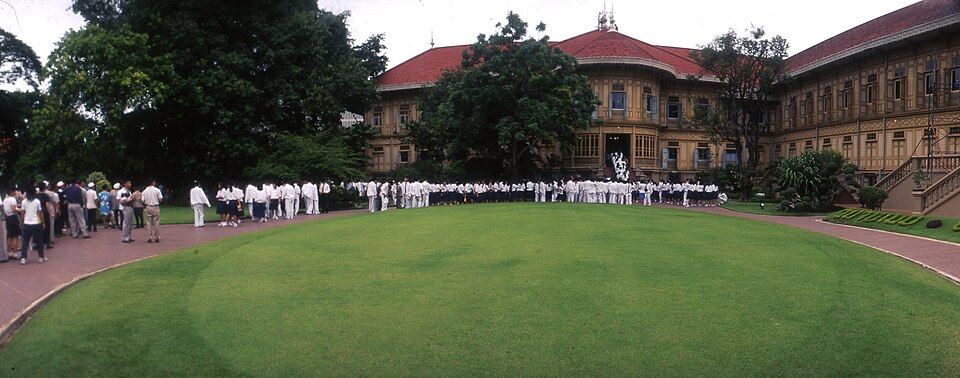
The trap with Vimanmek Mansion is the internet's memory. Guidebooks, tour listings and aggregator pages continue to publish opening hours, admission prices and combined-ticket arrangements for a building that has admitted nobody since 21 July 2016 and was physically dismantled in 2018 and 2019, and travellers still arrive in Dusit expecting a teak palace tour. Anything quoted for Vimanmek that does not name the Bureau of the Royal Household as its source should be assumed to predate the closure. The second trap is the 2019 statement itself, which is easy to read as good news: the building is to be rebuilt exactly as it looked, but the same official disclosure said it would be permanently closed and not reopened to the public, so a completed reconstruction is not a reopening. No reopening announcement has been found. Third, this is an active royal precinct with the parliament complex adjacent; conduct and access there are governed by the household and by security arrangements rather than by museum rules, and a visitor should not test a boundary to get a look at a construction site. Anyone planning a Dusit day should build it around places whose operators actually publish hours, and treat Vimanmek as reading rather than as an itinerary entry.
Checked 2026-08-25
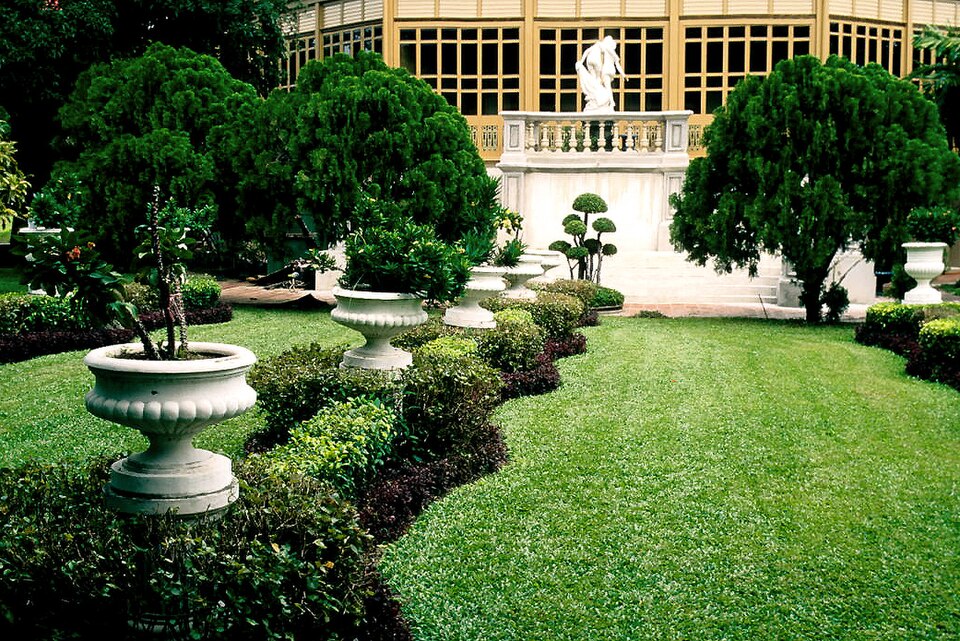
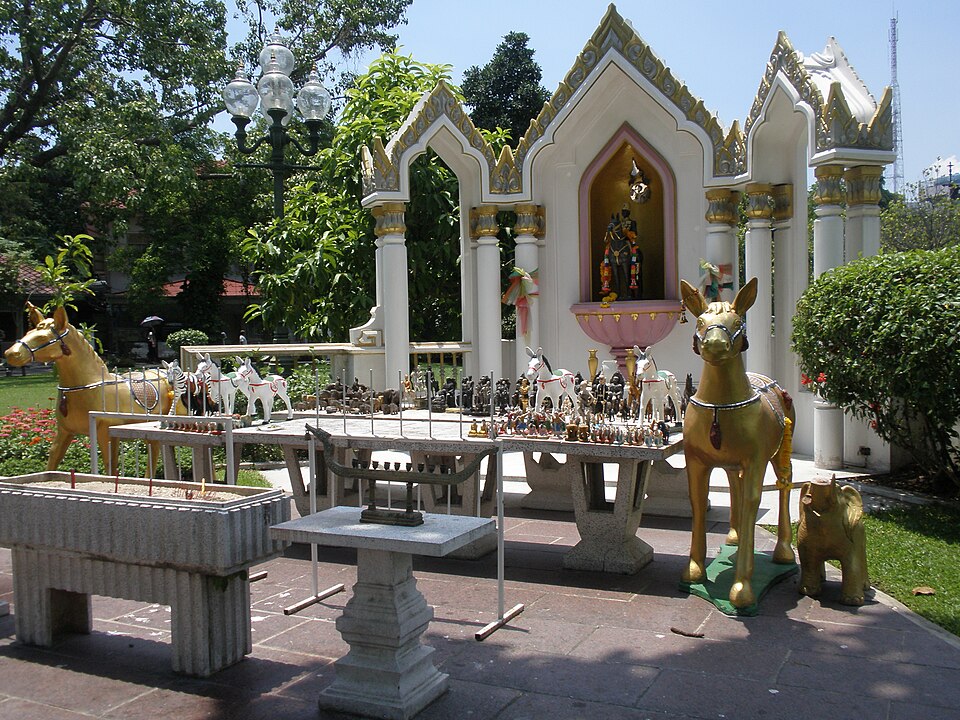
There is nothing to photograph. The mansion was disassembled in 2018 and 2019 and its timbers were reported stored in tents on the grounds of the adjacent parliament, so the subject that draws photographers — the long teak facade with its fretwork and its cream and red roof — is not standing at the coordinates on this page. The images shown on this page are archival, taken while the museum was open and licensed for reuse: a shot of the Rama V altar in the palace park by Thérèse Gaigé under CC BY-SA 3.0, and two 1998 views of the mansion by LBM1948 under CC BY-SA 4.0. They are the record of the building, not a preview of a visit. A photographer with an interest in Rama V's Dusit Garden architecture is better served by the Commons category for the mansion than by a trip to the fence line, and photographing into a closed royal and parliamentary precinct is not something to attempt for a picture that will not be there.
Checked 2026-08-25
No. The Bureau of the Royal Household closed Vimanmek Mansion to visitors on 21 July 2016, and the building was subsequently dismantled for foundation work. It should be treated as closed, not as an attraction with hours. Third-party pages that still list opening times for it are repeating information from before the closure.
In July 2019 an official in the Office of His Majesty's Principal Private Secretary said the mansion would be rebuilt exactly as it looked, with a large fishpond added to its north, and disclosed at the same time that it would be permanently closed and not reopened to the public. The construction works were estimated at 81 million baht. No later reopening announcement from the Bureau of the Royal Household has been found, so a finished reconstruction should not be read as a reopening.
Nothing is on sale, because the mansion does not admit visitors, and no admission figure is recorded here. The operator sites checked publish none: palaces.thai.net now redirects to royalgrandpalace.th, which does not mention Vimanmek at all; royaloffice.th returns HTTP 403; and vimanmek.com serves an empty placeholder. Any price quoted elsewhere dates from before July 2016.
Not at present. The mansion was disassembled in 2018 and 2019 so that its deteriorating wood and metal pilings could be replaced with steel pilings and a concrete foundation, and the dismantled structure was reported stored in tents on the grounds of the adjacent parliament. The stated intention is to rebuild it exactly as it looked.
It is commonly described as the world's largest golden teakwood mansion: an L-shaped building of 72 rooms, sixty metres by twenty, on three levels with an octagonal four-level residential wing. It is also a documented case of relocatable Thai architecture, created in 1900 by dismantling the Munthatu Rattanaroj Residence at Ko Sichang and reassembling it in Dusit Garden, and it served as King Chulalongkorn's residence from its inauguration on 27 March 1901 until Amphorn Sathan Residential Hall was finished in 1906.
None, while it is closed. The 45 minutes attached to this page is the default figure a historical site receives when nothing specific has been established, kept only so planner arithmetic stays consistent. No visit duration can honestly be given for a building nobody has entered since July 2016, and none is published by any source with standing.
Loading the interactive map…
The interactive map could not be loaded.
Last updated:
Source: OpenStreetMap contributors, Wikidata ·