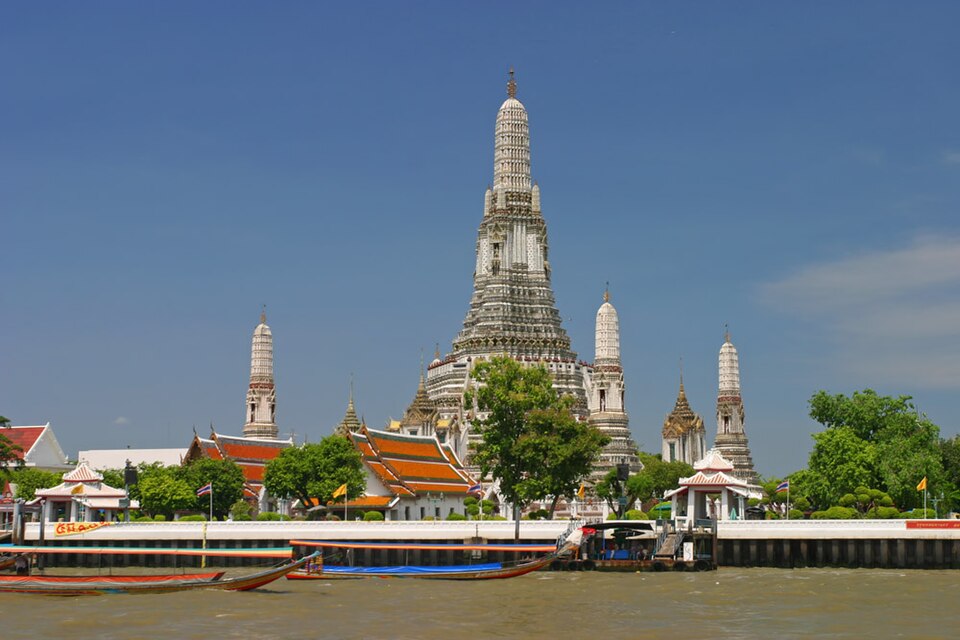
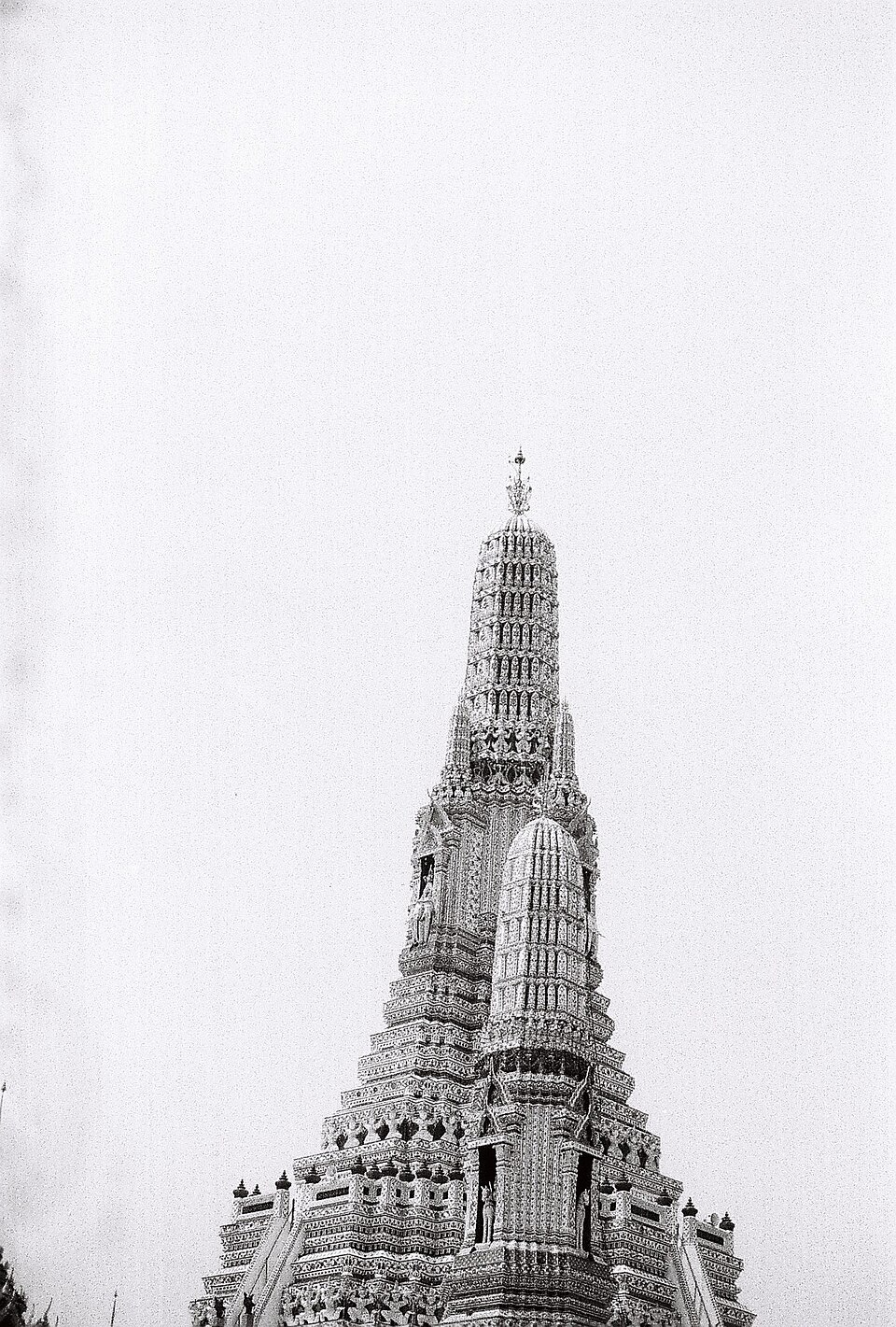
Wat Arun stands on the Thonburi bank of the Chao Phraya, directly across the water from the old royal city, and it is the one Bangkok monument built to be read from the river. Its central prang rises about 80 metres and is clad in more than a million pieces of glazed Chinese porcelain, cut and set into the stucco so that the entire tower is a mosaic rather than a painted surface: from the water it reads as pale grey and silver, and only from a few metres away does it resolve into flowers, plates and broken bowls. The temple carries the Thonburi era with it. It was the landmark of the capital that preceded Bangkok, and it held the Emerald Buddha before that image crossed the river to Wat Phra Kaew. The Thai government's own visitor page treats Wat Arun as a defining symbol of the city. Unlike the Rattanakosin sites, reaching it means crossing the river, and the crossing is part of the visit.
The prang is the visit. It stands on a square terrace with four smaller prangs at its corners, and it is climbable: steep flights of steps run up two levels of the central tower to a gallery, and the point of the climb is less the view from it than the porcelain at arm's length, which is the only place the tower's construction becomes legible. Demon and monkey figures shoulder the tiers. Read as architecture, the prang is a Khmer-derived Mount Meru, the axis of the world rendered in three cosmological registers stacked one above another, which is why its proportions climb rather than spread. The ordination hall stands apart from the tower in its own walled precinct and is quiet in a way the terrace never is; most visitors photograph the prang and leave without going in. Sources differ on where the porcelain came from: one reading has it salvaged from a wrecked British ship, another has it landed as ballast from Chinese trading vessels. Both are reported here rather than reconciled.
Allow 60 minutes: the prang and its climb, the ordination hall, and the river terrace. No operator figure exists to check that against, because the temple has no readable site of its own, so the hour is judgement. The climb is what makes the time hard to compress. The steps are steep enough that traffic moves single-file in both directions at once, and a queue forms on the lower flight whenever a group arrives. Anyone who decides not to climb can see the compound properly in half the time. Coming over from Wat Pho, add ten minutes for the ferry and the walk at each end, and treat Wat Arun as an hour and a quarter of the day rather than an hour. The temple repays a slower visit than it usually gets: the standard treatment is a fifteen-minute stop for a photograph from the terrace, which sees almost none of it.
The hours shown on this page, daily from 08:30 to 18:00, are not confirmed by the temple. Wat Arun's official domain, the one both Wikidata and Wikipedia name, no longer resolves at all: there is no DNS record for watarun1.com or for its www host, and the other candidate domain serves no content and does not belong to the temple. Its own social-media page carries no readable hours. Secondary sources disagree among themselves, giving 08:00 to 18:00 and 08:00 to 18:30, and since none of them is the operator none was recorded. Treat the times above as approximate and do not plan on arriving in the last half hour. Go at opening: the riverside terrace and the prang's lower gallery are both narrow and fill from mid-morning, while late afternoon gives far better light on the tower and a much heavier crowd on it. November to February for the season, since the prang steps are steep, unshaded and slick in the monsoon.
There is a charge to enter the prang terrace, and the admission rates are not published anywhere this page was able to verify on 25 August 2026. The temple's official domain does not resolve, its social-media page states no fee, and no operator page could be read. What is available instead is the reason to record nothing at all: aggregator sites and blogs quote 50, 100 and 200 THB for foreign visitors at the same entrance, while Thai-language sources say Thai nationals enter free. Three conflicting figures from sources that are not the operator do not make a price. Carry small notes and read the board at the gate, which is the only current statement of the fee that exists. The pages tried were watarun1.com and its www host, both DNS failures, watarun.com, an archived 2023 capture of the operator's site, and the temple's own Facebook page.
The crossing is the approach. A cross-river ferry runs from Tha Tien pier on the Rattanakosin bank, immediately west of Wat Pho, and lands at the temple's own gate in about three minutes, going back and forth continuously through the day for a fare of a few baht. That is the route to use: Wat Pho, walk to the pier, cross, and arrive at Wat Arun with the prang standing directly above the landing. Driving is the mistake. Wat Arun sits in Bangkok Yai on the Thonburi side, and reaching it by road means a long detour to a bridge through traffic worse than the old city's, so the boat takes three minutes where the car can take the better part of an hour. Chao Phraya express boats call nearby, and the MRT does reach the Thonburi bank, but neither improves on the Tha Tien ferry for a visitor already in Rattanakosin.
The steps are the hazard and they are a real one. The flights up the central prang are steep, narrow and worn, the handrail is not continuous, and both directions of traffic use them at once; in wet weather the treads are slick and the climb becomes genuinely dangerous rather than merely awkward. Come down backwards if that feels safer, as plenty of people do. Wear shoes with grip that still come off easily, since footwear is removed before the ordination hall and goes back on before the climb. The dress code is the Grand Palace's and is set out in that guide; cover-ups are available at the gate. Two commercial operations sit around this temple without belonging to it: shops renting Thai costume for photographs, which are private businesses and not a temple service, and boat touts on both banks selling river tours at the same pier where the public ferry runs. The closed-today approach described in the Grand Palace guide works on this bank as well.
Wat Arun is photographed from the far side of the river more often than from inside it, and both are worth doing. From within the compound the prang defeats a close frame: it is too tall and too near, so a wide lens at the terrace foot leans it backwards and a normal lens takes a third of it. Photograph detail instead, a hand's width of cut porcelain, the guardian figures on the tiers, the corner prangs from the terrace edge, and leave the whole tower to the opposite bank. From Tha Tien and the riverside terraces above it, the classic frame is the tower with the water in front of it, and it holds through the whole late afternoon and past sunset, when the prang is lit and the sky behind it has gone dark. The morning does the reverse: arriving from Rattanakosin at opening puts the sun behind the tower and reduces it to a silhouette. The name means dawn; the photograph is at dusk.
Checked 2026-08-25
Common questions
How much does it cost to enter Wat Arun?
Not established. There is a charge for the prang terrace, but the admission rates are not published by the temple: its official domain no longer resolves and no operator page could be read on 25 August 2026. Aggregator sites quote 50, 100 and 200 THB for the same entrance, which is why no figure is recorded here. Carry cash and read the board at the gate.
What are Wat Arun's opening hours?
The hours on this page, 08:30 to 18:00 daily, come from OpenStreetMap and are not confirmed by the temple, whose official domain does not resolve. Secondary sources give 08:00 to 18:00 and 08:00 to 18:30. Treat the times as approximate and do not arrive in the last half hour.
Can you climb Wat Arun?
Yes. Steep flights of steps run up two levels of the central prang to a gallery. They are narrow, worn, used in both directions at once and slick when wet, so grip matters more than nerve; many visitors come down backwards.
How do I get from Wat Pho to Wat Arun?
By the cross-river ferry from Tha Tien pier, immediately west of Wat Pho. It runs continuously and lands at the temple gate in about three minutes. Going by road means a detour to a bridge and can take the better part of an hour.
What is the porcelain on the prang?
More than a million pieces of glazed Chinese porcelain, cut and set into the stucco of the tower. Sources differ on its origin: one account has it salvaged from a wrecked British ship, another has it landed as ballast from Chinese trading vessels. Both readings are recorded.
Is Wat Arun better at sunrise or sunset?
Sunset, despite the name. From Rattanakosin in the morning the sun sits behind the tower and reduces it to a silhouette; the classic frame is from Tha Tien in the late afternoon and after dark, with the prang lit and the river in front of it.
Nothing non-essential is set before you choose, in regions where consent is required. If you decline, ads still appear but they are non-personalised, and analytics is switched off entirely.


_%E0%B8%A7%E0%B8%B1%E0%B8%94%E0%B8%AD%E0%B8%A3%E0%B8%B8%E0%B8%93%E0%B8%A3%E0%B8%B2%E0%B8%8A%E0%B8%A7%E0%B8%A3%E0%B8%B2%E0%B8%A3%E0%B8%B2%E0%B8%A1%E0%B8%A3%E0%B8%B2%E0%B8%8A%E0%B8%A7%E0%B8%A3%E0%B8%A1%E0%B8%AB%E0%B8%B2%E0%B8%A7%E0%B8%B4%E0%B8%AB%E0%B8%B2%E0%B8%A3_%E0%B9%80%E0%B8%82%E0%B8%95%E0%B8%9A%E0%B8%B2%E0%B8%87%E0%B8%81%E0%B8%AD%E0%B8%81%E0%B9%83%E0%B8%AB%E0%B8%8D%E0%B9%88_%E0%B8%81%E0%B8%A3%E0%B8%B8%E0%B8%87%E0%B9%80%E0%B8%97%E0%B8%9E%E0%B8%A1%E0%B8%AB%E0%B8%B2%E0%B8%99%E0%B8%84%E0%B8%A3_(4).jpg)
_%E0%B8%A7%E0%B8%B1%E0%B8%94%E0%B8%AD%E0%B8%A3%E0%B8%B8%E0%B8%93%E0%B8%A3%E0%B8%B2%E0%B8%8A%E0%B8%A7%E0%B8%A3%E0%B8%B2%E0%B8%A3%E0%B8%B2%E0%B8%A1%E0%B8%A3%E0%B8%B2%E0%B8%8A%E0%B8%A7%E0%B8%A3%E0%B8%A1%E0%B8%AB%E0%B8%B2%E0%B8%A7%E0%B8%B4%E0%B8%AB%E0%B8%B2%E0%B8%A3_%E0%B9%80%E0%B8%82%E0%B8%95%E0%B8%9A%E0%B8%B2%E0%B8%87%E0%B8%81%E0%B8%AD%E0%B8%81%E0%B9%83%E0%B8%AB%E0%B8%8D%E0%B9%88_%E0%B8%81%E0%B8%A3%E0%B8%B8%E0%B8%87%E0%B9%80%E0%B8%97%E0%B8%9E%E0%B8%A1%E0%B8%AB%E0%B8%B2%E0%B8%99%E0%B8%84%E0%B8%A3_(5).jpg)
_%E0%B8%A7%E0%B8%B1%E0%B8%94%E0%B8%AD%E0%B8%A3%E0%B8%B8%E0%B8%93%E0%B8%A3%E0%B8%B2%E0%B8%8A%E0%B8%A7%E0%B8%A3%E0%B8%B2%E0%B8%A3%E0%B8%B2%E0%B8%A1%E0%B8%A3%E0%B8%B2%E0%B8%8A%E0%B8%A7%E0%B8%A3%E0%B8%A1%E0%B8%AB%E0%B8%B2%E0%B8%A7%E0%B8%B4%E0%B8%AB%E0%B8%B2%E0%B8%A3_%E0%B9%80%E0%B8%82%E0%B8%95%E0%B8%9A%E0%B8%B2%E0%B8%87%E0%B8%81%E0%B8%AD%E0%B8%81%E0%B9%83%E0%B8%AB%E0%B8%8D%E0%B9%88_%E0%B8%81%E0%B8%A3%E0%B8%B8%E0%B8%87%E0%B9%80%E0%B8%97%E0%B8%9E%E0%B8%A1%E0%B8%AB%E0%B8%B2%E0%B8%99%E0%B8%84%E0%B8%A3_(4).jpg)
_%E0%B8%A7%E0%B8%B1%E0%B8%94%E0%B8%AD%E0%B8%A3%E0%B8%B8%E0%B8%93%E0%B8%A3%E0%B8%B2%E0%B8%8A%E0%B8%A7%E0%B8%A3%E0%B8%B2%E0%B8%A3%E0%B8%B2%E0%B8%A1%E0%B8%A3%E0%B8%B2%E0%B8%8A%E0%B8%A7%E0%B8%A3%E0%B8%A1%E0%B8%AB%E0%B8%B2%E0%B8%A7%E0%B8%B4%E0%B8%AB%E0%B8%B2%E0%B8%A3_%E0%B9%80%E0%B8%82%E0%B8%95%E0%B8%9A%E0%B8%B2%E0%B8%87%E0%B8%81%E0%B8%AD%E0%B8%81%E0%B9%83%E0%B8%AB%E0%B8%8D%E0%B9%88_%E0%B8%81%E0%B8%A3%E0%B8%B8%E0%B8%87%E0%B9%80%E0%B8%97%E0%B8%9E%E0%B8%A1%E0%B8%AB%E0%B8%B2%E0%B8%99%E0%B8%84%E0%B8%A3_(5).jpg)