
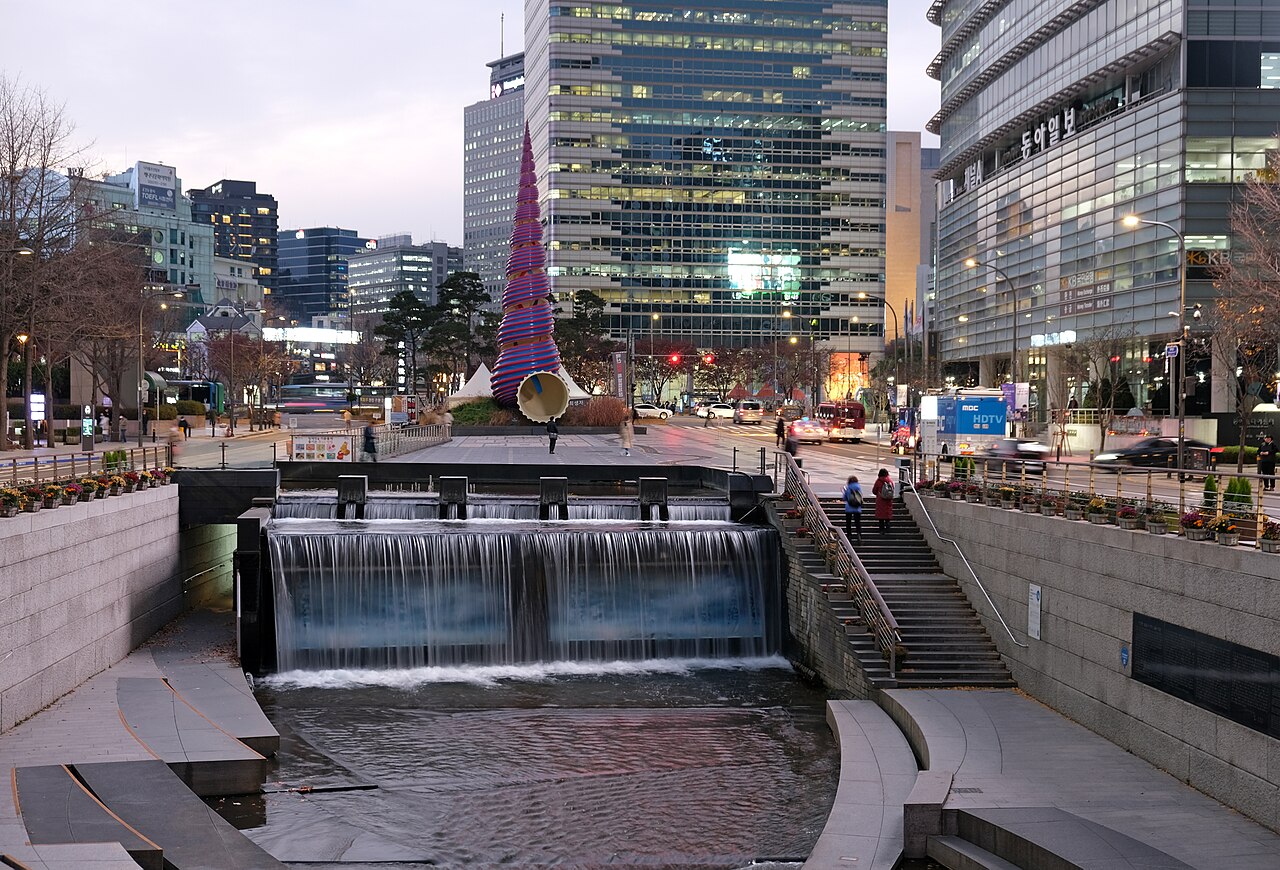
9 min walk
Cheonggyecheon
- Must see · Heritage site
- Nature site
Language · 11 published
Historic monument · Seoul
종묘

| Monday | 09:00 – 18:30 |
|---|---|
| Tuesday | Closed |
| Wednesday | 09:00 – 18:30 |
| Thursday | 09:00 – 18:30 |
| Friday | 09:00 – 18:30 |
| Saturday | 09:00 – 18:30 |
| Sunday | 09:00 – 18:30 |
Checked 2026-08-31 · Source
Read from the OpenStreetMap access tags; anything not listed has no tag recorded.
Set the group type to family in the planner and the day window contracts to about three quarters of a solo day.
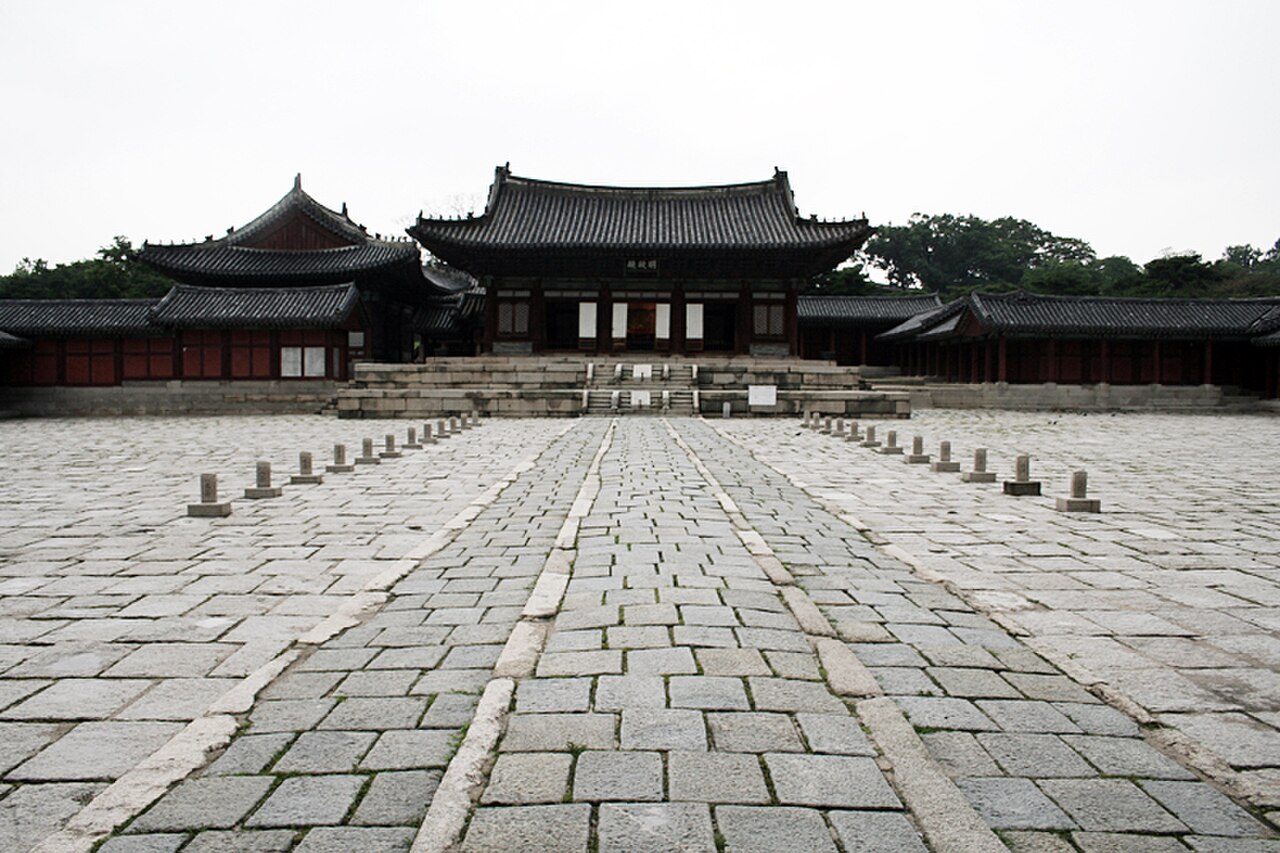
Jongmyo is the Confucian royal ancestral shrine of the Joseon dynasty, and it is a working ritual precinct rather than a temple or a palace. The spirit tablets of Joseon kings and queens, and of the emperors and empresses of the later Korean Empire, are enshrined here, and the rites addressed to them are still performed on the site. It was founded in 1395, the fourth year of King Taejo, on the principle that the shrine stands to the left of the palace and the Sajikdan altar to its right. At first there was only the Main Hall, and the place was called Daemyo or Taemyo.
Checked 2026-08-31 · Source
The Korea Heritage Service publishes a five-stop route through the precinct, and it is the order a guided group is walked in: Hyangdaecheong, Jaegung, Jeonsacheong, Jeongjeon and Yeongnyeongjeon. Hyangdaecheong is where the incense and the written ritual prayers were kept. Jaegung is where the king and the crown prince prepared themselves before a rite. Jeonsacheong is the kitchen where the ritual food was made. Jeongjeon, the Main Hall, is the reason people come: nineteen bays of identical dark wooden doors under one continuous roof, fronted by a raised stone terrace, with almost no decoration anywhere on it.
Checked 2026-08-31 · Source
Allow ninety minutes. The Korea Heritage Service publishes one figure of its own: on a timed-entry day a group enters at a fixed time and walks the precinct with a guide for about one hour. Ninety minutes is this guide's judgement built on that hour, and the extra half hour is the part the operator does not count — the walk in from the ticket office, the queue at the gate before a slot opens, and the time most people spend standing in front of Jeongjeon afterwards, which is longer than they expect.
Checked 2026-08-31 · Source
February–May and September–October: 09:00–18:00, last entry 17:00. June–August: 09:00–18:30, last entry 17:30. November–January: 09:00–17:30, last entry 16:30. Regular self-guided admission applies on Saturdays, Sundays, public holidays and the last Wednesday of each month; Monday and Wednesday–Friday normally use timed guided entry. From 1 July through 31 August 2026, self-guided admission also replaces timed weekday entry. During this temporary arrangement, last entry is 16:40 on Monday, Wednesday, Thursday and Friday, and 17:30 on weekends, public holidays and the last Wednesday. Closed Tuesdays; when Tuesday is a public or substitute holiday, the shrine opens and closes on the next non-holiday instead. Jongmyo is closed every Tuesday.
Checked 2026-08-31 · Source
General adult admission is KRW 1,000. The adult bracket is ages 25–64 for Korean visitors and ages 19–64 for foreign visitors. Adult admission is 1,000 won per person, and unusually the group rate is the same 1,000 won, so there is nothing to gain by arriving as a party. The adult band is ages 25 to 64 for Korean nationals and 19 to 64 for foreign nationals. Below and above those bands entry is free: foreign visitors aged 18 and under or 65 and over pay nothing, as do Korean visitors aged 24 and under or 65 and over, on production of identification.
Checked 2026-08-31 · Source
Take Seoul Subway Line 1, 3 or 5 to Jongno 3-ga Station. Exit 8 is approximately 220 metres from the shrine at 157 Jong-ro, Jongno-gu. This is the named approach for an independent visit. The shrine is at 157 Jong-ro, Jongno-gu, Seoul 03135, and the office number is 02-765-0195. No car is needed and a car is the worst way to arrive. Jongno 3-ga station is served by subway lines 1, 3 and 5, and the operator gives exits 11 and 8 with a five-minute walk from either — which puts the entrance inside the densest transfer point in central Seoul.
Checked 2026-08-31 · Source
Ramps are installed along some sections of the principal approach. The visitor map marks a route suitable for wheelchairs and strollers. Accessible toilets are located at Jaegung, Yeongnyeongjeon and in front of Jeonsacheong. Designated accessible parking is available at Jongmyo Parking near the outer gate. The access description applies to the documented visitor route. The trap here is the timetable, not the shrine. Arrive on a Monday, Wednesday, Thursday or Friday expecting to wander and you will be turned back to a departure time; the operator's own reservation page states that entry times must be kept and that late arrivals are not admitted. English departures run four times a day, at 10:00, 12:00, 14:00 and 16:00, so missing one costs two hours.
Checked 2026-08-31 · Source
Ordinary souvenir photography needs no application: the viewing regulations treat a visitor's own commemorative pictures as already permitted. Three limits sit on top of that. Photography using costumes or props that are not everyday clothing — character outfits, mascot heads, inflatable suits and the like — does require a permit application to the site manager. The manager may restrict photography in particular parts of the precinct to stop crowding, and the regulations name Jongmyo specifically, alongside the royal tombs and Chilgung, as places where photography may be restricted because of the character of the site, so an instruction from staff is a rule and not a suggestion.
Checked 2026-08-31 · Source
It is the royal Confucian shrine where ancestral tablets of Joseon kings and queens and Korean Empire emperors and empresses are enshrined and honored through rites.
The shrine was established at its present location in 1395, the fourth year of King Taejo's reign.
The Main Hall, or Jeongjeon, has 19 bays, while Yeongnyeongjeon Hall has 16 bays.
Jongmyo Shrine was inscribed on the UNESCO World Heritage List in 1995.
A timed guided visit takes about one hour. English tours are scheduled at 10:00, 12:00, 14:00 and 16:00 on Monday, Wednesday, Thursday, Friday, Sunday and Culture Day.
The current Jongmyo Jerye schedule places the rites on the first Sunday of May and the first Saturday of November.
Loading the interactive map…
The interactive map could not be loaded.
Last updated:
Source: OpenStreetMap contributors, Wikidata ·