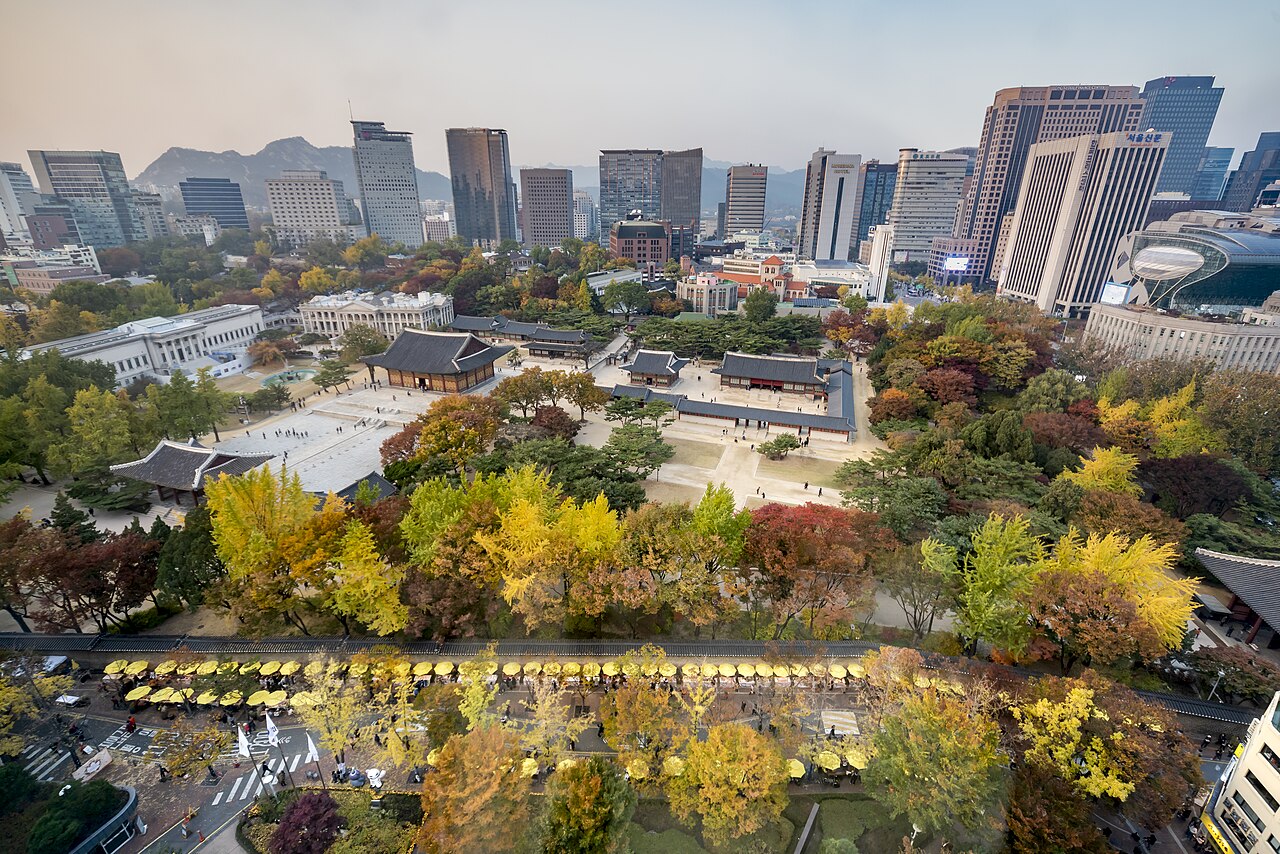
Gyeongbokgung
Gyeongbokgung was the first royal palace of the Joseon dynasty, established in 1395 a year after Hanyang, now Seoul, was chosen as the capital.
- Must see
- Historic monument
Language · 1 published
City guide · South Korea
Seoul is 605.21 km² holding 9,579,449 people at the start of 2026, inside a metropolitan area of 26,037,000 spread over 12,685 km². The Han River bisects it, and the halves are not interchangeable: Gangbuk to the north carries the Joseon capital, Gangnam to the south was built in the last fifty years. Four mountains — Bugaksan, Inwangsan, Naksan and Namsan — frame the old centre, and Gyeongbokgung, completed in 1395, sits under the first of them. Twenty-five gu and 467 administrative dong are stitched together by a metro that carried around seven million passengers a day in 2024. A visitor will use six or seven of those districts.
Ranked by importance — sitelinks, pageviews and heritage status, not editor preference.
Gyeongbokgung was the first royal palace of the Joseon dynasty, established in 1395 a year after Hanyang, now Seoul, was chosen as the capital.
Changdeokgung was raised in 1405 as a secondary palace to Gyeongbokgung, and the garden on the slope behind it was laid out the following year.
Jongmyo is the Confucian royal ancestral shrine of the Joseon dynasty, and it is a working ritual precinct rather than a temple or a palace.
Namsan Seoul Tower is a working broadcast mast with an observation deck bolted onto it, standing on the summit of Namsan, the wooded hill that sits in the middle of central Seoul.
Bukchon is a lived-in neighbourhood rather than a museum village, and every rule a visitor meets there follows from that one fact.
Deoksugung is the palace of the Korean Empire, and the Royal Palaces and Tombs Center's own history of it is unusually blunt about how it became one.
Set your days, your pace and the hours you actually want to be out. The planner works around closing days and travel time, and leaves room to eat.