
15 min walk
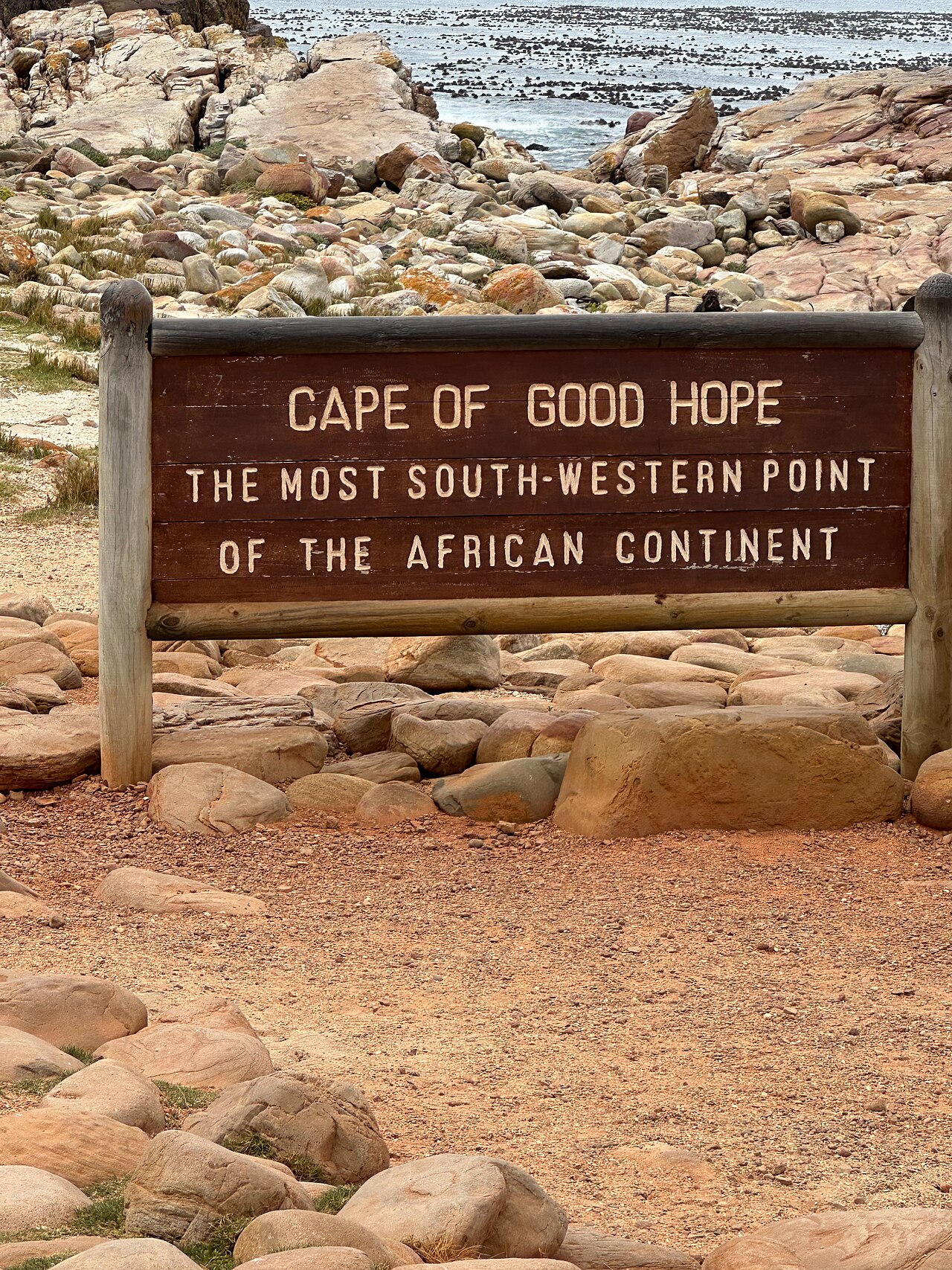
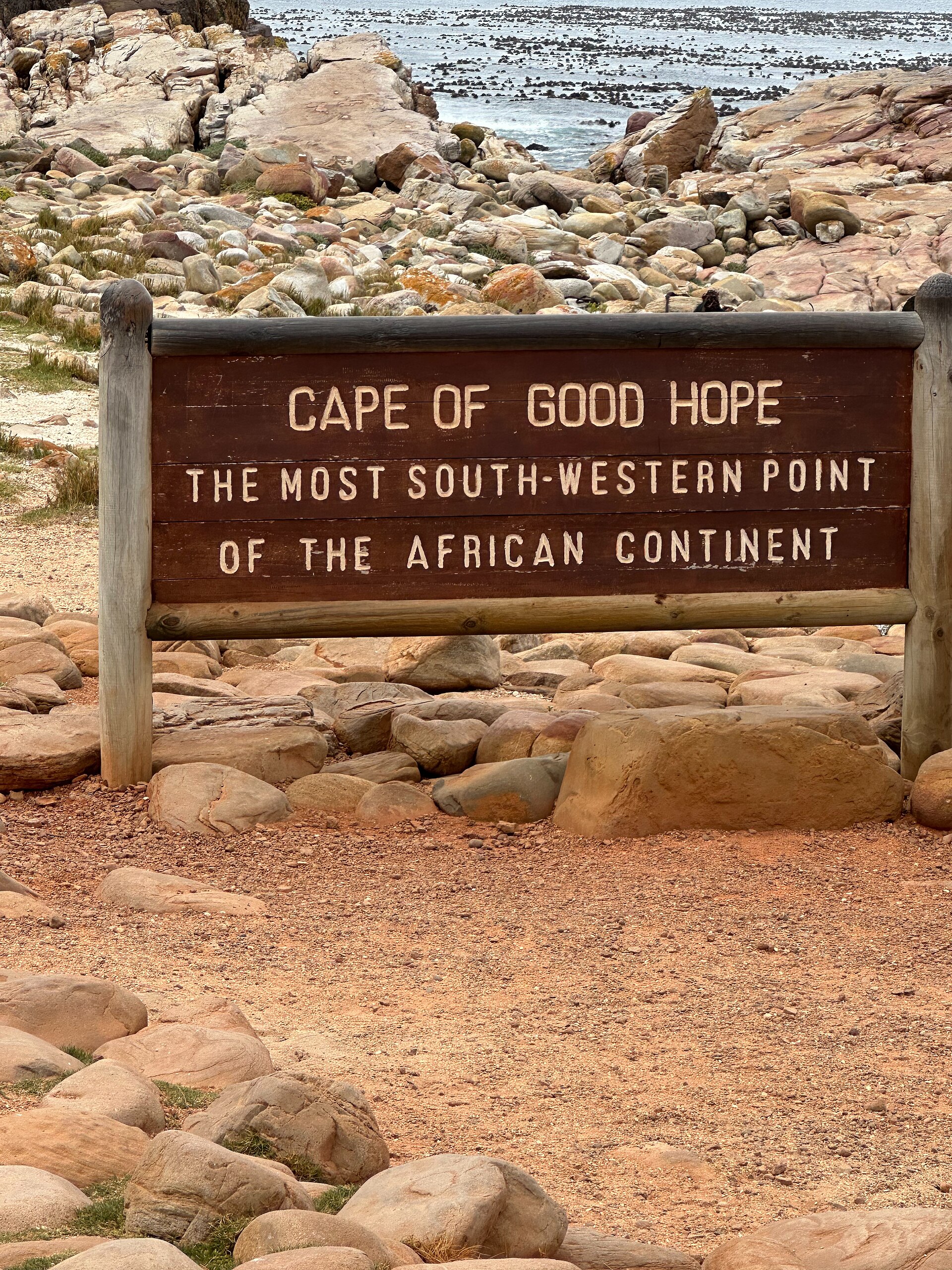
Cape of Good Hope
- Must see
- Historic monument
Language · 11 published
Viewpoint · Cape Town
Cape Point S.W. Lookout

| Monday | 07:00 – 17:00 |
|---|---|
| Tuesday | 07:00 – 17:00 |
| Wednesday | 07:00 – 17:00 |
| Thursday | 07:00 – 17:00 |
| Friday | 07:00 – 17:00 |
| Saturday | 07:00 – 17:00 |
| Sunday | 07:00 – 17:00 |
Checked 2026-08-31 · Source
Read from the OpenStreetMap access tags; anything not listed has no tag recorded.
Set the group type to family in the planner and the day window contracts to about three quarters of a solo day.
Cape Point is the dramatic headland at the southern tip of the Cape Peninsula, within the Table Mountain National Park. It forms part of the Cape of Good Hope Nature Reserve and represents one of Cape Town's signature natural landmarks. The area encompasses steep cliffs, fynbos vegetation, and sweeping Atlantic Ocean views. The location carries historical maritime significance as a navigational reference point for vessels rounding the southern African coastline. Open daily: April–September 07:00–17:00; October–March 06:00–18:00. Standard adult conservation fee: ZAR 515. This tariff is valid from 1 November 2025 through 31 October 2026. Gate admission does not include the Flying Dutchman Funicular.
Checked 2026-08-31 · Source
The main features include the old lighthouse perched on the cliff edge, accessible by funicular railway or footpath. The newer lighthouse operates lower down. Walking trails crisscross the headland, varying in difficulty and length. The Cape Point Oceans Restaurant and curio shop sit near the parking area. Wildlife sightings may include baboons, ostriches, and various antelope species. The broader nature reserve contains diverse fynbos flora. Interpretive signage explains geological and maritime history. Standard adult conservation fee: ZAR 515. This tariff is valid from 1 November 2025 through 31 October 2026. Gate admission does not include the Flying Dutchman Funicular.
Checked 2026-08-31 · Source
A thorough visit demands a full day from Cape Town, accounting for driving time and exploration. The journey from the city centre typically requires over an hour each way via scenic coastal routes. On-site, visitors should allocate several hours to reach the lighthouse, walk selected trails, and absorb the views. Those combining Cape Point with the Cape of Good Hope and Boulders Beach penguin colony nearby extend the excursion substantially. Picnic stops and wildlife observation further extend typical stays. Standard adult conservation fee: ZAR 515. This tariff is valid from 1 November 2025 through 31 October 2026. Gate admission does not include the Flying Dutchman Funicular.
Checked 2026-08-31 · Source
Clear visibility days offer superior ocean and cliff panoramas. Summer months bring stronger winds and more visitors. Winter can deliver atmospheric conditions with dramatic cloud formations, though rain may restrict walking. Early arrival reduces congestion at the funicular and parking areas. Seasonal variations in daylight hours affect feasible walking time. Open daily: April–September 07:00–17:00; October–March 06:00–18:00. Designated accessible parking bays are provided at Cape Point. The information centre, lower curio shop and public toilets can be reached by wheelchair, although the ramp to the car-park toilets may be too steep for some visitors.
Checked 2026-08-31 · Source
Entry fees apply for the Table Mountain National Park section encompassing Cape Point. The funicular railway to the old lighthouse requires separate payment. South African residents typically receive discounted rates upon producing valid identification. Annual park permits may benefit repeat visitors. The restaurant and shop operate independently of park admission. Standard adult conservation fee: ZAR 515. This tariff is valid from 1 November 2025 through 31 October 2026. Gate admission does not include the Flying Dutchman Funicular. Designated accessible parking bays are provided at Cape Point.
Checked 2026-08-31 · Source
Private vehicle represents the most common access method, following the M65 and M4 along the peninsula's western flank. Rental cars or organised tours predominate among visitors. No reliable public transport serves the site directly from Cape Town. Cycling presents an option for experienced riders covering significant distances. The named coach option is City Sightseeing’s Cape Point & Penguin Xplorer Tour, a daily guided full-day service from Cape Town. Its principal departure points are the V&A Waterfront tour office outside the Two Oceans Aquarium and the CBD tour office at 81 Long Street; nearby hotel pickup points are also offered. The coach returns to the V&A Waterfront at approximately 17:45. By road, SANParks lists the M4 via Simon’s Town and Miller’s Point, the M64/M65 via Ou Kaapse Weg, Sun Valley, Kommetjie and Scarborough, or the M6 via Chapman’s Peak; Chapman’s Peak can close temporarily after heavy rain.
Checked 2026-08-31 · Source
Baboons present the most significant wildlife hazard; maintaining distance, securing food, and keeping vehicle windows closed proves essential. Steep cliff edges lack continuous barriers in all areas. Sudden weather deterioration can strand visitors exposed on trails. The funicular suspends operation in high winds. Sun exposure intensifies at this latitude with limited shade on upper paths. Tidal conditions affect some coastal access points. Designated accessible parking bays are provided at Cape Point. The restaurant has ramped access; its lower deck has a particularly steep ramp and may require assistance.
Checked 2026-08-31 · Source
The old lighthouse against Atlantic backdrops provides the iconic composition. Wide-angle lenses accommodate the expansive cliff and ocean vistas. Morning light illuminates the western-facing slopes favourably. The funicular upper station offers structured viewpoints. Wildlife photography demands telephoto reach and patience, particularly for cautious ostriches and antelope. Macro opportunities exist in fynbos detail. Drone operation falls under national park restrictions requiring permits. Salt spray affects equipment near cliff edges. Tripods assist in windy conditions. On 2026-08-31 the lighthouse area is inaccessible to wheelchair users because the funicular is closed, and neither the temporary shuttle nor the walking route is wheelchair accessible.
Checked 2026-08-31 · Source
Yes. Cape Point remains fully open, but the Flying Dutchman Funicular is closed through 31 August for planned maintenance and is scheduled to reopen on 1 September 2026.
A paid shuttle runs between the main car park and the lighthouse area, and a marked walking route is available. The adult shuttle fare is ZAR 80 return or ZAR 70 one way; neither option is wheelchair accessible.
No. Gate admission and the Flying Dutchman Funicular are separately ticketed.
No. A gate ticket permits one redemption during operating hours; visitors cannot exit and return on the same ticket.
No. SANParks states that there are no lifeguards anywhere along the Cape Point coast.
The Cape Point operator identifies approximately June through October as the annual whale-migration period.
Loading the interactive map…
The interactive map could not be loaded.

Last updated:
Source: OpenStreetMap contributors, Wikidata ·