.jpg)
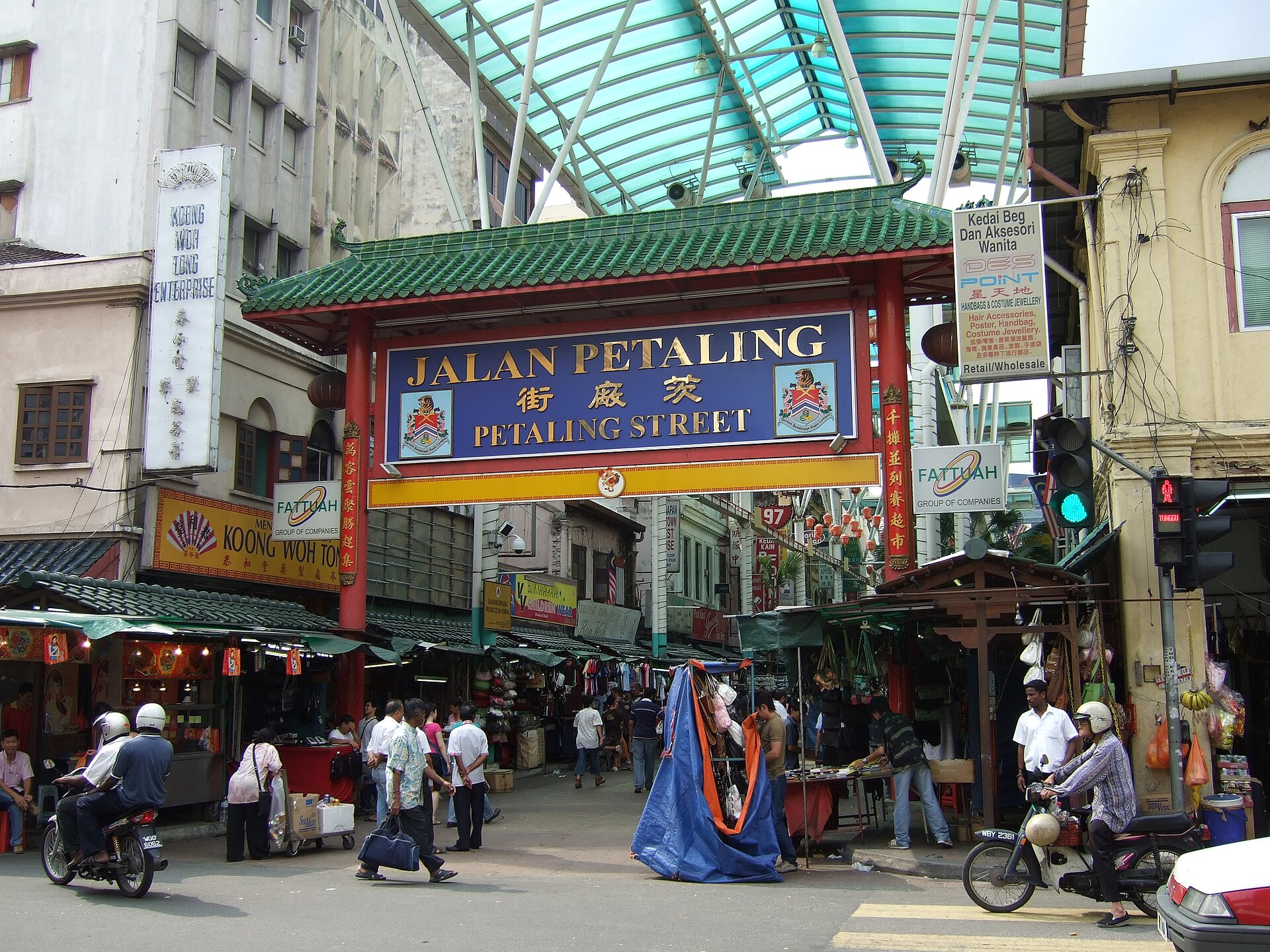
2 min walk
Petaling Street
- Must see
- Market
Language · 11 published
Place of worship · Kuala Lumpur
Guan Di Temple Chinatown

| Monday | 07:30 – 15:30 |
|---|---|
| Tuesday | 07:30 – 15:30 |
| Wednesday | 07:30 – 15:30 |
| Thursday | 07:30 – 15:30 |
| Friday | 07:30 – 15:30 |
| Saturday | 07:30 – 15:30 |
| Sunday | 07:30 – 15:30 |
Checked 2026-08-31 · Source
Read from the OpenStreetMap access tags; anything not listed has no tag recorded.
Set the group type to family in the planner and the day window contracts to about three quarters of a solo day.
Guan Di Temple stands at 168 Jalan Tun H. S. Lee, on the eastern edge of Kuala Lumpur's Chinatown and a short walk from the Petaling Street market arch. It is a Taoist temple dedicated to Guan Sheng Dijun, the deified general Guan Yu, and it is not a free-standing institution: it belongs to the Selangor and Federal Territory Kwong Siew Association, the Cantonese clan body whose premises surround it and whose secretariat works from the same block.
Checked 2026-08-31 · Source
The building is Lingnan work: red walls, a green-tiled roof, and ridges crusted with jian ci, the cut-porcelain shard decoration that turns broken bowls into dragons and ceramic figures from opera legend. A pair of stone lions holds the entrance, a gilded board reading 關帝廟 hangs over the gate, dragon-carved columns take the weight of the front veranda, and the Door Gods are painted either side of the doorway. Inside, the plan is simple and old-fashioned: an open courtyard, the tianjing, with the main hall beyond it, so the light falls in one shaft and the incense smoke has somewhere to go. Coils of incense hang and burn overhead.
Checked 2026-08-31 · Source
This guide records twenty-five minutes, and that is an honest figure rather than a cautious one. The temple is one courtyard and one hall. A slow circuit takes in the lions and the gilded board from the pavement, the Door Gods on the way through, the ridge decoration seen from the courtyard looking up, the three figures on the main altar, the plaques and couplets along the side walls, and the Guan Dao. Twenty-five minutes covers all of that at a pace that does not feel like a march, with a few minutes left to stand still and watch what the people around are actually doing, which is the more interesting half of the visit.
Checked 2026-08-31 · Source
Monday–Sunday, 07:30–15:30 Open daily with no regular weekly closure day. The operator’s August 2026 activity report confirms that the temple remains active. The Kwong Siew Association states that the temple operates Monday to Sunday, every day of the week with no closing day. It publishes no opening and closing times anywhere on its own site, and this guide records none — see the tickets and hours notes below before planning around a specific hour. In practice the sensible window is the middle of the day, when Chinatown is fully awake: Tourism Malaysia gives the Petaling Street market as running 08. 00 to 20. 00 Sunday to Friday and to 22.
Checked 2026-08-31 · Source
Free general admission; no visitor ticket is required. Voluntary offerings are separate from admission. No admission price is recorded here, because the Kwong Siew Association does not publish one. Its website carries the temple's address, two telephone numbers and a statement that the temple operates Monday to Sunday, and nothing about a fee, a ticket, a donation minimum or a guided tour charge. That absence is reported rather than filled in: no figure from a booking site or a listing directory has been substituted for one the operator has not given. What is true of most working Chinese temples is worth knowing anyway.
Checked 2026-08-31 · Source
Use Pasar Seni station, served by the MRT Kajang Line and connected to the LRT Kelana Jaya Line. Leave toward the Jalan Sultan side and continue to 168 Jalan Tun H. S. Lee. MRT Corp lists lifts, ramp access, tactile paving, accessible toilets, low lift buttons and counters, and staff assistance at Pasar Seni station. No car is needed, and one is a liability. The temple is at 168 Jalan Tun H. S. Lee, inside a grid of narrow one-way streets where kerbside parking is scarce, the market spills onto the road and part of Petaling Street is closed to traffic. Rail gets closer than a car park will.
Checked 2026-08-31 · Source
The entrance gates are wide, and wheelchair users can enter the front courtyard. There is no ramp from the courtyard into the main temple, so the interior is not step-free. The first thing is the smoke. Hanging incense coils burn continuously above the courtyard and hall, and the air in a small enclosed temple is thick with it; anyone with asthma or sensitive eyes should stand near the open courtyard rather than deep in the hall, and should not plan a long stay. The second is that no opening and closing time has been published by the association, so this is not a place to build a tight itinerary around.
Checked 2026-08-31 · Source
The association publishes no photography rule, and in practice cameras are ordinary here — but the courtesy is not optional. Ask before photographing anyone praying, drawing a fortune stick or handling the Guan Dao, and accept a refusal without negotiating. No flash near the altar: it is rude, it flattens everything worth photographing, and the light is better without it. The building rewards three positions. From across Jalan Tun H. S. Lee the whole facade reads at once, red wall against the green tiled roof, with the jian ci ridge figures sharp against the sky in late afternoon when the sun is off the frontage and the colours stop burning out.
Checked 2026-08-31 · Source
It is an active Taoist temple dedicated to Guan Di, also called Guan Sheng Di Jun.
The operator dates the temple to 1887; the associated Kwong Siew hall was formally completed in 1888.
The temple is managed by the Selangor and Federal Territory Kwong Siew Association and forms part of the association’s property at 168 Jalan Tun H.S. Lee.
Yes. The association established a restoration committee in 1994, funded the work with public donations, and completed the project within about a year.
The operator lists the temple telephone number as +60 10-442 1988.
Yes. The operator held its 2026 Guan Di birthday observance on 6 August 2026 and published the event photographs on 7 August 2026.
Loading the interactive map…
The interactive map could not be loaded.

Last updated:
Source: OpenStreetMap contributors, Wikidata ·