


3 min walk
Athens Polytechnic uprising
- Must see
- Historic monument
Language · 1 published
Museum · Athens
Εθνικό Αρχαιολογικό Μουσείο
| Monday | 08:00 – 20:00 |
|---|---|
| Tuesday | 13:00 – 20:00 |
| Wednesday | 08:00 – 20:00 |
| Thursday | 08:00 – 20:00 |
| Friday | 08:00 – 20:00 |
| Saturday | 08:00 – 20:00 |
| Sunday | 08:00 – 20:00 |
Checked 2026-08-26 · Source
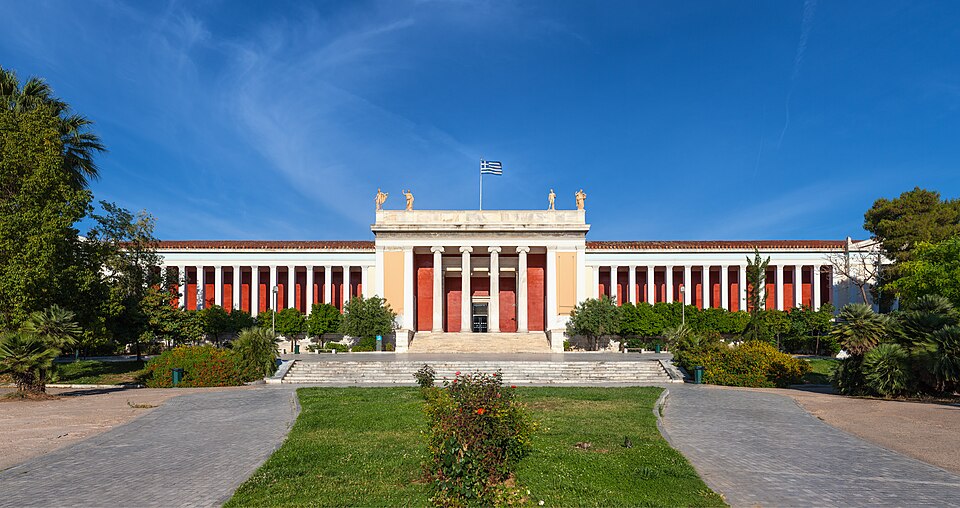
The National Archaeological Museum is the largest museum in Greece and the place where the finds of the great nineteenth-century excavations were gathered before anywhere else existed to hold them. It was built to receive material from Attica and then took in objects from every part of the Greek world, so its collections are not a regional sample but a national one: more than 11,000 exhibits are on display, running from the Neolithic period to late antiquity. The building is a neoclassical block on Patission Street, begun to designs by Ludwig Lange in the later nineteenth century and given its final form by Ernst Ziller, and its exhibition floors cover about 8,000 square metres across dozens of halls on two levels. The Museum describes six collections in its own words — Prehistoric Antiquities, Sculpture, Metalwork, Vases and Minor Arts, Egyptian Antiquities and Cypriot Antiquities — and each of them would be a significant museum standing alone. Two consequences follow for a visitor. The first is that this is a museum of objects rather than of places: the Mycenaean gold, the Cycladic marble and the Antikythera bronzes were all excavated elsewhere and brought here. The second is that nobody sees it in one visit, and planning which halls to walk matters more here than at almost any other site in Athens.
Checked 2026-08-26 · Source
The ground floor opens with the Prehistoric collection in Halls 3 to 6: the Mycenaean antiquities including the treasures from the royal tombs of Mycenae and the Linear B tablets, the Neolithic material, and the Cycladic marble figurines. Hall 48, upstairs, holds the Thera antiquities, where the wall paintings recovered from the volcanic ash — the Spring Fresco with its lilies and swallows, the Boxing Children, the Antelopes — are the reason most people climb the stairs. Halls 7 to 35 are the Sculpture collection, which the Museum numbers at roughly 16,000 sculptures and displays in sequence from about 700 BC to the fifth century AD. Halls 36 to 39 hold the Metalwork collection, one of the richest collections of original bronzes anywhere, and the place where the finds from the Antikythera shipwreck are shown, the Mechanism among them. Halls 40 and 41 are the Egyptian collection, built on the Dimitriou and Rostovich bequests of 1880 and 1904, and Hall 42 the Stathatos Collection. The first floor carries the Vase and Minor Arts collection across Halls 49 to 57 — about 6,000 objects on show — with terracotta figurines in 58 and 59, the Vlastos-Serpieris material in 60 and 61, jewellery in 62, glass in 63, and roughly 850 Cypriot works in Hall 64.
Checked 2026-08-26 · Source
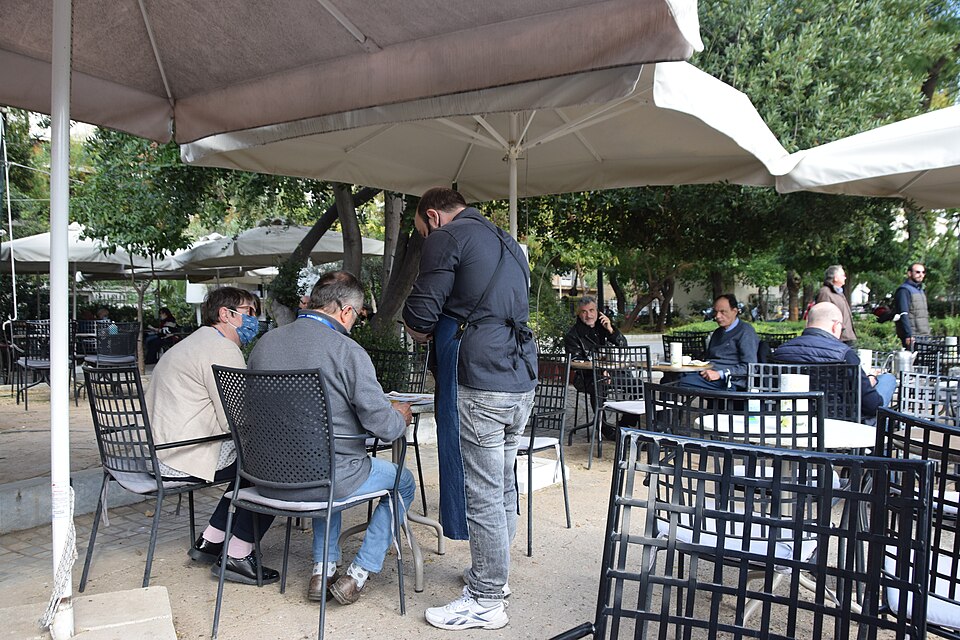
Allow three hours. The Museum publishes no suggested visit length of its own, so three hours is this guide's judgement rather than a figure read off its site, and the figures it does publish are what the judgement is built on: about 8,000 square metres of galleries, more than 11,000 objects on display, and six collections each with its own run of numbered halls. Three hours is enough to walk the Prehistoric halls properly, climb to the Thera frescoes, take the length of the Sculpture galleries at a steady pace, and stop in the bronzes for the Antikythera material. It is not enough to add the Egyptian, Cypriot and vase collections on the first floor at any speed worth calling a visit. A visitor with ninety minutes should choose the Prehistoric halls and Thera and skip the rest deliberately rather than sample everything. A visitor who wants the whole building should plan five hours and eat somewhere in the middle of it — the café is inside and needs no ticket. In the summer season the Museum is open twelve hours a day from Wednesday to Monday, so length is a matter of stamina rather than of the timetable; in winter the short 08:30 to 15:30 day is the real constraint.
Checked 2026-08-26
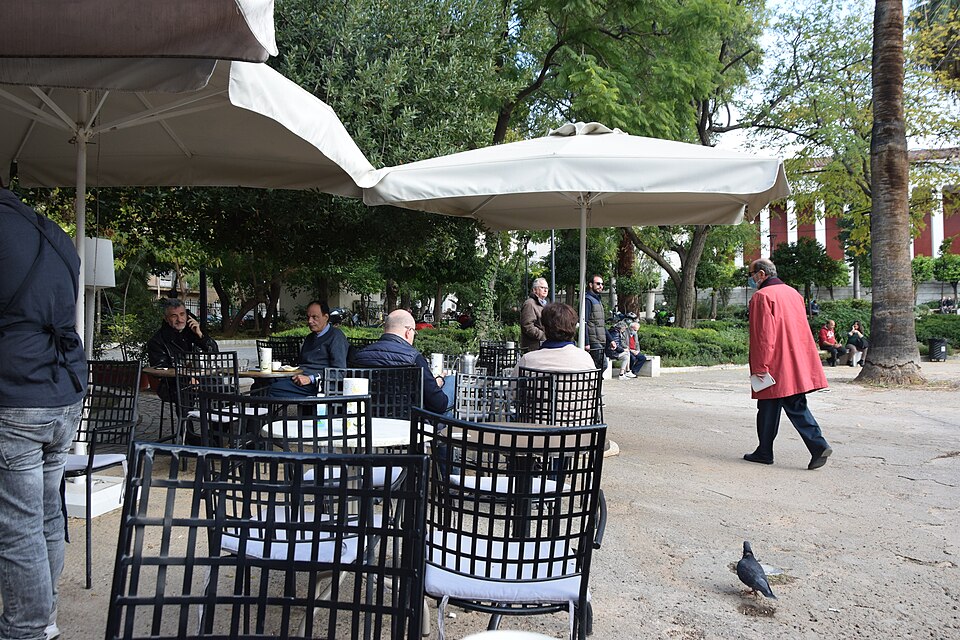
The Museum runs two seasons and they are very different. In the summer season, which for 2026 runs from 4 May to 15 November, it is open Wednesday to Monday from 08:00 to 20:00, with last admission at 19:30. In the winter season, from 16 November 2025 to 3 May 2026, the same days run only 08:30 to 15:30 with last admission at 15:00 — a seven-hour day cut to seven fewer hours than the summer one. Tuesday stands apart in both seasons: the Museum opens at 13:00 and closes at 20:00, so a Tuesday morning here is a wasted journey and a Tuesday evening in winter is the longest opening of that week. There is no weekly closing day; the Museum is shut on 25 and 26 December, 1 January, 25 March, 1 May and Orthodox Easter Sunday. For quiet, the first hour of a summer morning is the best in the building: the doors open at 08:00 and the tour groups that have started their day on the Acropolis have not yet crossed the city. The free-admission dates draw crowds by design — 6 March, 18 April, 18 May, the last weekend of September, 28 October, and the first and third Sunday of each month from 1 November to 31 March.
Checked 2026-08-26 · Source
Admission is 20 euro, and the Museum states that the entrance fee remains stable throughout the year — there is no cheaper winter ticket, even though the winter day is much shorter. Tickets are sold at the reception desk and through the Ministry of Culture's e-ticketing system, and an online ticket buys more than convenience: the Museum gives priority access to holders of what it calls no-queueing tickets, meaning those bought online. Ticket sales stop 30 minutes before the published closing time, so the last moment to buy in the summer season is 19:30. A long list of visitors pay nothing, and the ones a traveller is most likely to fall into are these: anyone up to 25 from an EU member state, on production of an ID card or passport; anyone up to 18 from outside the EU, on production of a passport; a person with a disability of 67 per cent or more and one escort; ICOM and ICOMOS members; and journalists with a valid press card. Admission is reduced by half for visitors over 65 from Greece or another EU state, but only between 1 October and 31 May. Every reduction and every free entry has to be proved with the document that establishes it — the ticket desk asks.
Checked 2026-08-26 · Source
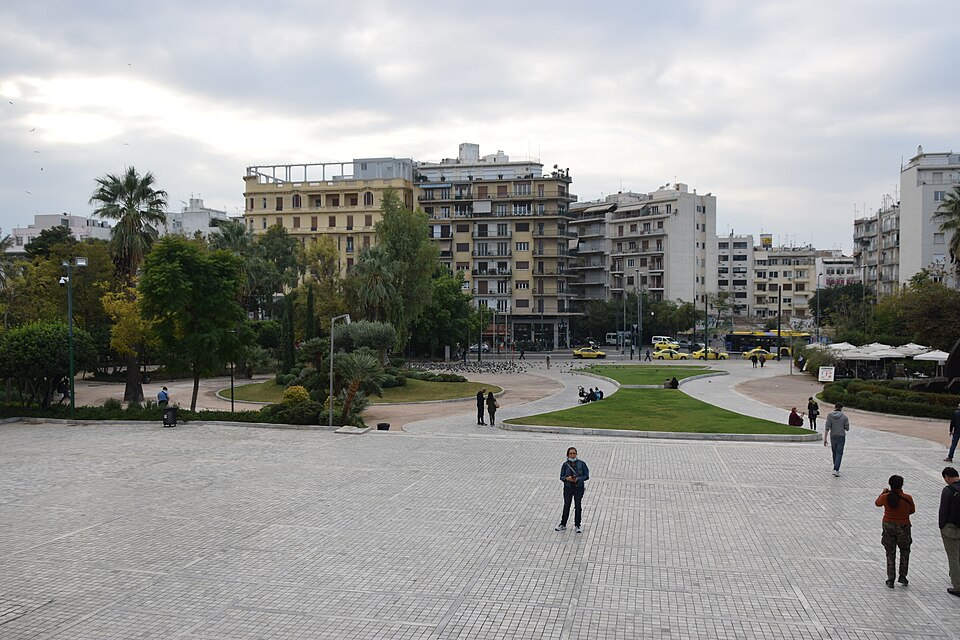
The Museum is at 44, 28is Oktovriou Street — the street everyone in Athens still calls Patission — in the 10682 postcode, north of Omonia and a good distance from the Plaka and Acropolis cluster where most visitors sleep. No car is needed and a car is a nuisance: the Museum has no parking of its own and points visitors at private car parks on Mpoumpoulinas Street, Zaimi Street and Alexandras Avenue. The two nearest stations are Omonia and Victoria, both reachable by Metro and by the electric railway, and each is a walk of several blocks. Victoria is the closer of the two on foot; Omonia is the better connected. The Museum lists a long roster of bus routes serving it — B5, A6, B6, E6, A7, B7, E7, A8, B8, A12, B12, G12, E12, 022, 035, 046, 060, 200, 224, 605, 608 and 622 — and trolleybus routes 2, 3, 4, 5, 6, 7, 8, 9, 11, 13 and 14. Visitors with disabilities have a separate entrance on the Vasileos Irakleiou side, reached by a ramp from the front of the building or straight off the pavement, with lifts to the basement and first floor and a wheelchair available on request at the information desk.
Checked 2026-08-26 · Source
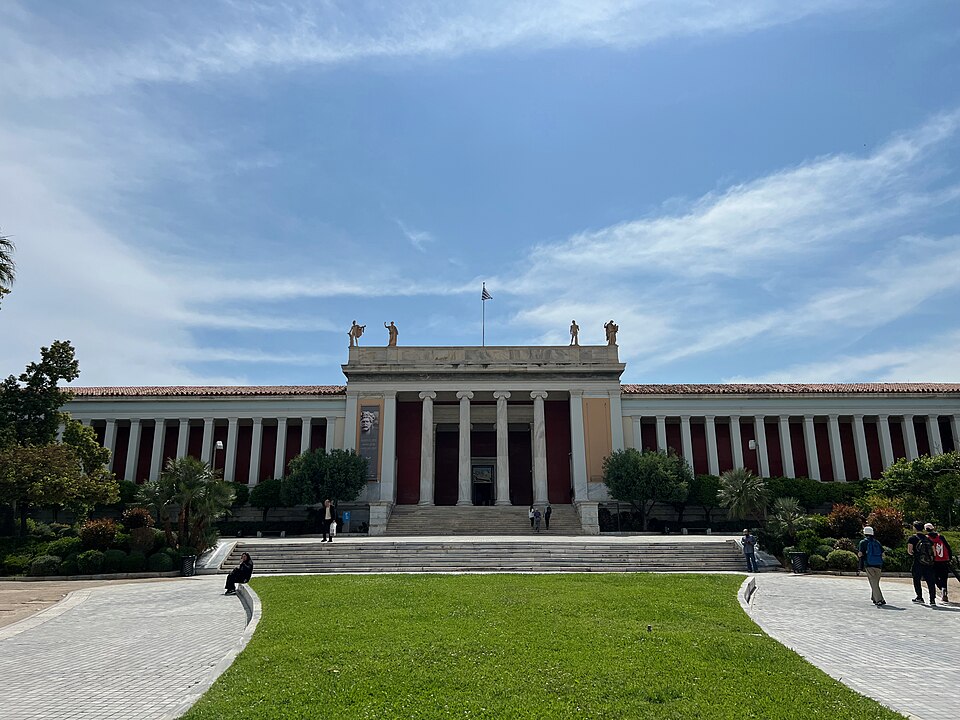
Closing time is not the time to plan around. Ticket sales end 30 minutes before the posted close, and clearance of the galleries begins 20 minutes before it, so a visitor who wants a full last hour in the summer season should be through the door by about 18:30 rather than 19:20. The second trap is the size rule at the cloakroom: any object over 30 by 30 by 15 centimetres, luggage included, and any sports equipment must be left downstairs — and the cloakroom will not accept coats, cash, cards, passports, identity documents, cameras, laptops or phones, so a traveller arriving between trains has to solve the bag problem somewhere else first. The third is that the Museum reserves the right to close individual exhibition areas at its own discretion and without notice, and states plainly that no refund follows, full or partial. A visitor who has come for one particular hall should ask at the desk on the way in. Two smaller ones: the seasonal timetable changes on fixed dates in early May and mid-November, so a shoulder-season visit needs the current season checked rather than remembered, and Tuesday's 13:00 opening catches out people who arrive on the morning the rest of the week is open.
Checked 2026-08-26 · Source
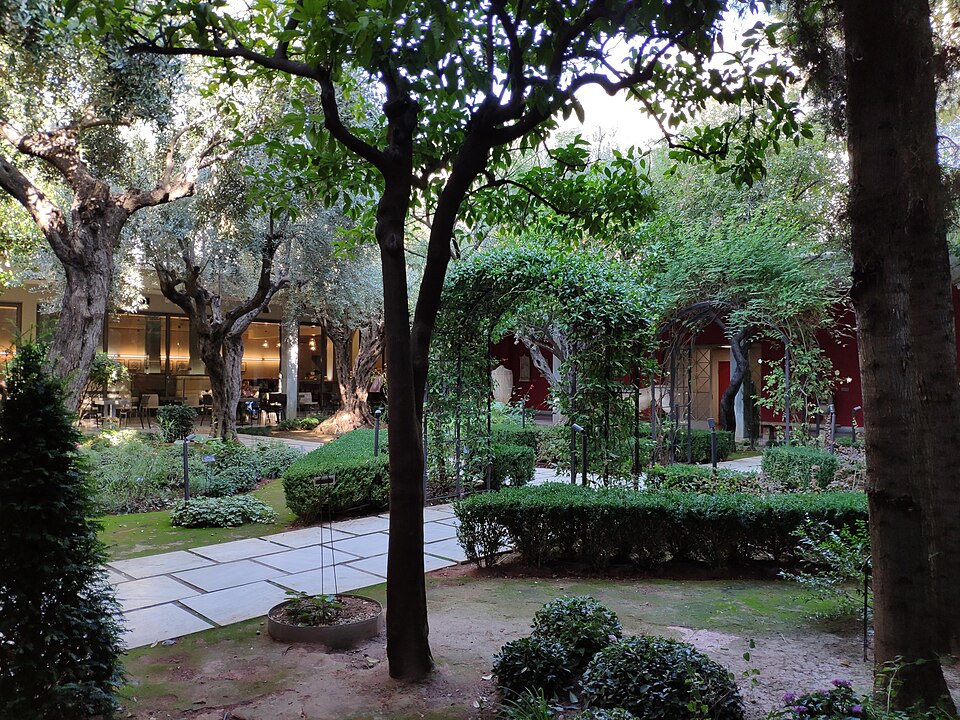
Photography of the antiquities with a hand-held camera is allowed and free of charge, but flash is not permitted anywhere — a firm rule rather than a discouraged practice, and one worth knowing before arriving with a camera that fires automatically. Individual objects may be marked with a plate forbidding photography, and where that plate is on the case the general permission does not apply. Tripods, filming and video recording all require the permission of the Museum's Directorate and are not covered by the ordinary rule; photographing and filming people inside the Museum is allowed provided it does not affect the character of the monuments or obstruct the running of the building. Free-hand sketching needs no permission at all, as long as it does not disturb other visitors and is done on a pad, board or folder no larger than 50 by 40 centimetres, using pencil, charcoal or pen. In practice the light governs the results. The sculpture halls on the ground floor are the best-lit rooms in the building and hold their light through the middle of the day; the gold from Mycenae and the bronzes sit in case lighting that punishes a slow shutter, so a fast lens or a steady elbow matters more than any setting a tripod would have given.
Checked 2026-08-26 · Source
It depends on the season. In the summer season, 4 May to 15 November 2026, the Museum opens Wednesday to Monday from 08:00 to 20:00 with last admission at 19:30. In the winter season, 16 November 2025 to 3 May 2026, those days run 08:30 to 15:30 with last admission at 15:00. Tuesday is different in both seasons: 13:00 to 20:00, last admission 19:30. Ticket sales stop 30 minutes before closing and the galleries are cleared from 20 minutes before it.
There is no weekly closing day — the Museum opens seven days a week, with Tuesday starting at 13:00 rather than in the morning. It is closed on 25 and 26 December, 1 January, 25 March, 1 May and Orthodox Easter Sunday. Individual exhibition areas can also be closed at the Museum's discretion without prior notice, and the Museum states that no refund of the ticket follows when that happens.
Twenty euro for a full-price adult ticket, and the Museum states that the entrance fee remains stable throughout the year, so the shorter winter day costs the same as the twelve-hour summer one. Visitors over 65 from Greece or another EU member state pay half, but only between 1 October and 31 May. Tickets are sold at the reception desk and through the Ministry of Culture's e-ticketing system, and online buyers are given priority access as holders of no-queueing tickets.
Several categories can. Visitors up to the age of 25 from EU member states enter free on production of an ID card or passport, as do visitors up to 18 from outside the EU on production of a passport; so do people with a disability of 67 per cent or more and one escort, ICOM and ICOMOS members, and journalists with a valid card. Admission is free for everyone on 6 March, 18 April, 18 May, the last weekend of September, 28 October, and on the first and third Sunday of each month from 1 November to 31 March. Every entitlement has to be evidenced at the desk.
Three hours for a proper first visit, five if the whole building is the plan. The Museum publishes no suggested visit length, so this is a planning judgement rather than an official figure: it is built on the roughly 8,000 square metres of galleries and the more than 11,000 objects on display across six collections. Three hours covers the Prehistoric halls, the Thera frescoes, the Sculpture galleries and the Antikythera bronzes. Ninety minutes is enough for the Prehistoric halls and Thera and nothing else.
Yes, with a hand-held camera and free of charge, but flash photography is not allowed anywhere in the Museum. Objects carrying a plate that forbids it may not be photographed at all. Tripods, filming and video recording need the permission of the Museum's Directorate. Free-hand sketching is permitted without any application, on a pad or board no larger than 50 by 40 centimetres, in pencil, charcoal or pen.
Loading the interactive map…
The interactive map could not be loaded.
Last updated:
Source: OpenStreetMap contributors, Wikidata ·