


2 min walk
Monument of Nikias
- High
- Historic monument
Language · 1 published
Historic monument · Athens
Παρθενών
| Monday | 08:00 – 20:00 |
|---|---|
| Tuesday | 08:00 – 20:00 |
| Wednesday | 08:00 – 20:00 |
| Thursday | 08:00 – 20:00 |
| Friday | 08:00 – 20:00 |
| Saturday | 08:00 – 20:00 |
| Sunday | 08:00 – 20:00 |
Checked 2026-08-26 · Source
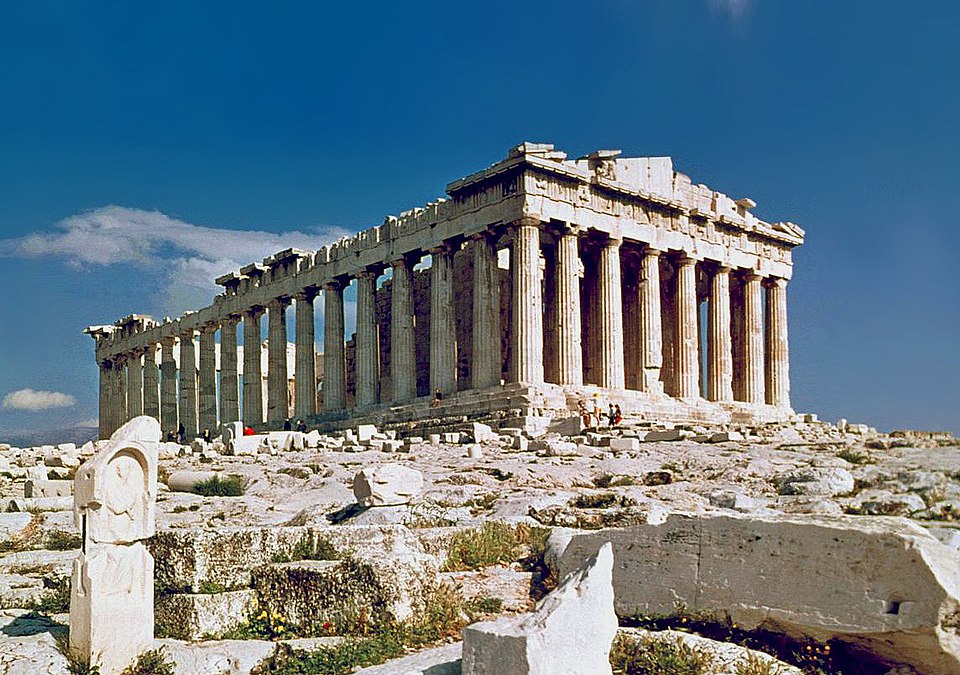
The Parthenon is the Doric temple that stands on the summit of the Acropolis rock, dedicated by the Athenians to Athena Parthenos, the patron of their city. The Ministry of Culture dates its construction to 447-438 BC, as part of the building programme Perikles began, and calls it the finest monument on the Acropolis in both conception and execution. It was the third temple on the spot. Parthenon I went up around 570 BC; Parthenon II was begun after the victory at Marathon around 490 BC and was still unfinished when the Persians sacked the Acropolis in 480 BC. The Periklean temple reused the material cut for its predecessor, which is why its columns are the same width although the building is broader. Iktinos and Kallikrates were its architects and the sculptor Pheidias supervised the whole programme, including the gold and ivory statue of Athena that stood inside the cella.
What a visitor sees today is a ruin with a long second life behind it. The temple became a church of Saint Sophia and later of the Panagia in the fifth century AD, a mosque under Ottoman rule, and a powder magazine by 1687, when Morozini's bombardment blew out its centre. Lord Elgin removed much of the remaining sculpture in the early nineteenth century.
Checked 2026-08-26 · Source
The temple cannot be entered. Visitors walk a circuit around it on the rock, so the building is read from the outside, and knowing its plan helps. It is a double peripteral Doric temple, eight columns across each short side and seventeen down each long one, divided into pronaos, cella and opisthodomos with a separate west room that held the city's treasures and carried four Ionic columns. A double pi-shaped colonnade inside the cella framed the statue of Athena.
The sculpture is the part that is not here. Ninety-two metopes carried reliefs of legendary battles - the Gigantomachy on the east, the Trojan War on the north, the Amazonomachy on the west, the Centauromachy on the south. The east pediment showed Athena springing from the head of Zeus, the west the contest between Athena and Poseidon for the city. An Ionic frieze, unusual on a Doric building, ran along the top of the cella with the Panathenaic procession on it. Most of what survives is now divided between the Acropolis Museum below the rock and the British Museum in London.
The same ticket admits to everything else on the rock and its slopes: the Propylaia, the temple of Athena Nike, the Erechtheion, the Beule Gate, the pedestal of Agrippa, the Brauronion and the Chalkotheke, the theatre of Dionysos and the Odeon of Herodes Atticus below.
Checked 2026-08-26 · Source

Allow two hours. The Ministry of Culture publishes no suggested visit length for the Acropolis on its own information page, so that figure is this guide's judgement rather than a number read off an official source, and it is built around the things the Ministry does publish.
Two hours breaks down roughly as follows. The walk from either entrance up to the Propylaia takes fifteen to twenty-five minutes at a normal pace, more in heat and more in a queue. The summit circuit - Propylaia, Athena Nike, the full walk around the Parthenon, the Erechtheion, the north wall viewpoint - is another forty-five minutes if it is walked rather than rushed. The descent is quicker than the climb. That leaves half an hour of margin for the slopes, which the same ticket covers and most visitors skip: the theatre of Dionysos and the Asklepieion are on the south side and are worth twenty minutes between them.
Last entrance is thirty minutes before closing time in every season the Ministry lists, so arriving at the last admitted moment buys half an hour, not two. A visitor with only an hour should climb, circle the Parthenon once, and leave the slopes for another day rather than compress everything.
Checked 2026-08-26

The site is open every day of the week. There is no weekly closing day and no midday break, which makes the Acropolis unusual among Greek archaeological sites and means the choice is about hour and season rather than about which day is free.
The Ephorate of Antiquities of the City of Athens publishes two base schedules. Summer hours are 08:00 to 20:00 with last entrance at 19:30. Winter hours are 08:00 to 17:00 with last entrance at 16:30. Between them the site steps down through autumn: 1 to 15 September 08:00 to 19:30, 16 to 30 September 08:00 to 19:00, 1 to 15 October 08:00 to 18:30, and 16 to 31 October 08:00 to 18:00, with last entrance half an hour before closing in each case.
The rock closes on 1 January, 25 March, 1 May, Easter Sunday, 25 December and 26 December. On Good Friday it opens 12:00 to 17:00 and on Holy Saturday 08:30 to 15:30.
There is almost no shade on the summit and the marble reflects heat back at knee height, so in July and August the sensible slots are the first hour after opening and the last two before closing. Free-admission days are the most crowded days of the year.
Checked 2026-08-26 · Source
The Ministry of Culture publishes a full ticket of 30 euro and a reduced ticket of 15 euro, charged per person. That single ticket covers the archaeological site of the Acropolis and its Slopes as a whole; there is no separate Parthenon ticket, because the temple is not a separately gated monument and cannot be entered in any case. The Ministry lists no summer and winter difference in that price on its own information page.
Tickets are sold at the ticket offices on site and online. The Ministry names tickets.hh.gr as its official e-ticketing service for the Acropolis and its slopes, and no other seller as official.
Five free-admission days are published: 6 March, in memory of Melina Mercouri; 18 April, International Monuments Day; 18 May, International Museums Day; the last weekend of September, for European Heritage Days; and 28 October. Separate categories of visitor qualify for free or reduced entry year-round, and the Ministry keeps that list on its own page rather than on the site page.
One thing that is not a ticket: the Ministry states that its Digital Tour Guide application, built under the Greece 2.0 recovery plan, has been available free of charge since March 2026.
Checked 2026-08-26 · Source

No car is needed, and the Ministry publishes no parking information for the site at all, so a driver arriving without a plan is on their own. The rock sits inside the pedestrian belt of central Athens and is easiest reached on foot or by metro.
OpenStreetMap records the Akropoli metro station at the corner of Makriyianni and Dionysiou Areopagitou, roughly a hundred metres from the south-east entrance to the slopes and about four hundred metres from the Parthenon itself in a straight line - a distance that is mostly vertical rather than horizontal. The station is mapped as step-free.
There are two ways in. The south-east entrance, beside the metro and the Acropolis Museum, starts the walk at the theatre of Dionysos and climbs the south slope, which spreads the ascent out and passes more on the way. The main west entrance, at the top of the Dionysiou Areopagitou promenade below the Beule Gate, is the shorter and steeper approach and is where the queues form.
A lift serves the north side of the rock for visitors who cannot manage the ramp and steps. The Ephorate posted on 25 August 2026 that it was in working order; it also posts outages on the same page, which is worth reading the morning of a visit.
Checked 2026-08-26 · Source

The surface is the first hazard. Centuries of feet have polished the bedrock on the summit to something close to glass, and the Ministry's own visiting rules recommend footwear suitable for walking on archaeological sites. Smooth soles are a genuinely bad idea here, wet or dry.
The rules are enforced rather than posted for form. Under Law 4858/2021 and the Ministry's decisions, eating and drinking are prohibited inside the site, as is smoking, and littering; visitors are asked not to touch anything and to keep to the marked routes. Pets are not allowed on the Acropolis and its slopes at all, with the exception of dogs accompanying people with disabilities. Non-compliance can end in eviction.
Two practical warnings stand on the Ephorate's page at the time of writing. The toilets inside the archaeological site are under renovation and closed; visitors are asked to use the facilities to the right and left of the central entrance before going in. And the Ephorate uses that same page for urgent notices - a power fault on 14 August 2026 that stopped the evening illumination was announced there within hours.
OpenStreetMap records wheelchair access to the Parthenon itself as limited, even though the site lift reaches the summit.
Checked 2026-08-26 · Source

The building faces the light differently at each end of the day, and the two hours the Acropolis is least crowded are also the two that photograph best. At 08:00 the sun is on the east front, the end where the pediment showed the birth of Athena, and the colonnade is lit from behind the viewer rather than into the lens. In the last hour of the summer schedule the west front takes the low sun and the Doric flutes read as ridges rather than as flat stone. The middle of the day flattens everything and burns out the marble.
Restoration is permanent, not temporary. Work has run continuously since 1975, so cranes and scaffolding sit in nearly every frame taken from the north-west, and there is no season in which they are absent. The cleanest angles are from the south-east, where the long flank is largely unobstructed.
The Ministry's published visiting rules restrict photography only in one respect: images of indecent or defamatory scenes are prohibited on site.
For the wide shot of the temple on its rock, the Areopagus and the Philopappos hill sit outside the paid site, are open at any hour, and both look straight at it - Philopappos from further back and higher.
Checked 2026-08-26
No. The Ministry of Culture sells one ticket for the archaeological site of the Acropolis and its Slopes - 30 euro full, 15 euro reduced, per person - and that covers the Parthenon along with the Propylaia, the Erechtheion, the temple of Athena Nike, the theatre of Dionysos and everything else inside the fence. There is no Parthenon-only ticket, and the temple itself cannot be entered under any ticket; visitors walk around it.
It opens at 08:00 every day of the year that it is open at all. Summer closing is 20:00 with last entrance at 19:30; winter closing is 17:00 with last entrance at 16:30. Through autumn the Ephorate steps the closing time down: 19:30 for the first half of September, 19:00 for the second, 18:30 for the first half of October and 18:00 for the second, with last entrance thirty minutes before closing throughout.
No. The site is open seven days a week and takes no midday break. It closes on six dates in the year - 1 January, 25 March, 1 May, Easter Sunday, 25 December and 26 December - and runs short hours on two more, 12:00 to 17:00 on Good Friday and 08:30 to 15:30 on Holy Saturday.
Two hours is a realistic figure for the climb, the summit circuit and a look at the south slope on the way down. The Ministry publishes no suggested visit length of its own, so that is this guide's estimate rather than an official one. An hour is enough only for the climb and one circuit of the Parthenon. Arriving at last entrance leaves thirty minutes before the gates shut, in every season.
Yes, five of them: 6 March in memory of Melina Mercouri, 18 April for International Monuments Day, 18 May for International Museums Day, the last weekend of September for European Heritage Days, and 28 October. They are also the busiest days on the rock. Separate categories of visitor qualify for free or reduced admission year-round, on a list the Ministry keeps separately.
No. The Ministry's visiting rules prohibit consuming food or beverages inside the archaeological site, along with smoking and littering, and non-compliance can lead to eviction. Water is the practical problem this creates, since the summit has almost no shade; the sensible move is to drink before the gate rather than to rely on drinking inside. Note also that the toilets inside the site are currently closed for renovation, and visitors are asked to use those beside the central entrance first.
Loading the interactive map…
The interactive map could not be loaded.
Last updated:
Source: OpenStreetMap contributors, Wikidata ·