


.jpg)
.jpg)

1 min walk
Earth Hole
- High
- Historic monument
Language · 1 published
Historic monument · Athens
Βιβλιοθήκη του Αδριανού
| Monday | 08:00 – 20:00 |
|---|---|
| Tuesday | 08:00 – 20:00 |
| Wednesday | 08:00 – 20:00 |
| Thursday | 08:00 – 20:00 |
| Friday | 08:00 – 20:00 |
| Saturday | 08:00 – 20:00 |
| Sunday | 08:00 – 20:00 |
Also recorded: 08:00 – 15:00, 08:00 – 19:30, 08:00 – 19:00, 08:00 – 18:30, 08:00 – 18:00
Checked 2026-08-26 · Source
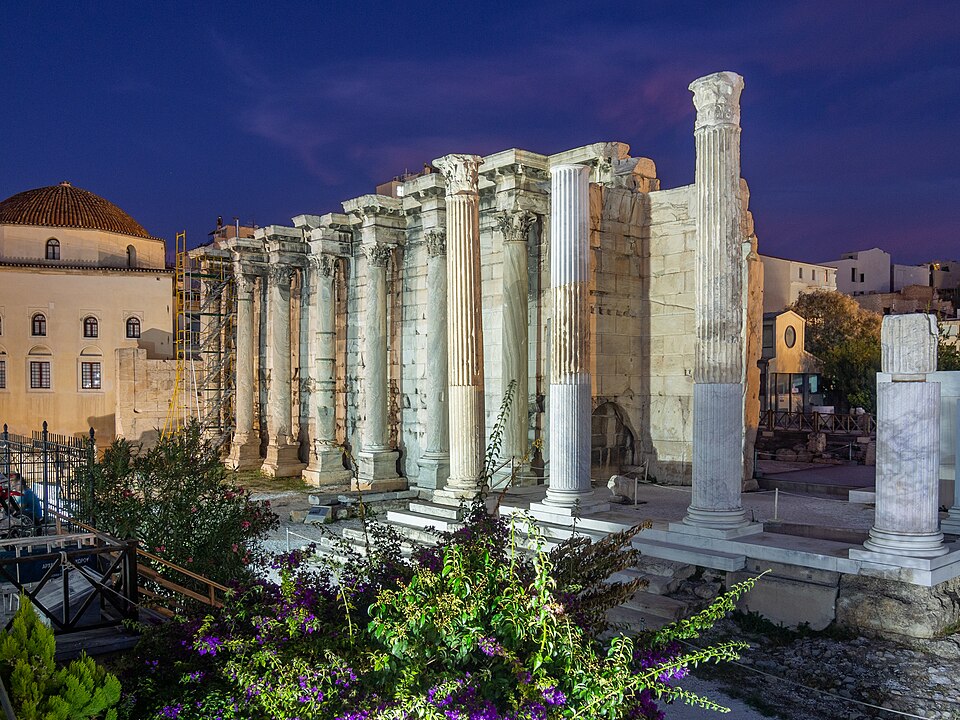
Hadrian's Library is a walled Roman enclosure in the middle of Athens, a few minutes north of the Acropolis and immediately east of Monastiraki Square. The Hellenic Ministry of Culture, which runs the site through the Ephorate of Antiquities of the City of Athens, dates its construction to AD 132 and attributes it to the emperor Hadrian. It was never only a library. The rectangular building held a library, study rooms and lecture halls arranged around a large open colonnaded courtyard, and it served the Roman city as a cultural precinct rather than as a reading room. What a visitor actually sees on the ground is the later history. The Herulians destroyed the building in AD 267 and its ruins were absorbed into the Late Roman fortification wall; the Roman eparch Herculius repaired it in AD 412. From the fifth century the courtyard was occupied by one church after another, and under Ottoman rule the compound became the seat of the Voevode, the governor of Athens. In 1835 the barracks of King Otho were raised on the spot the Voevodalik had held. The enclosure is therefore not one building from one century but roughly seventeen hundred years of demolition and reuse stacked inside the same rectangle of wall.
Checked 2026-08-26 · Source
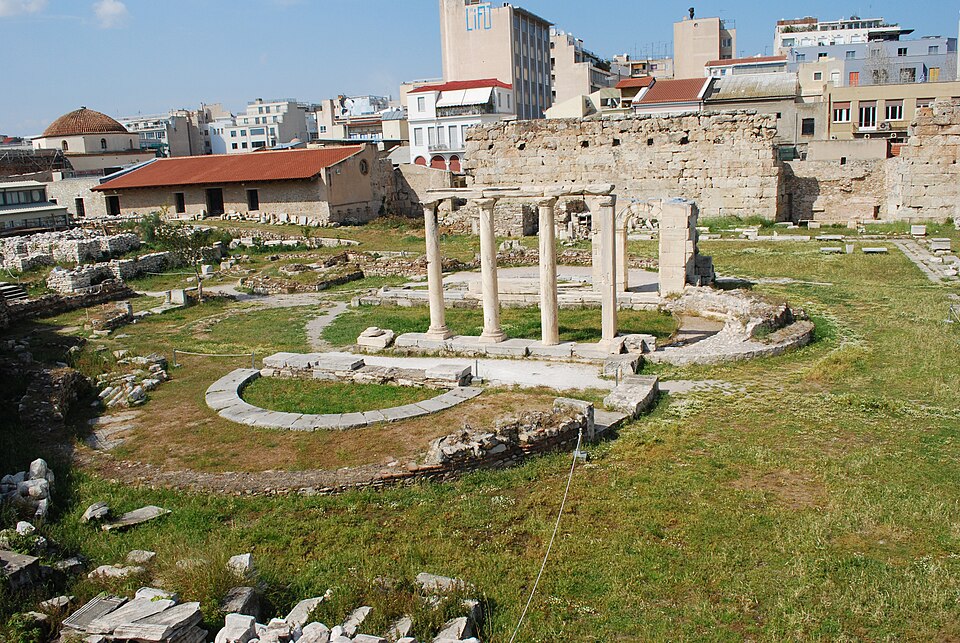
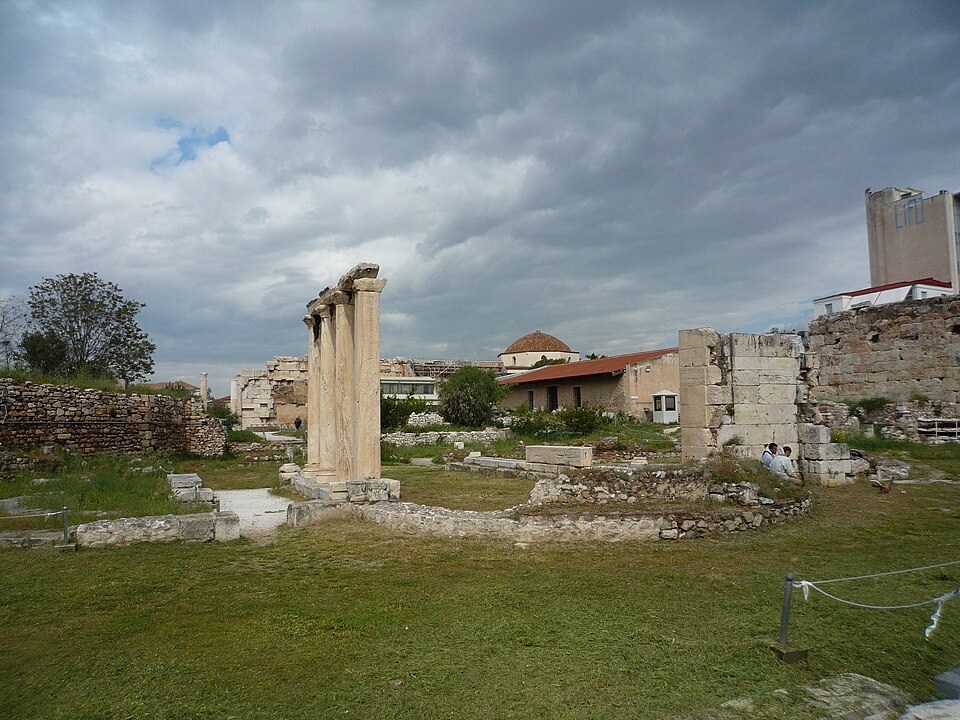
The plan is easy to hold in the head. A Corinthian propylon stands on the west side, facing Areos Street, and behind it lies the open peristyle courtyard with three projecting conches set into each of the long sides. The library proper, along with the study and lecture halls, occupied the eastern range. The west wall with its row of columns is the piece most people photograph, and it can be read from the pavement outside before a ticket is bought. Inside the courtyard the Ministry singles out three later monuments. The quatrefoil building, dated to the fifth century AD, was an Early Christian church with four apses, a peripteral narthex, an exonarthex and a wide atrium on its west side; its foundations sit squarely in the middle of the Roman court. On its ruins a three-aisled basilica was built in the seventh century, and when that in turn came down in the eleventh a single-aisled church with a north chapel took its place, the church of Megale Panaghia, which stood for centuries and burned in 1885. North of the quatrefoil are the ruins of a seventeenth-century church, of which the north wall and part of the sanctuary survive.
Checked 2026-08-26 · Source

Allow forty-five minutes. The Ministry of Culture publishes no suggested visit length for Hadrian's Library, so this figure is the guide's own judgement rather than an operator number. The site is one enclosure with one circuit: the walk from the entrance along the north side, across the courtyard past the quatrefoil foundations and back along the south is well under a kilometre, and the interpretive panels are few. Half an hour covers it at a steady pace. The extra quarter of an hour is for the two things that reward standing still, the west colonnade seen from inside rather than from the street, and the stacked church foundations in the middle of the court, where the sequence from fifth-century tetraconch to eleventh-century chapel is legible only if a visitor reads the ground slowly. Anyone with a real interest in Late Antique Athens can spend ninety minutes here without straining, and anyone treating it as a stop between Monastiraki and the Roman Agora will be out in twenty. It pairs naturally with the neighbouring sites rather than filling a morning by itself, so plan it as one item in a half-day rather than as the half-day.
Checked 2026-08-26
The site opens every day of the week, and the length of the day is what changes. The Ministry publishes a summer schedule of 08:00 to 20:00 with last entrance at 19:30, and a winter schedule of 08:00 to 15:00 with last entrance at 14:40. It also publishes a graduated autumn timetable: 1 to 15 September 08:00 to 19:30 with last entrance at 19:10, 16 to 30 September 08:00 to 19:00 with last entrance at 18:40, 1 to 15 October 08:00 to 18:30 with last entrance at 18:10, and 16 to 31 October 08:00 to 18:00 with last entrance at 17:40. The Ministry does not state on this page the calendar date on which the summer schedule begins, so a visitor planning for spring should check before travelling. The site is closed on 1 January, 1 May, Easter Sunday, 25 December and 26 December; on Good Friday it opens 12:00 to 17:00 and on Holy Saturday 08:30 to 15:30. Come early. The courtyard has almost no shade, the winter closing time of 15:00 removes the whole afternoon, and in high summer the Ephorate has closed the site during the middle of the day for heat.
Checked 2026-08-26 · Source
The Ministry of Culture lists one ticket for Hadrian's Library: full admission at 10 euros and reduced admission at 5 euros. Tickets are sold at the ticket office on site and online through the Ministry's official e-ticketing service at tickets.hh.gr, so a visitor who arrives without a booking can simply buy at the gate. The Ministry's page for this site quotes that single ticket only and does not say whether any multi-site package covers the enclosure, so treat the 10 euro ticket as the price to budget for and ask at the office if a combined ticket for the surrounding sites is in hand. Admission is free for everyone on five dates each year: 6 March, in memory of Melina Mercouri; 18 April, International Monuments Day; 18 May, International Museums Day; the last weekend of September, for the European Heritage Days; and 28 October. Separate categories of visitor qualify for free or reduced entry year-round, and the Ministry keeps that list on its own pages rather than on the page for this site, so anyone expecting a concession should carry the document that proves it. Prices and free days here were read from the Ministry's site on 26 August 2026.
Checked 2026-08-26 · Source
No car is needed and a car is a liability. The Ministry gives the address as Areos 3, 105 55, in Monastiraki, which puts the west facade on the pedestrianised street running north from Monastiraki Square. Monastiraki station, served by the metro and by the suburban line into the square, is a walk of two or three minutes; from Syntagma it is one stop, and from the Acropolis Museum it is a level walk of about fifteen minutes through Plaka. Driving into this quarter means the Athens traffic ring, streets that are pedestrian or one-way, and no parking worth the search, so leave the car outside the centre if there is one at all. There are two ways in. The main entrance is on Areos Street beside the propylon; a second entrance on Dexippos Street is the one the Ministry names for step-free access, and the accessible route of beaten earth starts there and runs into the eastern part of the site. The enclosure sits between Monastiraki Square, the Roman Agora and the Tower of the Winds, so the approach on foot from any of them takes only a few minutes.
Checked 2026-08-26 · Source

Heat is the practical hazard. The courtyard is open ground with no shade, and the Ephorate has closed the site in the middle of the day during heatwaves for the safety of staff and visitors, as it did between 12:00 and 17:00 on three days in late July 2025. The Ministry asks visitors to check its own hub, odysseus.culture.gr, daily for changes, which is the right habit in July and August. Accessibility is partial and specific. The beaten-earth route for wheelchairs, pushchairs and visitors with reduced mobility begins at the Dexippos Street entrance and serves the eastern part of the enclosure; movement in the western part, the facade side, is not permitted for visitors with disabilities at present. There are accessible toilets on site. The Ministry's operating rules apply here as at every state archaeological site: no eating or drinking, no smoking, no collecting or moving anything, no leaving the marked routes and no touching the remains. Suitable walking shoes are recommended for archaeological sites and are genuinely worth it here, because the ground inside is uneven stone, gravel and exposed foundation.
Checked 2026-08-26 · Source
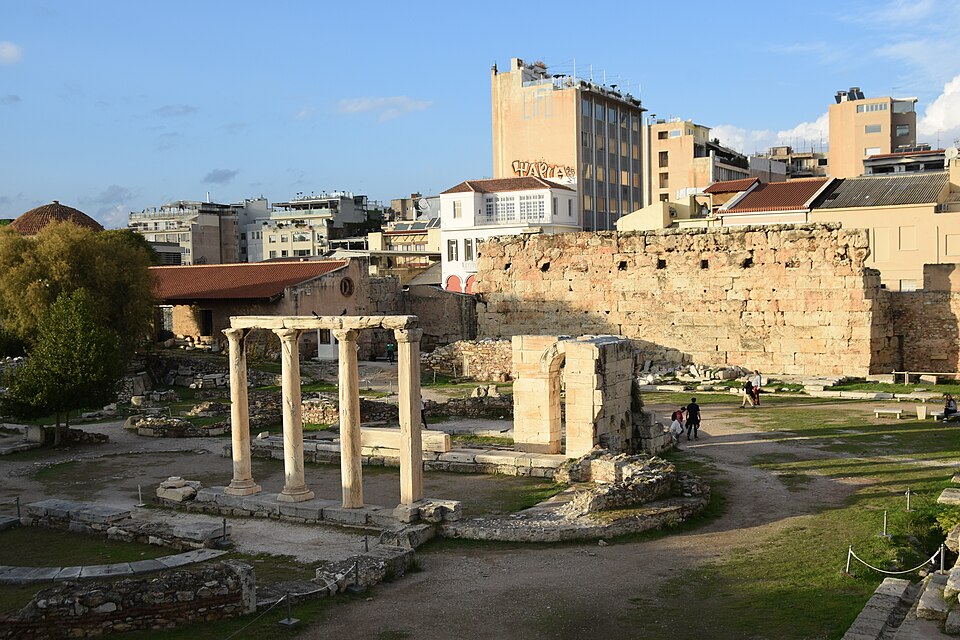
The best-known picture of Hadrian's Library is taken from outside it. The west wall with its surviving Corinthian columns runs along Areos Street and faces roughly west, so it is flat and grey in the morning and lit warm in the late afternoon; the last two hours before closing in summer are the ones to aim for, and in winter the 15:00 close takes that light away entirely. From inside the enclosure the useful compositions are different. The quatrefoil foundations in the centre of the court read as a shape only from a raised angle or from the far side with a long lens, and a photograph taken standing over them usually shows nothing but stone. The colonnade photographed from within the courtyard, with the modern street invisible behind it, is the frame that separates a considered picture from a snapshot. Small compact site, wide skies, hard midday shadow: a polariser earns its place and a tripod is unnecessary. Personal photography is normal practice at Greek state sites, and professional shoots and filming require a permit from the Ministry's resources organisation rather than a word with the guard, so keep the kit modest if the visit is a casual one.
Checked 2026-08-26
The site opens daily. The Ministry of Culture publishes a summer schedule of 08:00 to 20:00 with last entrance at 19:30 and a winter schedule of 08:00 to 15:00 with last entrance at 14:40, plus a graduated autumn timetable that steps the closing time down from 19:30 in early September to 18:00 in the second half of October. It is closed on 1 January, 1 May, Easter Sunday, 25 December and 26 December.
Full admission is 10 euros and reduced admission is 5 euros. Tickets are sold at the ticket office on site and online through the Ministry of Culture's official e-ticketing service at tickets.hh.gr. The Ministry's page for this site lists that single ticket and does not state whether a multi-site package covers the enclosure.
Allow forty-five minutes. The Ministry publishes no suggested visit length, so this is the guide's own judgement: half an hour walks the single circuit at a steady pace, and the extra quarter of an hour is for the colonnade seen from inside the courtyard and for reading the stacked church foundations in the middle of the court.
No. The site is open seven days a week. The closures are calendar dates rather than weekdays: 1 January, 1 May, Easter Sunday, 25 December and 26 December. On Good Friday it opens 12:00 to 17:00 and on Holy Saturday 08:30 to 15:30. In heatwaves the Ephorate has closed the site during the middle of the day, so check odysseus.culture.gr in high summer.
Partly. The Ministry describes a beaten-earth route for wheelchair users, pushchairs and visitors with reduced mobility that starts at the Dexippos Street entrance and runs into the eastern part of the site, and there are accessible toilets. Movement in the western part of the monument, the facade side, is not currently permitted for visitors with disabilities.
No, and a car is a hindrance. The Ministry gives the address as Areos 3, 105 55, Monastiraki, two or three minutes' walk from Monastiraki station; the surrounding streets are pedestrian or one-way and parking is impractical. The Acropolis, the Roman Agora and the Tower of the Winds are all within a short walk.
Loading the interactive map…
The interactive map could not be loaded.
Last updated:
Source: OpenStreetMap contributors, Wikidata ·