


_-_2022-03-25_-_1.jpg)
_-_2022-03-25_-_2.jpg)
_-_2022-03-25_-_3.jpg)
3 min walk
Stoa Poikile
- Must see
- Historic monument
Language · 1 published
Historic monument · Athens
Αρχαία Αγορά
| Monday | 08:00 – 19:30 |
|---|---|
| Tuesday | 08:00 – 19:30 |
| Wednesday | 08:00 – 19:30 |
| Thursday | 08:00 – 19:30 |
| Friday | 08:00 – 19:30 |
| Saturday | 08:00 – 19:30 |
| Sunday | 08:00 – 19:30 |
Checked 2026-08-26 · Source
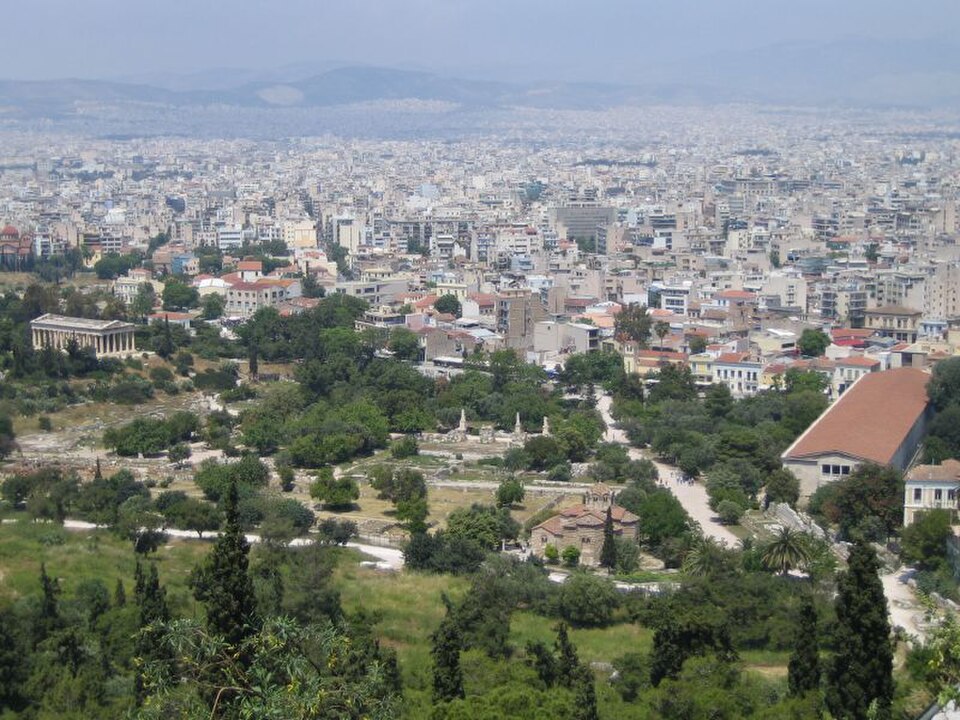
The Ancient Agora is the flat ground below the north slope of the Acropolis, hemmed in by the Areopagus to the south and the low hill of Kolonos Agoraios to the west. The Greek Ministry of Culture, which runs the site through the Ephorate of Antiquities of the City of Athens, describes it as the heart of ancient Athens: the focus of political, commercial, administrative and social activity, the religious and cultural centre, and the seat of justice. Its own account records occupation without interruption through every period of the city's history, beginning as a residential and burial area in the Late Neolithic around 3000 BC and becoming public ground early in the sixth century BC, in the time of Solon. The square reached its final rectangular form in the second century BC, after damage by the Persians in 480/79 BC, the Romans in 89 BC and the Herulians in AD 267; following the Slavic invasion of AD 580 it was gradually abandoned, and from the Byzantine period until after 1834, when Athens became capital of the independent Greek state, houses covered it again. What a visitor walks through is therefore the result of a clearance as much as a dig. The American School of Classical Studies began systematic excavation in 1931, work that continues today, and uncovering the square required demolishing around 400 modern buildings over roughly twelve hectares.
Checked 2026-08-26 · Source
The site is crossed by the Panathenaic Way, the road that climbed from the Dipylon Gate to the Acropolis and carried the procession of the Panathenaic festival. Near the middle of the open square stood the Altar of the Twelve Gods of 522/1 BC, a place of asylum and the milestone from which distances out of Athens were measured. The public buildings line the western edge under Kolonos Agoraios: the circular Tholos of 470 BC where the fifty prytaneis were quartered, the New Bouleuterion where the Boule met, the Metroon of the second century BC which was both a sanctuary of the Mother of the Gods and the city archive, the long base of the Monument of the Eponymous Heroes of 350 BC, the Ionic temple of Apollo Patroos of 325 BC, the Stoa of Zeus Eleutherios and the Stoa Basileios. Above them on the hill stands the temple of Hephaistos and Athena of the later fifth century BC, popularly the Theseion and one of the best preserved ancient temples anywhere, owing its survival partly to its centuries as a Christian church. Southward are the Southwest and Southeast Fountain Houses, the Aiakeion, the two South Stoas, the Mint and the Middle Stoa; northwest, a boundary stone reading "I am the boundary stone of the Agora" and the Poros Building, tentatively identified as the state prison. The museum occupies the reconstructed Stoa of Attalos.
Checked 2026-08-26 · Source
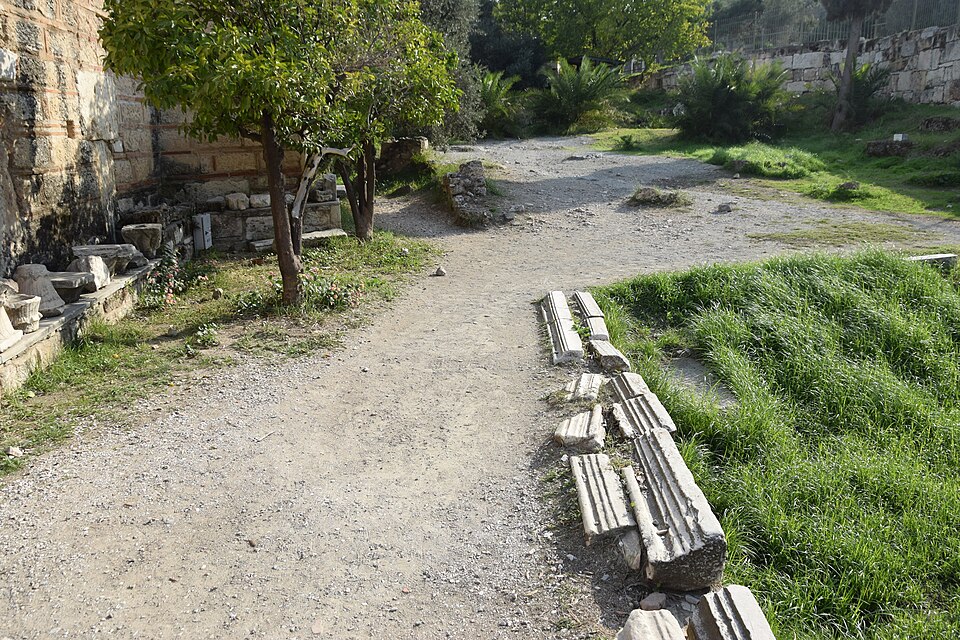
The Ministry of Culture publishes no recommended length of visit for the Ancient Agora, so the ninety minutes recorded on this page is an editorial estimate rather than an operator figure, and it is what the itinerary planner uses. It is built from what there is to walk. The site is a single enclosure of roughly twelve hectares on two levels: the flat square, and the climb up Kolonos Agoraios to the temple of Hephaistos. Walking the Panathenaic Way from the entrance to the far side, taking in the west-side foundations, going up to the temple and coming down again is about forty-five minutes at a steady pace with brief stops. The reconstructed Stoa of Attalos and the museum inside it take another thirty to forty-five, more if the sculpture in the colonnade holds attention. An hour is enough only for the temple and a quick crossing of the square; two hours suits anyone who wants to read the foundations against a plan and identify the Tholos, the Bouleuterion and the Metroon on the ground, which is not obvious without one. The last entrance time, not the closing time, sets the practical limit at the end of the day.
Checked 2026-08-26 · Source
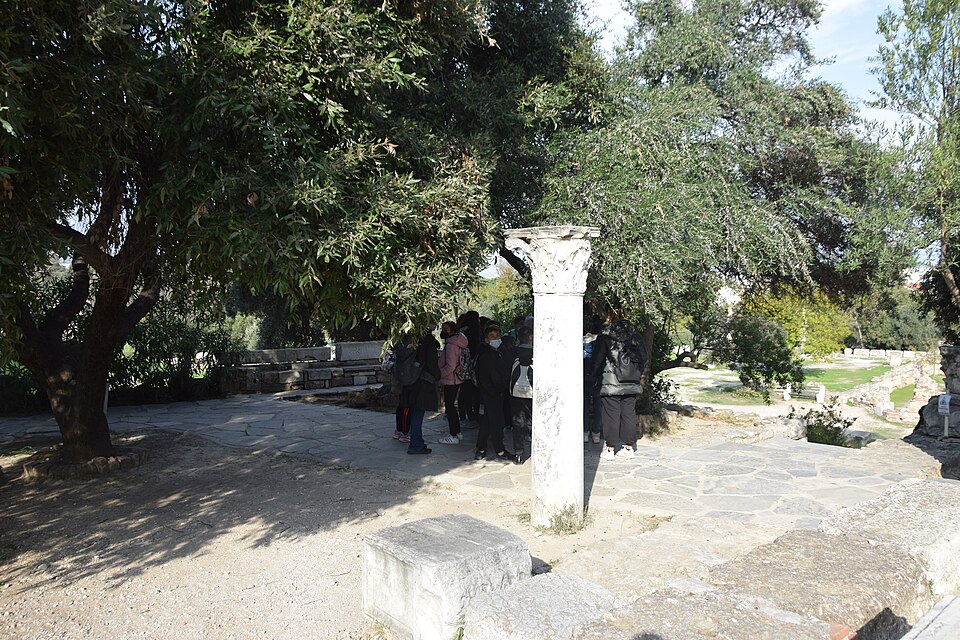
The gate opens at 08:00 every day of the year on which the site opens at all, and only the closing time moves. The Ministry publishes the summer timetable as 08:00 to 19:30 with last entrance at 19:00, then a stepped autumn: 08:00 to 19:00 from 1 to 15 September with last entrance 18:30, 08:00 to 18:30 from 16 to 30 September with last entrance 18:00, 08:00 to 18:00 from 1 to 15 October with last entrance 17:30, and 08:00 to 17:30 from 16 to 31 October with last entrance 17:00. The winter timetable is 08:00 to 16:30 with last entrance at 16:10. The exact dates on which the summer and winter timetables begin are not given on that page beyond those September and October steps, so a visit close to a change of season is worth checking on the day. There is no weekly closing day. The site is closed on 1 January, 25 March, 1 May, Easter Sunday, 25 December and 26 December; Good Friday it opens 12:00 to 17:00 and Holy Saturday 08:30 to 15:30. The early opening matters more here than at most Athenian sites, because the square has very little shade and the stone holds heat all afternoon.
Checked 2026-08-26 · Source
Admission is 20 EUR full and 10 EUR reduced, and one ticket covers both the archaeological site and the museum of the Ancient Agora, so there is nothing further to pay at the Stoa of Attalos. The Ministry lists the same 20 and 10 EUR as its special ticket package for the site. Tickets are sold at the ticket offices on site and online through the Hellenic Ministry of Culture's official e-ticketing service at tickets.hh.gr; the Ministry names no other authorised seller. Five days a year carry free admission for everyone: 6 March, in memory of Melina Mercouri; 18 April, International Monuments Day; 18 May, International Museums Day; the last weekend of September, for the European Heritage Days; and 28 October. Categories entitled to free or reduced admission at Greek state sites are set centrally rather than by this site, and the Ministry links to that list from the Agora's own information page rather than reproducing it. The site's page does not state whether the combined multi-site ticket sold for the Acropolis and other central Athens sites includes the Agora, so anyone counting on one should confirm it at the point of sale rather than assume it. Bring the booking reference or a printed ticket; the entrance is currently a temporary one.
Checked 2026-08-26 · Source

The postal address is Adrianou 24, 10555 Athens, on the Monastiraki side of the site, but that is not currently where visitors go in. Because of the Recovery and Resilience Fund project to redevelop the main entrance at Adrianou 24, the Ministry states that from 1 July 2025 until the works are finished both entry and exit are through the archaeological site gate at Thiseio Square, named for Jacqueline de Romilly. That gate is at the western, lower end of the site, a short walk from Thiseio station on Metro Line 1 along the pedestrianised Apostolou Pavlou. Monastiraki station, on Line 1 and Line 3, sits at the other end and is the more useful arrival if the day also takes in the Roman Agora or the flea market, though it means walking around the fenced perimeter on Adrianou to reach the open gate. No car is needed or wanted: this is the dense centre of Athens, the surrounding streets are pedestrianised or one-way, and the site's own page gives no parking of any kind. The Ephorate of Antiquities of the City of Athens can be reached on +30 210 3210185 or at [email protected].
Checked 2026-08-26 · Source

Two closures are live and neither is obvious from outside. The Ministry states that from 1 November 2025 the exhibition on the floor of the Stoa of Attalos and the Church of the Holy Apostles remain closed to the public, so the eleventh-century church in the middle of the site and part of the museum display may not be seen; the page asks visitors to check odysseus.culture.gr for daily changes. The temporary entrance at Thiseio Square is the second: anyone arriving at Adrianou 24 on an old map walks the length of the fence to get in. The published operating rules are stricter than most visitors expect and are enforced by the site guards. Eating and drinking are prohibited inside, as is smoking; nothing may be collected, moved or damaged, litter of any kind is forbidden, and pets are not admitted except dogs accompanying people with disabilities. Visitors are asked to keep to the marked routes and out of restricted areas, not to touch anything, and to follow the guards' instructions, and the Ministry specifically recommends footwear suitable for walking, which on this ground means closed shoes rather than sandals: the paths are gravel, dust and uneven ancient paving, and the climb to the temple of Hephaistos is a real slope.
Checked 2026-08-26 · Source

The two subjects that carry a visit are the temple of Hephaistos and the reconstructed Stoa of Attalos, and they want opposite hours. The temple stands alone on Kolonos Agoraios with nothing behind it, so it photographs best early, when the low sun rakes across the Doric columns from the east and the Acropolis is not yet a bright silhouette behind the lens; by the middle of the day the whole hill goes flat and white. The Stoa is the reverse: its two-storey colonnade is deep and shaded, and late afternoon light entering under the roof runs the length of it and gives the receding columns the ranks of shadow that make the picture. From the upper part of the square the Acropolis and the Hephaisteion can be framed together, which is the shot most people come away with and the one that needs the entrance-time discipline in high summer. Foundations photograph poorly at eye level and much better from the slope looking down, where the plan of the buildings reads as a plan. The Ministry's published rules prohibit photography or videography of indecent or defamatory scenes; the site's own page states no rule on tripods, flash or drones, so ask the guards on the day rather than assuming permission.
Checked 2026-08-26 · Source
The Greek Ministry of Culture charges 20 EUR full and 10 EUR reduced, and the ticket is valid for both the archaeological site and the museum of the Ancient Agora. The same 20 and 10 EUR are listed as the site's special ticket package. Tickets are sold at the ticket offices on site and online through the Ministry's official e-ticketing service at tickets.hh.gr. Admission is free for everyone on 6 March, 18 April, 18 May, the last weekend of September and 28 October.
The site opens at 08:00 every day it is open, and the closing time follows the season. Summer is 08:00 to 19:30 with last entrance at 19:00 and winter is 08:00 to 16:30 with last entrance at 16:10. Between them the Ministry publishes four steps: 08:00 to 19:00 from 1 to 15 September, 08:00 to 18:30 from 16 to 30 September, 08:00 to 18:00 from 1 to 15 October and 08:00 to 17:30 from 16 to 31 October, with last entrance thirty minutes before closing in each case. There is no midday break.
There is no weekly closing day: the site opens seven days a week. It is closed on six dates in the year — 1 January, 25 March, 1 May, Easter Sunday, 25 December and 26 December — and Easter Sunday and May Day are closures that apply to all Greek archaeological sites, monuments and museums. Two days have shortened hours rather than a closure: Good Friday, when it opens 12:00 to 17:00, and Holy Saturday, when it opens 08:30 to 15:30.
The Ministry publishes no recommended duration, so the ninety minutes recorded here is this site's own estimate. It covers walking the Panathenaic Way and the western foundations, the climb to the temple of Hephaistos and about half an hour in the museum in the Stoa of Attalos. An hour is enough for the temple and a crossing of the square, and two hours suits anyone identifying the Tholos, the Bouleuterion and the Metroon on the ground with a plan in hand.
Not at the address on the map. The Ministry states that because of the project to redevelop the main entrance at Adrianou 24, from 1 July 2025 until the works are complete visitors enter and leave through the archaeological site gate at Thiseio Square, named for Jacqueline de Romilly, at the western end of the site. It is a short walk from Thiseio station on Metro Line 1. Arriving instead at Monastiraki means walking the length of the Adrianou fence to reach the open gate.
Yes. The Ministry states that from 1 November 2025 the exhibition on the floor of the Stoa of Attalos and the Church of the Holy Apostles remain closed to the public. The church, built around AD 1000 and restored by the American School in the 1950s, stands in the middle of the site and is normally one of its set pieces, and the museum occupies the reconstructed Stoa of Attalos, so both closures are worth checking before a visit. The Ministry asks visitors to check odysseus.culture.gr daily for changes.
Loading the interactive map…
The interactive map could not be loaded.
Last updated:
Source: OpenStreetMap contributors, Wikidata ·