
24 min walk
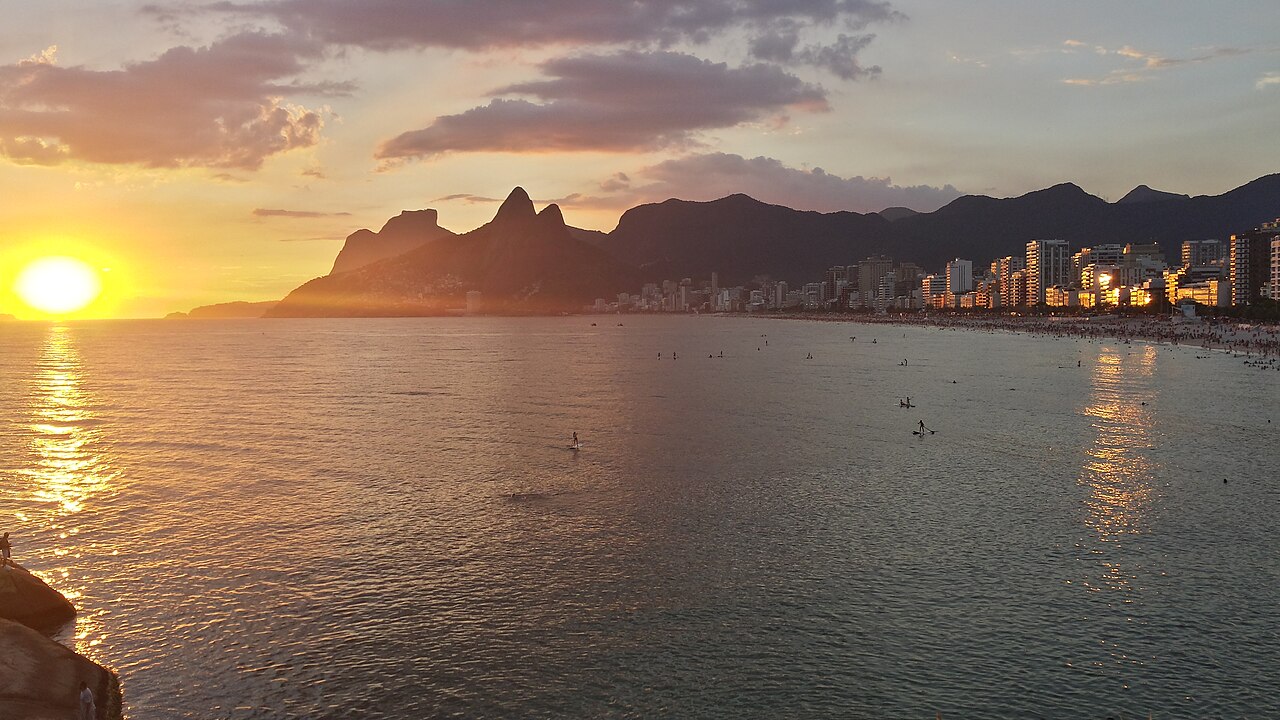
Pedra do Arpoador
- Must see
- Historic monument
Language · 11 published
Nature site · Rio de Janeiro
Praia de Copacabana

| Monday | 00:00 – 23:59 |
|---|---|
| Tuesday | 00:00 – 23:59 |
| Wednesday | 00:00 – 23:59 |
| Thursday | 00:00 – 23:59 |
| Friday | 00:00 – 23:59 |
| Saturday | 00:00 – 23:59 |
| Sunday | 00:00 – 23:59 |
Checked 2026-08-31 · Source
Read from the OpenStreetMap access tags; anything not listed has no tag recorded.
Set the group type to family in the planner and the day window contracts to about three quarters of a solo day.
Copacabana Beach, known locally as Praia de Copacabana, is Rio de Janeiro's most internationally recognised urban beach and promenade. The crescent-shaped stretch of sand and adjacent Avenida Atlântica form one of the most iconic coastal cityscapes globally. No distinct beach Point of Interest is assigned to the broader Rio production identity, making this relation the primary reference for visitors seeking the famous shoreline. Open continuously, 24 hours daily. This is an open public beach with no regular closure days. Authorities may temporarily control nearby roads or access points during major events or safety operations.
Checked 2026-08-31 · Source
The beach features a wide sandy shore backed by a distinctive black-and-white wave-patterned promenade in Portuguese pavement style. Avenida Atlântica separates the beach from the dense urban fabric of Copacabana neighbourhood. The area includes various kiosks, sports facilities, and informal vendor activity along the shore. Lifeguard posts are positioned at intervals. The broader Copacabana district contains numerous hotels, restaurants, and residential buildings. The beach serves as an active recreational space for both visitors and local residents throughout daylight and evening hours.
Checked 2026-08-31 · Source
Visitors typically spend between two hours and a full day at Copacabana Beach depending on their interests. Casual walkers may traverse the promenade in approximately one to two hours without extended stops. Those combining beach time with meals at adjacent establishments or participation in sports activities should plan for half-day or longer visits. The experience is generally self-paced with no mandatory circuit or guided route. Sunset viewing adds popular evening hours for many visitors seeking the atmospheric transition from day to night. Free public access; no general-admission ticket is required.
Checked 2026-08-31 · Source
Rio de Janeiro has a tropical climate with warm temperatures year-round, though seasonal variation affects visitor experience. Summer months from December to March bring highest temperatures and rainfall, alongside peak domestic and international tourism. Winter months from June to August offer milder conditions with less precipitation. Open continuously, 24 hours daily. MetrôRio Line 1 serves Copacabana through Cardeal Arcoverde/Copacabana, Siqueira Campos/Copacabana and Cantagalo/Copacabana stations. For the designated accessible approach, use Cardeal Arcoverde and follow Rua Rodolfo Dantas toward the sea. An accessible route follows Rua Rodolfo Dantas from Cardeal Arcoverde/Copacabana metro station to the beach.
Checked 2026-08-31 · Source
Access to Copacabana Beach and its promenade is free of charge as public space. No admission fee applies for beach entry or pedestrian use of the sidewalk. Individual services such as chair and umbrella rentals, food and beverages from kiosks, or sports equipment operate as separate commercial transactions. No advance booking is required for general beach access. Free public access; no general-admission ticket is required. An accessible route follows Rua Rodolfo Dantas from Cardeal Arcoverde/Copacabana metro station to the beach. The route includes ramps, tactile paving, audible signals, Braille street signs and a bamboo mat across the sand.
Checked 2026-08-31 · Source
Copacabana Beach is accessible via Rio de Janeiro's public transportation network including metro, bus, and taxi services. The neighbourhood is served by Cardeal Arcoverde and Siqueira Campos metro stations on Line 1, located within walking distance of the beach. Numerous bus routes traverse Avenida Atlântica and connecting streets. MetrôRio Line 1 serves Copacabana through Cardeal Arcoverde/Copacabana, Siqueira Campos/Copacabana and Cantagalo/Copacabana stations. For the designated accessible approach, use Cardeal Arcoverde and follow Rua Rodolfo Dantas toward the sea. The route includes ramps, tactile paving, audible signals, Braille street signs and a bamboo mat across the sand.
Checked 2026-08-31 · Source
Strong ocean currents and variable wave conditions require swimming caution; lifeguard presence does not eliminate risk. Sun exposure is intense; protective measures are advisable. Beach vendors operate throughout the area; visitors should negotiate clearly and maintain awareness of belongings. Urban safety considerations apply in the surrounding neighbourhood, particularly during evening hours and in less populated stretches. An accessible route follows Rua Rodolfo Dantas from Cardeal Arcoverde/Copacabana metro station to the beach. Cardeal Arcoverde/Copacabana station lists access for disabled passengers. Accessibility is concentrated on this route rather than provided continuously across the full sandy beach.
Checked 2026-08-31 · Source
Copacabana Beach offers extensive photography opportunities including the curved shoreline, patterned promenade, mountain backdrop, and street life. Early morning and late afternoon provide favourable natural light with reduced crowd density. The full crescent shape is best captured from elevated positions in surrounding buildings or nearby viewpoints rather than beach level. Drone operation requires awareness of Brazilian aviation regulations and local restrictions. Respect for individuals' privacy is expected when photographing beachgoers. Tripod use on crowded walkways requires consideration of pedestrian flow. The beach is an open public space with continuous access, no regular closure day and no general-admission charge.
Checked 2026-08-31 · Source
The beach is an open public space with continuous access, no regular closure day and no general-admission charge.
Cardeal Arcoverde/Copacabana, Siqueira Campos/Copacabana and Cantagalo/Copacabana stations on MetrôRio Line 1 serve different stretches of the beachfront.
Yes. The municipal route along Rua Rodolfo Dantas links Cardeal Arcoverde station to the sea using ramps, tactile paving, audible signals, Braille signs and a bamboo mat over the sand.
Roberto Burle Marx redesigned the Portuguese-stone promenade in 1970; IPHAN describes it as extending for 4.5 kilometres along Avenida Atlântica.
On Sundays and public holidays, the beachfront carriageway operates as a leisure area from 07:00 to 18:00.
Riotur operates tourist-information points at Posto 2 and Posto 5; its published service hours are 08:00–20:00.
Loading the interactive map…
The interactive map could not be loaded.

Last updated:
Source: OpenStreetMap contributors, Wikidata ·