211 min walk · Marmaris
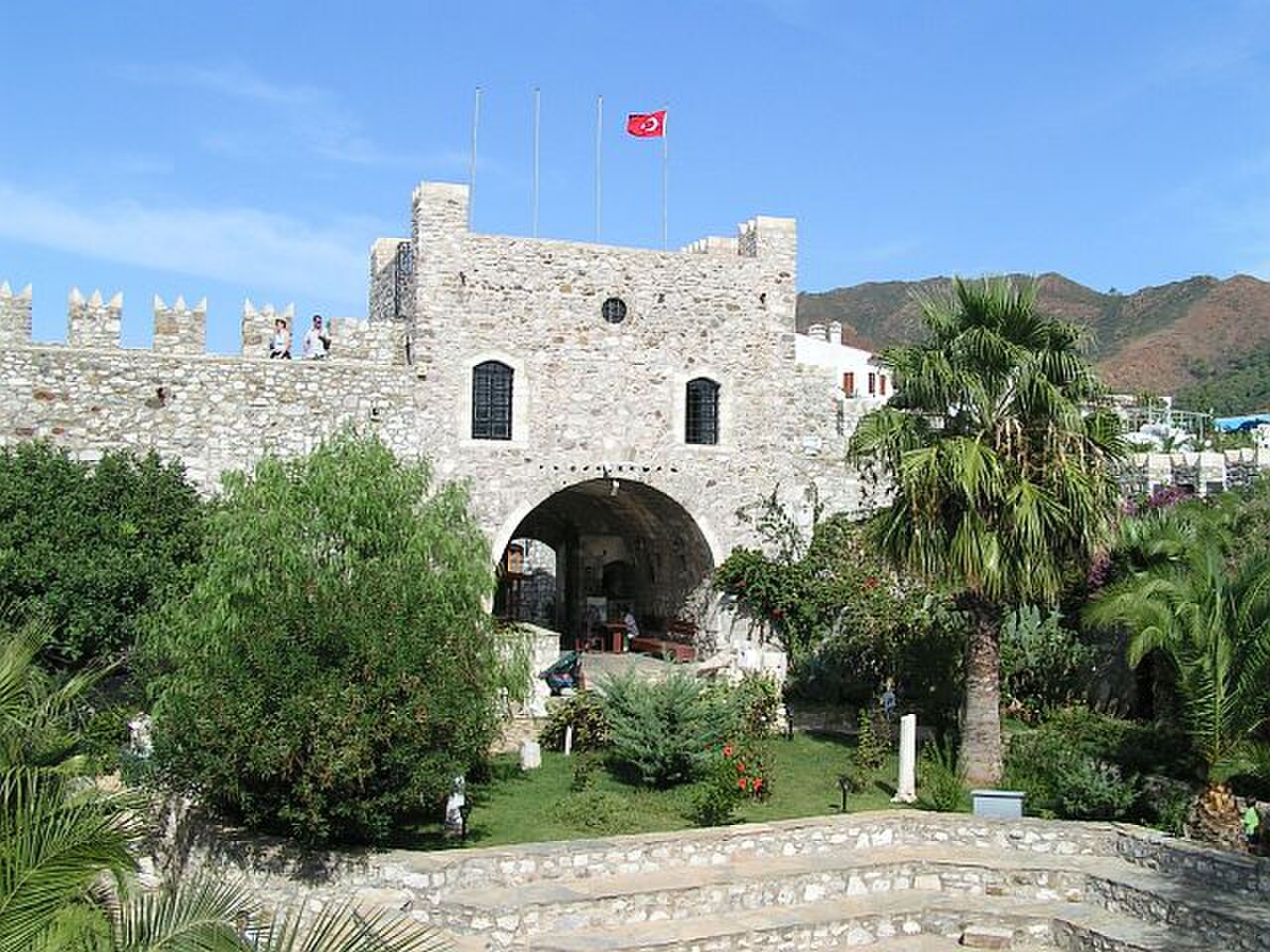
Marmaris Castle
- Must see
- Historic monument
Language · 11 published
Historic monument · Marmaris, Muğla
Agora is a principal surviving civic space within Euromos Ancient City, near Milas in Muğla Province. Its approximately 95 by 83 metre plan is nearly square, giving the remains a strong sense of order. Unlike a detached monument, it belongs to Euromos’s urban fabric and helps explain how the ancient settlement organised a public centre. Begin by taking in the complete footprint before examining the porticoes, then relate the open space to the wider archaeological setting. Its central position makes the agora a particularly useful place to understand Euromos as a planned settlement, with civic, religious and funerary remains occupying one connected landscape. Agora is one of the principal surviving remains at the centre of Euromos Ancient City, within the archaeological area near Milas.
Checked 2026-09-02 · Source
The nearly square agora measures about 95 by 83 metres and is enclosed on all four sides by porticoes. The south portico is Ionic on its inner side and Doric on its outer side, while the other three porticoes use the Doric order. At the north-west corner, a heart-shaped pier preserves an inscription honouring Kallisthenes, son of Polykhares, dated to around 150 BC. Walk the perimeter slowly to compare the open centre, repeated architectural rhythm and changing column orders. Looking from the centre towards each side makes the different treatments easier to distinguish, while the inscribed pier gives the circuit a specific point of focus.
Checked 2026-09-02 · Source
Allow around 30 to 45 minutes for the agora itself if you want to circle its edges, compare the Ionic and Doric treatments and examine the inscribed pier. Because the agora is a feature within Euromos, a fuller visit should include the surrounding remains. Set aside roughly 90 minutes to two hours for the archaeological area, including the Temple of Zeus Lepsynos, theatre, baths, necropolises, city walls and chapel remains. This longer allowance leaves time to pause at the corners, change viewpoints across the central space and understand how the agora relates to the ancient settlement rather than treating it as an isolated stop.
Checked 2026-09-02 · Source
This guide therefore assigns no opening times, seasonal hours or closing day. The physical arrangement is most rewarding when visitors can see the full near-square footprint, follow all four porticoes and inspect the north-west pier without rushing. Daylight also supports a combined walk to the Temple of Zeus Lepsynos, theatre, baths, walls, chapel remains and necropolises. Plan the sequence around the light and the time you have available, while keeping the agora as the anchor for reading the site’s civic layout.
Checked 2026-09-02 · Source
This guide records no adult tariff, child category, citizen rate, foreign-visitor rate or free-admission claim. Agora is described as a principal remain inside Euromos Ancient City, not as a separately priced attraction. The absence of a recorded price must not be converted into an assumption that entry is free.
Checked 2026-09-02 · Source
Euromos Ancient City is in Kızılcakuyu neighbourhood, Selimiye, 48200, within Milas district of Muğla. The archaeological area lies immediately east of the Milas–Selimiye road and approximately 12 kilometres from Milas. Use Euromos as the destination because the agora is an internal feature of the ancient city, not a separately accessed modern venue. The official location description provides the neighbourhood, postal address and road relationship as practical orientation points for a Milas-area route. Once at Euromos, orient yourself within the archaeological area rather than expecting a separate road entrance or ticket point for the agora itself.
Checked 2026-09-02 · Source
Agora is an open archaeological setting, so visitors should expect ancient masonry, exposed ground and a walk interpreted through surviving structures rather than modern indoor displays. Firm footwear is appropriate for moving around the porticoes and between the agora and Euromos’s other remains. Leave enough time to study the perimeter and north-west inscribed pier, and treat the preserved architecture as a place to observe carefully rather than climb or handle.
Checked 2026-09-02 · Source
The agora’s near-square footprint gives photography a clear geometric subject: four porticoes frame an open centre, while the south side contrasts Ionic treatment inside with Doric treatment outside. Walk around the perimeter before choosing a viewpoint, then use a wider composition to show the civic space within Euromos. For a closer image, seek the heart-shaped pier at the north-west corner and its inscription honouring Kallisthenes, son of Polykhares. Changing position separates the colonnade rhythm from the surrounding landscape and reveals how this public space sits among the city’s other remains. A central-axis view can emphasise symmetry; an oblique view can show the order contrast.
Checked 2026-09-02 · Source
Agora is one of the principal surviving remains at the centre of Euromos Ancient City, within the archaeological area near Milas.
It measures approximately 95 by 83 metres, giving the agora an almost square plan within Euromos.
Porticoes surround it on all four sides. The south portico is Ionic on the inside and Doric on the outside; the other three are Doric.
A heart-shaped pier at the north-west corner bears an inscription honouring Kallisthenes, son of Polykhares, dated to around 150 BC.
The wider archaeological area includes the Temple of Zeus Lepsynos, a theatre, baths, necropolises, city walls and chapel remains.
It is inside Euromos Ancient City, immediately east of the Milas–Selimiye road in Kızılcakuyu neighbourhood, about 12 kilometres from Milas.
Loading the interactive map…
The interactive map could not be loaded.


Last updated:
Source: OpenStreetMap contributors ·