5 min walk · Şehzadeler
Grand Mosque of Manisa
- Must see
- Place of worship
Language · 1 published
Historic monument · Şehzadeler, Manisa
Sandikkale
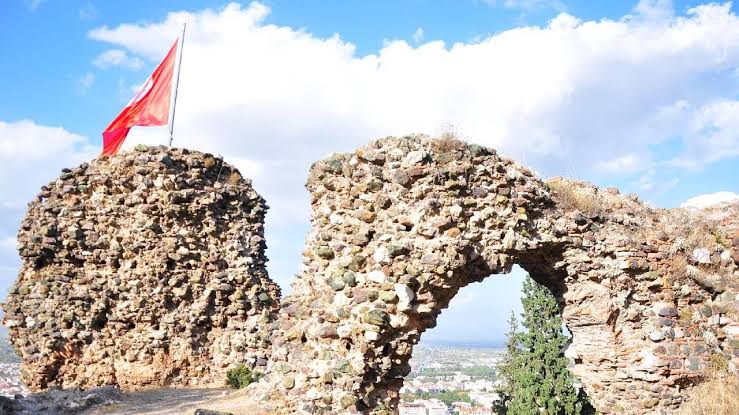
Sandıkkale is the inner citadel of the Byzantine-era Manisa Kalesi, on the north slope of Spil Dağı immediately above Manisa city centre, in the Turgutalp neighbourhood. Its construction date is not precisely recorded, but it is attributed to the early 13th century, and the inner castle specifically is dated to 1222, built under the Byzantine emperor John III Doukas Vatatzes. The name Sandıkkale, "Chest Castle," comes from its five-sided plan, which reads from above as a chest or box shape; local usage applies the name to this inner castle to distinguish it from the larger outer castle around it.
The site began as the city's acropolis in the Hellenistic period, when Manisa was the Lydian city of Magnesia ad Sipylum, and the Byzantine fortification reused that high ground. After the Saruhan Turkmen dynasty took the region from the Byzantines, they held and repaired the castle; the Hacet Mosque, built by Saruhan Bey within the outer castle, dates from that period. Walls were reinforced in the early 14th century, and the fortifications suffered significant damage by the 15th century.
Checked 2026-08-24
The complex divides into two parts: Sandıkkale, the five-sided inner citadel, and a larger outer castle around it. The inner citadel's walls are reinforced with seven towers. The outer castle is about 4.5 km in circuit, fortified with 13 towers, and had seven gates, of which the remains of two have been located. Construction throughout uses the standard Byzantine technique of rubble masonry bonded with brick courses. Within the outer castle stands the Hacet Mosque, a Saruhan-period addition rather than a Byzantine one.
Little of either circuit survives intact; this is a ruin to walk through and read as a layered site — Hellenistic acropolis, Byzantine citadel, Saruhan stronghold — rather than a restored monument with interior rooms to visit.
Checked 2026-08-24
Forty-five minutes to an hour covers the ruins and the viewpoint over Manisa city below, longer for a visitor who wants to walk the wider outer-castle circuit rather than just the inner citadel. There is a real climb involved from the city below, so the time needed depends heavily on fitness and how much of the site a visitor chooses to cover on foot; a visitor who only wants the inner citadel and the view can be in and out in well under an hour, while covering the full 4.5 km outer circuit is a two- to three-hour undertaking on unmarked, uneven ground.
Checked 2026-08-24
Morning or late afternoon avoids both the summer heat on the exposed hillside and the harsh flat light of midday for the view over the city below. There is no seasonal closure recorded for the site; the main practical consideration is weather on an unsheltered hillside path rather than any operating calendar.
Checked 2026-08-24
No admission fee is recorded for Sandıkkale on the sources this page uses. It is an open ruin on the city-facing lower slope of Spil Dağı, in the Turgutalp neighbourhood, reached from the neighbourhood itself by a climb up the hillside — a different access route entirely from the 24 km paved road that leads to Spil Dağı Milli Parkı's own ticketed gate. That separate route is the strongest evidence that the castle sits outside the park's boundary, but no source consulted for this page states the exact boundary line, so this should be taken as the best available reading rather than a certainty.
If Sandıkkale does sit inside the national park's boundary despite the separate access route, the park's own admission would apply: 60 TRY per adult (30 TRY reduced) plus a separate per-vehicle fee from 60 TRY for a bicycle to 1,800 TRY for a coach. No source consulted for this page states that it does.
Checked 2026-08-24 · Source
Sandıkkale sits in the Turgutalp neighbourhood on Manisa's southern edge, close enough to the city centre to reach by car without the drive out to Spil Dağı Milli Parkı proper, which lies about 23 km from the centre by its own separate road. Manisa has no metro and no useful rail service, so a car, taxi or local transport to Turgutalp followed by a walk up the hillside is the practical route; there is a genuine climb from the neighbourhood to the ruins.
Checked 2026-08-24
The ruins are unrestored and partly collapsed, so uneven footing and loose stone are the main hazard, more than any posted rule. There is no ticket booth, staff presence or fencing recorded at the site, and no dress code applies to a ruined fortification like this one.
The approach involves a real uphill walk on the mountainside, which matters for visitors with limited mobility, and there is no shade for most of that climb, so heat and sun exposure are a bigger practical concern in summer than anything at the ruins themselves.
Checked 2026-08-24
The main reward here is the view: from the citadel's elevation on the mountain's lower slope, Manisa city and the Gediz valley spread out below, and this composition works best in the low, warm light of early morning or late afternoon.
Among the ruins themselves, the brick-coursed rubble masonry and the tower bases photograph well in close, textural shots rather than wide ones, since so little of the original circuit stands to full height.
Checked 2026-08-24
None is recorded. It is an open, unstaffed ruin reached from the Turgutalp neighbourhood on a different route entirely from the road to Spil Dağı Milli Parkı's ticketed gate, which points to it sitting outside that park's boundary, though no source states the exact line.
Forty-five minutes to an hour for the inner citadel and the viewpoint; two to three hours if walking the full 4.5 km outer-castle circuit.
By car, taxi or local transport to the Turgutalp neighbourhood, followed by an uphill walk to the ruins; there is no shortcut that avoids the climb.
The inner citadel is dated to 1222, built under the Byzantine emperor John III Doukas Vatatzes, on a site used earlier as the Hellenistic acropolis of Magnesia ad Sipylum and later held and repaired by the Saruhan Turkmen dynasty.
No. There is no ticket booth, staff, fencing, shade or shop recorded at Sandıkkale; it is an open ruin with nothing beyond the walls and towers themselves.
Sandıkkale is the five-sided inner citadel with seven towers; the outer castle around it runs about 4.5 km with 13 towers and originally seven gates. Both together make up Manisa Kalesi.
Loading the interactive map…
The interactive map could not be loaded.
Last updated:
Source: OpenStreetMap contributors ·